
To go directly to Pre-Muscle Car Era Engines, click here, 1946 through 1963 Engine Development by Automaker.
We’re going to parse the U.S. automotive history prior to the muscle car era into three different sections: (1) Through WWII, (2) 1946 – 1954, and (3) 1955 – 1963. The last section details engines from the era 1946 through 1963.
- From the inception through WWII (1945). We won’t cover this time period in minute detail, instead touching on some of the some of the more significant events during this period. Although our focus will be on performance vehicles, we’ll also look at the larger overall automotive market. Performance cars were a smaller portion of this market and were hugely influenced by it.
- Post WWII, 1946 through 1954. These nine years saw stunning changes in the U.S. automotive market, with the growth of high-cost, large, powerful cars.
- 1955 through 1963. This was the pre-muscle car performance era, with large displacements, multi-carburetion and with engine outputs rivaling those of the muscle car era itself, which started in 1964 and extended through 1974.
- 1946 through 1963 Engine Development by Automaker. Information on each engine of the era, by automaker.
We are not going to spend much time on the automakers that didn’t last long enough to participate in the muscle car era, even though some of them were significant and were extremely interesting. Perhaps later we will be able to come back and fill in these stories.
1860’s Through WWII
The early domestic automotive scene was like the wild West. There was virtually no standardization and people entering the business had incredibly diverse backgrounds, some providing valuable skills and others not so much.
As the graph below shows, 1900 saw an explosion of activity in the automotive field, but there were handfuls of people working on ‘horseless carriages’ in the four previous decades. What was missing was the technology needed to first, produce a truly viable vehicle, and second, to produce it in volume sufficient to enable a company to survive.
The majority of automobiles produced prior to 1900 were far more similar to carriages than they were to, say, an early Ford. That shouldn’t be too surprising. What might be, though, is that the choice of propulsion was anything but standardized. There were cars powered by gas, oil, wood, coal, electricity, compressed air and clock springs. If any power source had the early edge, it would be electricity.
Electricity Rocks!
This might seem odd, given the range limitations imposed by batteries, especially early batteries. The fact that early cars tended to be lightweight helped the range, but in general, range wasn’t much of an issue at this time. The reason for this was the way people traveled then was much different than today and their expectations were vastly different. Travel between towns would continue to be largely by train, with cars being used for in-town travel. Roads at this time were mostly dirt, and the concept of ‘road maintenance’ didn’t even exist. This would change, of course, as people would increasingly use their cars for their travel needs, even between towns. By this time gasoline had taken the lead, aided by the ever-increasing number of filling stations. Although a few automakers had grandiose plans for stations dispensing compressed air or electricity to recharge vehicles so powered, these never came to fruition.
The Model T
Henry Ford’s Model T was introduced in 1908, which put the automobile within reach of the average person. It wasn’t the first car, just the first affordable car. As Ford refined manufacturing techniques and became more efficient, car prices fell year after year. It wasn’t long before a number of companies were offering aftermarket parts to allow the T to go faster. Of course, this was a time when Ford and their Model T dominated the market. For example, 1915 saw approximately 800,000 cars sold by the eight largest automakers. Of these, over 500,000 were Fords!

I know it seems strange now, but multi-valves and overhead cams go way back to the early part of the 20th Century. It would be another seven decades or so before this engine architecture became mainstream. The same could be said for turbocharging, fuel injection, direct fuel injection, and other technologies.
The automobile was still rather new when the first speed equipment made the scene. For the Ford Model T there was a rather sophisticated aftermarket, offering a surprisingly broad array of serious speed equipment. We’re talking things like overhead valve heads, with overhead cams and four valves per cylinder! Even when the muscle car was in its heyday, you could only dream about stuff like this! Speedway Engineering Equipment of Indianapolis offered Craig-Hunt 16-valve heads, as well as performance cranks, connecting rods, pistons and rings, oiling systems and a bunch more. Chevrolet Brothers Manufacturing company offered Frontenac 16-valve racing heads.
Model T Price Plummets

Model T price dropped by more than two-thirds over the length of its production, due to manufacturing efficiencies and economies of scale. This phenomenon was certainly seen first and foremost with Ford and the ‘T’, but this reduction in cost over time was seen in many industries such as radios, televisions and personal computers.
This chart shows how the price of the Model T declined over time, as manufacturing efficiency increased. These values are for the five-passenger touring car, but other body styles showed similar declines.
In the interest of addressing a misconception, Henry Ford did not invent the assembly line. The innovation he was responsible for was the moving assembly line. Introduced in late 1913, the moving assembly line was instrumental in reducing the time to make a Ford from twelve hours to roughly one and one-half hours.
People discovered how fun and exciting it can be to go fast(er) almost as early as automobiles themselves were invented! The mainstream auto manufacturers in the early years weren’t really interested in this market segment, although there were some smaller automakers who did somewhat specialize in performance models. This wouldn’t change until mainly the ’50’s, when a majority of U.S. auto makers started offering larger, more powerful engines in their larger cars.
The Common View. . .
Most of us tend to view our automotive high-performance history in something of a linear way. First came small, crude, low compression engines that eked out two-digit horsepower figures. These were inline, valve-in-block designs, limited to lower rpms. Later came bigger engines, some in V8, V12 and V16 configurations, higher compression ratios, more sophisticated brakes and transmissions, etc.
According to this narration, things got interesting in the ‘50’s, with increasing engine displacements, multi-carburetion, higher compression ratios and much higher horsepower. This era even saw fuel injected V8s.
Performance exploded in the ‘60’s with the birth of the muscle car, with a return to mediocre performance in the 1970’s. We had to wait until the ‘80’s and later to see the widespread use of fuel injection, aluminum alloy heads with overhead cams and four-valves-per-cylinder. The ‘90’s and 2000’s witnessed flex fuel engines, variable valve timing and direct fuel injection. While there is some truth in this, the path that engine technology took is not a straight one. The common view was certainly not accurate!
Over a Thousand Companies!
Over the past one hundred twenty plus years, there have been literally hundreds of U.S. automakers who have come and gone. The total number is probably in excess of one thousand! As with any new product, the ambitious flocked to get involved and become automakers themselves, sensing (rightly) that there were fortunes to be made. Of course, some did make fortunes (Ford, Chrysler, Durant, etc.), but for many it was a short-lived venture. In the first twenty years of the new century, untold numbers of “automakers” came and went. Some had managed to design and produce products and offer them for sale, many had not. Some had sales figures in the hundreds before losing the battle, and for others the number was in the single digits. All sorts of backgrounds were represented in those who entered the business, blacksmiths, bicycle makers, general mechanics, hobbyists, and businessmen with little if any knowledge of automobiles.
Take a look at the following graph, which shows the numbers of automakers entering and exiting the automobile manufacturing business by year. Between 1900 and 1920, there were literally dozens of automotive startups every year, and an equal number of companies closing shop! These cars were powered by gasoline, kerosene, steam, electricity, compressed air, and even one with a windup clock spring. At least one was a gas/electric “hybrid”!
In the 1890’s, electric cars greatly outnumbered gas! Both Oldsmobile and Studebaker originally started with electric vehicles. One source states that Ford’s moving assembly line and the efficiencies it offered were the final nail in the coffin of electric vehicles. Once the momentum swung to gas engines, that particular battle was over.

It’s not clear why 1914 shows such huge numbers. WWI started in July of that year, but the US was not yet involved.
A Porsche But Not a Porsche
The Austrian Dr. Ferdinand Porsche, at age 23, built his first car, the Lohner Electric Chaise. It was the world’s first front-wheel-drive. Porsche’s second car was a hybrid, using an internal combustion engine to spin a generator that provided power to electric motors located in the wheel hubs. On battery alone, the car could travel nearly 40 miles. This was circa 1898. And, yes, it’s that Ferdinand Porsche! I knew that Porsche was a favorite of Adolph Hitler and that he designed a diesel electric heavy tank during WWII. Of course, all modern locomotives for the past seventy years have been diesel electric. Anyway, the tank broke down and caught fire when it was being demonstrated to Der Fuhrer! Too bad Hitler couldn’t have been a passenger at that particular time.
Gone but not Forgotten
I think it’s fascinating to read about long-gone automakers and to see, or see pictures of, their vehicles. These were “living, breathing” companies, with from two to ten thousand (or more) people involved, living and working in their communities, supporting their families.
Their vehicles themselves often reflect individual thought and innovation, as common practices had often yet to develop. It’s easy to think “out of the box”, when there is no box! I encourage you to avail yourself of the books and web resources that deal with these companies and their vehicles. If you happen to be a US history buff, it’s really cool to see how the particular product, cars, “fits in” with the overall era.
This doesn’t include the small, “here today, gone tomorrow” companies for which little information exists. Things were already slowing down by the time the Great Depression hit (1929), which would be considered the normal industry consolidation. After all, some fifty-plus companies opening and closing every year wasn’t going to go on forever! In addition to the Depression, the war years (’42 – ’45), when most automakers were involved in the war effort, saw very few entrances to or exits from the business.
Not a Unique Process
In many ways the evolution of the auto industry was mirrored in the evolution of other industries. For an example, look at the PC industry. At one time there were dozens and dozens of American PC makers, with names like Commodore, Atari, Sinclair, Texas Instruments, Packard Bell, Edge, Gateway, Osborne, Zenith, NeXT and Tandem, to name but a few. Anyone who could even assemble a computer (Michael Dell) was making money hand over fist.
However, today if you stroll (or saunter, sashay, or whatever it is you do…) down the PC aisle of your local office supplies mega-store, you will see a mere handful of PC maker’s products. The industry consolidated into a relative few large companies. The auto industry did the same thing, as did the aircraft, radio, television, motorcycle, and banking industries, as well as many others. It’s inevitable and inescapable. People flock to the “new industry” and the resulting competition spurs development and invention, as well as creating a few winners and a lot of losers.
First Generation Engine and Car Technology
Yeah, maybe the designation ‘First Generation’ is a bit arbitrary, but I’m gonna run with it. Really, what better car and engine to focus on as premier examples of early automotive state-of-the-art than the Model T and its 175.6 cubic inch straight four? The Model T was the standard bearer in so many ways; reliability, longevity and brilliant engineering, to name three.

The exhaust manifold was located above the intake manifold on this engine. Note the low-mounted carburetor. Remember that there was no fuel pump, the gasoline being gravity fed. Gotta have your tank above the carb!

Introduced in 1909, the 175.6 in3 straight four had a 3.74 in. bore and a 3.98 in. stroke. The 20hp was all in by 1,800 rpm. The 3.98:1 compression ratio allowed not only problem-free operation on the low octane gasoline at the time, but it could also use kerosene or grain alcohol. E85 had nothing on this engine! Note that the exhaust manifold, fed by all four exhaust ports, is mounted above the intake manifold. The intake feeds two intake ports, each of which feeds two cylinders.
The engine initially used a water pump, but that was dispensed with in favor of a system that simply used coolant temperature differential to circulate the liquid. A magneto was used to generate the electrical energy used for the ignition. No battery was needed; there was no starter, the engine being hand-crank only, and the lights were not electric.
Non-Electric Headlights?
Well, yes. In the earliest part of the 20th century the majority of homes and offices with lighting did not have electric lights; they used gas. Early car headlights were often powered by acetylene gas.
If you put calcium carbide in a container with water, acetylene gas was produced. Miners used the same method for their hardhat-mounted lights.

This is a diagram of an acetylene gas generator. These were often referred to as ‘carbide lamps’.
Some Unusual Features
The single barrel carburetor was the model of simplicity, with nothing so fancy as an accelerator pump. Both the throttle and the spark advance were controlled by hand levers. The Model T utilized transverse leaf springs front and rear. Wait—didn’t the C4 Corvette have a rear transverse leaf? Why, yes it did; made of fiberglass. Since a transverse leaf can’t locate the rear axle, the T used a torque tube to do so. This, of course, enclosed the driveshaft. The rear suspension was of a type known as de Deon, which used a tube to tie the two rear hubs together, in a quasi-independent type of rear suspension. The suspension allowed high ground clearance, which was significant given some of the road conditions encountered.

Yeah, I knew that you were thinking “de Deon? Just what the …?”. So, I thought I’d show you what this looked like. If you look at early photos of cars on roads, some of them show the incredible axle-deep mud that cars had to deal with. Most roads were not even gravel covered at this time, and the ground clearance of the T could be of incalculable value.

I grabbed this from the US Census Bureau. They haven’t done a damn thing for me, so I thought they could at least donate this pic.
Two-Speed Transmission

The two-speed manual transmission used a planetary gearset; these would become common in another four decades or so, when fully automatic transmissions became commonplace. Surprisingly, planetary gearsets were fairly common in manual transmissions at this time.

The cylinder head had huge combustion chambers, but this was typical with the low compression ratios of the era. Spark plugs were positioned closer to the valves than the main part of the combustion chamber.
Internal Components

Connecting rods were long and thin; plenty strong for 20hp! Note how the small end was fastened.

Pistons were cast iron initially and had four rings. How to Hop Up Ford & Mercury V8 Engines, by Roger Huntington, copyright 1951 by Floyd Clymer, indicates that this is mainly for stability of the pistons, to keep them from scraping their sides on the cylinder walls. In fact, this publication specifically stated that 3-ring ‘racing pistons’ were unacceptable for street use specifically for this reason! Later pistons were of aluminum.
Those Iron Pistons
Yes, most early pistons were made of iron or steel. This makes perfect sense, given the low engine speeds and the challenges aluminum pistons presented when they became common. There were, in fact, aluminum pistons used in some engines in the earliest part of the automobile era; they just weren’t common.
The expansion rate of aluminum pistons presented challenges, and the earlier aluminum pistons in general use contained steel struts to control the thermal expansion. The earlier aluminum pistons were quite fragile and dropping one from bench height onto a hard floor would most likely result in cracking. Aluminum, though known indirectly in antiquity, is remarkably difficult to produce from its natural state as bauxite, which is the primary source of aluminum. Aluminum has a remarkable affinity for oxygen and does not exist in nature by itself. The ancient Greeks used alum (KAl(SO4)2·12H2O) to fix dye to fabric. It wasn’t until 1825 that the element was produced in its pure form. In 1954 aluminum became the most produced non-ferrous metal. wikipedia.org/wiki/Aluminium

The crankshaft was simple yet functional. Again, plenty strong enough. Three main bearings were used and were of the poured babbitt type. (See Engine Lubrication and Bearings) Three main bearings rather than the five you’d see in a four-banger today.

This is a Holley NH carburetor for the ‘T’. As with the other Model T engine components, is is a model of simplicity.

The T intake (below) and exhaust (above) manifolds were remarkably simple and functional. Air flow wasn’t much of a concern when you’re making 20hp!


Here’s a Champion sparkplug advertisement from the June 17, 1919 ‘The Buffalo News.’ The Ford ‘T’ used Champion plugs. AC Sparkplugs had a similar ad, with a lengthy list of the companies who used their products. This is a reflection of just how many automakers there were at this time. There were over four dozen passenger car companies listed!

I thought it would be a shame to end this section without showing the total package, a Ford Model T in all its magnificence. The runabout was just one of six or so Model T styles available in 1927.
The 1930’s
The 1930’s saw all aspects of American life impacted by the Great Depression, and the auto industry was no exception. However, this decade did see such things as larger engines in straight and vee configurations. Automatic transmissions became available, as did four-wheel hydraulic brakes, heaters, radios and low-pressure balloon tires for improved ride quality. Also, of note are the streamlined bodies that appeared during this decade. Styling became all important in the ‘30’s, with innovation becoming merely incremental. Most of the major features a 1950’s car offered were already existing, though not necessarily commonplace.

As you might expect, the Depression was hard on most US auto makers and cost some of them their very existence. Examples include Auburn (1900 – ’36), Brewster (’15 – ’37), Cord (’29 – ’37), Cunningham (’07 – ’36), Detroit Electric (’07 – ’39), Duesenberg (’20 – ’37), Essex (’19 – ’32), Franklin (’02 – ’34), Marmon (’02 – ’33), Overland ’03 – ’39), Peerless (’00 – ’33), Stutz (’11 – ’35) and Willys-Knight (’14 – ’33). There were others, but these are the most noteworthy.
The comings and goings of automobile companies would continue to the present day, though at a reduced pace. Some recent (ish) examples:
- Willys-Overland 1953
- Nash 1957
- Packard 1958
- Studebaker 1963
- Rambler 1969
- King Midget 1970
- Int. Harvester 1980
- AMC 1987
- Plymouth 2001
- Oldsmobile 2004
- Avanti 2007
- Saturn 2010
- Pontiac 2010
- Mercury 2011
- ??
(Data source: wikipedia.org/wiki/List_of_defunct_automobile_manufacturers_of_the_United_States)
There were some performance cars in the 1930’s. These had up to 200hp, while hauling around sometimes over 5,000 pounds, and costing up to around $5,500 (about $100,000 in 2019). Most of the auto makers that would survive and participate in the muscle car era had relatively meager performance offerings during the ’30’s.
High-Performance Cars
Below are some of the noteworthy high-performance offerings from the 1930’s.

Affordable Performance

Be aware that these tables contain generalized information. For example, the Buick 320cid inline 8 engine was introduced in 1936 at 120hp, saw 130hp in ’37 and reached 141hp in ’38 and ’39. This engine persisted until 1952, making 170 hp. Also, note the under-square nature (stroke much longer than bore) of the majority of these engines, which reflected the prevalent engine practice of the time. These were not high RPM engines!
The Problem with 8’s
A straight eight, even if it has overhead valves, is inherently very, very limited. It can’t do high rpms, and the rotating mass is, well, massive! This engine configuration came about as a response to those buyers who wanted more power than a six-cylinder engine would give them, but who couldn’t step up to a V8. Remember, Ford had an affordable V8, which was a valve-in-block design. This engine was revolutionary and was offered from 1932 until 1953. But what if you wanted a Chrysler or GM product? Or one of the independents? They chose to serve this niche with a more tried and proven approach, the straight eight.
The enormously long crankshaft of a straight eight prohibited high engine speeds. The crankshaft simply didn’t have high torsional rigidity, given its length. That was fine, as engines at that time didn’t flow well enough to support high rpm power production anyway. Of course, the long engine made for challenges in packaging, requiring a long hood.
Gotta Reseal My Top Today!

This is an illustration of an advancement that took place in the mid ‘30’s. In 1935 GM introduced their models with ‘turret tops’. These were all-steel tops, the type of which we’re all familiar and have likely never thought twice about. However, things were not always this way. Prior to the innovation of the turret top, car tops were not steel, they were a combination of canvas and wood, which required regular resealing.
But why the heck weren’t they solid steel, like they’ve been for the past eight decades? As it turns out, the size of available hot-rolled steel had been a limiting factor. Plus, cars had not yet begun the trend toward lowered bodies, and people couldn’t even see the tops of cars. The recent availability of 76” hot-rolled steel allowed this innovation. The resulting bodies were stiffer and stronger, as well as more attractive and maintenance-free. Soon the entire industry would follow suit.
These weren’t the first all-steel tops, but this was when they became the norm rather than the exception. Perhaps it would be fair to say that it was this time that the last vestige of carriages (as in horses…) still present in auto design went away.

The Pontiac ‘Silver Streak’ is just one example of an engine that spanned from the pre-war era, well into the post-war era (1933 – 1954). It arguably had more in common with the pre-WWI Ford 4 than it did with engines that were appearing in the early- and mid-Fifties.
The First Performance Engine for the Common Man
The Ford Flathead V8
This was perhaps the most significant engine of the 20th Century. It is the ancestor of all of the muscle car era engines as well as the V8 engines in use today. Why? Simply because it was the engine that brought V8 power within reach of most of us, the average buyers.
Yes, there had been V8 engines in use, here and there, for thirty years prior to Ford’s introduction of their new flathead, 221cid V8 in 1932. In fact, Ford’s Lincoln Motor Car division had been manufacturing V8 engines for some time. Ford purchased Lincoln from its founder, Henry Leland, in 1922, just five years after being founded by Leland. Leland was also one of the founders of Cadillac.
Early V8
At the time of the Ford acquisition of Lincoln, the Lincoln V8 was a 60° L-Head unit of 357.8 cubic inches displacement. It made all of 81hp at 2,600 rpm, using a 4.8:1 compression ratio. As was the norm at this time, this was an expensive engine to manufacture and was available only in expensive automobiles. The same was true with other automakers and their V-configuration engines, whether 8, 12 or 16 cylinders. The average buyer was just never going to afford a V8 powered car, period.
Henry Ford changed this with his new V8 in 1932. What made this engine revolutionary was that it was designed with a single-piece block, something not previously thought possible. Virtually all V-configuration blocks had been assembled from multiple castings.

Here’s a picture of a Lincoln V8, that shows where two of the three block components meet. Casting a block in smaller pieces like this was far less challenging than trying to cast them as one piece. As you might imagine, the extra casting steps and machining of additional mating surfaces made this design labor intensive and expensive.
A True Skunkworks Project
Ford worked in relative secrecy, involving only those who needed to know. He closed the majority of the Ford factories, being less than forthcoming about the details, and apparently saying only that they would reopen when the next generation of Ford cars were ready for production. Twenty-four of the thirty-one plants were shut down, with only nine of those twenty-four ever reopening. This was due to the economic ruin wrought by the Great Depression of 1929 – 1939.
A handful of Ford engineers were assigned the task of developing the one-piece 90° iron engine block. The project was exceedingly challenging. And why wouldn’t it be? This had never been done, right?
Well, that’s not entirely correct. Just a couple of years earlier, both the low-volume Viking and Oakland, both belonging to GM, had produced relatively small numbers of mono-block V8 engines. The all-important distinction, though, is that Ford found a way to produce these engines in far larger quantities, and at a cost that made the engines cheap enough to manufacture to be able to offer them in midrange models. This might be a bit like the incandescent light bulb. Thomas Edison didn’t conceive it or invent it, he perfected it. And the rest is history!
Flathead Engine Construction
Early V-type automotive engines used blade-fork connecting rods, as did V-type aircraft engines and motorcycle engines. The Ford V8 abandoned this practice in lieu of the side-by-side mounting of rods on a single crank journal that’s in use today.

T-Head and L-Head
The flathead used a T-head design, rather than an L-head. This required the exhaust ports to be routed between the cylinders, to the exhaust side of the engine. This sometimes taxed an already marginal cooling system.

An L-head engine has the valves positioned such that the intake valve is on the intake side of the engine and the exhaust valve on the exhaust side. This allows for more straightforward routing of ports. It does place the ports between the cylinders, though.
A T-head layout has both valves on the inside, intake, side of the engine. This removes them from between the cylinders but puts the exhaust valves on the ‘wrong’ side of the cylinder bank, requiring exhaust ports be routed between cylinders.
The two inner cylinders of each bank routed their exhaust between them, resulting in three, not four, exhaust ports to the exhaust manifold. To the unsuspecting, this made for an odd look.

This shows the flathead block and the direction of exhaust flow through the block.

Unusual Crankshaft
The flathead continued to use the pre-existing three main journals for the crankshaft, rather than the five that would become common later. This, as I understand it, was done strictly to control costs.
The flathead crankshaft was a high strength cast 90° piece with three main bearings. Flat (180°) cranks were commonly used in earlier V8 engines, as they were easier to manufacture. Ford was able to produce this piece economically enough to keep engine manufacturing costs low. Another innovation.

The flathead pistons weren’t all that different from pistons of contemporary engines. Note the fourth, lower, ring.
Pistons were originally made of cast iron. 1935 saw the first use of aluminum pistons in the flathead.
The Ford flathead V8 wasn’t without its early problems, which included excessive oil consumption, cracked pistons and overheating. Ford worked aggressively to address these issues. It’s said that Ford also was very responsive in addressing the needs of customers who had already purchased a V8 car and were experiencing problems.
Other flathead changes addressed the desire for higher output. The 65hp engine had its compression ratio raised from 5.5:1 to 6.33:1, adding 10hp. The 1bbl Detroit Lubricator carburetor was replaced by a Stromberg 2bbl unit, adding another 10hp for a total of 85.
Improvements
1936 saw the use of insert main bearings, replacing the poured babbitt. In 1937 a smaller 136cid V8 became available. The two engines were named V-8/85 and V-8/60 to differentiate them. The water pump was relocated and was modified to be lubricated with oil rather than grease. The fan was modified to incorporate six blades. New heads featured centered coolant outlets and combustion chambers were modified to allow the use of domed pistons. The compression ratio fell slightly to 6.12:1. A less obvious change was the move to a new ‘LB’ block that featured larger main bearing journals.
In 1939 Mercury got a new version of the engine that had a 3 3/16” bore, 1/8” larger than the Ford V-8/85. This bumped the displacement to 239cid and produced 95hp. In 1941 compression ratios for both engines were increased, which resulted in a Ford rating of 95hp and Mercury an even 100hp.

Connecting rods were rather contemporary looking. They no longer had the funky rotated cap that the Model T engine had.
Model T Information
There are many vintage and contemporary books about the Ford flathead V8 that will tell you everything you need to know to increase durability or output, or both. I found a 1951 copy of How to Hop Up Ford and Mercury V8 Engines by Roger Huntington for about 5 bucks in a used bookstore. In addition, I think there are more aftermarket parts made for the engine than ever before. Thirty or more years ago, the process of going through your flathead engine would have involved making many phone calls and ordering whatever catalogs you could find. It could take months of work to find some parts. Today it’s mostly a matter of just getting online!

A thing of beauty it was! Here, some seven decades after the flathead was replaced by the M-E-L Y-block engine family, many people still regard the flathead as a work of art.
Why not an OHV?
It’s a fair question to ask why Henry Ford didn’t make his new V8 an overhead valve design. After all, OHV designs had been around for ages even at this time. They weren’t yet popular probably due to higher manufacturing costs and a lack of perceived value by the public.
Going beyond OHV designs, there had been at this time more than a few overhead cam head designs! In fact, Henry Ford himself had patented one such design in the early ’30’s.

This image is from the USPTO (United States Patent and Trademark Office) and is a portion of Ford’s patent for an overhead camshaft engine.
Ford was very aware of the options for his new engine and must have carefully weighed the various elements when deciding on valve/cam designs. These would be such variables as tooling costs, manufacturing costs, material costs and market acceptance. I don’t know for sure, but it seems that ‘going too far’ might have carried the risk of the buying public not understanding the benefits of an OHV or OHC design. We Americans have turned up our noses at something new more than once in the past, not stopping to consider the potential benefits.
Perhaps buried in writings by and about Henry Ford are clues to his thoughts at this time. Regardless, his V8 flathead was met with wild market acceptance and will forever be regarded as one of the landmark and historic internal combustion engines. This engine whet the appetite of Americans for V8 performance, laying the foundation for the myriad V8 engines that would emerge post WWII, after domestic automakers got their feet back under themselves. Thanks, Henry!
Buyers Loved the Flathead!

This is one rare letter from an appreciative customer! Not ‘customer’, really, as much as maybe ‘user’. I mean, what do you call someone who really appreciated your products, but stole them rather than buy them? The author, of course, is one Clyde Barrow who was one half of the infamous Bonnie and Clyde. Maybe Clyde wasn’t all bad, since he did take the time to write this letter of appreciation to Henry Ford. Well, maybe that’s being a little too kind.

Behold the 1934 Ford Deluxe that was the last set of wheels for Bonnie Parker and Clyde Barrow. Clyde carried a Browning Automatic Rifle (BAR) which usually allowed him to outgun his pursuers. However, on May 23rd, 1934, the posse waiting in ambush also possessed similar weapons. The result is what you see here.
Clyde himself didn’t enrich the Ford Motor Company directly, since he stole the cars he drove. Come to think of it, though, I guess his theft victims did have to replace those cars.
World War II
The 1930’s rolled into the 1940’s with no huge changes in the auto industry. After the US was attacked by Japan in December of 1941, the government turned most of industry (and all of the auto industry) to the production of the machines and materiel of war. This was something that our enemies hugely underestimated.
The period was interspersed with other flathead modifications, such as the change from 21 head bolts to 24, the move to a fully counterbalanced crankshaft, and the change to a different Stromberg carb and finally a Holley. Remember that Holley was very much a mainstream carburetor maker, like Carter, Stromberg, Rochester and so many others. It would still be some years before Holley started focusing on performance 4bbl carbs. In fact, by this time Ford had been using Holley carburetors for over three decades.
US Automaker WW2 Production
Ford built over 86,000 aircraft, a large portion of them B24 Liberator heavy bombers. They also built over 277,000 jeeps. GM’s Fisher Body made over 11,000 Sherman tanks; Buick made over 2,500 M-18 “Hellcat” tank destroyers; Cadillac made M-5 tanks; Pontiac made axles, torpedoes and anti-aircraft guns; Oldsmobile made millions of tons of artillery shells and Chevy made over 280,000 trucks. Chrysler built M3 and Sherman tanks. (Chrysler Defense builds the M1 Abrams main battle tank, America’s front-line tank.) Both Pontiac and American Harvester built the Mark 14 torpedo.
These figures represent just a portion of the output of the companies mentioned, and there were many other companies involved in the war effort.
Chrysler Materiel
Chrysler was greatly involved in the war effort and they put their expertise to good use. They designed and built a thirty-cylinder gas engine that powered the M4A4 version of the Sherman medium tank. The engine demonstrated Chrysler’s ingenuity, by using five six-cylinder engines to make a 30-cylinder engine. This tank was manufactured by a number of companies in absolutely astounding numbers. What it made up for in capabilities it would (attempt to) make up in numbers.

This table shows just a small sample of the wartime production by U.S. automakers. There were more aircraft subassemblies produced by automakers than by aircraft manufacturers. The U.S. and its allies dramatically outproduced the axis countries in war materiel by a factor of several to one.
M4 Sherman Tank
The M4 “Sherman” medium tank was named after Civil war general William Tecumseh Sherman. It was to be, unfortunately, a costly learning lesson for the US army.
The tank was too small to effectively battle German panzers. Its armor was too thin and its 75mm gun was not powerful enough. Their 75mm shells were known to bounce off of German Tiger frontal armor, where the German 88mm gun would shoot right through a Sherman. There were times when three or four M4s were taken out by a Tiger, before a surviving M4 could maneuver to a position where it could, at close range, take a shot at the rear of the Tiger, where armor was thinner.
It’s been said that US tank crews universally hated the tanks, which they regarded as death traps. They would often affix logs or other materials to the outside in an effort to add further protection. As limited in ability as it was, US soldiers did what they do and made the best of it. The lesson was learned, though, and the current US main battle tank, the M1A2 Abrams, is widely regarded as the most capable in the world.

This tank was named after Civil War Union general William Tecumseh Sherman. His middle name was due to his father’s fascination with the Shawnee chief of the same name.

Here’s a B-24 Liberator, very possibly made by Ford. The B-24 was a workhorse in Europe, though it never gained the reputation that Boeing’s B-17 did. James Stuart (It’s a Wonderful Life) piloted 20 missions in B-24’s and possibly as many as 20 more uncredited missions.
War Rationing
In the U.S. rationing started in the spring of 1942, with sugar first and then coffee. The rationing of some things, like gasoline, made obvious sense in wartime. But sugar and coffee? The Philippines fell to the Japanese, and we lost a major source of sugar. Ships that would normally be shipping sugar and coffee to the USA were far more needed to ship war supplies overseas. Other items rationed were rubber, nylon, silk, meat, lard, oils and shortening, butter, margarine, cheese, as well as other items and foodstuffs. Rationing ended in the US in 1946. In Britain, rationing of some items lasted until 1954!
Chrysler Experimentation
Sometime in the mid to late ‘30’s Chrysler tasked its engineers with identifying the best engine head configuration. Going through an exhaustive process of testing, they concluded that the hemispherical head design was overall optimal for the desired characteristics as defined at that time. This set the stage for Chrysler’s 2220 engine, which was a hemispherical head, inverted V16, 36.4-liter, liquid cooled engine proposed for the still experimental aircraft that would become the P-47 Thunderbolt. The engine made some 2,500hp, and although not used by the P-47, it was Chrysler’s first hemi head engine. This experience would serve them well when the post-war automakers were finally able to introduce new engine designs in the very late ‘40’s and early ‘50’s.


Thunderbolt was a monster of an aircraft. It escorted US bombers to Germany and back and was death to anything on the ground. The A10 ‘Warthog’ is actually named ‘Thunderbolt II’.

The Daimler-Benz DB 605 engine that powered the Messerschmitt Bf 109 fighter during WW2 had its roots in the 1930’s. There was a lot of aircraft engine technology that eventually made it to the automotive field. This engine is fascinating in its use of technology and very well illustrates the state of the art in engine design at this time.
Daimler-Benz DB 605
Yeah, this site is about American cars and engines, and I picked a German engine to feature, and an airplane engine to boot! There were some very impressive U.S. and British engines, but the sheer buttload of forward thinking in this engine and plane have always captivated me.
This plane had its roots firmly planted in the pre-war 1930’s, yet with updating, it remained competitive throughout the war. And that’s with the allies fielding all-new planes, like the Spitfire and the P-51 Mustang.
The DB 605 was a 35.7-liter, liquid cooled, inverted V12. Maximum engine speed was 2,800 rpm, where it made over 1,400 hp. The supercharger had a barometrically controlled hydraulic clutch to automatically adjust for altitude. The engine had overhead cams and was direct fuel injected! In addition, it had water/methanol injection for “emergency power”.
Don’t miss the fact that this engine was inverted! The oil would indeed tend to flow down into the bottom of the pistons, where it would be tossed back up to coat the cylinder walls. The inversion of an engine is incredibly unusual, to say the least, and presents numerous technical challenges. There must be at least one significant benefit to justify such an unusual configuration, right? Yes indeed, and that advantage is a lower positioning in the fuselage and a lowered center of gravity. Seemingly no other aircraft designer deemed this lowered center of gravity a significant enough factor to undergo the challenge of designing a similar engine. Remember that such a configuration requires fuel injection, which itself was not yet popular.
Could this technology have been applied to car engines sooner? Absolutely! After all, it would be the mid ‘50’s before OHV engines became prevalent. What was missing was the all-important urgency, as well as resources. Creating machines of war, especially in time of war, isn’t at all about profit and loss. Creating autos is all about profit and loss. Still, the time spans from the inception of a technology to the widespread automotive adoption seem awfully long sometime, don’t they?

War-Era Ingenuity
World War I and World War II eras changed a lot of everyday things, particularly in some of the European countries. One interesting response to the scarcity of gasoline was the use of coal gas to power some vehicles.
Coal gas is produced from coal, obviously enough. It consists of approximately equal parts hydrogen and carbon monoxide. Before natural gas became readily available, coal gas was used for many of the same uses, including cooking and heating.

Coal gas was pressed into service to power vehicles. It wasn’t at that time possible to store it under any sort of real pressure, so it became common to use low pressure bags affixed to the vehicle top. As you might imagine, range was severely limited. I’m not sure about other countries, but Germany had distributed roadside ‘stations’ for the refueling of coal gas buses.
The Reawakening (1946 – 1954)
Prior to the muscle car era itself, the post-World War Two automotive market can be separated into two eras. The first era starts with 1946, the resumption of auto production after the automakers converted back to cars, having produced war materiel from ‘42 to ‘45. This era extended through 1954. There were so many significant advancements in 1955 that this is considered the beginning of the next era, the one that led directly to the muscle car era. As such, this era goes from 1955 through 1963.
Post-War Explosion
The end of World War II saw the resumption of car production by American car companies. The combination of the end of the Great Depression and the pent-up demand resulted in an explosion in US auto sales.
1941: 3,571,000
1942: 1,142,000 (early end)
… US in WWII …
1946: 2,226,000
1947: 3,361,000
1948: 3,414,000
1949: 5,241,000
1950: 6,350,000
Post war cars became larger, with smooth lines and streamlined styling that is still pleasing to the eye today. The first of millions of modern overhead valve V8 engines appeared at the end of the ‘40’s, with a tsunami of new OHV V8s appearing in the 1950’s.
This was truly the “Mother of all seller’s markets”. People tended to have money, since the war effort resulted in full employment and goods were limited during the war.
These nine years might have witnessed more changes in the U.S. automotive field than any other comparable time span.
What? I Can’t Have a Chevy?
Often times new car buyers were forced to accept their second, third or fourth choices, due to the limited supply of new cars. For most buyers, just having a new car was enough, even though it might not have been their make or model of choice. It would take some time for supply and demand to balance and for a normalcy to return to the auto market. Change would be minimal for the next few years, with 1949 and 1950 being years of huge change in the industry as market forces rekindled competition and automakers got a bit of breathing room. The decade of the fifties would witness absolutely breathtaking changes in every facet of the automobile market.
The 1946 cars were essentially “new” 1942 models. Average horsepower was a handful of hp over 100, with a horsepower per cubic inch (hp/in3) being a paltry 0.424. Average engine age was well over seven years and compression ratios averaged about 6.7:1.
My How Things Changed!
Contrast this with the end of the era, 1954. The most powerful ‘46 engine was Buick’s 320cid OHV inline 8, with 144hp. In 1954 the title went to Chrysler’s 331 hemi, with 235hp. 1946 saw only two OHV eight-cylinder engines, both Buick inlines. In ‘54, there were eight OHV V8s, including three hemi designs. Average horsepower rose from 106 to 147, a 39% increase.
Vehicle bodies also changed markedly during this period. The ‘46 models were characterized by 2-piece windshields of flat glass, mildly swept and tilted back. Both front and rear fenders were of the style that protruded from the body, and hoods were domed and anything but flat. Traces of running boards were still seen, as were several fastback models. Small rear windows were the norm, and just what the heck was a “hardtop”?
By the end of this era, front and rear fenders were nicely integrated into the bodies. Hoods and trunk decks were much flatter and some rear windows were huge. Front glass was well sloped back, curved, and wrapped around the front of the passenger compartment. Hardtop body styles abounded.
While in 1946 only Buick and Cadillac offered a true automatic transmission, 1954 saw every other automaker on board with an automatic. This by no means reflects all of the changes during this period.
A Whole Bunch of Firsts
The following table gives the dates that each automaker introduced basic features or reached engine benchmarks. These include:
- First overhead valve engine
- First V8 engine
- First OHV V8 engine
- All engines OHV
- Four-barrel carburetor
- First use of multi-carburetion (3 x 2bbl or 2 x 4bbl)
- Year that 200hp was reached
- Year that 300hp was reached
- One horsepower per cubic inch achieved (not all reached this)
- Use of semi-automatic transmission (Just Chrysler companies)
- Use of four speed manual transmission
- Fully automatic transmission
- Power steering introduced
- Power brakes introduced
- Air conditioning available
- 12V electrics used (from prior 6V)

You might notice the absence of companies like DeSoto, Packard, Studebaker and others. We’re just focusing on companies who made it through to the muscle car era, although at some later time we may fill in information on the other, now gone, automakers.
The engine story in 1946 saw one automaker, Buick, with two OHV eights. These were inline eights. There were V8 engines, but they weren’t overhead valve. Plus, there were inline L-head sixes and Chevy’s OHV six. Buick’s inline eight 322 OHV held the horsepower title, at a mere 144hp. Engines were split almost evenly between six cylinders and eight. In 1963, not only were all engines overhead valve, but V8s led sixes (inline and V) by a margin of almost five to one! Of course, the inline eights had been relegated to the trash heap of history. Most of the fours and sixes were inline configurations, but Buick did already have their beautiful little 198cid V6.
Why So Many V8 Engines?
To a great extent, the engine offerings reflected what the buying public wanted. None of the automakers in the early post-war years had an inkling of how popular V8 engines would become.
This engine demand caused varying degrees of difficulty for the automakers. Chevrolet borrowed the Pontiac-developed stud mounted, pressed steel rocker arm design. At this time, it was very rare indeed for one company to borrow technology from another, even if those two companies were under the same umbrella, such as G.M. To illustrate this point, three of the Chrysler companies had their own hemispherical and/or polyspherical head OHV V8 engine designs that shared nothing!
This last point became an issue for the Chrysler companies, as V8 demand grew. The hemi-head (small ‘h’) engines were expensive to manufacture. The head design was the result of exhaustive research the company had done, both before and during the war, as well as their design and manufacturing experience for wartime production. The number of V8 engine they sold, all hemi designs, put them at a substantial cost disadvantage relative to their competition, with their cheaper to manufacture wedge head designs.
What’s so special about V8’s?
The V8 was an infinitely better configuration than the straight eight. The packaging of the cylinders was more compact, and the cylinders not being oriented vertically allowed an engine compartment that was both not as long and not as tall as with a straight eight. Stylists didn’t have to design around the engine to such a great degree. The cylinders being closer together allowed a single carburetor to more efficiently feed equal quality mixture to all cylinders.
One advantage that would be huge when engines began to make power at higher and higher engine speeds is the V8 crankshaft. It’s much shorter and stouter than one for an inline, and much more resistant to twisting, with the resulting vibrations and potential problems. The main thing initially prohibiting the wide-spread use of V8s was the difficulty and complexity of casting one-piece blocks. Henry Ford did more to solve this issue than anyone else, with the release of his flathead V8. We just had to wait for overhead valves to be added to the recipe, and then the real fun began!
The Dawning of an Era (1955 – 1963)
As exciting as the past couple of years were, things were about to take off. The fire was going to turn into a blaze. This era, 1955 through 1963, was distinctly different from the preceding post-war era, as well as different from the muscle car era that followed, extending from 1964 through 1974.
1955 saw the landmark Chevy small block introduced, in its 265cid form. In ‘57 it would grow to 283cid, and 1hp/in3 as an optional Corvette engine. It would have dual 4bbl induction, as well as fuel injection. Compression ratios would soon climb past 10:1. By the end if this era, the 327 fuelie would make 360hp, with an 11.25:1 compression ratio!
This wasn’t the only worthwhile engine news, though. Not by far. Chevy also had their big-block 348 and 409cid V8s. Pontiac would introduce their 317, which would grow to 347cid, then 370cid, then become the famous 389.
Things weren’t quite as exciting at Buick and Olds, with the 401 and 394, respectively. It’s not that they made substantially less power than the Pontiac 389, but they clearly hadn’t found their stride yet. The Chrysler companies didn’t take a backseat to anyone. The 392 hemispherical head V8 would approach 400hp, before the “hemi-head movement” lost steam and they were replaced by wedge head engines.
The wonderful, long-lived 383 would be introduced, the 413 would exceed 400hp, and the wild 426 Max Wedge would hit 425hp.
Ford’s 352 would go on to make more than 350hp, and the 390 would break the 400hp mark. The 406 and 427 would follow, taking things to the 425hp mark.
Engine Excitement
This was an exciting time in the American automotive field. Swift change became the norm. The previous ceiling of 200hp would be passed in ’54, and just a couple of years later would see every manufacturer offering multiple models and engines well exceeding this. 1957 and ’58 would see the 300hp level handily passed by as top power levels reached for 400 hp. The decade started with top power levels of about 150hp and ended with several different offerings at or above 400hp! Had this rate continued, the muscle car wars of the ‘60’s would have seen 1,000hp engines!
The 1950’s brought us noteworthy vehicles like the Corvette and the Thunderbird. There was an interesting interplay between the two vehicles, and both would see great success for decades to come. To a significant degree, the Corvette owes its existence to the Thunderbird. Early Corvette sales were disappointing, and the model was actively being considered for cancellation. Then, along came the ’55 Thunderbird. Its sales success showed Chevrolet that there was a market for a two-seat roadster, and if Ford could do it, so could they with the Corvette. They just needed some V8 power and a bit more time. Of course, by the time the Corvette really took off, the Thunderbird had changed into a four-passenger vehicle.
To many Thunderbird lovers today, the ’55 – ’57 models were it; all other years were a distant second place. However, that’s not necessarily how the buying public perceived them at the time. The four-passenger models were real marketing successes. Apparently, people wanted the sportiness, but the limitation of only being able to accommodate one additional person was too much of an obstacle for significant numbers of potential buyers.
Pre-Muscle Car Era Engine Metrics
From an engine perspective, the following graphs should give you a pretty complete picture of the ’46 – ’63 era.
The graphs are, in order:
- Average Engine Age
- Average Horsepower
- Average Compression Ratio
- Average 8 Cylinder Displacement
- Average Horsepower per Cubic Inch
- Average Octane
- Average Gasoline Prices
There are a couple of things to keep in mind. For the first several years, ’46 through ’54, both sixes and eights are included. For the graph of Displacement, is just V8 engines.
These graphs don’t take engine production numbers into account. This was intentional. For a simple example, consider the following: A manufacturer made 100,000 200hp engines and just 1,000 400hp engines in a given year. The average horsepower would be the average of 200 and 400, which is 300, even though the overwhelming majority of engines were 200hp. We feel that the manner chosen better reflects the true nature of the era, indicating more accurately what was available.
Average Engine Age
From the Engine Age graph, it’s easy to see that there were no new engines in the first few years. Then, the decline in age was steady until about 1954, when everyone introduced new engines. Many of these were one-year-only versions, which were bored or stroked the next year. Automakers were scrambling to get their feet under themselves. Modifying engine designs each year wasn’t a position they wanted to be in.

Of course, it wasn’t going to be this way forever, as the average age rose to a still extremely low 2+ years in the early ’60’s.
Average Horsepower
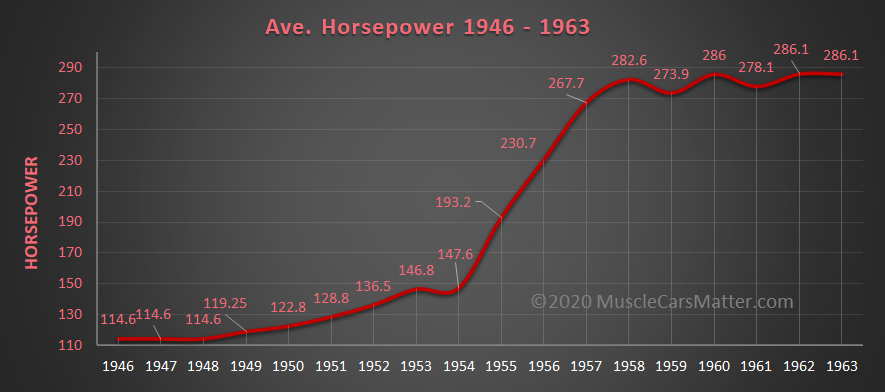
Oh, horsepower! 1954 to 1958 was a freakin’ rocket ride! Average power went up by over 130hp in that short period. Again, there was a predictable leveling off after that. By this time, there were a multitude of engines at or above 400hp.
Average Compression Ratio

The general shape of the Average Compression Ratio graph is remarkably like that of the Horsepower graph. The availability of higher-octane gas was key to operating an engine at the 10:1 and above ratios that were seen for the higher output engines during the late ‘50’s and early ‘60’s.
Average 8 Cylinder Displacement
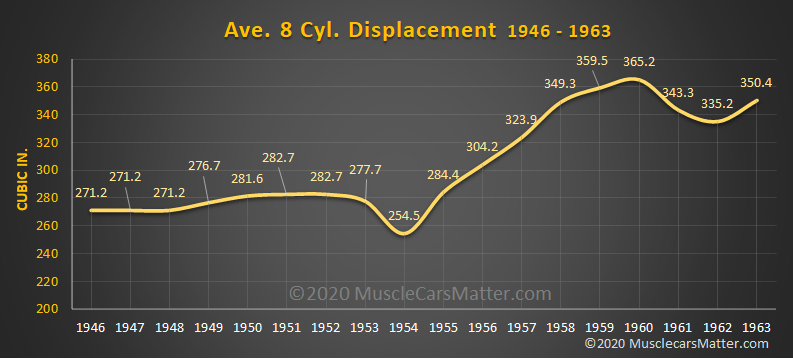
V8 engine displacement reached a peak in 1960, then declined. There weren’t necessarily fewer large engines as much as there were increased numbers of small V8s. Chevrolet was known for their small (block) V8 engines, the 265, 283 and 327. Buick had the wonderful little aluminum 215, which Olds shared the general design of. The Chrysler corp. had the sweet little 318, and Ford had small V8s coming out of their butts! 221, 272, 292, 312, 332, 221, 260, and 289. Add to that Mercury’s 255 and 256. I never could figure out what Ford was thinking.
Average Horsepower per Cubic Inch

The Hp/in3 graph is rather interesting. It shows the same rapid rise starting about 1953, reaches a peak in ’57, then declines slightly and takes six years to reach a new peak in 1963. There are a couple of reasons for this, one of which was the U.S. recession in 1958 and a resulting increased interest in fuel economy. Many engines that would otherwise have been 4bbl-fed were now fueled by 2bbl carburetors, with a resulting drop in horsepower. This was especially true of the “luxury” car segment.
Average Octane Ratings
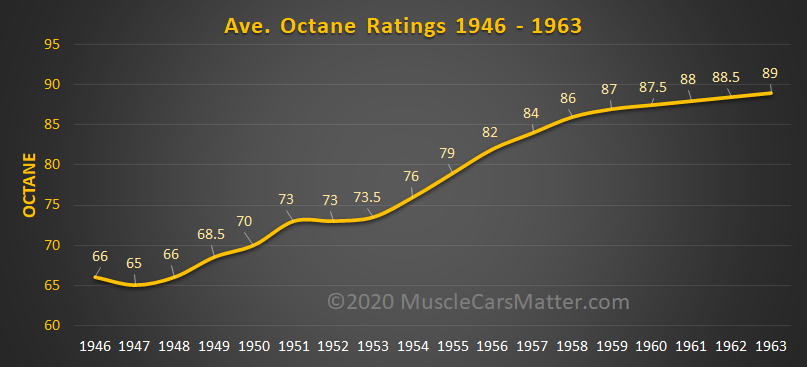
The Average Octane graph will give you an idea of the improvement in post-war gasoline quality. Had this not been the case, the overall compression ratios could not have increased in the manner they did.
U.S. automakers and oil companies both had vested interests in making gasoline affordable. Toward that end, additives were investigated that could increase octane ratings without resorting to costly additional refining. That additive was TEL, or tetraethyl lead. What was conveniently ignored was that this substance is a deadly poison!
Gasoline Prices

The ’46 to ’63 gas prices (blue) show the gradual increase you might have expected. What’s not so intuitive are the prices relative to 2019 dollars. This is mostly due to the changing rates of inflation during the period. Due to the differences in scales (0 – $0.35, $2.30 – $3.00), a 10% change in the Price (blue) is going to look less significant in a 10% change in the Price 2019$ (orange). In ’46 – ’47, an increase of a couple of cents is actually a significant drop in the adjusted (2019) price, while in ’59 – ’63, the price remaining constant during strong inflation results in a plunge in the adjusted price.
1946 through 1963 Automotive Market
It’s interesting to note the peaks and valleys of the Sales graph, and how the different companies tend to be in sync with one another. Peak sales years, as shown, were 1947, 1950, 1953, 1955, 1957, 1960 and 1962-63.
Regarding the Market Share graph, the huge ‘49 – ’50 peak in Ford sales, after poor performance in ’47 and ’48, requires some explanation.
While most makes saw ’47 sales similar to ’46, Ford (the company) was the exception to this. Hence, the Ford and Mercury market share dropped dramatically. They then experienced tremendous ’49 sales, as did the GM companies.
Also, Ford shut down production of the ’48 models in the middle of the 1948 calendar year to set up for the all-new ‘49’s. Additionally, these models were introduced two or three months early, which further reduced the ’48 numbers, while increasing the ’49.
Market Share Graph
The Market Share graph displays similar trends to the Sales graph, but removes the peaks and valleys caused by market sags and surges. It’s clear that Ford and Chevrolet had something of a see-saw battle for the number one position, with Chevrolet dominating. The red dash-dot “Ford+Chevy” line is the total of these two companies.

The graph above shows a few interesting things. First and foremost, Chevrolet and Ford controlled roughly one half of the total market. Plymouth and Buick each had shares approaching or exceeding 10%, with Pontiac and Oldsmobile also having significant shares at times. The rest were mostly lost in the noise.
Ford and Chevrolet ended up with a greater share of the overall market at the end of this period than they had at the beginning. No other automakers showed significant gains, and both Chrysler and Plymouth experienced period-long declines.
Note that from 1957 on, the Ford+Chevy market share exceeds 50% of the total market. The overall era was, more than anything, the “Ford, Chevrolet, and everyone else Story”.
Total Auto Sales


The Sales Percentage Change by Year graph is interesting in that it shows the cyclic nature of the automotive business incredibly well. You have to be careful, though, and pay attention to the 0% line. Take 1950 and 1951 as examples. 1950 was a peak year, but the change in ’51 was close to 0%, or ‘no change’. 1951 wasn’t a bad year at all; far from it! 1952 is another matter. The Korean War caused a substantial drop in the automotive market, as shown by the 30% – 50% drop everyone experienced.
It might help to do the mental exercise of picturing a fictitious company who experienced 10% growth each and every year. Their graph line would be simply a flat horizontal line at the 10% mark. With 10% growth, they would be growing at a wonderful rate, but this type of graph wouldn’t show it quite as obviously as maybe a sales-by-year graph would, where the line would be tilted upward.
Mercury Strangeness
In looking at more details from the graph, you will see that Mercury was down in ’48, like everyone else, but their 1949 saw a 500% change! Their sales change in 1960 was roughly twice that of anyone else for this year, but the few following years saw lowered performance. Mercury’s yearly sales were lower than most makes, which means that smaller net sales changes will be reflected by higher percentages.
The ’49 peak was a clear indication of this, but the 1960 peak is a bit harder to explain. If you look at the Market Share graph, you’ll see that Mercury actually approached the number three position for 1961! This was their highest market share for this entire era. It was followed by slightly lower sales in ’62 and ’63, and virtually everyone else was anywhere from slightly higher to substantially higher, thus Mercury’s fall back to 8th place.
Mercury’s ’59 sales were about even with their ’58, while most companies were up for ’59. Merc’s ’60 sales were up, when everyone else was coming off of the ’59 peak. The Mercury Percentage Change is out of sync with the rest of the market by one year. If you look at the ’48 to ’50 range, you will see less obvious examples of the same out-of-sync behavior with some of the makes.
The Reason?
I have to think that Mercury’s pairing with Ford comes into play here. Mercury was but a tiny part of Ford, with Ford itself vying for number one each year. If a small percentage of Ford buyers were attracted to Mercury in a given year, this could create huge percentage changes in Mercury’s sales. That might have been a factor in 1949 and 1960. With all of the divisions GM had, this sort of effect would never have been as significant.
The other factor in the 1960 sales percentage change for Mercury was undoubtedly the introduction of their new little Comet. It was introduced in March, yet sold some 117,000 copies, which accounted for 43% of Mercury sales for the year!

Horsepower for the Common Man
Engine offerings played a direct role in these market results and the battles for consumers. As can be seen by the chart below, the competition over horsepower began in earnest in the early ‘50’s and took off in about 1955.
People wanted more power, and not just for the performance-oriented cars. Obviously, the power demand was greater for some types of cars than for others, but the demand existed across the board.
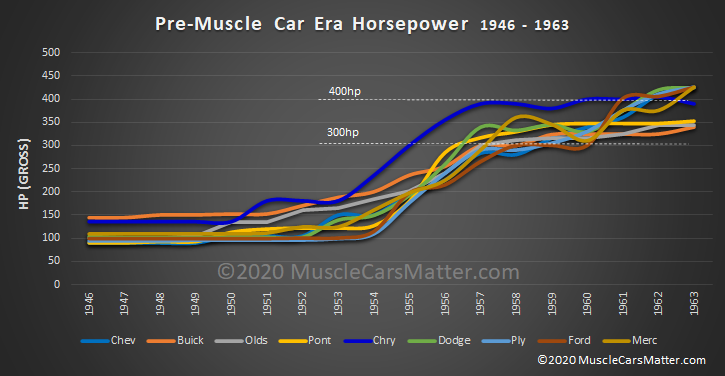
The graph above shows the highest horsepower offerings of each of the automakers. 150hp was about the limit until 1950, which makes perfect sense. For the first handful of years after the war, companies were focusing on many other things, new engines taking a back seat.
The years of 1954 to 1958 were nothing less than a rocket ride! Horsepower more than doubled, with each of the companies taking part, some more than others. It was an exciting time!
Engine Offerings by Company
The following tables, by manufacturer, show the growth in engine size, engine numbers and engine horsepower over this period of time. Within the cells, the numbers “AA/BB” are (Intro or low hp) / (highest hp).
GM Companies

Chevy started this period with their 217cid straight six and didn’t even offer a larger displacement than this until 1950. At least it was an OHV design, but at 90 and 105hp, who really cared?
Chevrolet crossed the 300hp barrier in 1959, but that was with a smallish engine, with less torque than some of the competition.

Buick came into the post-war era with only eight-cylinder engines, which were both overhead valves. They were unique on both counts. The 144hp of their 320 was competitive with anything else.

Oldsmobile went to a V8-only policy, when the 257cid inline 8 was dropped after 1950. This resulted in them mostly having only one large engine at a time.

Pontiac held on to their 239cid inline six through 1954, and added the 194cid four cylinder in 1961. Their V8 went through several short-lived iterations, starting at 287cid and going to 389cid. Of course, the 421 was also a product of this evolution.
This made Pontiac unique in the regard that their first V8 design was really their only V8 design, spanning from 1955 until well into the ’70’s.
Chrysler Companies

For the last half of this era, Chrysler offered at least two V8 engines that weren’t vastly different in displacements. Hemi offerings were from 1951 through 1958, ending with the wonderful 392.

Dodge engine offerings were on par with those of Chrysler, with few exceptions. Plymouth was the lower cost make, and didn’t have quite the high-output engine availability of Dodge.

Both Plymouth and Dodge began the era with lowly valve-in-block inline sixes. Who would have thought that they would end the era with five or so V8 engines as well a couple of sixes? And one of those was the beautiful Slant Six!
Ford Motor Company

Ford had an interesting, somewhat eclectic engine lineup. Inline sixes and small V8 engines abounded. Did they really feel they needed 221cid, 260cid, 289cid and 352cid V8 engines? As well as 144cid, 170cid and 200cid sixes? They had two large engines at a time, if you ignore the one-year overlap of the 406 and the 427. The 427 was expensive to manufacture, being a thin-wall casting, and the 390 was really the workhorse of the company. It would be detuned in ’63 as the hot engines were now the 406 and the 427. It’s hard to believe that Ford had only two engine offerings from ’46 through ’54, then went from three in ’55 to eleven in ’63!

Mercury more or less followed Ford’s lead. They didn’t get the hottest versions of the 390, and the 406 was one year only. As with Ford itself, the 427 was available for selected vehicles. Merc did start the era with a lone engine offering, only to have nine in 1954!
Engines and Engine Configuration Numbers

Notice how the number of engines takes off in about ’57. Also of note is that while the number of unique engines increases incrementally, the numbers of engine configurations jumps markedly and remains high through the end of the era. This reflects not only market competition, but the attempt to tailor an engine more specifically to the buyer’s needs.
The best example of this might be Pontiac and their 389. They had 2bbl and 4bbl versions, both low compression (for regular gas) and 10+:1 for higher performance. Added to this was the top-shelf 3 x 2bbl version for those who wanted maximum fun.
Korean War (1950 – 1953) and Chrome
The Korean war affected the American auto industry, though it was almost nothing compared to World War II. There were shortages of copper and chromium, which meant that chrome plating was at times unavailable, the substitute being a sprayed-on clear protectant. It wasn’t remotely as durable as chrome.
Did you ever wonder about this thing called “chrome”? The element chromium was discovered in the late 18th century and gets its name from the Greek “chroma”, for color. It can make some bright, attractive colors when it’s combined with other elements. Oh—chromium is found as an ore and is the 21st most common element of the earth’s crust.
Simple chrome plating involves electroplating a thin layer of chromium to a metal (or plastic) object. The best process is triple-plating, which deposits a layer of usually copper first, then nickel, and finally chromium. The process of plating with chromium dates back to the early 1920’s.
V8 Market Mayhem
The degree to which buyers embraced V8 engines caught all automakers by surprise. The V8 configuration wasn’t new, as it had existed since the ‘teens. However, it had always been expensive to manufacture V8 engines, due primarily to the difficulty in casting blocks. Early blocks were cast in multiple pieces. The conversion from valve-in-block to overhead valves and the evolution of block casting techniques allowed the benefits of a V8, good affordable power, to be made available to all.
Earlier attempts to provide good, affordable power had led to the development of the inline (L head) eight, which came after the first V8 engines. The problem with a straight eight was the long crankshaft, which severely limited engine rpms. There was also the challenge of feeding fuel and air to a long line of cylinders, as well as the challenge of designing a body around a really long engine. The straight eight was for the guy who wanted power but couldn’t afford a V8.
1946 – 1963 Engine Development by Automaker
When the WW2 ended and US automakers resumed production of cars, it was a monumental undertaking to get to the point of having vehicles roll off the assembly lines. Production was not shifted from war materiel to cars overnight. Given this, it’s entirely predictable that for the first few years, there should be no substantive advancements in design or mechanics.
New designs were introduced by most automakers in 1949, with the engine advancements not far behind. The floodgate was about to be opened, and Americans would begin to learn what it was like to drive a modern V8 powered car that didn’t necessarily have to cost a fortune. Horsepower for the common man!
Here we’ll look at the highlights and milestones of engine development of this era.
- Chrysler Corp
- Hemispherical Head Engines
- Polyspherical Head Engines
- 241
- 259
- 277
- 301
- 303
- 331
- 356
- Chrysler RB-Series
- 383
- 413
- 426
- Chrysler B-Series
- 350
- 361
- Chevrolet
- Small block
- 265
- 283
- 327
- W-Series
- 348
- 409
- Small block
- Buick
- 215
- Nailhead
- 264
- 322
- 364
- 401
- 425
- Oldsmobile
- 215
- 304
- 324
- 371
- 394
- Pontiac
- 287
- 317
- 347
- 370
- 389
- 421
- Ford Motor Company
- Lincoln Y-Block
- Ford-Mercury-Edsel Y-Block
- 239
- 256
- 272
- 292
- 312
- Mercury-Edsel-Lincoln
- 383
- 410
- 430
- Ford FE Series
- 332
- 352
- 360/361
- 390
- 406
- 427
- Ford 90 Degree Series
- 221
- 260
- 289
Chrysler Corp Engines
Chrysler Corp. Early Hemispherical and Polyspherical Head Engines
The story of the first series of Chrysler company hemi-head engines is absolutely fascinating, and has all of the elements of a good novel.
Hemispherical-shaped combustion chambers were not new, even in the mid-to-late 1930’s, when the Chrysler research began. They were not at all widely used. Chrysler engineers had been tasked with testing a multitude of different engine and head configurations and selecting one that would become the standard on which future Chrysler company engines would be based. This research started before WWII and continued, in some form, through the war years.
Chrysler Corp. Displacement-O-Rama
GM companies and Ford never seemed to have this level of ‘WTC*’. While there was a bit of engine sharing in GM and a bit more in Ford motor Company, they didn’t begin to approach the level of the Chrysler companies. Was it a Dodge engine, a Chrysler engine or a Plymouth engine. Who the hell knows, and to an extent, who cares!
Another source of confusion was, for example, whether an engine was a Chrysler hemispherical head engine of 331cid or whether it was a polyspherical head engine of the same displacement. Then, Dodge had both 325cid and 326cid engines, and Plymouth had its 301 and 303cid engines. It was like trying to watch a basketball game when you didn’t know the teams and didn’t have a program. Believe me when I say that this stuff even confuses hardcore Mopar guys!
*WTC What the Crap. A gentler, kinder, more mature equivalent of the more familiar ‘WTF’.
331cid hemispherical head V8
In 1951 Chrysler fired one of the first shots in the horsepower war, making good use of their pre- and wartime experience. Their first overhead valve V8 was the 331 hemi (small ‘h’), with 180hp on tap. This would grow to 300hp by 1955 with 2x4bbl induction. This family of engines was given the name “Fire Power”. Connecting rod length was 6.625″. The crankshaft was forged steel, the connecting rods were forged and the pistons were made of cast aluminum alloy. The camshaft was hydraulic. The later high-output versions had forged pistons, solid lifter cams and 1x4bbl or 2x4bbl carburetion. Chrysler only.
354cid hemispherical head V8
1956 would see the 331 bored by 0.125” to become the 354, with up to 280hp from the start. This engine would be in use for three years, its last year being 1958. Connecting rod length was 6.625″. In 1957 and 1958 there would also be 354cid poly-head engines for the lower two series. Chrysler only.

392cid hemispherical head V8
The very next year, 1957, the definitive early hemi engine would arrive, the 392. It’s bore and stroke were both increases over the 354. This engine would make 380hp and 450 lb.-ft of torque. Connecting rod length was 6.950″. Chrysler only.
Chrysler had the lead in the introduction of these new engines, and Dodge, Plymouth and DeSoto would all have to wait a bit to introduce theirs. In addition, Chrysler had the engine that was unquestionably at the top of the heap, in the 392.
Chrysler, Dodge and DeSoto would each have their own, entirely unique, hemispherical-head engine designs. This was before the era of (much) corporate sharing of engines and technology. As an example of this, in a few years, Chevy would have their own 350, Pontiac theirs, Buick theirs and Oldsmobile theirs, all entirely different engines that had the same approximate displacement.

These were all hemispherical head engines, with the exception of the 1955 – ’56 331 that had polyspherical heads.

Hemi heads are large and wide, and require additional machining, relative to wedge heads. Valvetrain hardware is more substantial and pistons are of a more complex design. The pistons must be domed to achieve the desired compression ratio, which results in more complex pistons. Stud mounted rockers, like Chevy’s, won’t work.

Hemispherical combustion chambers were cool looking, weren’t they? The extra machining required added to the cost of production of these engines.


Hemi engines, whether small ‘h’ or large ‘H’, were some of the most attractive engines made. Heck, I’d even go as far as to say they were downright sexy!
Dodge Engine Offerings
Dodge had to wait until 1953 for their new engine, the 241. It was a good bit smaller than the 331 that Chrysler had brought to market in 1951. Its 140hp wasn’t going to impress many, either. In ’55 the 241 would be bored by 0.1875” to become the 270. This engine produced up to 189hp. Finally, in 1956, by merit of a 0.5625” increase in bore, the 315 would appear. With a 9.25:1 compression ratio and two 4bbl Carters, this engine would make 295hp. Not too shabby.
241cid Hemispherical Head Engine
As was the norm with hemispherical head engines, the 241 sported a forged steel crankshaft, forged connecting rods, cast pistons and a hydraulic camshaft. This engine was christened ‘Red Ram’. 1953 through 1954.
270cid Hemispherical Head Engine
A 0.1875″ bore of the 241 gave us the 270cid engine in 1955. The name was ‘Super Red Ram’. 1955 only.
270cid Polyspherical Head Engine
This was, naturally, a polyspherical head version of the Super Red Ram. The poly head engine was given the name Red Ram. 1955 through 1956.
315cid Hemispherical and Poly Head Engines
in 1956 the 270cid engine received an addition to the stroke of 0.562in. to make the 315cid engine. It made 260hp with a 4bbl carb and 295hp with 2x4bbl carburetion. Poly head versions were labeled Red Ram and Super Red Ram. 1956 only for both versions.

318cid Polyspherical Head Engines
This was the premier poly-head engine, primarily due to its incredible longevity, first as a Chrysler ‘A’ series engine then starting in 1967 as a Chrysler ‘LA’-series engine. 1960 through 1966 as a Chrysler ‘A’ series.
325cid Hemispherical and Poly Head Engines
The 325 made its appearance in 1957 and consisted of both poly and hemispherical head engines. Red Ram and Super Red Ram were the polyspherical-heads and the D500 was the hemi-head engine. Top output was 310hp, courtesy of 2x4bbl carburetion. 1957 through 1958 for poly engines; 1957 only for hemispherical head.

326cid Polyspherical Head Engine
This appeared as a 1959 Dodge engine and displaced 325.25 cubic inches. It was referred to as 326cid to avoid confusion with the 325cid engine. It shared the stroke of the 318 and had hydraulic lifters. Interestingly, this was a one year only engine, 1959.

Both the 315 and the 325 were under-square, with strokes larger than their bores. This was unusual, and the exact opposite of many engines a decade earlier. The industry would gravitate to bore/stroke values that were moderately over-square. The color coding in the Bore/Stroke column groups engines by common stroke values.

Dodge just didn’t get the big engines that Chrysler did. In addition, their hemispherical head engines were modified to use the less expensive to manufacture polyspheric heads. With five different engines within an 11 cu. in. spread, one might wonder just what Dodge was doing.
My Plymouth has a Dodge Engine?
This never seemed to be a big deal within the Chrysler Corporation family of companies. Plus, it’s entirely normal today. Many GM owners today don’t know or care if the thing under the hood was made by Buick, Chevrolet, or whoever.
Several years ago, back in the late 1970’s, General Motors exhibited their unrivaled capacity for dumbassery by quietly dropping the Oldsmobile 403 between the front fenders of the Pontiac Trans Am, referring to it as a “400”. The problem was that buyers of new Pontiac Trans Ams expected a freakin’ Pontiac engine, not some low-po Olds thing. People became unhinged and the General had a public relations crap-storm on their hands. I mean, c’mon! They really thought this sleight of hand would go unnoticed? Absolute buffoonery.

The 318 was a wonderful little engine and served admirably in a number of different capacities, including Dodge trucks. It was also a very long-lived engine.

There are still Red Ram engines kicking around today, should you want one. Back in ‘the day’, you might spend months or years looking for something as off-the-beaten-path as a 241. Today, you could have one on the way this afternoon! God bless Al Gore! (Inventor of the Internet)
Dodge First V8 Engine Highlights
- Introduced in 1953 as the 241
- Overall a very short-lived engine family
- The 318 is the exception to the above
- Hemi-head engines were gone after 1956
- Pretty much the last branch on the family tree
DeSoto Engine Offerings
276cid Hemispherical Head Engine
The initial DeSoto hemispherical head engine arrived in 1952 with a 276.1cid displacement. As with other Chrysler corp. first series V8 engines it featured a forged steel crankshaft, forged connecting rods, cast pistons and a hydraulic cam. The engined was caried over into 1953 and 1954. Highest output was 170hp @ 4400rpm.
291cid Hemispherical Head Engine
1955 saw the Fire Dome become the “Firedome”, its 291cid the result of a boring of the 276. Interestingly, on the DeSoto Fireflite models, this same engine was called the Fireflite. Highest output was 200hp @ 4400rpm. 1955 only.

330cid Hemispherical Head Engine
A 1956 increase in stroke yielded the 330cid engine. A 4bbl carb allowed it to make 255hp @ 4400 rpm. 1956 only.
341cid Hemispherical Head Engine
What happens if you not only bore the 291, you also increase the stroke? Well, DeSoto did just this and got the 341. By merit of a 9.25:1 compression ratio, this mill made up to 320hp. 1956 through 1957.
345cid Polyspherical Head Engine
In 1957 a polyspherical head engine was added, at 345cid. It was a slightly stroked 341. Output was 345hp with two 4bbl carbs. 1957 only.
A Dodge-sourced 325cid engine was used in 1957.


The color coding in the Bore/Stroke column groups engines by common stroke values. The 291 and the 330 also shared a common bore.

DeSoto engines grew almost 75 cubic inches over the period from 1952 to 1957. Not sure what led to the less than 2/100ths inch bore increase to pick up 4 cubic inches.
Chrysler Corp. A-Series Engine Family
This was a small block engine family that spanned across the Chrysler corporation companies, first introduced in 1956. The engines had polyspherical combustion chamber heads, and included displacements of 277, 301, 303, 313, 318 and 325 (326) cubic inches. Interestingly, the 318 was by far the most successful member of the family and in 1967 would receive conventional wedge style heads as a member of the LA family.
Chrysler Corp. A-Series Engines
This engine family was also referred to as the Plymouth A-Series family.
The Plymouth engines, the 277, 301, 303 and 318, constituted the A-engine family. Those of you who are more astute might realize that the letter ‘A’, being the first letter of the alphabet, was an apt designation for Chrysler’s first V8 engine series. These were separate from the other poly-head engines in that they had some unique key dimensions, such as bore spacing. They were also produced with cost in mind, with such features as cast, not forged, components, no separate valley cover, and cast-in-place rocker pedestals, rather than screw-in. The 318 would be the only truly successful engine of the A-series, later becoming a member of the LA-series of engines and utilizing more standard wedge-shaped combustion chamber heads.
Plymouth Engine Offerings
241cid Polyspherical Head Engine
This was basically the Dodge 241 with polyspherical heads. 1955 only.
259cid Polyspherical Head Engine
Also arriving in 1955 was the 259cid engine, which was a 0.125in. bore of the 241. 1955 only.
270cid Polyspherical Head Engine
On 1956 a 0.0625in. bore of the 259 resulted in the 270. 1956 only.
277cid Polyspherical Head Engine
The 277cid Hy-Fire was the first A-Series engine, arriving in 1956 and lasting through 1957. Bore and stroke were 3.75″ x 3.12″. Components were strictly low-performance. The 2bbl made 187hp, with the 4bbl making 197hp.
303cid Polyspherical Head Engine
The 303 didn’t share the bore or stroke of any previous engine. The 318 would share the 3.312in. stroke, with a slightly larger bore. As a 1956 only engine, this was very much an interim engine. Dual 4bbl carbs made 270hp.
301cid Polyspherical Head Engine
This was a 0.1562in. bore increase of the 277cid engine. 235hp with 4bbl. 1957 only.
318cid Polyspherical Head Engine
Yes, this was a Dodge engine, appearing here in 1957. Dodge kindly allowed Plymouth to use this engine.


Plymouth was the poor stepchild. They had to make due with poly engines exclusively—no hemis. And then, they had to use Dodge-sourced engines for a couple of years, waiting until 1956 to have their own polyspheric-head engines. Plymouth would hold on to their largest poly engine, the 318, far longer than any of the other companies would theirs. It would see use in Dodge trucks, as well.
Plymouth used three slightly different stroke values, as shown. The 301 and the 318 shared a common bore of 3.9062 in.

Seven different engines in three years! In keeping with their position at the bottom of the Chrysler Corp. lineup, Plymouth’s engines were polyspheric head engines.
Plymouth First V8 Engine Highlights
- Introduced in 1953 as the 241 (Dodge engine)
- Overall a very short-lived engine family
- Plymouth did not have their own hemi engine
- Mostly forgotten
The Polyspherical Head Engines
“The Polyspherical Conspiracy”
Chrysler fully embraced hemispherical combustion chamber designs for their first post-war V8 engines. They were all-in. At that time the use of shafts for the rocker arms was common, as it would be four more years (1955) before the Chevy smallblock would introduce the Pontiac-designed post-mounted, stamped steel rockers. These were just as effective as shaft mounted and much less expensive to manufacture. Chrysler wouldn’t have seen that coming.
The hemi designs used two rocker shafts per head, while their competitor’s designs used only one. Hemispherical heads required more machining than some heads, too. Chrysler must have known that they were going to be at a cost disadvantage, but I suspect they factored this in with everything else. One thing they didn’t anticipate, because nobody did, was the degree that the buying public would embrace V8 power. This was once the exclusive domain of large (expensive) cars, but now most people could afford V8 models. The fact that so many cars were ordered with V8 engines served to exacerbate the production cost differential. Something had to be done, but whatever this was, it mustn’t tarnish the “hemispherical head” reputation.
That “something” was the development of engine heads that would work with the existing hemi blocks, as well as for new displacements. These heads were not of ordinary wedge design, in that the valves were more optimally placed and were canted toward their respective intake or exhaust. These were canted valve heads, like Chevy’s Mark IV 396 would be! Canted valve heads would be highly unusual at this time. Chrysler had a huge investment in hemi head engines and didn’t want to be seen as abandoning that design.
What Should We Call this Thing?
The problem was what to call the new design. They came upon “polyspherical”, which means “many spheres”. This was nothing short of pure marketing genius. I have to think that the term evoked images of a “modified hemi”. That was certainly my belief when I first encountered these engines. In fact, they were also referred to as “single-shaft hemis”. Problem is, hemispherical they were not!
These engines had to use a rocker shaft, at a time when other automakers were going the post-mounted, stamped steel design. Chrysler had partially addressed the problem, in providing good performing heads that had a tie-in with the hemi engines. However, much of the manufacturing cost problem remained.
318cid V8
Most of the polyspheric engines were gone by the end of the ‘50’s, with the notable exception of the 318. Significantly, when Chrysler brought to market new engine families, none were polyspheric.
In 1964 the 318 will transition to more standard wedge heads and become a member of the LA-series of engines. In this form it would exist into the 1990’s! Connecting rod length was 6.123in.

Canted Valves
Configurations such as this had valves that were placed closer to their respective manifolds, as well as angled (“canted”) toward that manifold. The opposite of this was the more traditional layout where the valves were all in a single row, with all valve stems aligned. Canted valves provided two things. First, they allowed each port to be better aligned with its respective intake or exhaust manifold port. Secondly, it unshrouds the valves. Both valves have adjacent cylinder walls, which tend to shroud the incoming mixture or exhausting gases from the port area exposed by the opening valve. Canted valves don’t move strictly parallel to their adjacent combustion chamber walls, they move somewhat away from them, too. This helps to unshroud, or expose, the opening, resulting in better flow characteristics. Why don’t all engines do this? It creates wider heads and a more complex valve train, as well as possibly additional machining. That’s cost!
The following two figures show the polyspheric head setup, and how the single rocker shaft works. As you can see, it made for some odd pushrod angles. You can see how the intake pushrods were located on the exhaust valve side of the shaft, and vice versa. The angle between the intake and exhaust valves wasn’t nearly as large as on the hemi heads. The combustion chambers were far more similar to those in a wedge head than a hemispherical head.


The polyspherical heads used a funky pushrod and rocker arm setup to actuate the very non-parallel valves using a single rocker shaft.
Chrysler Corp. Wedge-Head V8 Engines
B-Series Engines
The B-series of engines were the 350 and 361, and the first-year 383. The family would later include the unloved 400cid V8 engine.
350cid V8 and 361cid V8
The 350 and the 361 were both introduced in 1958, as members of the ‘Low-Block’ B-Series engine family. Both engines shared a 3.375” stroke, a 9.98” deck height and a connecting rod length of 6.358”. The 350 had a bore of 4.06”, while that of the 361 was 4.125”. Aside from pistons, engine components were interchangeable.
The 350 would be very short-lived, lasting for only one year, 1958. The 361 would be around longer, lasting into the mid 1960’s as a truck engine. As was often seen, an engine was introduced and given 4bbl carbs, being placed as the new horsepower standard bearer. When a larger engine came along, the first was de-tuned and pressed into service as “the standard V8”, or, as here, in truck service.
This type of thing, introduce an engine and enlarge it the very next year, illustrates the craziness of the mid to late ‘50’s. The engine timeline charts show this best. I’m sure this made for excitement among engine designers and automakers, but people had to wonder “When’s this going to end?”.
The 361 was referred to by Plymouth as “Golden Commando” or “Sonoramic Commando”. Dodge’s name was “Super Red Ram”, while for DeSoto it was “Turboflash”. The Chrysler corp. advertising guys must have been working long hours. Or smoking reefer. Highest output seen for the 361 was the fuel injection setup, good for 355hp. This was in ’58, the 361’s debut year and the only year with fuel injection.

The 361 followed the tried and proven pattern of high horsepower in the first year or two, then declining values as the detuned engine is used more as a base V8. For the 361 it was 355hp at the start and 265hp at the end. Many, many engines followed this pattern.


383cid V8
The 383 had a bore of 4.06” and stroke of 3.75”. As a B-block, it had 4.80” bore spacing, which allowed substantial future bore increases. This was a one year only engine in this particular configuration. In 1959 an engine with the same displacement would be produced, with different bore and stroke, as a 383cid RB engine.
Chrysler B-Series Engine Highlights
- Introduced in 1958 in both 350 and 361 cubic inch versions
- 350 was only used in 1958
- 361 quickly became an entry-level sort of engine
Chrysler RB-Series Engines
This engine family, with its 3.75″ stroke, included the 383, 413, 426 and 440cid engines. Again, after being a member of the B-series in its first year, the 383 became a member of the RB-series in 1960. Most RB heads are interchangeable, with the exception of the 426W.
383cid V8
Just one year later, in 1959, the first ‘RB’ (raised block) engine was released. The RB engines had a 10.725” deck height, an increase of the B engines’ 9.98 “. The 383 had a bore of 4.25” and stroke of 3.38”. Connecting rod length was 6.358in.
Significantly, the 383 would never be relegated to being merely a detuned, large car engine. It would serve admirably as Chrysler corporation’s “entry level” muscle car engine until its retirement.


The 383 would be one of the key Chrysler corporation engines, spanning three different decades. I’m not sure I could name a more important Chrysler engine, can you?

Here’s the 383 in its most potent form, with 2 x 4bbl induction. Not only that, it featured the wild long-runner cross ram intake setup. Gorgeous and effective, this was one sweet engine.

Mopar engines seemed to always have some of the nicer intake manifolds; this is a big block 4bbl manifold.
413cid V8
The 383 would be the largest Chrysler corp. engine for just one year, as the 413 arrived in 1959. This was an RB engine with a 4.1875” bore and 3.75” stroke. The 413 shared valve sizes with the smaller RB engines, and in 1961 it got 2.08” intake valves, like the 361.
This engine would see some interesting developments in its higher output versions, indicative of the forward thinking of Chrysler’s engineers.
30 Inch Intake Runners
Aside from the usual big valves, hot cam, big ports, etc., the 413 had a series of dual four-barrel intake manifolds that were nothing short of brilliant. The first version had 30 in. long intake runners, with the carburetors placed well off to the sides of the engine. Each carb fed cylinders on the opposite side of the engine. In addition to this long-ram intake, there was also a 15 in. short-ram version, which had a better high rpm power curve. There was also a cross-ram manifold that was more “box-like” than the short or long ram versions. It was functionally more like the short ram.
Names given for the engine consisted of Max Wedge, Ramcharger 413 and Super Stock 413. This 413 version also utilized heads with bigger ports and valves, a higher compression ratio, and hotter cam. All engines had exhaust manifolds that swept upwards from the exhaust ports, not down. These flowed well and the upward sweep was more for chassis clearance than for flow qualities.

Oh, my! What a cool engine the 413 was when equipped with one of the wild intake setups that the engine could be fitted with. There was truly nothing else like it. There were a few other engines that had, or would have, a cross-ram setup like this engine, but they were few and far between.

This is an early type 2 x 4bbl cross ram intake. Nice, huh?


The long ram and short ram intakes were truly unique and were perhaps an indication of what was to come in the mid ’80’s with the first series of fuel injected performance engines like the Ford 5.0 and Chevy L98. These engines featured long narrow runners, too.
426cid V8
The 426 was the pinnacle of Chrysler corporation pre-muscle car era engines. It was essentially a bore increase of the wonderful 413. As such, it had a 4.25” bore and shared the 413’s 3.75” stroke. First arriving in 1963, it would only be around through 1965, as the 426 Hemi would replace it in 1966.
The 426 would receive the same performance treatments as the 413 did, plus a bit more. The Max Wedge version in ’63 would be joined by a “Stage II” version later that year. 1964 would see the top-shelf 426 Max Wedge Stage III being offered. The top offering in 1965 had the same horsepower and torque values as the Stage III of ’64, but the “Max Wedge” and “Stage” designations were dropped. Perhaps this was in anticipation of the Hemi, which would arrive in street form next year?
‘Only’ 425hp?
As with the hottest versions of the 413, the top-shelf 426 versions were given horsepower ratings at, or only slightly above, the more pedestrian versions of the engine. Many suspect that the factory didn’t want to attract undue attention by giving the engines their actual ratings. For instance, in ’65 the 425hp 426 had a 12.5:1 compression ratio and smaller exhaust valves (for some strange reason). The 1963 425hp version had 13.5:1 compression and the larger exhaust valves. Why didn’t the horsepower rating drop in ’65? Because the 425hp rating was bogus for both engines!
See Understanding Horsepower and Torque for more information about factory horsepower rating.


The 426 wedge sported large ports and valves and was a performance powerhouse.

While it might not have had the enormous sex appeal of the 426 Hemi that was based on this engine, this was still one sexy beast of an engine. It could go toe-to-toe with anything else made at the time.
Chrysler RB Series Engine Highlights
- 383 was introduced in 1958, 413 in 1959
- 383 was extremely long-lived
- 426 wedge was the basis for the 426 Hemi
- All engines had many hi-po variants
Chevrolet V8 Engines
Chevrolet Small Block V8
The Chevy small block holds the envious distinction of being the most successful and long-lived engine series in US automotive history. Given this, one thing that is really cool is that this engine came from a company that relied on mundane, six-cylinder engines for decades and decades. A shot out of the blue, for sure.

Chevrolet had actually built small numbers of V8 engines in the WWI timeframe. These had the low compression of all engines at that time and made a paltry 55hp or so. This engine, like so many other early engines, has been forgotten by history, and rightly so.
265cid V8
The small block first arrived in 1955 in the form of the 265cid “Turbo-Fire”. It made 162hp with a 2bbl and 180hp with a 4bbl carb. The Corvette version made 195hp.
The engine was developed in record short time. Key influencers at Chevrolet had come to believe that the company could attract younger buyers with an overhead valve V8. Most of the other automakers had already introduced their own OHV V8 engines by ’55, and Chevy was late to the party. But, oh, how they made up for it!
The 265 weighed less than the “stovebolt-six” that preceded it. It used block casting techniques that allowed the creation of thin-wall castings, with few miscast blocks. The block didn’t extend down below the centerline of the crankshaft, as was the trend. Bore centers were set at 4.40 in. The valvetrain consisted of stamped steel rockers mounted on screw-in studs, something that GM had provided them, curtesy of Pontiac. This was unusual at that time, as each GM division usually had a year or two of exclusive use of technology they had developed. Was it the right thing to do? Hell, yeah!

Thin-Wall Castings
Engine blocks would ideally have walls that were no thicker than they needed to be. Extra material was wasted and increased vehicle weight. The problem was with the immature casting methods at the time. It was much easier to design thick walls. Then, if a core shifted (which was common), the resulting thinner wall would still be thick enough to serve its purpose. Intentionally making walls thin was fine, as long as you could ensure that no cores shifted. Trying to cast thin wall blocks without the needed techniques and experience to control core shift resulted in ruined blocks.
Thin wall castings were an evolutionary step that not all automakers were able to take at the same time.
It should be noted that the term “small block” only arose when the W-Head engines were introduced, with their larger block size. It was natural that some term would be used to differentiate the two different engine series. Somewhat unfortunately, the two terms were later applied to other manufacturers’, where the terms at times were less applicable.
283cid V8
A 0.125” bore of the 265 resulted in the long-lived, landmark 283. This engine would give the Corvette the horsepower it needed to define itself as acceleration and exhilaration par excellence. No more comparisons with small, European sports cars like MGs and Fiats; this thing could kick ass! It also allowed Chevy and Corvette to stake a claim in the exclusive “1hp per cubic inch” club. Who was there first really wasn’t as important as who was there, and Chevy was there! The connecting rod length for the 283 is 5.700”.


Valves were aligned in a row, of course. The revolutionary stud-mounted, stamped steel rocker arms are nicely displayed.

Combustion chambers were smallish, and of a contemporary design.

Intake ports were generously sized.

Exhaust ports were of a rather straightforward design; nice but unremarkable.

327cid V8
After five years of the 283, Chevy brought out the 327, with its 0.125” larger bore and 0.25” longer stroke. The 283 would remain, but the 327 became the “go to” small block. For the highest output incarnations, the 327 would see the 283’s 315hp and raise it 45, to 360hp. This is a very respectable “big block” number. Later years would see 365hp and 375hp versions of the engine, before the Mark IV big block was introduced.
The 327 featured a 1.94” diameter intake valve, versus the 283’s 1.72”. The connecting rod length was the same as the 283, 5.70”.


This was a fabulous engine! I can guarantee you that if I had a Chevy with one in the garage, I’d spend many an evening sitting there with the hood raised, beverage in hand, maybe listening to my favorite late-fifties and early-sixties songs. Boring? Says you!
Chevrolet Small Block Engine Highlights
- 265 introduced in 1955, 283 in 1957 and 327 in 1962
- 283 reached 1hp/in3
- 2bbl, 4bbl, 2 x 4bbl and fuel injected
- Exceedingly long-lived engine family
- State of the art thin-wall blocks
- Revolutionary rocker arm design
Chevrolet W-Series Engines
348cid V8
The W-series engine project was begun because of the obvious limitations of trying to press the 283 into heavy duty service. We’re talking trucks. It simply couldn’t be made to have the displacement that was needed.
What was clearly needed was a design that would allow for larger displacement, in the forms of both bore and stroke. A larger block. Chevrolet engineers started with a clean sheet of paper in their quest, and ended up with the 348cid Turbo Thrust and Super Turbo Thrust engines. The latter engine featured a three 2bbl intake setup, which was the ticket for high performance. In ordinary driving, the center 2bbl carb was used. However, when the driver pressed the accelerator far enough, the two end carbs would be opened by vacuum, and all three carbs would supply 675cmf of flow to the engine. Relative to the 450cfm 4bbl carb, this was a huge increase.
A Flexible Design
It was said that the initial design requirements for this engine series included the necessity to be able to easily accommodate a range of different compression ratios. Toward this end, the somewhat unusual head design was developed. The engine had in-block combustion chambers. Not strictly unique, but certainly unusual. The block deck was cut at 76°, rather than the usual 90°. The resulting upper wedge, above the piston at TDC, was the combustion chamber. Changing compression ratios didn’t require different heads or machining; all you had to do was use different pistons! For certain low-compression uses, such as in trucks, the compression ratio could be further lowered by machining a notch in the cylinder wall, above the piston. Perhaps a less than graceful way of enlarging the combustion chamber, but it worked well.
The block itself was 1.7 in. longer and 3 in. wider than the 265/283/327 block. Assembled, the 348 weighed some 125 lb. more than a 283. The 348 connecting rod length is 6.135 in.
1958 Intro.
The first 348’s appeared in the 1958 model year, in two different flavors. The Turbo Thrust had a 4bbl and made 250hp, while the Super Turbo Thrust (what else?) had a dual quad setup and made 280hp. Predictably, the high-output versions of the 283 were now unique to the Corvette, as the 348 was now carrying the torch for all other Chevy high-performance cars. The top ‘Vette 283 was the fuel injected job, making 290 hp.
1959 would see further detuning of the non-Vette 283 engines, and a proliferation of 348 versions, now making up to 315hp with the 3 x 2bbl setup. No more dual quads for the 348.

In 1960 the top 348 would make 335hp, with an 11.25:1 compression ratio. This would be the last year the 348 would be the top Chevy hi-po engine, as the fabulous 409 (“She’s so fine, my 409…”) was on the way.

409cid V8
What the 348 did well, the 409 did better. Both the bore and stroke were increased from the 348, and the sturdy block was new as well. Engines built later in the year received heads with bigger ports. The top 409 offering for ’61 made 360hp, just 10hp more than the top-shelf 348. The base engines valves were 2.06” (Int.) and 1.72” (Ex). The high-performance heads had valves of 2.19” (Int.) and 1.72” (Ex). Can you say “freakin’ huge”?
Things were exciting, and they’d get more exciting in ’62. You could now have your choice of a 380hp 4bbl or a 409hp dual quad. The short stroke limited peak torque a bit, to 420 lb.-ft @4000 rpm on the 409hp engine. Regardless, this thing was a hot rodder’s dream. The great performance was due in part to the large valve sizes utilized. The connecting rod length is 6.00 in.
Can you say “425hp”?
1963 and ’64 were the 409’s high water mark. There were three engines each year, 340hp, 400hp and 425hp. If you had a 409, particularly the 425hp job, good gearing and decent traction, you didn’t have to back away from anyone or anything.
While still around in ’65, the new kid on the block was the Mark IV big block, in the form of the 396. We won’t discuss it here (see Muscle Car Era Engines), but it would equal the 409’s top output with a single 4bbl carb. It also had a contemporary, slightly-over square bore and stroke, versus the 409’s “very over square”. Add great ports and large, canted valves, and it was a worthy successor to the marvelous, and now legendary 348/409 W-head engine line.
I want a 409!
I’ve never owned a 409 car, though I’d love to. There are complete 409 engines still available as I write this, for somewhere in the $12k range. How about someday transplanting a 409 into something that came with a more mundane power plant? Maybe! Oh, and there are now aluminum aftermarket cylinder heads available, too!
The 409 (yeah, 348 too…) with its large, scalloped valve covers was just plain gorgeous. Add chromed air breather and valve covers, and oh, man! Today, snap a plastic intake cover on an engine, and most people think it’s attractive. I’m not dissing late model tech, as it’s cool, too. But sometimes you just can’t improve on “classic”!


The 409 was such a gorgeous engine! If you look at the heads below, it becomes obvious why the valve covers were shaped like the letter ‘W’.

Yeah, these are unusual heads. With the huge valves that are oriented toward their respective ports, they are gorgeous. The ‘W’ shape is cool, too! I love the looks of these heads!

Dig these huge intake ports! Beautiful, huh? The 409 used ‘small port’ and ‘large port’ heads. Generally, the higher output engines used the larger port heads.

The center two exhaust ports on a 409 head were siamesed.
RPO Z11 427
I should at least mention the 427. No, not the Mark IV 427 that so many of us know and love. This was a race-only 427cid version of the 409.
There were two mostly-different Chevy engines that carried the “Z11” designation during this timeframe. The first, and the one we’re interested in here, was an enlarged version of the 409, with the stroke increased to 3.65”. The second engine, also with a 427cid size, was much more similar to the Mark IV big block that would be introduced in 1965. It’s sometimes referred to as the Mark II, and what would have been the Mark III was dropped by Chevy.
The Z11 (‘409’ version) featured a dual 4bbl intake and a 13.5:1 compression ratio. Like so many other Chevy 427 engines to come, it was given a nominal 430hp rating, while the actual output was certainly well above that. This engine was made in small numbers and any survivors today are not only historic, but very valuable.
Chevrolet W-Head Engine Highlights
- 348 introduced in 1958, just 3 years after small block
- 409 introduced in 1961
- large, canted valves
- 2bbl, 4bbl, 3 x 2bbl
- Many performance variants
- Combustion chamber in block
- Racing heritage
- Immortalized in song and culture
Buick V8 Engines
It’s no longer common knowledge that Buick, along with Cadillac, was at the forefront of GM technology for decades. It shouldn’t be surprising that among the automakers who participated in the horsepower wars of the ‘50’s and early ‘60’s, as well as the muscle car wars of the mid ‘60’s to early ‘70’s, Buick was the only automaker to come into the post-war era with an overhead valve eight-cylinder engine, their straight-8 322cid. Everyone else was making do with flathead straight or vee eights.
Nailhead Engines
Buick would get their new OHV V8 engine before Chevy and Pontiac. Cadillac and Oldsmobile had both gotten their new OHV V8 engines in 1949. The Buick V8 appeared in 1953, in the form of a 322cid engine, the same displacement as the departing straight eight. The shared displacement had to be more than a coincidence, although it seems now like that was insignificant. Few others made their new engines the same displacement as the outgoing, except for Ford, when they replaced the venerable flathead V8.
322cid V8
The 322 V8 featured a 4.00” bore and a 3.20” stroke, being substantially over-square. They weren’t alone in this regard, but future engines would migrate toward closer to square bore/strokes. The engine made 164 hp with a 2bbl and 188 hp with a 4bbl carb. The latter was an 18 hp improvement over the old straight eight.
It wasn’t long before someone coined the less-than-complimentary term “nailhead”, in referring to this engine. This was in reference to the smallish valves, which were aligned in a row. This moniker was to apply to Buick engines for the next dozen or so years, until this engine series was retired.
The valves indeed were not large, nor were the ports. Sizes were 1.75” (Int) and 1.25” (Ex); yeah, rather tiny! It’s said that Buick made up for this, at least in part, by camshaft timing and lift. Excuse me if I question how much compensation this actually provided. Something else was rather unusual about this engine, and the nailheads that followed it, and that’s the combustion chamber shape. The valves were placed side-by-side on one side of the chamber, which was reminiscent of a pent roof design. The valve stems were thus displaced 45° from the axis of the cylinders. The pistons were domed as necessary to achieve the desired compression ratio, which was generally in the 8’s for the 322. Also, automakers were embracing the new “slipper” pistons, which had cutouts to clear (slip between) the crankshaft counterweights. Not Buick! They modified the counterweights themselves to avoid interference!

Buick turned up the fire under the marketing guys and tried to portray the small valves as a “benefit”, with “better cooling”, “less costly to manufacture”, and other pap. Yeah, right!

This view of the intake ports (left) and exhaust ports (right) illustrate that the 322 wasn’t known for its huge ports.

264cid V8
This little engine was used in the Buick Special in 1954 and 1955. Just a two barrel, it would never be a performance engine.

364cid V8
1957 saw Buick enlarge the 322 into the 364, with both a bore and stroke. The new engine’s values were 4.125” x 3.40”. Valves were enlarged to a still small 1.875” (Int) and 1.50” (Ex). The 322 was indeed a compact engine, and the deck height for the 364 needed to pick up an additional 0.25 in. It also required going to longer connecting rods.

The 2bbl 364 made 250hp, which was just 5hp short of the top 322 with a 4bbl. The 4bbl engine made an even 300hp the first year. That would be it for the 364, as no versions of the engine with a higher output would be seen in the coming years. Something of a bummer.

401cid V8
The 364 remained the sole Buick V8 for 1958 and 1959, as 1960 saw the introduction of the 401cid engine. With a 4.1875” bore and a 3.64” stroke, it had both dimensions increased over the 364. It also needed to add deck height to the block. Very few components will interchange between a 401 and the 364. As was the case with the 364, the 401 would never make more power than the 325hp it debuted with in 4bbl form, in 1959. Think that Buick took the opportunity to increase valve sizes? Nope! Same 1.875”/1.50” as the 364.
401 or 400?
The 401 would hold the position of the top Buick engine until the 425cid V8 arrived in 1963. For the ’59 through ’61 model years, both the 401 and the 364 were available, with the 401 being the sole V8 offering for 1962. It should be noted that the GM internal mandate regarding horsepower and displacement caused Buick to refer to the engine as a “400”, so as to not run afoul of the GM 400cid limit.
Buick had a bit of an odd way of referring to the 401 varieties, that would carry over to the 425. This was referring to the engine by its peak torque number. For the 401 engines, the name was “Wildcat”, followed by 375, 410 or 445, depending on the torque rating. The connecting rod length for both the 401 and the 425 was 6.220 in.


Buick Nailhead engines are easy to recognize, due to the unique valve angles. The valve stems are vertical, putting them at a 45° angle relative to the cylinder bores. The valve covers are not at an angle, as on most heads, but are positioned horizontally.

These are certainly unique combustion chambers, aren’t they?

What strange heads! Buick was clearly not following anyone else’s lead here. The vertical valve stems in a row led to the ‘nailhead’ term.

Along with the weird heads, Buick used pistons that looked right out of the 1930’s, that is if you ignore the really wild domes. If you look at the combustion chambers above, the dome of the pistons makes sense.
425cid V8
The 425 did arrive in 1963, as a bored version of the 401. Dimensions of bore and stroke were 4.3125” bore and 3.64” stroke. The heads were the same as the 401 heads. Throughout its existence, the 425 would make 340 hp with a 4bbl carb and 360 with the dealer-installed 2 x 4bbl, once that became available.
Following the 401 engine naming, the 425 engines were named Wildcat 465. There was also a Super Wildcat 465, which consisted of dealer installed dual 4bbl carburetors. Initially, the components came in the trunk, for dealer installation. Later in the year, the components came already installed.


Buick Nailhead Engine Highlights
- Small valves (hence the name!)
- Vertically aligned valve stems, all in a row
- Combustion chambers somewhat like pent roof
- Popular with hot rodders in the past
GM Dumbassery
Ah, General Motors. Why the hell did you do the weird-ass crap that you did? Cars other than the Corvette couldn’t make “too much” horsepower or have engines that were “too big”. Also, they couldn’t have multiple carburetors. No, Sir! That was racing hardware, and racing is evil, evil, evil! However, we can put the carbs and intake in the trunk and let the dealer install them—that’s okay. And, if you check the right box (we don’t advertise this—you just have to know it…), we can sell you a Camaro with a 427. Sure, this violates our own rule, but we’ll just take your money and promise we won’t say anything.
The internal GM mandate limited engines of more than 400 cubic inches to large cars or the Corvette. Midsize cars and smaller, which accounted for the remainder, were limited to 400cid or smaller, which was to ensure that no car, Corvette excepting, exceeded 1hp per ten pounds of weight. An example of this would be the Chevelle, with its 396cid engine. The car weighed less than 4,000 lbs., and the top 396 made 377 hp. The 425 hp version of the 396 was not available in the Chevelle, as it was in the Corvette, as it would have exceeded 1 hp per 10 lbs.
Fireball 215
This little gem of an engine arrived in 1961. What made it unique was that it was all-aluminum! Yeah, in 1961! The aluminum giant ALCOA had been actively courting US automakers in an attempt to increase their use of aluminum. Oldsmobile would have their own version of this engine. The bore/stroke of the engine were 3.50” x 2.80”. It made 185hp with 4bbl when it arrived, and would go on to see an even 200hp in 1963, its last year. There was an Olds version, too, which we’ll comment on that in the Olds section. It had 2.299″ main bearings and 2.000″ rod bearings. Connecting rods were forged and were 5.566″ in length.
The 215 was a great example of forward thinking. In another forty or fifty years from then, all-aluminum engines would proliferate and become “nothing special”. But, in the early ‘60’s, this was definitely pushing the envelope; too far, as it would come to be known. The main issue was the lack of experience with aluminum castings of this size. There were many problems with miss-cast blocks, and it was often late in the assembly process before a particular problem was detected. Scrap rates were high. In addition to this, customers didn’t know about compatibility issues with engine coolant and aluminum blocks. I’m not sure how well Buick tried to educate them in this matter, either.


215 aluminum head showing intake ports.

The rather unremarkable 215 exhaust ports.
Holy Crap! That’s One Big Piece of Aluminum!
We might take for granted the use of aluminum engine castings today, as they’re so common. It wasn’t all that long ago that this wasn’t true. Remember the late ‘80’s Ford Taurus SHO and the 1990 Corvette ZR1? Both Ford and Chevy farmed out the casting of the aluminum heads, intakes and blocks to other companies (Yamaha Motor Corporation and Mercury Marine, respectively), as their experience with large cast aluminum components was limited.

Here is an example of more large pieces of aluminum! Although some three decades after the 215, the mighty General Motors and Chevrolet farmed out the casting of the aluminum intake, heads and block.

From the Land of Monte Python

What’s this? What does a Range Rover have to do with anything? The Brits purchased the rights to produce an aluminum V8 based on the Buick design. In a way the design lived on, even after being ignored by the domestic market. Why did it find success in Range Rover that it couldn’t in a Buick model? This is an interesting question, but I think there are just too many variables to provide a simple answer.
Oldsmobile V8 Engines
The Oldsmobile V8, along with the Cadillac V8, were the first “modern” engines of the post-war era, in that they were not only V8 configurations, but they were also overhead valve! For Olds, this was the Rocket V8, introduced in 1949.
303cid V8
The 303 was the first Rocket V8, introduced in 1949. The engine had a 3.75” bore and a 3.4375” stroke. The output was 135hp with a 2bbl carb and 165 with a 4bbl, in its final year. Remember that the flathead Ford V8 of 1949 made only 100hp, so this was a third more power for the 2bbl and two-thirds more with the 4bbl. Valve sizes were 1.75” (Int) and 1.44” (Ex).
The compression ratios varied from 7.25:1 to 8.0:1, a reflection of the compression ratios of the time, that had yet to rise into the 9’s, 10’s and 11’s they would in a few short years. The engine would find use in GM trucks, in addition to Oldsmobile cars.

Popular Science Olds V8 Article January 1949


This is an interesting article, with the key message in the title: ‘High Compression’. We all know that this term in the late ’50’s and early ’60’s meant something like 9.0:1. However, the research cited here anticipates ratios of above 12:1. And, yes, we’re talking street engines here, not race engines. In reality it would be the twenty-teens before a few street engines saw such compression ratios.
324cid V8
The 303 would be replaced by the 324 in 1954. The bore of this engine was enlarged to 3.875”, while the stroke remained the same at 3.4375”. The compression ratio used in the first year was 8.25:1, which yielded 170hp with a 2bbl and 185hp with a 4bbl carb. In 1956, its final year, the top 324 offering was good for 240hp, with a 9.25:1 compression ratio. The valves were the same size as the 303cid engine.
371cid V8
Another bore and stroke, and the 371 was born. The year was 1957. Bore and stroke were 4.00” x 3.6875”. Highest output the first year was 277hp with 9.5:1 compression ratio and 300hp with 3 x 2bbl induction. It would later make 305hp with a 4bbl and 312hp with the 3 x 2 setup, both at 10.0:1 compression ratio. Valve sizes were 1.875” (Int) and 1.562” (Ex). 1949 to 1958 Olds engines has connecting rods with a length of 6.625”, except the 394.

394cid V8
In 1959, a 1/8 in. over bore, to 4.125”, would add twenty-three cubic inches to the 371, to make the 394cid V8. This engine would prove to be more long lived than its predecessors, lasting through 1964. Initially making 315hp with a 9.75:1 compression ratio, the engine would see 345hp in ’62 through ’64, with a 10.5:1 compression ratio and a 4bbl carburetor. The valve sizes were the same as the 371cid engine. The connecting rod length is 7.00”. The 394 was to be the final iteration of the Rocket engine.


The intake ports of the Olds 394 were generously sized . .

. . . as were the exhaust ports!

394 combustion chambers were clean and contemporary.

The 394 pistons certainly look dated to the modern eye, don’t they? The dished tops and valve reliefs are odd, too. The piston designs varied throughout the 394’s production.

215cid Aluminum V8
Oldsmobile had their own version of the Buick-developed 215cid all-aluminum V8. It wasn’t the same engine, per se, but shared the same key dimensions and design elements, while being given an Oldsmobile “personality” of its own. The Olds 215 had slightly larger intake valves, combustion chambers of a different shape, flat-topped pistons and six bolts per cylinder, versus the five for the Buick engine. Horsepower values were fairly similar.
What was totally unique, though, was the Turbo-Rocket version of the engine. This engine used a Garrett T5 turbocharger, capable of 5lbs. of boost. While the turbocharger did increase the horsepower, to 215hp, it was more effective in adding to the torque, which was now up to 300lb-ft. Another example of Oldsmobile engineering was their response to the knocking issues the engine tended to have under heavy throttle. This was the introduction of distilled water and methyl alcohol into the intake under these conditions. Olds called this “Turbo-Rocket Fluid”. One of the differences between this engine and the Buick version was the smaller intake valve and the larger exhaust valve used in the Olds.
If you wanted this engine, you had to specify the Olds Jetfire, which was a version of the compact Cutlass. This engine and vehicle, and the Chevy Corvair Monza Spyder Turbo, were the first two turbocharged cars to be offered to the public.


This is an absolutely gorgeous little engine! It was rare when still being sold and finding one today is like finding a sasquatch wearing a fedora.
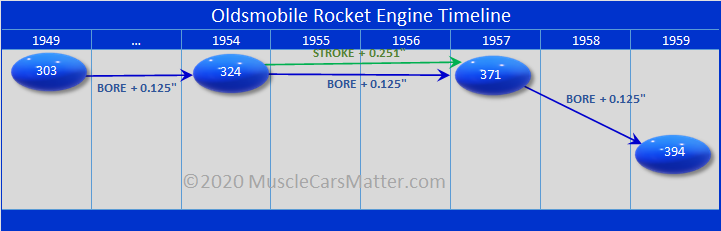
Oldsmobile V8 Engine Highlights
- Introduced in 1949
- Progressive enlargement of initial design
- Nicknamed ‘Rocket’, which was undeniably cool
- Turbocharged aluminum 215 V8 was cutting edge
Pontiac V8 Engines
The Pontiac story is not so different from that of Buick or Oldsmobile. Introduce a V8, bore/stroke it, wait a year, bore/stroke it; repeat as needed. One notable thing was the Pontiac-developed stamped steel, stud mounted rocker arms, the same ones that were given to Chevrolet to introduce on their small block in 1955. Of course, most of the new V8 engines at this time had shaft mounted rocker arms, a design that was more costly to implement. All Pontiac V8s had a connecting rod length of 6.625 in.
215cid V8
For 1961 and 1962 Pontiac offered an optional engine for Tempest, which was the Buick 215cid all-aluminum V8. This provided an option for those who wanted more output than the Indy 4 could produce. When the Pontiac 326 appeared in 1963, the 215 was no longer needed.

287cid V8
While Buick had their 322 and Olds their 303, Pontiac’s new V8 arrived in ’55 with a mere 287 cubic inch displacement. Bore and stroke were 3.75” x 3.25”, with an 8.0:1 compression ratio. Output was 180hp for the 2bbl and 200hp with the 4bbl. Not bad at all, and actually higher than the Olds or Buick engines. So there! Valve sizes were 1.72” (Int) and 1.50” (Ex).

Here’s the unimpressive little Pontiac V8 that started it all, the 287.
317cid V8
Pontiac didn’t let any grass grow under their feet, boring out the 277 the very next year, 1956, to 3.9375”. The 2bbl version was good for 205hp, with 227hp for the 4bbl engine. There was also a dual quad version available, making 285hp with 10.5:1 compression. Valve sizes remained the same.

347cid V8
Well, 1957 was a new year and for Pontiac this meant enlarging their V8 again. This time it was the stroke that increased, to 3.5626”. The result? 347 cubic inches, of course! This was the year that Pontiac would embrace the 3 x 2bbl induction system as their go-to for high output engines. Thus was born the not unique, but certainly famous, Tri-Power. Low output was 227hp and the top version made 290hp with a compression ratio of 10.75:1.
There were also dealer-installed camshafts available. I don’t think very many automakers went this route. 317hp was available if the buyer chose this option. For the Bonneville, there was also a Rochester-built mechanical fuel injection setup. It was similar to Chevy’s, but not identical. For most interested in performance, the Tri-Power was the better way to go. Valves were enlarged to 1.88” (Int) and 1.60” (Ex).

370cid V8
Another year, another engine! Bore was increased to 4.0625”, resulting in the 370cid engine. Valve sizes were unchanged. The engine was given a nickname of the TEMPEST V8, which means the marketing guys must have had some spare time on their hands. The fuel injection setup was offered on any model this year, but the price scared away most potential buyers. The option was dropped with little mention. The time just wasn’t right, yet.

Yeah, walk into your local auto parts store and ask for something to fit your Pontiac 370. Unless the person behind the counter is an old car guy, they might think you’re making crap up. Actually, today you might get the same response with a 389!

389cid V8
1959 saw the quintessential Pontiac engine of the ‘50’s/early ‘60’s, in the 389. Since the bore was increased last year, it was the stroke this year, to 3.75”. Although valve sizes were a carryover when the engine was introduced, they would be enlarged in later iterations of the engine. The Super Duty engines featured larger valves. In addition, SD engines had four-bolt mains, forged crank, forged connecting rods, and forged pistons. These engines were designed literally for ‘super duty’! The NASCAR version used a single 4bbl carburetor, while the NHRA version featured a 3 x 2bbl setup. Camshafts were of the solid lifter type.

We Have Your 31 Flavors!
One thing that was different about the 389 is that there was a butt load (or crap ton, I’m not sure…) of different flavors of the engine, for most of the years of its existence. 1962, for example, there were nine different versions! The compression ratios ranged from 8.6:1 to 10.75:1. Carburetors were 2bbl, 4bbl and Tri-Power, and horsepower levels offered were 230, 235, 251, 267, 283, 303, 318, 333, and 348 hp. Each year there were one or two 2bbl engines, and one 4bbl, with a low compression ratio. This allowed some engine options for the V8 buyer who wanted to avoid the cost of higher-octane fuel. Some of the high compression 2bbl engines for a given year made more power than their low compression 4bbl kin.
Some of the Pontiac engines had some sweet, good flowing exhaust manifolds. I always felt the Pontiac exhaust and intake manifolds were only second to Chevy, in the GM stable.

Pontiac 389 heads featured combustion chambers that were a bit different from others. Note the minimal quench areas.

The rectangular intake ports of the 389 were nicely sized.

The two center exhaust ports of the 389 were ‘D’ shaped.

Okay, these manifolds are from a slightly later era. They do show that Pontiac did offer some well-flowing exhaust manifolds.

421cid V8
The 421 had an interesting history. Unlike its predecessors, it didn’t replace the previous engine. Its first year, 1961, it was a dealer-installed option, as the Super Duty 421. Like the dealer-installed camshafts, it was a bit odd. This was a race-only engine. The following year, ’62, it became a factory-installed engine, but it was still very much intended for racing. It would be 1963 when a street version (non-SD) became available.
The street versions featured both a dual 4bbl setup and a Tri-Power setup. The 421 had a larger main bearing journal size than its predecessors, at 3.25 in. Its bore and stroke were both larger, being 4.094” by 4.00”. The 2 x 4bbl was intended for the drag strip, while circle track cars had a single 4bbl. Valve sizes varied by application. 1.92”/1.66” were the low-po street valves. The Super Duty engines got 2.02”/1.76” valves for ’62 and ’63. 421 heads shared the same design as the 389 heads.


Pontiac 326
The 326 showed up in 1963 (See Muscle Car Era Engines for ’64 – ’67 info.) Although most 326’s would have a bore/stroke of 3.72”/3.75”, the first-year engine had a 3.78” bore. This ‘336’ was still regarded as a 326!
There would later be a 285hp version of the 326, but the engine never possessed any high-output hardware and was not regarded as a high-performance engine.


Pontiac V8 Engine Highlights
- Introduced in 1955
- Single design, constantly enlarged
- State of the art valvetrain design
- Nice use of multi-carburetion
- High performance, race-specific engine variants
- Strong competition legacy
Ford Motor Company V8 Engines
I love Ford. To this day, the only new car I’ve owned has been a Ford. My wife would love to own a 1964 ½ Mustang, since she was born in 1964. I still remember seeing my first Mustang, when I was eight or nine years old.
What I would like to know is exactly who at Ford said “We ought to have three or four different V8 engine families and at least fifteen different engines! Stupid Chevrolet just has a couple, and we’ll kick their asses!” Who? How did this happen? There were so many Ford engines that most Ford enthusiasts can’t keep them straight. And this continued into the muscle car era. Why have a 351 when you can have two? If a 427 is good, a 428 is better, and a 429 even better than that! I’d love to read or hear from someone involved with FoMoCo during this era and learn more about what led to this.
Lincoln Y-Block Engine
Ford, as a company, introduced their first OHV V8 in the form of a new Lincoln engine in 1952. This put Lincoln three years behind their rival Cadillac. While we’re not going to cover those engines, it’s still worthwhile to know something about them. In cars, this engine family was replaced by the MEL engines in 1958, though it would live on in truck applications for six more years.
The family would see six different displacements, the largest of which was 368cid and 300hp. Interestingly, this engine family was more successful as truck engines than it was for Lincoln automobiles, for which it’s named!
The engine blocks were quite heavy and the block walls extended well below the center of the crankshaft. The long walls resulted in the resemblance of a ‘Y’, hence the name.
317cid V8 Engine
The initial flathead replacement arrived in 1952 with a 3.80″ bore and a 3.50″ stroke. The crankshaft was nodular iron and was supported by five main bearings, versus the three bearings of the flathead. The engine saw use through 1954.
341cid V8 Engine
A bore increase of the 317 resulted in the 341. This was a 1955-only engine, making 225hp.
368cid V8 Engine
The 1956 bore and stroke of the 341 gave the 4.00″ bore and 3.66″ stroke of the 368cid engine that would be the last of the Lincoln Y-Block engine family. It would make up to 300hp.

In the table above the 279, 302 and 332cid engines are heavy duty truck versions.

Lincoln Y-Block Series Engine Highlights
- Introduced in 1952
- FoMoCs’s first OHV engines
- 3 years behind Cadillac
- Six closely sized displacements
- Not well documented
- None were landmark engines

Ford-Mercury-Edsel Y-Block Engines
This engine family would overlap with the previous Lincoln Y-Block series, but it would become much more successful than the earlier series.
239cid V8
Ford’s flathead V8 was in desperate need of replacement by the time the Y-block arrived in 1954. The next few years would see a bewildering array of engines from the Ford Motor Company, some seemingly just a few cubic inches larger or smaller than others. The 239 had a 3.50” bore and a 3.10” stroke, with a mild 7.2:1 compression ratio and a 2bbl carb, making a flathead-beating 130hp. One year only.
256cid V8
This engine also arrived with the 239 in 1954, and it, too, would only see use in its inaugural year. Its bore was 3.62″, which was 0.12″ larger than the 239.
Why ‘Y’-Block?
This type of block was specific to FoMoCo. The lower block skirts extended down a couple of inches past the centerline of the crankshaft. If you looked at the engine from the front, it had the shape of a Y, rather than a V, hence the name.
They used this extra material for anchoring some of the transmission bolts. I’m not sure what led to this design, but Ford tried to portray it as being a stronger block. In reality, this extra material contributed only to weight, which was already considerable as these were thick-wall castings.

The Ford Y-Blocks had an interesting intake port arrangement, as you can clearly see from the picture. This was actually advertised by Ford as “promoting turbulence” of the incoming air/fuel charge. Yeah, and small valves are good because…? Clearly, this “better idea” wasn’t successful because it was discarded. I’m not sure what the real reason was for this design, and I suspect they were just making the best of it. I dunno.
Ford’s Better Idea
An advertising campaign in the late ‘60’s was built around the slogan “Ford has a Better Idea*”. I had a Ford sedan in the early ‘80’s, and like most vehicles of its day, it had almost no redeeming values whatsoever. Detroit malaise-era car at its best. (Yeah—Dearborn….) This thing had a stalk on the steering column that had all sorts of functions built into it, including the horn! Don’t know how many times someone cut me off or whatever and I pounded the center of the steering wheel, resulting in a big, fat nothing! This was invariably followed by a curse directed at Ford. It would only be after driving the car for well over a year that I discovered that I had intermittent wipers! I’m placing this squarely at the feet of Ford!
I’m glad they gave up on that “better idea”.

You can see from the table the performance of these engines. Only a couple variants of the 312 made more than 0.8hp/in3, and one of those was supercharged. Wonder why the Chevy small block lived so long and engine families like this died in a decade or so?

Where many V8 blocks extended down only to the crankshaft centerline, or slightly beyond, the Y-block continued on several inches. The rotating assembly was nearly fully enclosed by the block itself. Contrast this with the block of a ‘generic’ Chevy small-block.

Where the Y-block skirts extend way below the crank centerline, Chevrolet took a different approach. As you see here, the skirts stopped at the crank centerline.

Mercury 256cid V8
Blah, blah, blah. One year only. 2bbl carburetor. 161hp. Nothing exciting here, folks.
Ford 272cid V8
This engine was a bore and stroke of the 239. It would live through ’58, with the vast majority of the engines receiving 2bbl carbs and giving “meh” performance. It served as an entry level V8.
Ford 292cid V8
A bore of the 272 resulted in the 292. Both engines were released the same year, so it’s not really accurate to view the 292 as a descendant of the 272. More like a sister. The 292 and 272 shared the same 3.30” stroke. Earlier versions of the 292 would have both 2bbl and 4bbl carbs, with the later versions making due with only a 2bbl. The highest output version would make 212 hp. Of the Ford, Mercury, Edsel Y-Block engines, the 292 would be the last man standing, seeing car engine duty as late as 1962, after the 312 was gone.

Ford 312cid V8
The 312 was a bore and stroke of the 292, and arrived in 1956, just one year after the 272 and 292. It would usually be outfitted with a 4bbl carb and would make 265hp in ’57, with a dual-quad setup, as well as over 300hp as the supercharged engine available in the Thunderbird. The engine would serve through 1960. It was the sole engine of this family to see compression ratios in the nines, and the only one with valve sizes that were anything except “tiny”.

This is the Paxton supercharged version of the 312, which made the Thunderbird one hot model. Interestingly, when teaching their dealers how to compete with Chevrolet, one Ford source claimed that the Chevy fuel injection wasn’t true fuel injection! Wow! And did Ford make their own superchargers? Why, no they did not! That would have given Chevy the ability to address “bolt-on third party equipment” had they desired, but they seemed to have passed on this opportunity.

This is one iteration of a Y-Block head, with closed chambers.
Ford-Mercury-Edsel Y-Block Series Engine Family Highlights
- Introduced in 1954
- Obsoleted the flathead
- 292 would last through 1963
- Mostly smaller displacements
- Odd ‘stacked’ port configuration
- Hard to say that any were ‘landmark’ engines
Mercury-Edsel-Lincoln Series Engines
This engine family came on the scene just four years after the Y-Block, 1958. These engines were intended for Mercury, Lincoln and Edsel cars, nothing else. There were four different displacements, and all blocks shared the now-retired Lincoln Y-block side skirts. Displacements would eventually be 383, 410, 430 and 462cid. The 430 would go on to be the longest lived of the variants, with the MEL series overall being very short-lived. It never became popular with performance enthusiasts and was relegated to service as engines for large cars.
The MEL Series was but one of two different engine series FoMoCo would introduce in 1958, the other being the FE engine series.
The engines used thick-wall castings and were quite heavy. This contributed to their short production life. Also of note was the combustion chamber and head design. It was much like the Chevy 348/409 in that the combustion chambers were in the cylinder itself. The deck was milled 10° off of 90°, somewhat less than the 14° of the Chevy engines. However, where the 348/409 had canted valves, the MEL engines followed the more conventional practice of having them all in a row. Valves were generously sized at 2.09”/1.78”.
Interestingly, all but the 462 were introduced together in 1958.
383cid V8
This engine lasted but three model years, ’58 – ’60. It featured a very over-square 4.30” bore and 3.30” stroke. Not exactly what the engine for a 4,000lb+ vehicle needed. The highest output version had a Holley 4bbl, 10.5:1 compression and made 330hp.
410cid V8
This had a smaller bore and a much longer stroke than the 383, something of a surprise. Bore and stroke were 4.20”/3.70”, respectively. The 410 was exclusive to Edsel, and just for ’58! It made 345hp and 475 lb.-ft. of torque, with a 4bbl and 10.5:1 compression. The designation “E-475” referred to its application and its torque rating.

430cid V8
This was the hot-rod of the group, at least when it was introduced in ’58. With a 3 x 2bbl intake and 10.5:1 compression, it was good for an even 400hp and 500 lb.-ft of torque. Later versions would be detuned, which seemed to be something of a Ford common practice, especially during this timeframe, which saw a Ford focus on mileage and economy. The US was in a serious economic recession in 1958.

As said, the heads were like the Chevy 348/409 in that they were flat to accommodate the combustion chamber-in-block design, but unlike the 348/409, the valves weren’t staggered toward their respective ports. This shouldn’t be confused with ‘canted’. Anyway, they didn’t have the sexy-as-hell W-shaped valve covers, either! The highest specific output of the MEL family was 0.930 hp/cu. in, compared to 1.039 hp/cu in. for the top 409.
462cid V8
This is a 1966 – 1968 engine and is covered in Muscle Car Era Engines.


MEL Series Engine Family Highlights
- Introduced in 1958, along with FE engine series
- 383, 410, 430, 462
- Long side skirts, like Y-block
- Combustion chamber in head, like Chevy 348 and 409
- Short-lived series
- 462 was largest car engine of its time
- Never popular with hot rodders
Ford Super Duty Engines
What!? These are truck engines! Well, yes, they are. How can your engine education be complete if you don’t even know that some automakers had separate engine lines for their trucks? Say your buddies consider you a Ford savant and one of them comes across a reference to the ‘Ford 534’ and asks you about it. You’d look pretty foolish as your mind raced while you tried in vain to formulate an answer. Trust me on this.
It’s pretty simple; the 401, 477 and 534 were the ‘truck-equivalent’ engines that were built with the same M-E-L technology as the car engines of this family. As such, these engines had the same combustion chamber in block design. Compression ratio was 7.5:1 and engines were typically governed to a 3,400rpm limit. Top horsepower was 266hp and torque 490lb.-ft. These were heavy, durable engines that could run all day, every day. Production ran through 1981.

Ford FE Series Engines
The Ford-Edsel series appeared in 1958, the same year the Edsel was introduced. This was also the same year the MEL series of engines appeared. Unlike the MEL series, the FE series engines had conventional wedge-shaped combustion chambers contained entirely within the heads.
These engines were thick wall castings, with block sides that extended below the crankshaft centerline. As such, they shared the main distinguishing characteristic of the Y-block engines, although they were not referred to in this manner. This engine series would be used in cars through 1971 and in trucks through 1976.
332cid and 352cid V8s
The 332, along with the 352, first appeared in 1958. The 352 was a longer stroke version of the smaller engine, and was exclusive to the thunderbird this first year. Both engines shared the generous valve sizes of 2.04” (int) and 1.57” (ex). The 332 was pretty short-lived, seeing service just through 1959.
The 352 was named the Interceptor V-8, with the 4bbl versions being the Interceptor Special V-8. The second year, 1959, names would be changed to Thunderbird V-8 and Thunderbird Special V-8. Of special note was the 360hp version that was available in 1960. Notably, the 352 would exist through the end of this era and into the muscle car era, last appearing in 1966.
An interesting side note is that in 1962 a version of the 352 made 360 hp with a 10.6:1 compression ratio and a 4bbl carburetor. This was 30 hp more than the highest output 351 Cleveland, some decade later. (See the section “Horsepower and Torque” for more discussion about this.
Along with the 390, the 352 was a “corner stone” engine for FoMoCo.


360 and 361cid V8s
This was actually just a single engine. In Edsel cars, it was referred to as the 361, while in trucks it was the 360. Its bore and stroke were 4.0469” and 3.50”, respectively. It can be viewed as a bored 352, sharing the 3.50” stroke of that engine. As the “360”, it would sport heavy duty components and serve as a truck engine from ’68 through the USA bicentennial year. As a car engine, the 361 was hardly more than a footnote.

390cid V8
With the 390, the FE-series engine came into its own. The engine had a bore of 4.05” and a stroke of 3.785”, giving it a modern bore/stroke ratio of 1.07. Valves were 2.04” (int) and 1.57” (ex), the same as it’s smaller series mates, the 332 and 352.
Two of the 390’s highest output versions made 375 hp and 401 hp, the latter with dealer-installed 3 x 2bbl intake. The 390 also saw duty in pickup trucks and larger Ford cars. Little wonder that the 390 earned a reputation as both a work horse engine and a popular high-performance engine. This engine would see the 406, 410 and the 427 come and go, lasting into the 1969 model year.

406cid V8
The 406 was introduced in 1962, when the 390 was only in its second year. This might have been a short-lived engine, but it was significant for one reason; it was the first Ford performance engine that started as a performance engine, and wasn’t a high-performance derivative of a general-purpose engine. The engine had a 4.130” bore and a 3.784” stroke, being a bored 390. Valves were larger, at 2.09” (int) and 1.66” (ex). With 3 x 2bbl induction and 11.4:1 compression ratio, the engine would make a rounded-up 1hp/cubic inch (405hp). Some of the FE engines had wonderful, free-flowing exhaust manifolds that were nothing less than gorgeous.

Engines Magazine Ford 406 Article


The FE engines could be nothing short of gorgeous. Some of the exhaust manifolds were free-flowing works of art. Put two 4bbl carbs on top, chromed valve covers, and sculpted exhaust manifolds, and it’s nothing short of pure art.

What Exactly was Ford Thinking?
Why would Ford introduce two separate ‘big-block’ engine families in one year? The two families shared bore centers and not much else. Two from each family were almost the same displacements as one another. The only answer as to why Ford did this would be that, in having huge expectations for the new Edsel, they wanted to have a low-end family for Ford and Edsel, and then a high-end family for Mercury, Lincoln and Edsel. An obvious question regarding this thought is why Edsel was represented in both families. Here, your guess is as good as mine. Perhaps they wanted flexibility in placing Edsel as the market developed. If you find something that sheds light on this, please pass sit on to me.
Mercury 410cid V8
A 406cid engine and a 410cid engine? Well, yeah. This is FoMoCo, after all. The 410 was a Mercury engine, and this FE didn’t come along until ’66. Still, we’re going to mention it here. This engine was a stroked 390, even using the cylinder heads from the 390. Much more a big-car engine than a performance engine. Yes, there were high performance 390’s, but this 410 had none of those characteristics.
427cid V8
This was the engine. It appeared at the very end of this era and was much more a part of the muscle car era than the pre-muscle car era, but it bears mentioning here. It will get thorough coverage in the Muscle Car Era Engines section.

The number “427” has been a special number for both Ford and Chevy fans, and with good reason. Both engines were at the performance pinnacle of their respective engine lineups and had unmistakable racing heritage. Each elicited murmurs of approval when you popped the hood at the gas station. Both had a “pinup girl” sex appeal that is impossible for most people to understand.
The 390 and 427 shared the same 3.78” stroke, while the bore of the 427 was 4.23”. It’s accurate to say that the 427 was a bored 390, but the 427 blocks were somewhat different than the 390 blocks. Some of the 427 variants had 4-bolt main caps (cross-bolted), in the inside bearing positions (2, 3 and 4). The over-square bore/stroke would result in an engine that loved to rev.
‘Riser’?
Everyone has heard the terms “low riser” and “high riser”, but exactly what do they mean? The low riser was the engine introduced in ’63. Of course, the term wasn’t coined until there was the need to differentiate between two different engine varieties, hence the “low riser” and “high riser”, when the HR arrived in 1964. The next year, ’65, would bring the medium riser (MR).
The LR engine had 2.04” intake valves and 1.66” exhaust valves. The intake valve size would increase to 2.09” in 1964. The engine featured solid lifters and either a single Holley 4bbl, good for 410 hp, or dual carbs, making 425 hp. This was with a rather high 11.5:1 compression ratio. No, these engines weren’t intended to see much “daily driver” duty.

Strongest Block on the Block!
It’s a wee bit ironic that Ford had been touting their Y-block designs as “being stronger”, when in fact, this bore little truth. That is, until the extra-long skirts were used for cross-bolted main caps! The light must have gone on for someone at Ford, that they could actually use these useless skirts for something worthwhile. Thank goodness for that!

Ford 427 Tunnel Port
This brilliant engine was destined for use in the GT40 and in NASCAR. The enormous round ports had the pushrods pass through the center of the Intakes and enabled enormous airflow. High airflow is needed when you make 657hp and 575lb/ft of torque!

Ford FE Series Engine Highlights
- Introduced in 1958, along with M-E-L engine series
- 332, 352, 360/361, 390, 406, 427
- 332 and 406 were short-lived
- Long side skirts, like Y-Block
- Long-lived series, especially 352 and 390
- 390 and 427 were two of Ford’s best engines
Ford 90-Degree Series
This series of engines were the Ford ‘small blocks’, intended to power the new, smaller models such as the Fairlane. They had small exterior dimensions, being significantly smaller than the Chevy small block. They were also manufactured using thin-wall block castings, resulting in an engine that was not only small, but light, too. All three engines share the same 2.87″ stroke.

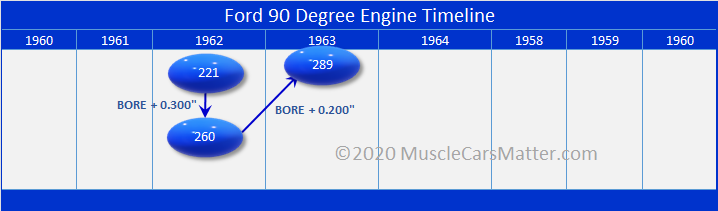
221cid V8 and 260cid V8
These two engines were released together in 1962. The 221 had a 3.50” bore and a 2.87” stroke, while the 260 shared the stroke length, but had a 3.80” bore. Ford obviously rethought the 221, as it lasted only through 1963. After all, it only made a handful more horsepower than the Ford six cylinder.
289cid V8
In 1963, the 260 became the junior V8, with the introduction of the 289. This was a 0.20” over-bore of the 260, resulting in a bore/stroke of 4.00”/2.87”. With a bore/stroke ratio of 1.3937:1, this was one over-square engine. It would be hard to find an engine that’s more over-square than this.
There weren’t any particularly noteworthy versions of the 221 or 260, but the 289 HiPo (K-code) was a little gem. With a Holley 4bbl and moderate 10.5:1 compression, this little screamer made 271hp at 6,000 rpm.
This engine had a higher compression ratio than the garden variety 289, and it also received a hotter cam and a larger (595 cfm) Autolite carburetor. The block was specially selected to be free of flaws, and then received thicker main bearing caps. The connecting rods received larger bolts. The crankshaft was cast from 80% nodular iron, for greater high-rpm reliability. Even the pulleys and fan were designed for high-rpm operation!
The 289 HiPo was targeted for the Fairlane, and was also offered as an optional engine for the Mustang, when it was introduced. A smaller, lighter car with a smaller, lighter high-output engine is a sweet combination. As the decade progressed, and the ‘more cubes are better’ mentality prevailed, small, high revving engines like this were only sold in small numbers. Unfortunately, it’s generally more cost effective to manufacture, and purchase, an engine that makes power at a lower engine speed, thanks to larger displacement, relative to a little high-rpm screamer like the 289 HiPo.
Nodular Iron
Nodular iron isn’t as strong as steel, nor is it as expensive. It is, however, much stronger than regular cast iron, especially being far less brittle. The graphite that’s in cast iron is in the form of flakes in regular cast iron. In nodular iron, the graphite has been forced into spherical structures (nodules), by the addition of a nodulizing element. A metal piece can be X% nodular iron, where X is less than 100. The 80% nodular iron of the K-code crankshaft was verified by polishing an area of it and then examining this area under magnification. Naturally, a high-nodularity iron is more expensive to manufacture than plain old cast iron.


The exhaust manifolds of the 289 HiPo were gorgeous, and were much more free-flowing than those found on lesser versions of the 289.
Primary Sources
- Sessler, Perter C. Ultimate American V-8 Engine Data Book, 1949 – 1974. Osceola, WI, MBI Publishing Company, 1999
- Gunnell, John. Standard Catalog of American Cars 1946 – 1975. Iola, WI. Krause Publications, 2002

