
The record market of ’73 saw a correction this year, by dropping 18.8%. As bad as this was, it was even worse for the performance segment of the market, which by this time was a mostly dead corpse that just twitched every so often.
As we said for the ’73 market, this statement still applies completely:
To be brutally honest, the SD 455 was the sole DNA strand left of the muscle car movement. If not for this vehicle and engine, the muscle car era, as defined by any reasonable standards, would be over.
Total Sales: 8,691,000; change: -18.8%.
1974 Noteworthy Events
- Pontiac – SD 455 Trans Am.

1973 was a big year, so ’74 would of course be a down year. That’s how it works, right? Ford and Chevrolet only experienced moderate declines, with the rest of the main players seeing declines from Plymouth’s 16% to the 39% of Buick.
Chevrolet
Chevrolet had come into the post-war era with nothing of note except a single overhead valve six-cylinder engine that was unimpressive except for the OHV configuration. They were in most years the largest single automotive company in the US, the makers of affordable transportation and conservative vehicles. Chevy, despite having been named after an auto racer, was about as far from auto racing as a company could get. A decade after the end of WWII, that would begin to change and would see the most remarkable transformation of an automotive company as has ever been witnessed. The little caterpillar would emerge from its chrysalis as something very, very different than it was before.
Long Ago…
The totally out of character Corvette and the 265cid OHV V8 would be the first fruits of the ‘new’ Chevrolet. It would not be long before Chevy was to offer several performance engine versions in different platforms, led by Corvette and its stable of >1 hp/in3 engines. This included the most successful fuel injection engines of this era, arguably the only successful F.I. engines of the era.
From this point forward, high-performance within Chevy would be largely limited to Corvette.
Approximate sales: 2,334,000; change: -9.5%; industry rank:1st.
Camaro

The third series Camaro didn’t have the visual impact of the previous series when it arrived, but it was really quite well done. It had the wonderful 5 mph bumpers, but they were not quite as obtrusive as they were with some cars.
The buying public seemed to like the new Camaro, as sales were smartly up over 1973. The 250cid six and 307 V8 were standard engines, with the 245hp 350 serving as the Z/28 engine.

Camaro received a major restyling both front and rear. The front featured a Vega-like egg crate grille and bumper and was a thoroughly contemporary look. The rear no longer had the four round taillights, instead featuring rectangular lights that wrapped around the corners of the fenders as they came to a point. This design allowed them to function as rear body side markers.

Nova

Nova was mostly unchanged from ’73. Regular models (non-SS) now had a Chevy bowtie emblem in the middle of the front grille.

Good old Nova was a marvelous survivor from the early part of the muscle car era.

1962 was the first year for Chevy II and Nova, so 1974 was the thirteenth year. (Do the math. Or ask a sixth-grader.)

Beside seeing a lineup of GM models, you also get a sampling of some of the sweet 1974 clothes styles. There was no such thing as ‘gaudy’!

The staging in this ad leaves me a bit perplexed. We’re at an all-girl’s school…why?

Note, after the first paragraph, the ‘LOOK AND FEEL GOOD AT 55’. Yup, this was early in the era of the 55-mph federal speed limit.

National Maximum Speed Limit
The Emergency Highway Energy Conservation Act was signed into law by Richard Nixon on January 2, 1974. It became effective six days later. This was a response to the Arab oil embargo of 1973, orchestrated by OPEC.
The legislation allowed the federal government to withhold highway funding from any states that didn’t enforce the 55-mph maximum speed limit. Nixon had actually wanted the speed limit to be 50 mph for cars and 55 mph for trucks and buses. Other legislation in the 1980’s mandated the ’55’ on speedometers to be highlighted and the maximum speedometer value to be 85 mph. The NMSL was finally repealed in 1995. Only a small portion of the projected fuel savings was actually realized. The law eventually morphed into a ‘safety measure’, but even the effectiveness of this is in question. Cars became so much safer during this period that it’s difficult to accurately sort all of the variables regarding this question.


Corvette
This was the beginning of the Corvette ‘Dark Ages’. Performance was essentially gone, and Corvette buyers were either harkening back to the past Corvettes they were too young to buy at the time or just interested in the exclusivity and uniqueness of the Corvette. I dunno.
I’m picturing a guy with a few bucks back in ’74 looking at a brand spanking new ’74 Corvette for $6k and a used ’68 for half that amount, or less. Gotta love those plastic bumpers to want to pony up to the counter with your $6k for your new lo-po ‘Vette. The 350cid V8 and 454cid V8 were both available.
You have to remember that this was the era of the Arab Oil Embargo, lines at gas stations and people dumping their large-engine cars everywhere you looked.
Approximate sales: 37,500; change: +18.9%.

To my eye, the ’74 and later Corvettes just didn’t have the look of the chrome-bumper cars, and the ’73 and later cars certainly aren’t as highly regarded as the earlier cars are. The loss of the high-compression performance engines likely had something to do with this. It would seem, though, that the regard at the time was high for the ‘new’ Corvette, as sales rose each year since 1970.

Corvette for ’74 now sported body-colored covers on both front and rear bumpers. This created a contemporary look which might have might have been part of the reason for the 18.9% sales gains over 1973 levels.


Not much to brag about in ’74. I do like the statement “If you’ve wanted a Corvette since you were a kid, you’ve waited long enough”. Corvette had been around long enough that some buyers had indeed wanted one since they were a kid.


Buick
Performance was but a memory at Buick. All that was left consisted of a few terms that would have been better off left behind with the high-compression engines. Frankly, it was a bit embarrassing. But again, this was a period of adjustment and trying to discern the future in a market beset by so many adversaries.
Approximate sales: 495,000; change: -39.7%; industry rank: 6th.
Riviera


Riviera remained an attractive car, but in going away from the boat-tail styling, it lost much of the earlier distinctiveness that it seemed to possess from its very beginning in ’63.

Here’s the front of the ’74 Riviera, in all its glory. See what I mean about some models of this era being a bumper with a car attached? Not that the ’73 was any better in this regard. It looks like the stylists grabbed an intern (or 6th grader) and said “Put a bumper on this sukka!” Then, the intern (or 6th grader) had a railroad tie chromed and bolted it to the front of the wonderful Riviera.

Here’s the ’73 front-end, looking the world like the ’74 front-end.

In what has to be regarded as a ‘WTF’ moment, Buick designers decided they had to get rid of the cool, attractive boat-tail rear.

These weren’t bad looking cars. Maybe the Colonnade style was the best that could be done in lieu of an actual hardtop. Imagine these models with the integrated color-coded bumpers that Corvette had!
There was a $96 Apollo ‘GSX’ trim option, which seems like sacrilege. There was also a ‘Stage 1’ option for the Century. Ugh, Buick!


Oldsmobile
Oldsmobile faired about as well as Buick in the performance arena. That’s to say that there wasn’t really much interesting. Of note, though, was the Hurst/Olds W-30, which was the Indianapolis 500 pace car for ’74. It featured the top 455, making 275hp net. Of note, though not performance related, was that the three-speed manual trans was now standard on only the little Omega, with a Hydra-Matic auto standard on the rest.
Approximate sales: 581,000; change: -37.1%; industry rank: 4th.
Hurst/Olds

Maybe it was different than before, but it was still a nice-looking car. The white paint with gold stripes was the natural choice for the H/O.

The 1974 Hurst/Olds sold in small numbers, not that previous editions didn’t. The base engine was a 350cid V8, with the 455 being available with the W30 option.


I can’t believe they’re using the term ‘little limousine’ here, but they are!
It’s nice to know that in this era of ‘meh’, the ad guys can still toss out a big pile of warm poo once in a while.

Another of the disguised Novas that so many hundreds of thousands of people bought. What was the standard transmission with Omega, here in 1974? Why, a manual three-speed, of course!


Pontiac
This is really the story of the Pontiac Super Duty 455 engine, as installed in a relative handful of Firebird Trans Ams and Formulas. What was said of the ’73 Pontiac SD cars is doubly true of the ’74: This was the last muscle car engine and the last of the ‘true’ muscle cars. It all revolves around this marvelous engine.
There were approximately one thousand Firebirds sold with this engine in 1974, over three times the ’73 sales. The reasons for that probably lie in the fact that Firebird overall sales surged in ’74, after tanking the previous year. The SD-455 is perhaps the most unlikely engine in automotive history. There was no reason for it—automakers had accepted the end of the muscle car market and were looking elsewhere for sales. This was a project that wasn’t going to generate anything resembling significant profits and it was obviously not going to lead to anything in the future. What was the purpose of the SD-455? I guess it was done because it could be!
Super Duty 455
Some have said that it was a rogue group of Pontiac engineers who weren’t willing to throw in the towel on the muscle car market just yet. All of the earlier key players like John DeLorean, Jim Wangers, Bunkie Knudsen and Pete Estes had all moved on to other departments or companies.
The term ‘Super Duty’ harkens back to the late ‘50’s and early ‘60’s, when Pontiac was involved in racing. They had quite a bit of success on the drag strips and circle tracks. This was a suitable and appropriate term for these engines.
The SD-455, as with its earlier progenitors, was built with all of the finest components—forged pistons and connecting rods, and a nitrided crankshaft. The valves were huge, and the ports were both large and well designed. The only concession was the mild compression ratio; it still was required to run on unleaded gas, after all.
Nitrided?
Nitriding is a heat treatment process that infuses nitrogen into the surface of a metal to make it significantly harder. This can be done on steel, titanium, aluminum, and molybdenum. With automotive engines, crankshafts, camshafts, cam followers and parts of valves are often treated in this manner. Each N atom distorts the iron[steel] atomic lattice sufficiently to resist the movement/progress of dislocations. Dislocation movement is the way metals deform, so the addition of N to metallic lattice resists the metal’s distortion and increases it’s ability to accommodate stress, before it permanently deforms, which we measure as its strength. Strength is related to hardness, and is a true measure of the metal’s lattice ability to resist the pressure as applied by a hardened indenter on the metal’s surface.
Gas Nitriding submits the heated metal surface to a source of Nitrogen, often in the form of ammonia (NH3). The nitrogen disassociates from the hydrogen and penetrates the metal surface.
Plasma Nitriding uses intense electric fields to put the nitrogen in an ionized state, thus creating a plasma. This does not require the elevated temperature of the metal part being nitrided that gas nitriding does.
The ’74 version of the SD was rated at 290 net hp, a 20hp reduction over the ’73 engine. This was due to a less aggressive camshaft. This change was implemented to establish more of a margin in respect to emissions testing. While the ’73 engine did pass emissions testing, it was felt that more of a margin was desirable.
Both the ’73 and ’74 versions of the engine were designed for dry-sump lubrication. The engine was immensely tweak-able, and 400+ net horsepower was easily within reach. Further information on the SD-455 can be found in the Muscle Car Era Engines section.
As with the ’73 SD-455 cars, a ’74 SD could run the quarter mile in less than 14 seconds.
Approximate sales: 580,000; change: -37%; industry rank: 5th.
GTO
The ‘GTO’, such as it was, existed as a $195 option for the Ventura or Ventura Custom. This gave you the 350 4bbl V8, minor suspension mods, front and rear drum brakes, and a 3.08:1 rear-end. Let’s not forget the shaker hood scoop and the floor-shifted manual 3-speed. Quarter mile time was 14 sec. Wait—just kidding! That was more like the 0 – 60 time! Let it go, Pontiac; just let-it-go.

Trans Am

Pontiac got a new front end this year, after wearing the previous nose for four years. The previous design will always be regarded as ‘classic’, but I have to say that the new ’74 really looked fresh.

This body style looked good in just about any color, but in Buccaneer red it was drop-dead gorgeous. I’ve always loved the ’70 – ’73 front, but you know, the ’74 styling has something going for it. (Sure, it’s the year I graduated high school, which might color my view. Best six years of my life.)

The rear view of this beauty was every bit as appealing as the front.


The ’tilted back’ grille was obviously different from last year, but what might not be as obvious is the different treatment of the headlights. The bezel around the headlights was also tilted back in the same manner, which further added to the look. Firebird sales were on the upswing this year, which contributed to the continuation of the series. In fact, Firebird sales reached almost 8%, well above the 5% or so of recent years, but still far short of the peak year of 1968 with its 11.8%.
Grand Prix

Looks like everyone is wearing the classic Pontiac Rallye II wheels, here. Doesn’t anyone have the cool honeycomb wheels?

In ’73 the body-colored divider that separates the grille halves was larger than it would be in ’74. The grilles themselves were moved out at the center to become more angled. I like the changes.

The ’73 Grand Prix had horizontally aligned taillights, which would become vertical in 1974. Also, the license plate was moved up from the bumper to the back of the trunk lid.

‘Part engineering. Part soul.’ Yeah, I’d say that’s pretty accurate, right?

The last iteration of the GTO, at least the GTO option. You could get a Ventura or Ventura Custom with the GTO option. The $195 cost (2021$ – $1,165) for this option got you the 200hp 350, non-functional hood scoop, floor-mounted manual three speed, 3.08 geared rear end, power steering, front and rear sway bars and drum brakes on all corners.


Dodge
Dodge soldiered on for 1974. Charger sales were down substantially from the high numbers of last year. This would be the last year for Challenger, selling just over 16,000 units. The top engine remained the 440 Magnum, with the most potent version making 275 net hp.
Approximate sales: 477,700; change: -28.1%; industry rank: 7th.
Challenger

In this, its last year, Challenger would see no changes.

Charger

The popular Charger continued through ’74 with just minor changes front and rear.

Yeah, I know that Dodge had to do this with the three models, as Charger was their sole midsize. But, hey, they still offered a hardtop!

When was the last time you saw an automaker bragging about a 2.94 rear end? Let’s go land speed racing! But, hey, you did get a floor-shifted four speed trans! Gosh, I still can’t get over the 2.94 gears. I mean, 2.94:1!


Not an advertisement, as such, but still a nice picture of the 1974 Dodge Challenger.
Plymouth
This was the last year Plymouth was able to offer anything resembling performance. After 1974, Plymouth performance would consist of a 235 net hp 400 V8 motivating a 3,800 lb. vehicle through 3.23 gears. Ugh! Top engine for ’74 was the 275 net hp version of the 440cid V8 installed as an optional engine in Satellite. Speaking of Satellite, ’74 was its last year, as it was also for Barracuda.
Approximate sales: 739,900; change -16.1%; industry rank: 3rd.
Road Runner

This isn’t the Road Runner that first comes to mind, but it’s still an affordable performance car, in the image of the original.
Duster


Didn’t Duster continue to show clean lines and nice styling?


Plymouth is advertising the quietness of Satellite here. Come to think of it, Wasn’t Chevy marketing the quietness of their ‘dual panel’ top at this same time? I don’t know if this means that quietness was on the minds of car buyers, or if this was just the latest attempt of manufacturers to differentiate their products, with either real or imagined features and differences.


Ford
If you don’t count Mustang II as a ‘Mustang’ (most don’t), this was the first of five consecutive years without a Mustang. There hadn’t ‘not’ been a Mustang for a decade.
Mustang II
The Mustang II isn’t generally fondly remembered, and few have survived. You could build a strong argument, though, that it was the right car at the right time. Domestic automakers, Ford included, had long been content to build cars that got larger each year, while throwing crumbs to the economy car market, thinking “We have that segment covered”. Mustang had strayed away from its pony-car roots, and this car brought it back. Remember, Mustang was far more than a muscle car. It was immensely popular before it became a muscle car and would have been a successful product even had it not moved into the muscle car arena. Yes, in a couple of years there would be the hideous badge-engineered King Cobra muscle car wannabe, but one can overlook that misstep. First year sales for Mustang II were a solid 386,000. This would drop by 50% for ’75, but it still remained a popular vehicle.
It’s undeniable that the oil embargo aided the sales of Mustang II. Even without this assistance, it still would have been a successful car. GM responded with Chevy Monza and its clones, Buick’s Skyhawk, Pontiac’s Sunbird and the Olds Starfire. The easing of the oil embargo lessened the focus on small cars somewhat, and the short-lived Mustang II would be replaced by the new for 1979 Mustang based on the fox platform, introduced in 1978 in the Fairmont.
Approximate sales: 2,179,800; change: -7.2%; industry rank: 2nd.
Gran Torino

Can anyone say ‘Starsky and Hutch’? How many Torinos of this era were painted in this color scheme? I’d bet the number was in the hundreds.


The ’73 Torino grille was different than the ’74, but there wasn’t much else changed.
Starsky and Hutch
This show ran on ABC from 1975 to 1979, which accounted for 93 episodes. One of the three stars of the show (along with detectives Starsky and Hutch) was the red Ford Torino with the custom ‘vector’ striping.
Several different Torino’s were used during the show’s run, often two or more at the same time. They were ’74, ’75 and ’76 models, powered by various 351W’s, 400’s and 460’s. It’s said that you can spot the different cars, even within a single episode, by noticing such things as exterior mirrors. Who would have thought that this car would spawn such a cult following?
I’m sure you’ve seen cars on television screeching tires on dirt roads and all that. Well, S and H had engine noises dubbed in, as the cars that were used just didn’t sound muscular enough!
Paul Michael Glaser (‘Starsky’) was said to have had a serious dislike for the Torino, having desired a Camaro. The show’s production company had a contract with Ford, thus the Torino.

Mustang II hasn’t fared all that well in reputation. Ford made some miss-steps, certainly, but it could be argued that this was the right car at the right time. Mustang, in its previous (’71 – ’73) version had grown too large and had lost its direction. The 1974 Mustang II was really a returning to its roots: sporty looking, smallish, and distinctive. Ford sold a ton of these cars through 1978.
It was indeed based on the Pinto platform but had an added subframe and other measures intended to make it quieter than the Pinto.
Mustang II sold 386,000 copies in 1974, 188,600 in ’75, 187,600 in ’76, 153,000 in ’77, and 192,000 in 1978, its last year.


Ford really, really, really should have let the ‘Mach I’ name go. This year it was essentially meaningless, being powered by a six-cylinder engine. Good grief! Lastly, I’m wondering why this big oaf has not one, but two ladies vying for his attention. Is it his curly locks? His cool jacket? It couldn’t be his new Mach I, could it?


More FoMoCo Rating Silliness
Many FoMoCo engines this year had horsepower ratings that were very close in value. For example, the 302 had engines rated at 135, 136, 137 and 138 net hp, all at 2,800 rpm. We’re listing just one of these engines, rather than allowing things to get messy. Check ‘Ultimate American V-8 Engine Data Book’, Peter C. Sessler, ISBN 0-7603-0489-0, MBI Publishing Co, Osceola WI.
Mercury
Mercury didn’t see declines in sales as deep as most of the other automakers, but their 16.9% decline did exceed that of mamma Ford. The 429 was gone, but its sister the 460 was still around. That extra torque might come in handy with the Cougar, which had totally shed it pony-car roots, now weighing in at over two tons, like all of the Mercs with the exception of Comet (which was actually a Ford anyway…). Interestingly, the sales slide of Cougar, which had started after the peak introductory year, rebounded this year with substantial increases. The only Cougar available was the XR-7, as there was no ‘regular’ model this year.
Approximate sales: 404,000; change: -16.9%; industry rank: 9th.
Cougar XR-7

Cougar bore a very strong family resemblance to Montego, Monterey and Marquis.

The rear of the trunk deck sloped down more gently than it did in 1973. The rear styling of Cougar was now more like other large Ford/Mercury’s.

The grille on the ’74 Cougar was a bit different from the ’73, seen here.

The taillights having the bumper wrap around them was kind of a cool look but didn’t lend itself well to 2 1/2 mph impact survival. For 1974 it would take on a more conventional design.
Comet

Aside from the small Comet, all Mercury models were well over two tons in weight. Comet accounted for almost one third of Mercury sales.

Cougar had morphed into a sporty luxury car. And why not? So many other makes and models had decided to take this route.
Crap! We’re Out of Oil!

This is from the April 1974 Popular Mechanics. It reflects the level of absurdity that was reached during the 1973 – ’74 energy crisis. Vehicles like this were being proposed as ‘solutions’ to the high price of fuel. Along with these ‘car-bikes’, there were also small electric cars that were limited to under 30 mph or so and had maybe 50 mile ranges. For the ultimate in economy, there were four-person pedal-powered ‘cars’. Can you imagine four average people in a pedal-powered car? That would make an interesting video, especially if a moderate hill is involved!


Well, to save you from having to imagine the absolute pinnacle of early-70’s ‘gas is so expensive’ dumbassery, here’s a May 1974 issue of Popular Mechanics that treats these pedal cars as legitimate forms of transportation. It might surprise you (or not, you’re no idiot) that the years 2010, 2011, 2012, 2013 and 2014 saw gas prices, adjusted for inflation, that were higher than those of 1974! But unless I missed something, this five year period didn’t have the sheer level of crazed, desperate people grasping at whatever stupid ‘solution’ came along.


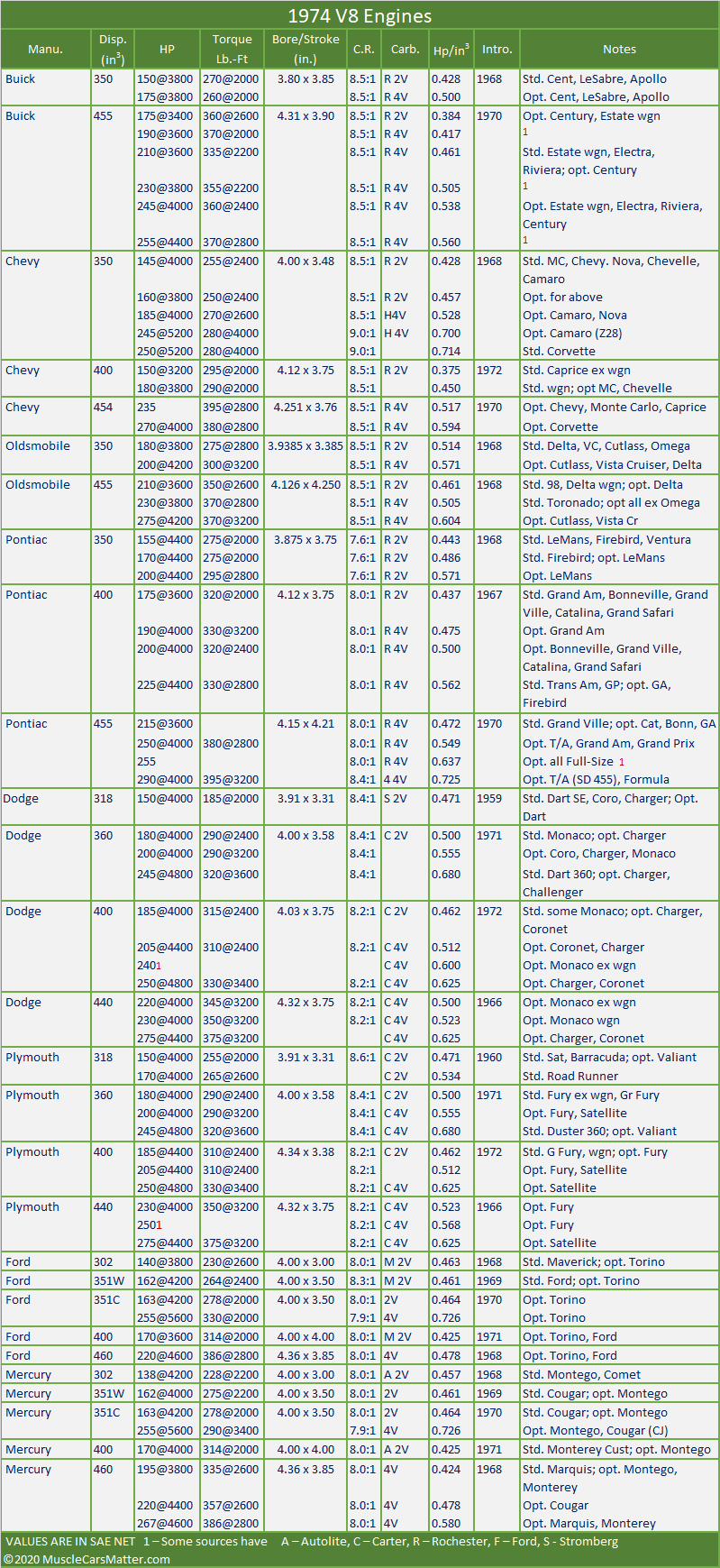
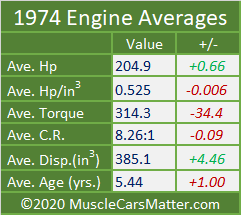
1974 V8 Engine Specs
1974 Newspaper Ads

I think I’ll go with the ’68 Firebird, please.


A couple of 4-4-2s, one of which is a convertible.

Yeah, the ’70 Challenger is my choice.
Very Miscellaneous
I ran into the following gem when I was looking for ’74 car ads. The story follows the picture.

Back in the ’60’s and ’70’s my mother would often say: “Jeane Dixon says…”. Jeane Dixon was a popular ‘psychic’ of the time. I’ve always had a healthy mistrust of such things but have tried to keep an open mind. It would be years later that I learned the true story of Jeane Dixon.
This Wikipedia paragraph kind of gives you the a taste of this lady:
Dixon was born Lydia Emma Pinckert, one of 10 siblings born to Richard Franz Pinckert, a native of Gräfenhainichen, Wittenberg, Saxony-Anhalt, and his wife, Luise Johanne Emma (née Graefe), both Roman Catholics. Dixon was born in Medford, Wisconsin, but raised in Missouri and California. Her birth date was often reported as 1918, and Dixon would proffer this date to reporters, at one point even producing a passport to this effect, but she once testified in a deposition that she was born in 1910. An investigation by a reporter for the National Observer, who interviewed family members and examined official records, concluded she was born in 1904.
Math Doesn’t Lie!
Another Wikipedia paragraph captures the true essence of Ms. Dixon:
John Allen Paulos, a mathematician at Temple University, explored the tendency of Dixon and her fans to promote her few correct predictions while ignoring the larger number of incorrect predictions, naming this habit “the Jeane Dixon effect.”
Many of Dixon’s predictions proved erroneous, such as her claims that a dispute over the islands of Quemoy and Matsu would trigger the start of World War III in 1958, that American labor leader Walter Reuther would run for president of the United States in the 1964 presidential election, that the second child of Canadian Prime Minister Pierre Trudeau and his young wife Margaret would be a girl (it was a boy), and that the Soviets would be the first to put men on the Moon. (End quote)
Jeane Dixon made hundreds of thousands of dollars from books and syndicated newspaper columns, such as the one here. She claimed her revelations were from God. This sounds a lot like Ken Copeland, Jessie Duplantis, Jim Bakker, Benny Hinn, Peter Poppoff, and Creflo Dollar. What differentiates Dixon from this list of human debris is that each one of them made tens or hundreds of millions of dollars, not the ‘pocket change’ that she did.
(Sorry for the rant. I just really, really despise people who make fortunes off of the frailty and the hopes of others.)

