
The 1953 U.S. automobiles saw a good year. Most companies saw sales increases of over 50%. The independent companies, Hudson, Nash, Studebaker, Kaiser and Henry J were down sharply; only Packard bucked this trend. The war in Korea came to an end in July.
The fiberglass-bodied Chevrolet Corvette debuted this year, powered by a Blue Flame six-cylinder engine. It didn’t make any big waves, and would teeter on the edge of failure, until the Chevy small block V8 gave it the power it needed to ignite its popularity. Approximate total sales: 6,081,000; change: +55.9%.
1953 Noteworthy Events
- Buick –New 322cid OHV V8! Power brakes and air conditioning.
- Chevrolet – Corvette! 1-piece windshields; Bel Air.
- Chrysler – PowerFlite trans, 1-piece windshields, power brakes, air conditioning.
- Dodge – 241cid hemi-head V8; 1-piece windshield; air conditioning.
- Oldsmobile – Air conditioning, 12V electrical system, power brakes
- Pontiac – 1-piece windshield, power steering.
- Ford – Power steering, power brakes.
- Mercury – Power steering, power brakes.
Wow, what a year! The only ones not having a great sales year were most of the independents. The decade of the ’50’s would be a hard one for this group of companies.

This was a huge year in the auto industry with all of the major players seeing sales way up over 1952. Ford saw an 85% increase in sales, which is almost unbelievable.
Chevrolet
The 1953 Chevrolet models no longer had the Styleline or Fleetline designations. Models were the Special 150 series, the Deluxe 210 series and the Bel Air. Previously the name Bel Air referred to a body style, whereas now it was more or less just a trim level. Changes seen were to the grille, which went from five teeth to three, larger teeth, and to the windshield which was now one piece. Rear fenders were squared, and the hoods were now flatter and lower, as were the trunks. One-piece windshields were seen this year.
The 216cid six was retired, which was fine, since it was a product of the mid ‘30’s. The Powerglide version did pick up 10hp. Power steering was available this year.
Approximate sales: 1,346,000; change: +64.5%; industry rank: 1st.

This was an attractive look, but I think I actually prefer the ‘5-tooth’ look of last year, over this ‘3-tooth’ look.

Tail lights got larger and rear fenders were now squarer. The wraparound rear window itself added a lot to the look.
Corvette
Though one might be tempted to say that Corvette was the big news, that really wasn’t true. These handmade, fiberglass-bodied cars sold a mere 300 copies. The car had no side windows and no outside door handles. Yeah, it would be fair to call it ‘crude’. The buying public was underwhelmed.

Corvette was inspired by small European sports cars and featured a fiberglass body on a rather ordinary solid rear axle auto chassis. The 150hp Blue Flame Six drove the rear wheels via a two-speed Powerglide automatic. It had a soft top, plastic sheets rather than side glass and no exterior door handles.
While the fiberglass body was certainly unusual (though not the first), underneath was pure off-the-shelf Chevy hardware. Before the name was assigned for the car, it was known by its project name, Opal.
Do you like options? The ’53 Corvette had three: heater, AM radio and white sidewall tires. The radio was $145 ($1,402 – 2019$), and the heater $91 ($880 – 2019$).

This is a picture of the 1953 General Motors Motorama, held Jan. 17 – 23 in New York City at the Waldorf Astoria hotel. The interest expressed by the attendees convinced Chevrolet that creating a production vehicle was viable. Production started June 30th of that year.
Harley Earl, the design head and eventual vice president at G.M., is said to have been impressed by the small European sports cars of post-WWII. He offered the project to Chevrolet, who gladly accepted. Earl was actually the person who conceived the idea of the concept car.
The First Corvettes
You may already know that Chevy named Corvette after a class of ship. To quite Paul Harvey, here’s ‘the rest of the story’.
Corvette was a class of small British warships that had been used in the north Atlantic during WWII. I’ve read the general design was based on whaling ships, but I haven’t been able to verify this. The size and their broad width allowed them to handle about any sea conditions, making it difficult for German U-boats to use rough weather as a cover. These ships were submarine hunters.
Early in the war the U.S. was still frantically building its warships and didn’t have an available solution for the German U-boats. Remember that we were supplying Britain before we actually entered the war in December 1941, and convoys enroute to Britain were savaged by U-boat wolfpacks. Britain provided Corvettes to the U.S. and allowed ones under construction to be diverted to the U.S. If you had to choose a boat class name for a car, ‘Corvette’ was a great choice.

Yes, indeed, this is a corvette, a Swedish stealth version of the ocean-going variety. This 640-ton ship can do 35 knots. You can do that when you make around 25,000hp!
Was Corvette really the First American Sports Car?
The short answer is ‘yes’, in my opinion it was. The longer answer, as always, is more nuanced.
Corvette wasn’t really an original concept. It was clearly influenced by the European sport cars of the 1940’s and 1950’s, especially those of English origin. The idea of a domestically manufactured sport car of this type seems natural given that the U.S. had some two million troops in Europe just a handful of years earlier. Men in their twenties were also a key demographic for this type of car.
This reality was obvious to a good number of people, and there were pre-Corvette efforts to capitalize on this. Some were more successful than others, but it would take the resources of a large automaker, backed by an even larger parent company, to see success, and then just barely. In the first handful of years Corvette’s success was anything but certain.
Chicagoan
This fiberglass-body car was manufactured in Chicago (surprise!) from 1952 to 1954, was Willys six-cylinder powered and was available in kit form or fully assembled. At a cost of $2,500, only 15 found homes. It seemed to garner a lot of press coverage at the time, and one can reasonably assume that it failed for the same reason as other new automotive ventures at the time – lack of resources.
Crosley Motors
Powel Crosby started his automobile company in 1907 but experienced limited success. He then turned his attention to consumer electronics (radios) and appliances, where he was enormously successful. He must have been quite a guy to pull this off!
Crosley returned to the automotive market in 1939, which revolved around his belief that a small inexpensive car would find eager buyers. I’d have to say that he was more right than not. Production was interrupted by WWII, but 1946 saw Crosley Motors’ return to the automotive market with two models priced below $1,000 and weighing about 1,150lbs.
1949 saw the redesigned lineup feature a two-door roadster, which some would nominate as the first domestic sport car. Like all Crosley’s the car was powered by a 44cid inline four-cylinder making 26.5hp. Yup, 26.5hp. While its output was truly unremarkable, what was really interesting about this engine is that the block was made of sheet metal, weighing all of 14 pounds! This was referred to as CoBra, for ‘Copper Brazed’. Why? Because it was! Copper brazed, that is.
A new engine this year was the CIBA or Cast-Iron Block engine. It had all of the same specs, except for weighing more. 1952 would see Crosley ending production in July.
Cunningham
Briggs Cunningham would manufacture a small number of roadsters from 1951 to 1955. The only price I’ve seen for the Cunningham is $9,000 in 1953, which is $100,800 in 2022 dollars. One has to question just how serious old Briggs was in actually selling cars!
Darrin
Howard “Dutch” Darrin had been a WWI pilot and desired to market a sport car of his own design. Darrin was a designer for Keiser-Frazier and convinced them to manufacture these fiberglass-body roadsters, selling about 450 in 1954.
1955 was the end for Kaiser-Frazier, and Darrin was able to secure the remaining unsold bodies, pairing them with various engines and selling about fifty a year through 1957 or 1958.
Others?
There were other pre-Corvette attempts to manufacture and market roadster type sport cars, but the above stand out. I don’t consider any of these models as really having ‘gotten off the ground’ like Corvette did. Sure, others had parts of the formula right, but it took Chevrolet and its resources to weather the early storm of low sales and prevail long enough to reach success.
It occurred to me that this was a lot like the Wright brothers, regarding the question of the first airplane. Others had put some of the elements in place, but it took Orville and Wilber to put it all together into a form that was successful and would lead to manufacture of a product.
Corvette Brochure


Can you say “jet influenced design”? Heck, it even had wings!

High Compression?
Here we have Chevrolet touting their increased compression ratios. All the way up to 7.5:1! Then they tell you how easy driving will be with those extra ten big horses!
Well, come to think of it, I’m not sure what else they would promote…
Higher quality (octane) gasoline was becoming increasingly available, allowing compression ratios to increase. This, of course, did allow the production of more horsepower, but it’s undeniable that automakers pushing this at this time were making way more of it than it was worth to the average driver.
Yeah, 10hp is going to transform my entire driving experience!
Note the cable car chasing the Chevy up the hill.
This is a cool drawing. Maybe downtown Des Moines, or someplace like that? I was never really good with geography.
Cable Cars
Cable cars have been in existence for almost 200 years, originating in England. There were once many U.S. cities that had such systems, including Seattle, Chicago, New Orleans, New York, Washington D.C. and others. Most were replaced prior to the 1930’s, with Seattle being the last U.S. city to cease operation of theirs in 1940. San Francisco is the sole operator of cable cars in this country.
Cable cars operate by gripping a cable that is moved on pulleys below the roadway, with the car accessing the cable through a slot between the tracks. The cable moves at a constant speed of about 9 mph, powered by a central facility. To stop, the car simply releases its grip on the cable. Since the car wheels don’t need to grip the track at all, cable cars can move up or down really steep inclines. Interestingly, and estimated 95% of the energy developed by the central motor facility is consumed just moving the cables over their pulleys and other supporting and guiding structures.

Here are the fun bits of a cable car system that you don’t usually get to see. Though the principle is the same, I bet this part of the system looked a lot different two hundred years ago!

A rather interesting advertisement for the new Corvette.
Given the low sales numbers in the first few years, I’m kinda doubting that it was actually a ‘sensation’. It wasn’t really revolutionary, but it would be!


Undoubtedly being an inquisitive soul, you might wonder where the ‘150’ and ‘210’ designations came from. They are the first three digits of the four-digit model numbers.

Buick
For 1953 Buick models remained Special, Super and Roadmaster. The models retained the new-in-‘51 waterfall grilles. Sheet metal was largely unchanged.
A 3-speed manual transmission was standard on the lower two series, with the Dynaflow again optional, but standard on the Roadmaster. Dynaflow went through the first of what would be many design changes this year. The earlier design had used two turbines and two stators, while the redesign used two turbines and a single stator, and was christened ‘Twin Turbine Dynaflow’. Confusing, eh?
New 322cid V8
The big news was the new 322cid OHV V8 engine. It came in a 164hp version for the Super and a 188hp version for the Roadmaster. The Special soldiered on with the 263cid straight eight. The Roadmaster’s hoods were shortened to emphasize that the new V8 was much shorter than the older straight eight. Air conditioning and power brakes became available this year.
Both engines, when installed in Specials or Supers with Dynaflow, had bumped compression ratios and an additional 5hp or so. Air conditioning was an option this year for the 50 and 70 series and power steering was offered.
Approximate sales: 488,000; change: +60.5%; industry rank: 4th.

Here’s the Riviera model of the Special. Riviera was a 2-door hardtop. Look at that bumper and grille; to me, this era Buick seemed to have a really heavy looking front end.
A member of the Roadmaster series was the Skylark Anniversary Convertible. At $5,000, Skylark was $1,000 more than any other Roadmaster model.


The greatest Buick in 50 years. Sorry. ’50 great years’.
This advert hit the high points—Buick’s engines, Dynaflow transmission, available power brakes and power steering.
You should keep in mind that at this time, there were still a lot of men who were of the mindset that driving was too much work for a woman, especially with a non-fully-synchronized manual transmission. But now, with the Dynaflow, that was no longer a consideration. And with the aid of power steering and brakes, this argument became invalid. (Invalid, as if it ever was valid…)
Regardless, one thing that was undeniable is that driving a car could now be far less physically taxing than it had been in the past.


Oldsmobile
The Oldsmobile lineup for 1953 remained Deluxe Eighty-Eight, Super Eighty-Eight and Ninety-Eight. Few significant changes were seen. The middle series, Super Eighty-Eight, outsold the other series by far.
Trans offerings were a 3-speed manual as standard equipment, with the Hydra-Matic optional in all models.
Air conditioning was offered this year, as “Oldsmobile – Frigidaire” air conditioning, a $550 option. That’s right at $5,200 in 2018 dollars!
(I have always loved the name Frigidaire. You have your “frigid”, which is way cold, and your “aire”, which is “air” with an extra “e” for class. What a cool name for products that cool or refrigerate! Whoever came up with that name ought to have a building named after him!)
Electrical systems changed from six volt to twelve volt this year.
Approximate sales: 334,000; change: +56.8%; industry rank: 6th.

Here’s the stunning Olds Fiesta. At $5,715 ($55,290 – 2019$), it was over twice the cost of any other Oldsmobile model. This thing came with just about every option you could want.
Speaking of options, how about hydraulic window lifts and seat adjusters? Hydraulic . . . !

This year the fire that destroyed the GM Hydramatic plant in Livonia, MI, caused some Olds models to be equipped with Buick Dynaflow automatics.

Here is Olds selling their styling. All in all, a pretty run-of-the-mill advert. Not bad, just not noteworthy.


Pontiac
For 1953, Pontiac models were again based on the Chieftain series. The subseries remained Special, Deluxe and Custom, both in six and eight engine configurations. Although bodies were new, but it was kind of hard to tell, at least to 21st century eyes. Windshields were now one-piece, the rear windows were of the wraparound type, the grille was tweaked a bit, and the horizontal sheet metal, particularly the hood, continued the trend of becoming flatter. The side sweep-spears were new, being a bit reminiscent of a stylized “T”. Power steering was made available this year.
As in ‘52, the 3-speed manual with column shift was the standard transmission. The Hydra-Matic four speed automatic transmission was available optionally. The 239cid six gained 16hp, due in part to an increase in compression ratio. The 268cid eight was unchanged. Wheelbases were increased two inches. Additionally, Some models were shipped with Chevy Powerglides due to a catastrophic fire at the Hydra-Matic factory.
Approximate sales: 418,000; change: +54%; industry rank: 5th.

*Don’t have a fit. It’s a Chieftain, but since it was sold in Canada, it was renamed. Maybe they were more sensitive to their indigenous population than we were, I dunno. Come to think about it, seems that Canadians are at least a bit nicer than us Americans are.


“It Does Everything Superlatively Well!”. This advert isn’t much different than the dozens of others from all of the automakers.


A Sweet Option

This has been referred to as a “Thermaster Refrigerator”, though I don’t know if Pontiac ever referred to it as such. It’s actually an ice chest, a.k.a. “cooler”. Unsurprisingly, this was dealer installed!
Chrysler
Chrysler came into 1953 with new sheet metal that continued the trend toward flatter surfaces. Side sweep-spears were changed to a two-piece design, with a traditional line that went from below the headlights to the middle of the front door. The second piece was a sill molding that went straight up at the rear wheel well, like a gravel guard; it then went straight back across the top of the wheel well, to the back of the car. The effect was attractive. The grilles were a new design, with three strong horizontal elements.
Windshields were now of the one-piece design. Air conditioning and power brakes arrived this year. The Saratoga name was dropped, with the series being Windsor, Windsor Deluxe, New Yorker and New Yorker Deluxe. Also, The New Yorker was no longer built with a longer wheelbase than the other series. The hemi 331 and the 264cid six were unchanged.
Approximate sales: 170,000; Change: +95.4%; industry position: 9th.

This is a nicely designed car. The chrome placement seems to balance out well.

It would appear that all of the Chrysler models had three-piece rear windows this year. (No, not the convertibles. That would be just plain silly!)

This ad mentions full-time power steering. That would imply that there’s such a thing as part-time power steering, I guess? Okay, color me confued!


Dodge
1953 was a big year for Dodge. They followed the lead of Chrysler with new body styles and with one-piece windshields. There was a new grille with two strong, horizontal pieces and several thin vertical pieces spaced between them. The Wayfarer series was dropped for ‘53. The remaining series were Meadowbrook and Coronet.
The Red-Ram hemi V8 was actually available midyear ‘52, but this was the first whole model year for it. Maybe the utter boredom that was Dodge was changing?
Also new this year was the option of air conditioning, which available midyear.
Approximate sales: 320,000, change: +55.3%; industry rank: 7th.

See the ‘V8’ emblem on the front of the hood? Those are ‘Jet Flow’ scoops around it. Yep–they have a name!

It’s kind of interesting that Dodge has a wrap-around rear window that’s one piece, while the Chrysler is a three-piece style. So, presumably the 3-piece look is ‘richer’?

One might question how exactly the ’53 Dodge is ‘Built for Action’. Well, according to the text, it’s Engineered, Powered and Styled for action. And there you have it!


Plymouth
Plymouth followed their Chrysler sisters in the introduction of all new bodies for ‘53. Bodies were flatter, and the detachable rear fenders were relegated to the trash heap of automotive history. One-piece windshields were also new this year, and the side trim was a modification of last year’s style, and grilles were all new. The Concord name was gone, with Cambridge and Cranbrook remaining.
Engine offerings were unchanged, with a six being the sole engine. However, ‘53 saw the availability of an optional semiautomatic transmission, the Hy-Drive.
Approximate sales: 650,000; change: +64.1%; industry rank: 3rd.

Plymouth is looking pretty fine here. The new grille was a nice improvement over last year.

A Plymouth with fender skirts? Isn’t that a bit like putting lipstick… oh, nevermind; I should be more kind. Actually not a bad looking car. There; I said it.


Hy-Drive Transmission
This was a refinement of the earlier Chrysler corp. Fluid Drive transmissions. The earlier fluid coupling was now replaced with a true torque converter. There was still a clutch pedal that was required to put the unit into gear or going between forward and reverse. Once the car was in motion the driver could shift without having to use the clutch.
One oddity of this transmission was that it used the same motor oil as the engine. You didn’t just fill the engine, you filled both, with a combined capacity of eleven quarts!
Also, this trans didn’t use a planetary gearset. The construction was essentially that of a three-speed manual transmission! Yes, this was a stopgap product, needed to ‘fill the gap’ until Chrysler could field a fully automatic transmission.

“It seems the sun always shines on those who drive Plymouths.” Yeah…

Ford
For 1953 Ford went with mostly unchanged bodies, having introduced new bodies last year. Series names were unchanged, being Mainline, Customline, and Crestline. A new grille was used, though it was mostly an adaptation of the ‘52 grille. Power steering and power brakes were available this year. A Ford Sunliner convertible was the Indy 500 pace car for 1953.
The 215cid six and the 239cid V8 were carryovers.
Approximate sales: 1,247,000; change: +85.8%; industry rank:2nd.

Not much difference from last year, but that’s okay — bodies were all new in 1952.

It just occurred to me that both the headlights and tail lights protruded on the ’53 Ford. How did I miss that?

Little Tony is using his Brownie camera to take a photo of Fred and Ethyl’s new ’53 Ford. That’s how special it is. If Mom lets him slip, he’s gonna faceplant on the curb and lose some front teeth. OSHA would have a fit over this type of behavior. They’d have Mom in cuffs before you could say “governmental over-reach”!
Ford points out here how well their cars are built. “Worth more when you sell it” is of course, an appeal to value.


Mercury
Mercury continued with two series this year, Custom and Monterey. Having seen a restyling last year, there were minimal changes for 1953. The grille was restyled. The bigger news was that power steering and power brakes were now available.
The trans was still a 3-speed manual, with Touch-O-Matic overdrive optional. However, a new Merc-O-Matic two-speed automatic was now available optionally. The 255cid L-head V8 was unchanged.
Approximate sales: 305,000; change: +78%; industry rank: 8th.

Maybe… not the best year for styling that Mercury has had, huh?


Here is Mercury again stating that this year’s Mercury is the best one yet.


1953 Engine Specs
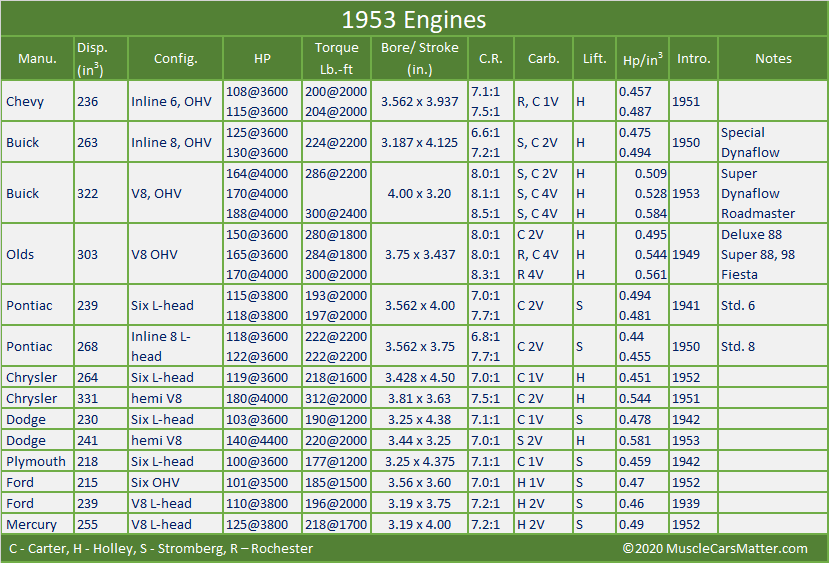

1953 Newspaper Ads

I did a double take with this ad. The ‘Demons’ is an abbreviation of ‘demonstrator’, not Dodge Demon! The ‘V-Eight’ reference is to the new 241cid hemispherical-head engine.


