
1964 was another great year for the auto industry, with marginal increases for Ford and Chevy, and double digit increases for most of the other companies. Approximate sales were 7,800,000, an increase of about 5.4%. Of course, that wasn’t the big news. This was the first year that an automaker placed a large engine in a midsized car for the express purpose of offering a new model that offered affordable performance and that was within reach of most buyers. This, of course, was the Pontiac GTO. (See the article “Muscle Cars are Like Dinosaurs” elsewhere on this site )
This was also the year the Mustang appeared, an event that was unrivaled in scope, excitement, and sales! In one short period, both the muscle car and pony car movements were independently born, and the U.S. automotive market would never be the same.
Approximate Industry sales: 7,794,000; change: +5.4%.
1964 Noteworthy Events
- Chevrolet – Chevelle Malibu! Chevy II gets 283.
- Buick – 425cid Nailhead V8.
- Chrysler – Experimental gas turbine powered cars; 426 Hemi (race only)
- Dodge – Ugly lines are gone! 273 V8.
- Ford – Mustang!!
- Mercury – Merc gets the 289.
- Oldsmobile – F-85 Cutlass becomes an intermediate; 4-4-2 option.
- Plymouth – Valiant Barracuda 2-door sport hardtop!
- Pontiac – GTO!!

All of the U.S. automakers had a solid 1964 with the exception of a few of the minor players. Total sales nudges up close to the magic 8 million level.
Chevrolet
Chevy may have had just marginal gains over their ’63 sales, but they totally dominated Ford this year. They introduced their new midsized model, the Chevelle Malibu, which would be a hugely important model for the company, as well as becoming the quintessential Chevrolet muscle car. It also offered an SS option. The Chevy II got an infusion of power, with the availability of the 283cid V8. At 2,700 pounds, this made for one responsive package. Impala SS became its own series this year. The 327cid V8 and 409cid V8 engines were available in the midsize and larger models.
Approximate sales: 2,318,000; change: +3.6%; industry rank: 1st.

Chevy II received a new grille and some minor trim changes. Of more importance was the availability of an optional 283!

The rear styling of Chevy II was clean and fairly simple, yet not unattractive. It would be a strong contender in the compact car field each and every year.

Here’s the front of the ’63 Chevy II. Chevy II was a car that would never see big change in any particular year. This was true with the 1963 and 1964 models, which were very similar to one another.
New Chevelle!

The new Chevelle fit nicely between Chevy II and the larger Chevrolet models. Chevelle shared much of the Chevy II styling but had curved side glass. It was a clean, uncomplicated look with smooth sides and subtle lines. There was also a Super Sport option available, which would secure a part of muscle car history.

Impala SS

The Impala SS became its own series for ’64. The SS gave you badges and other dress-up items, as well as bucket seats. SS cost compared to a similar Impala was around $160. It should also be noted that a ’64 Impala SS was not necessarily a V8 car!

The dual radio antennas mounted on the rear fenders was a good look! Come to think of it, the roof lines were pretty nice, too!

The grille on the ’63 Impala was kind of convex, with the bottom 2/3 or so angling out from the bottom and the top 1/3 angling from the ‘peak’, back to the body.
The grille on the new ’64 wouldn’t have this feature, and where the ’63 was flat across its top, the ’64 grille top would drop to a slightly lower level between the two pairs of headlights.

The rear on the new model retained the six tail lights, like the ’63, here. The ’64 rear style didn’t have the inset rear panel the ’63 had, nor did it have the extended rear fenders. Both years had great styling.

Make Mine Jet-Smooth!
Chevrolet liked to advertise their ride. And why not? Most Chevy models had coil springs front and back, but much of their competition were still using leaf springs in the rear. ‘Jet-Smooth’. Chevrolet would use the term ‘jet’ a whole crap-load during this era.

Okay, they’re selling Chevrolet luxury here. All in all, pretty ‘meh’.


I just love this ad! ‘Playing with Blocks’ is simply masterful! Don’t miss: “Looks like the Rock of Gibraltar with 409 cubic inches of tunneling punched in it.” This was enough to get a hotrodder’s pulse up to 180!
The text “…choose low gear ratios of 2.56 or 2.20 with the 4-speed all-synchro shift.” refers to the two different 4-speed manual transmissions, namely the wide-ratio (‘regular’) and the close-ratio. The 4.11 and 4.56 rear-end gears were specific to the close-ratio box with the 2.20 first gear ratio.
1964 Corvair Monza Road Test
February 1964 Car Life


Corvette
Chevrolet didn’t feel the need to change much on the Corvette this year. The cleanup included a new, one-piece rear window that was more aesthetically pleasing than the two-piece window the new body was introduced with (at least to people in 1964…). Sales increased marginally over ’63. The 327cid V8 continued to power Corvette, with horsepower ranging from 250hp to 375hp.
Approximate sales: 22,000; change: +4.8%.

Corvette didn’t change much this year, but it was brand new just last year. The lines are just fabulous!

A Change of Window
I’m sure the rear styling of Corvette was well received, with the one-piece rear window. It’s always amused me how the ’63 window style has become favored over the years. If the ’63 window hadn’t somehow become ‘iconic’, I have to think the ’64 and later 1-piece look would have been overwhelmingly preferred. What’s not commonly known is that the two-piece window was intentionally used, as it allowed the ‘stinger’ from the top to run down the back, between the two window halves.


This ad mentions the ‘new one-piece rear window’. It also mentions the Powerglide automatic. Remember that this is a 2-speed automatic! As nice as this little tranny was in some models, it just doesn’t seem like it goes with Corvette. Then again, with any car in this price range, I guess you’d have to offer an automatic.
Only about 3% of buyers opted to go with the standard 3-speed manual transmission. Well over three quarters went with the optional 4-speed.
I do like the view of the car from this angle!

Oh, the creature comforts of a ’64 Corvette convertible! I love the lines on the Sport Coupe so much, especially the fastback style. The convertible just doesn’t have the same lines.

I have to say, comparing the ’64 Corvette to an opera coupe kind of interesting. I like the line “…in a two-place projectile about as nostalgic as a space shot.”. Remember, man had reached orbit around the earth only two to three years earlier (April 12, 1961).
Opera Coupe
You might wonder about this term. It was archaic even in the 1960’s, and referred to a two-door vehicle that was nice enough to go to the opera in. It often had small windows for the rear seat occupants to allow them to see without being seen.
Manual 3-speed vs 4-speed
I always felt the 4-speed was the tranny to have, if it was offered. You didn’t have to go back too many years to find a time where a 3-speed was the only manual trans. GM, especially, frequently offered a ‘regular’ 3-speed and a ‘heavy duty’ 3-speed. Drag racers of the day often preferred a 3-speed unit, which required one less shift.
Buick
There wasn’t a huge amount of news with Buick this year, but models did receive attractive updating. New was a 300cid V8. At 210hp, it wouldn’t generate much excitement. The 225cid V6, and the 401cid V8 and 425cid V8 filled up the engine list. A new long-wheelbase station wagon series was now offered, being christened Sport Wagon. It accounted for 3% of Buick sales in its initial year.
The Special was now slightly larger, having become an intermediate model. Other series were Skylark, LeSabre, Wildcat, Electra 225 and Riviera. Skylark moved solidly into mid-sized territory by gaining 3” in wheelbase and 300 lb. in weight. This wasn’t an isolated thing, in that the smaller Olds and Pontiac models were experiencing the same growth.
Approximate sales: 510,000; change: +11.4%; industry rank: 5th.

Skylark continued to be an attractive, cleanly-styled car. It would be a true statement to say that the styling was conservative. The grille was changed from the fine vertical lines in ’63 to the horizontal bars here. It was a nice look.

Skylark was the highest trim level of the Special. Though not unique at all, this is often confusing. Skylark was its own series, separate from Special and Special Deluxe. Regardless of these designations, the models in these three series shared chassis, sheet metal and, to a large extent, engines.


Where the ’63 Skylark had a sort of ‘shaver’ sort of grille, it went to a more conventional look this year, with horizontal bars.

The rear styling of Skylark didn’t change much between the two model years. The ’63 here looks a lot like the ’64. Gotta say that I do like the extended rear fender look and I’m glad they carried it over to ’64.
Where’s Our Muscle Car?
Buick wasn’t able to respond to the Pontiac GTO this year, like Olds did with their 4-4-2. I’m not aware if they considered a response or not.

Wildcat, in its second year as a series, was one good looking car. The front grille was slightly peaked, with the Buick shields in a center circle and a horizontal bar bisecting the width of the grille. The grille and bumper were particularly well integrated together, resulting in a bold, clean look.

Cleanly styled, Wildcat had clean, slab sides accented with a broad horizontal piece running the length of the side at roughly the same height as the center of the wheels. Three horizontal ‘ports’ were located behind the front wheel openings. The rear styling was clean and uncluttered and the top was attractively rounded. It has the rear fenders extended, too, but maybe a bit more subtle than on Skylark.
Riviera Still Stunning!

While only in its second year, Riviera wisely didn’t change much in ’64.

Riviera continued to have a muscular yet refined look. Don’t the faux vents just ahead of the rear wheels help to break up the side well?

These photos of the ’63 Riviera show you that there was little change between the styling of the two years.

Unless I’m looking at this wrong, it seems the backup lights in ’63 were by the license plate, and then moved up to the outer ends of the tail lights in ’64. I could be wrong; I’m still feeling the bean burritos and Cheladas from last night. It’s tough to think straight when your bowels are trying their best to invert themselves!

Eh, another ‘nice’ Buick Riviera advert. Nice, but I don’t see anyone getting too excited. (Too harsh?) I hope the ice is thick… For the sake of the car, not the lady standing out there doing who knows what. I assume she can swim.

Here’s Buick selling ‘value’ in LeSabre. As with the Riviera, nice, but, uh, ‘my fire ain’t getting lit’. Know what I mean? (If you don’t, you’re not a Buick person!)
Can’t Find My Dynaflow!
By now the forward-thinking Dynaflow had become obsoleted. In addition, it wasn’t going to make sense for each GM company to have their own auto trans design.
Turbine-400 Automatic Transmission
This was Buick’s name for the Turbo-Hydramatic 400 transmission. This was to be the GM heavy-duty auto for the next several years. The Turbine-300 was the name for the Buick version of the Chevy Powerglide 2-speed automatic.


Buried in the small text is a reference to ‘young’, a concept that will appear in other Buick advertisements.
I’d almost guarantee you that the guy carrying the gal isn’t really running, as the ad would imply. If he could really run with her and smile at the same time, not to mention keeping her from shaking like she’s in a paint mixer at Home Depot, he’s a better man than I am. She’s not exactly the most petite model they could have used, either.
1964 Buick Lineup Brochure


Oldsmobile
Oldsmobile significantly sported-up their lineup this year. The sweet little F-85 became an intermediate this year, and the aluminum 215cid V8 was history. The 225cid inline-six and the 330cid V8 were offered. F-85 increased 3” in wheelbase and about 300 lb. in weight, as did it’s Buick and Pontiac sister models. This was the infamous GM “small-car-to-midsize-sprawl”.
The RPO B09 4-4-2 package was offered optionally for a cost of $136. The original designation stood for 4bbl carburetion, 4-speed transmission and dual exhaust. The 4-4-2 was a mid-year introduction, mostly in response to the Pontiac GTO. It was a nice package but would prove to be a little lite on cubes until ’66, when it got the 400cid V8.
The ’88’ series now included the Jetstar Eighty-Eight, the Dynamic Eighty-Eight, and the Super Eighty-Eight. The sporty Starfire now had a lower-priced sibling, the Jetstar I. It received the 330cid V8, rather than the Starfire’s 394cid V8. The Ninety-Eight remained as the top offering.
Approximate sales: 494,000; change: +3.6%; industry rank: 7th.

The hub caps (rather than wheel covers) and the redline tires indicate a certain sense of purpose for 4-4-2, and it isn’t to be a sedate, comfortable people-hauler.

4-4-2 was a pleasing if not remarkable. The crease feature on top of the rear fenders and adjacent to the trunk deck was unique.
4-4-2
The 4-4-2 was RPO code B09, and saw a midyear introduction on F-85. It added $285 to the F-85 or $136 to the Cutlass series ($2,400/$1,145 2020$). Body styles were either 2-door coupe (post) or 2-door hardtop. The interesting choice of names, “four four two”, reflected 4bbl carb, 4-speed manual trans, and dual (2) exhaust. Of course, many such cars had automatic trannies, but that didn’t matter. Note that it did have three characters, same as GTO. I’ve always thought that it was an interesting choice of names, and one that possessed just a bit of mystique.
Aside from the high output 330cid mill and the obligatory badges, what else did you get for your money when you checked this option on the order form?
Well, you also got a heavy-duty suspension, dual-snorkel air breather and wider, red-line tires.
Not a GTO Copy
It’s interesting to note the disparity between the new Pontiac Tempest GTO and the Oldsmobile response with their 4-4-2. Pontiac had put their mid-level V8, the 389, in the smaller Tempest platform. Their top-level V8, 421, was still strictly a big-car engine, while their 326 V8 was the regular ‘small V8’ for the Tempest series other than GTO. Olds had no such mid-level V8 engine. Even Buick had their 300, 401, and 425cid V8’s.
No 394?
I have to think that Olds simply could not put their 394cid V8 into the F-85 platform primarily because it was their only large V8 engine, and were thus relegated to rodding their 330 to an additional 20hp. Pontiac could offer the same Tempest platform with up to an additional 68hp as the GTO, while Olds was limited to a 20hp bump with the already-utilized 330. This hurt the Olds performance car effort right out of the gate, and it would be 1965 before Olds was able to field a larger engine for their 4-4-2. By that time, Pontiac’s GTO was so far ahead as for 4-4-2 to have lost sight of them. To provide some perspective, Olds sold about 3,000 4-4-2 optioned cars in 1964, while Pontiac’s numbers for GTO were 32,000!

This the beautiful first gen Olds 4-4-2 badge that was affixed to the grille.


Olds was like the person who wanted to join their friend in the water, but was afraid to go in. Their friend (Pontiac) had just run and jumped in, but they (Olds) were afraid the water was cold and just put a foot in and then waded in slowly.
The advertisement above is an example of this trepidation. Oldsmobile decided to portray the 4-4-2 as something that was intended for law enforcement, but now you, too, could have one!
Curiously, the car above in the 4-4-2 ad is a 4-door! It’s been rumored that there were 7 or 8 four-door 4-4-2 cars, but I think the jury is still out regarding this.
It might be that Oldsmobile was more afraid of the dumb-ass GM mandate against racing than Pontiac was. “Racing? No, no, no! This is for police, to catch bad guys! We no like racing! It’s bad!”
The Other Olds Models

Jetstar I was a single-model series that was based on Starfire but was a bit lower in price. Its sport hardtop sold as well as the two models of Starfire did.

Note the unique front and rear fender styling on the Olds models. The F-85 rear fender treatment is a bit different from the larger cars, but it’s the same concept. It’s pretty sharp.
Don’t miss the vent-like styling cues behind the front wheels of Starfire, either.

While I admit this might be good advertising, I’m amused at the ‘5 hours of air tests’, and how this demonstrates ‘…built in reliability’. Wow! It flew for 5 whole hours and didn’t fail!
Well anyway. This was with the 330cid V8. It seems like Olds didn’t spend much energy on promoting the 330, all in all. Maybe this was the odd exception?
‘Aircraft Engine’?
How’s an Aircraft Engine Different?
The Cessna 172 is the quintessential ‘light private aircraft’, having been manufactured almost continuously since 1956. The Lycoming 320 was a popular engine choice for such an aircraft, itself having started production in 1953! Lycoming dates back to 1845 (!) and once produced typewriters, sewing machines and bicycles. Auto and aircraft engines followed, with Auburn, Cord and Duesenberg being customers.
The Lycoming 320 is a 320cid opposed four-cylinder engine with air cooling. Its ignition system is composed of dual magnetos and two spark plugs per cylinder.
Air cooling means there’s no cooling system to fail. Magnetos are more reliable than alternators and don’t need battery current to operate. Redundancy adds further margin. Aircraft engines aren’t high rpm engines, the 320 making rated hp (150 – 160) at 2700 rpm. I don’t have any figures, but I believe an engine like this would be substantially more reliable in an aircraft installation than any auto engine would be.

This is a contemporary Lycoming 4-cylinder engine. Gorgeous, huh? It’s from their website, and copyrighted and stuff, but I didn’t think they would mind. If they say anything, I’ll take my own photo of the dirtiest Lycoming I can find and use that. That’s how I roll.

The Cessna 172 was built in Wichita, Kansas. Aircraft factories in Kansas? Might sound weird, but Learjet and Beechcraft were there, too, not to mention Boeing Military Aircraft Company. This part of Kansas is flat and windy, two things that were of special interest to the earlier aircraft industry. Plus, there’s nothing of any value you could hit if you crashed!
I couldn’t help myself. Here’s a pic of an F-15E Strike Eagle. You can see that it has a dual cockpit, and if you look closely, you can just see the conformal fuel tanks on the engine intake ramps peeking out from under the wings. This is one of the most capable and beautiful aircraft ever built.

Where were you in July 1972? That’s when the F-15 first flew!
Jetstar I

Olds sure liked the terms ‘star’ and ‘rocket’. That’s okay—this seems to have worked well for them.
Jetstar 1 was a single-model series, introduced in ’64 as a lower priced alternative to the Starfire series. With a Jetstar, you could get the 345hp top-dog V8 and save yourself about $500 over the cost of Starfire.
I like the horse racing shots. Once I went with a friend, years ago, and I’m not a betting person. I was bored out of my mind during the wait between races!
Wait! Was the Jetstar I a muscle-car? No, it wasn’t. Why? 4,030 pounds is why! Pontiac’s Tempest GTO had 20 less standard horsepower, but 800 less pounds.


Another look at Jetstar I. “Real sporting event…every time you take the wheel!”
O-k-a-y…if you say so.
1964 Oldsmobile Sports Cars Brochure


Pontiac
The news at Pontiac for ’64 revolved around the Tempest. The Tempest bodies were enlarged into midsize vehicles, and the “Indy Four” engine, rear transaxle and independent rear suspension went into the dust bin of history. As with the Olds F-85 and Buick Skylark, Tempest wheelbase grew to 115” and weight increased by about 300 lb. Tempest was also built with body/frame construction now. The base engine was a Chevrolet-sourced, 215cid straight-six.
However, by ticking off the correct box on the order form, one could purchase the “GTO” option. This got you a 325 or 348hp 389cid V8, the latter with a 3 x 2bbl intake. Either setup gave you way more engine in an affordable midsized body than was previously available. The 389 not only made significantly more horsepower than in previous years, in the Tempest GTO body it had 900 – 1,000 lbs. less weight to move. And move it did!
The rest of the Pontiac lineup saw minimal changes, and remained Catalina, Star Chief, Bonneville and Grand Prix. The big cars were powered by the 421cid V8, with up to 370hp on tap.
Approximate sales: 715,000, change: +21%; industry rank: 3rd.
Pontiac Tempest GTO
This car copied the name of the Ferrari 250 GTO of 1962 – 1964. The Ferrari GTO had a 3.0 liter 12-cylinder engine that made just short of 300 hp. It was blindingly quick, weighing just 1,900 lbs. The cost was about $18,000 ($155,325 in 2019). Pontiac did take some heat for their choice of name, but not only did it not hurt, it likely helped them. One magazine of the day did a shootout between Pontiac and Ferrari GTOs.
This was the first time a US automaker offered an affordable, “smaller” car with a large engine, a car that was designed for daily driving. It was the first example of the “Muscle Car formula”.
The GTO was conceived under the noses of the GM brass. GM was very “anti-racing” and would not have approved such a vehicle.
Pontiac’s John DeLorean, Bill Collins, and Russ Gee were the main guys behind the project. Pontiac’s sales manager didn’t believe in the project, limiting the initial run to 5,000 vehicles. The total first-year sales were actually over six times that number!
Stupid Mandate
The GM engine limit on midsize and smaller cars has been variously expressed as “no less than 10 lb. per cubic inch”, and later, as “no more than 1hp per cubic inch”. Bottom line—big engines go into big, heavy cars, or later, the Corvette. The Tempest GTO didn’t observe this corporate mandate. Of course, sales were off the charts, and with corporate types, money talks!

Tempest was a nice looking car, whether it was the standard, Custom, Lemans or GTO. For its first three years, Tempest had been unique with its rear transaxle and available all-aluminum 215cid V8, as well as the ‘Indy 4’ four-cylinder engine. It was also built with unibody construction.

1964 saw Tempest become larger and move to ‘intermediate’ status. It was also now built with separate body and frame construction. Of course, the rear transaxle, 4-cylinder and alloy V8 were all discarded. Too bad.

1964 Pontiac GTO Brochure


Motor Trend January 1964


Where the Hell Did Our Small Car Go?
GM has the Small Car Blues
You might wonder why Pontiac introduced a small car (Tempest) and then turned it into a mid-size. What changed? Well, nothing, really. All automakers seemed to go through this process of enlarge, enlarge, enlarge. The GM companies seemed to be the most obsessed with this. I’m at a loss to really understand this, given that they did perceive a threat on the horizon with import cars. At that time, it was mostly the VW bug that was stealing customers, and while there was concern, there didn’t seem to be alarm. That changed after 1970.

Grand Prix’s grille lost the round parking lamps as well as the horizontal bar. Still a nice look, but I think it lost something compared to the ’63 grille.

The rear design of Grand Prix continued to be elegant and stylish. The full-width accent piece above the bumper was changed, and the tail lights, formerly located on the rear fenders, were now enclosed by fenders at the top and bumper at their bottom.

The major change in the Grand Prix front this year was the deletion of the horizontal bar the ’63 grille, above, had.

While the ’63 tail lights were well seemingly disguised in the rear facia, the new model would have them upright, and placed in the ends of the rear fenders.
Wide-Track?
Pontiac started their ‘Wide-Track’ design campaign in 1959. Since front and rear tracks were increased some 3 in. over ’58, this was indeed ‘wide tracking’, I’d say. But, other companies, most notably other GM companies, followed suit. Still, Pontiac models still tended to have the widest tracks in the business, by a couple of inches typically. Truth in advertising? Well, mostly, yeah.
Pontiac continued to have a slightly wider front and rear track than their competition, but it’s hard to say that this minimal difference really made a significant ride/handling difference. Still, it was smart of them to continue to use this marketing theme.
2 + 2 = ??
In this case, 2 + 2 = Full-Size Performance! This Catalina option was approximately $291 in 1964 ($2,806 2022$) and was initially an appearance package. Later versions of the option would add suspension mods and the wonderful 421cid V8. For its inaugural year, the 330hp 389 Tri-power was the top 2 + 2 engine.
Next year, the ‘Catalina’ name was not found on the car, and in 1966 2 + 2 became its own series. It would become a Catalina option again in 1967, and it was no longer around by 1968. Poor sales were said to be the primary reason for its demise. Too bad.
You might have recognized that the “2 + 2” designation was at this time a European term for a performance coupe that had a vestigial rear seat. Yeah, we stole the “GTO” name AND the “2 + 2”. Deal with it.

Yeah, this thing wasn’t going to happen. Banshee was too much like Corvette!

If you wanted a 2 + 2, you had your choice of a 2-door hardtop or convertible.

This is a pretty okay advertisement for Tempest. I could get into cruising along a beach road in my new Wide-Track Tempest, couldn’t you?

Another advertisement focusing on value; not too exciting, really. I do kind of like the blue-red interplay and the stacked versus horizontal headlights.

Oh, yes, yes, yes! Behold the GTO!
The exhaust splitters are dealer-installed. Today that seems so odd, doesn’t it?
Notice that the 389 is referred to as ‘Motherly big’!
Car Magazines Reviews are Key
Pontiac and their advertising resources were well aware that for this type of car the car magazine reviews were going to be invaluable. To facilitate this, significant efforts were made to get the GTO into the hands of the magazine testers.
The Ol’ Switcheroo
Jim Wangers, ad man for Pontiac, wanted to get rave press reviews for the new GTO. He took advantage of the fact that it’s nigh impossible to tell a 421 from a 389 when it’s installed in the car. The ‘test vehicle’ he happily supplied to the car magazines was one hot little package, in large part because of the 421 disguised as a 389! This well-tuned engine ran some insanely fast times. A hot 389 would have done well, just not as well as the 421. Instead of merely generating interest, his car became a rock star and people were eager to get their hands on one. The car ran 13.1 sec. quarter miles. Wangers finally came clean in 1998!


This is one of the iconic GTO advertisements from the era. Not fancy or colorful, but attention getting and effective. Oh, yeah–and memorable!

Here’s Pontiac bragging about the accomplishments of the new GTO.
Hurst Shifters
The manual 4-speed GTOs came with Hurst shifters, although the shifters did not bear the name ‘Hurst’. Next year they would. Pontiac figured out earlier than the others that using some aftermarket hardware that was better than factory was far more of an advantage to them if buyers were aware of this fact. What better way than to have the manufacturer’s name (Hurst) on the product? Especially if that aftermarket manufacturer had a widespread reputation for quality?
Hurst shifters were fully boxed. Shifter boxes on most standard factory shifters were open on one end. In addition, being fully boxed allowed the use of two stop-bolts. These gave a crisp, solid stop to your shifts, not allowing the shifter mechanism to continue its movement after the shift was completed. Back in the day, one of the first mods to your 4-speed car might be to ditch the factory shifter for an aftermarket unit, usually a Hurst.


The large Pontiacs could be optioned with 8-lug wheels featuring huge aluminum drum brakes that were not only very effective, but also insanely attractive! The finned part that you see in this photo is actually part of the aluminum drum, not the wheel itself. I believe the drums were roughly 12″ x 3″ and they were lined with iron for the required longevity.

This is the bare 8-lug wheel, with brake drum removed. It’s interesting that most of the pretty bits you see when the wheel is mounted are part of the drum, not the wheel proper. 1964 pricing was $122 to $138 ($1,176 – $1,331, 2022$).

Here’s Pontiac talking about their great 421. You have to admit that the “Hands off the grab bar…” is a fantastic line. Be sure you read the text left of the table–it’s very well written.
Chrysler
The Chrysler models received minor changes, though nothing really significant. In an attempt to further blur the distinction between the 300 Sport, which was on the lower end of the lineup, and the 300K, at the top, they dropped the ‘Sport’ from the former’s name. The exclusivity of the “Letter Cars” took yet another blow. The rest of the lineup remained as before, being Newport and New Yorker. Engine and transmission choice were unchanged from ’63. This was the last year for the ram-tuned intakes. The 360hp version of the 413cid V8 was an additional $43 over the base V8 price, with the 390hp version adding $375. The 361cid V8 and 383cid V8 engines were the base engines for Newport and 300, respectively.
Approximate sales: 153,000; change: +18.6%; industry rank: 11th.

The 300 cars continued to use the ‘quadrant’ grille, which was modified just a bit for 1964. The bumper lost its bumper guards and now has a step-down in the middle. I think I like these subtle changes.

The emblem on the trunk deck makes an otherwise uninspired rear-end look a bit special. I just noticed the thing in the center of the back trim plate. It almost looks like the Chevy bowtie. (That or it’s the Cheladas still…)


The ’63 300(J) had the C-H-R-Y-S-L-E-R script above the grille, on the edge of the hood. The center ‘cross’ was a bit different, and the bumper had bumper guards.

In all fairness, I believe this is the rear of a 1963 Chrysler 300, not a 300J. As far as I can tell, the styling was identical, except for the ‘300’ badge in place of the round badge. The ’64 rear fenders actually picked up some small fins! I thought that had run its course!

‘Foam rubber front seats’, ‘sill-to-sill carpeting’; that’s going to generate excitement, isn’t it? The 5/50,000 warranty did convey a confidence the manufacturer had in their product and did generate sales for Chrysler.


Big, Attractive Car

This is an awfully attractive big Chrysler! I love the 4-door hardtop look. Once again, it looks like the art department boys have fudged the dimensions of the car, doesn’t it?

Here’s Chrysler corporation winning on Sunday and selling on Monday. I like the bottom picture ‘and you’. Note the Bob Hope and the Chrysler Theater, at the bottom.
High-Dollar Advertising
Bob Hope and the Chrysler Theater
This Friday night NBC show was, as the name implies, sponsored by Chrysler and hosted by Bob Hope, and ran from 1963 to 1967. It was common at this time for a company to sponsor a program, especially a variety show or an anthology series. Hope’s show was an anthology, which featured a wide range of stars of the day.
Hope received $214,000 (2020$) for episodes he hosted and $4,278,000 (2020$) for episodes he starred in. I know Hope was huge, but these dollar values astound me. Wikipedia.org
Dodge
The significant happenings at Dodge this year involved engines. The wonderful little 273cid V8 appeared, and it would go on to become a significant engine. However, 1964 will always be remembered as the year the hemispherical head engines reappeared. Not for street duty (yet), these were designed for NASCAR and for drag racing. The induction varied accordingly.
Approximate sales: 501,000; change: +12.6%; industry rank: 6th.
426 Hemi (race-only)
Mopar enthusiasts back in ’64 must have known that even though the new 426 Hemi was “race-only”, this had to bode well for future street offerings. The 426 wedge, upon which the Hemi was based, was a street mill, for crying out loud!
So, the question is how did this engine vary from the street version that would arrive in ’66? The short answer is head material (aluminum), camshaft, compression ratios, manifolds, and carburetion. If you were to take race and street versions, and then do a tear-down and compare, the similarities would overwhelm the differences, by far. All components were very similar, including the all-important heads. The street Hemi intake manifold actually might have been more impressive than the NASCAR 4bbl version!
Car and Driver May, 1964


Nice Restyling

Dart, in its second year, received a mild updating in the form of trim and grille changes.


The Dart grille was changed just a bit from ’63, shown here. Dart was too new to require any real change.

The 119″ wheelbase Dodges (330, 440, Polara) received a wonderful restyling for 1964. The look was clean and cohesive, with just the right amount of ‘muscular’.

Notice how narrow the C-pillars are on Polara. This is one helluva nice look.

The Polara styling in ’63 had the “Let’s smoke some reefer and do us some car designing!” sort of look. Yeah, the rear and sides were okay, but the front had the leftover ’62 look that was, well, ugly.
What would you have done back in the day when your neighbor, let’s call him ‘Phil’, asked what you thought of his new car? And it was a ’62 or’63 Dodge or Plymouth? Kinda like your little brother asking you what you thought of his new girlfriend, and she was, well, you know? Correct answer: lie your ass off, while trying not to be too specific! The equivalent situation today would be if Phil asked you about his new Smart car.

The rear styling of Polara in ’63 was pretty okay. It would be modified slightly for ’64.
426 Sexiness

Behold the mighty 426 Hemi! The chromed oval air breather covers the Carter carburetors that are mounted on the alloy cross-ram intake manifold. This was an absolutely gorgeous engine!
Note the small, single-chamber brake master cylinder. ’67 models were required to use the dual-chamber type.
I’m getting light-headed just looking at this beauty!

Ramchargers! Oh, yeah! I like the double meaning of the word ‘automatically’. Dodge’s relationship to racing worked well for them.

This is kinda cool. Practical or sporty- Dart has both bases covered.


Here are all the reasons you should consider buying a Dodge, like the Polara shown here.
Car Life Magazine March 1964


Plymouth
As with their sister, Dodge, the Plymouth news for ’64 could be summarized with “273 and 426 Hemi”. This wasn’t the only news, though. The Barracuda appeared on April 1st, being a Mustang-fighting compact fastback, built on the Valiant platform. It was unique and sporty, and when motivated with the new 273, it was responsive. The 225cid aluminum block was now history, now having both an iron block and head. Over the counter 426 Hemi engines were available in 415hp (11.0:1) form ($1,800) and 425hp ($2,000), (12.5:1).
Approximate sales: 551,000; change: +12.9%; industry rank: 4th.

If you wanted a Mustang-like car this year but didn’t want (or couldn’t get) a Mustang, Plymouth’s Barracuda was the next closest thing.

Look at that funky rear window! This thing had lines!

Did You Copy Me or Did I Copy You?
This question isn’t always easy to answer. Consider the Concorde, below. I’m convinced that the English/French did indeed conceive the final design and that the Soviets copied the design. Then, in true Soviet fashion, they rushed the aircraft to first flight (slightly), compromising the finished product.
Who’s on First?
Or, more appropriately, ‘Who was first?’. Barracuda actually beat Mustang to the marketplace, but not in the marketplace. Certainly, Barracuda, while being a fine car, didn’t cause nearly the sensation that Mustang did. Both were underway at the same time, and I have no idea who at Ford knew what Plymouth was doing or vice versa. I have to believe that both cars would have been more or less unchanged, had the other not existed. I doubt there was much cross-pollination with these two cars.
How about an example of just the opposite, but not with cars? The English/French Concord and the Soviet TU-144 are the perfect examples. Both were developed at the same time and bore a striking resemblance to one another. Of course, the Soviet jet was larger, since things are always larger in Russia. It’s certain that the Russian spy network got information on the Concord project. When finished, the Concord was successful and safe, while the TU-144 was anything but. Two actually crashed at airshows! At freakin’ airshows! People of importance were not allowed to fly in the few, short routes the TU flew within the USSR, nor were the planes allowed to carry their capacity of passengers. Just the ol’ Russian way of trying to minimize the PR catastrophe that a TU-144 crash, with passengers, would cause. The Russians were all about public appearance.

Look up one of the million photos of Concorde on the web and compare it to the TU. The resemblance is extraordinary. There were other companies with supersonic transport (SST) designs, only Boeing having reached the prototype stage. None of these designs looked very similar to Concorde, making the TU-144 design even more suspect.
Clean Styling

The parking lights are now more conventionally located on the ’64 model. The grille extends around the headlights, and the front fenders still extend forward.

Plymouths received a similar restyle as the Dodge models did, but rode on a 3″ shorter wheelbase. As with the Dodges, these bodies were gorgeous! This is part of the reason that both Dodge and Plymouth saw gains exceeding 12%, which was bettered only by Pontiac.

The grille changed for ’64, as did the front bumper. In the ’64 model the headlights wouldn’t be paired together on each side with their own pod. Also, the parking lights/turn signals would move down to the bumper.

The ’64 rear styling carried the same theme as the ’63, here. The tail lights on the new model would be flattened, not boxy like they are here.

I have to say that this is one good looking car. I love the roof treatment and the rear window. The little vertical pieces on the are bumper are a bit funky.
Huntley-Brinkley Report
The arrow points out the statement about seeing the Plymouth ‘victory’ (I assume, ad…) on the Huntley-Brinkley Report. This was a ground-breaking and award-winning evening news report on NBC TV, that ran from 1956 to 1970. If you grew up in the ‘60’s, and if you had a television set, you remember this show.
Their catchphrase sign-off was “Good night, Chet. Good night, David. And good night for NBC news.” One study concluded that they were more recognizable than John Wayne or the Beatles!

This was a fantastic little car. Sporty as hell and could haul a ton of crap at the same time. One of the best rear windows in the market.


For the cost of the 425hp 426 Hemi you could buy a Valiant 2dr sedan!

‘Get up and go Plymouth!’ Oh, yeah!
1964 Plymouth Barracuda
Car and Driver May 1964


Plymouth ’64 Brochure


Ford
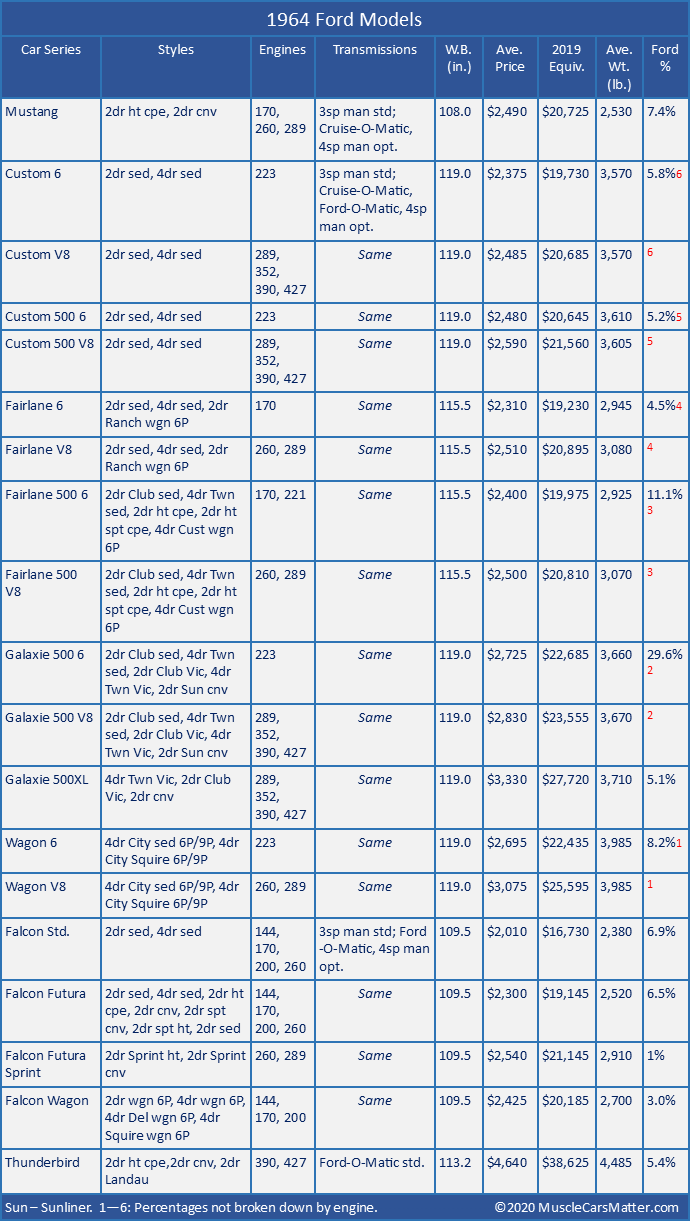
This year saw a U.S. automotive event that was instantly recognized as highly significant, one that would go on to define an entire genre of sporty cars. Unlike the debut of the Pontiac GTO this same year, the debut of the Mustang was highly anticipated. The public embraced the new Mustang and Ford was forced to take extra measures to meet demand.
As we’ll discuss later, this was intended by Ford to be an early introduction of a new 1965 model, not a 1964! This has caused no end of confusion to this day. Rather than ‘1964 1/2’ and ‘1965’ as the first two model years, these were more properly ‘early 1965’ and ‘late 1965’. Regardless, the ‘1964 1/2’ has become entrenched forever. Six years later Chevy would do the same thing with Camaro, although it seems that ‘1970’ and ‘1970 1/2’ were used more interchangeably.
The fourth generation Thunderbird showed up on dealer’s showrooms in ’64. Hoods were longer and roof lines shorter. The front had an aggressive new look, and the rectangular tail lights integrated into the rear bumper were striking. Side sheet metal was highly sculpted. The lightweight Fairlane Thunderbolts appeared this year, joining the lightweight dragstrip battles with Chevy and Dodge. The insanely expensive Thunderbird Sports Roadster of last year became a more manageable $269 fiberglass tonneau cover.
The sweet little 289cid V8 was back, of course, as were the 352cid, 390cid and 427cid engines. These four engines covered the (performance) needs of FoMoCo pretty well, with the possible exception of a high-output large-displacement small block. The 352 didn’t make the power that it did in previous incarnations.
Ford Motor Company was the Motor Trend Car of the Year for 1964. Just how in the name of Simon and Garfunkel (or Garfunkel and Oates) can a company be a car of the year? It makes no freakin sense! Motor Trend–What were you thinking?
Approximate sales: 1,594,000; change: +4.5%; industry rank: #2.
The Ford Mustang
If one person was responsible for the Mustang, it was Ford General Manager Lee Iacocca. This is the same guy who would later save Chrysler corporation in the 1980’s. The concept was a low-cost, sporty, smaller car, based on an existing platform. That last point is important; by using the Falcon platform, huge costs could be avoided. Plus, it was a great platform and still very current!
The build-up to the April ’64 Mustang debut was orchestrated by Ford Marketing, with plenty of market buzz. When the day came, public response was 180° opposite from that of the Edsel debut. The new Mustang exceeded the expectations of most buyers, and the biggest challenge the dealers had was getting new cars to replace the ones they sold. They were flying off of the showroom floors, a regular buying frenzy! None of their competition was able to mount much of a response until 1967.

When Mustang did arrive in April, it wasn’t exactly a surprise. It did, however, live up to its advance billing. The public was thrilled with Mustang, resulting in an automotive event almost without rival.

Mustang had sporty, roundish lines all around. The attractive grille had a chromed ‘running pony’ enclosed in a chromed rounded-rectangle (‘corral’). The back was clean, with three horizontal blade tail lights per side and round backup lights mounted below the bumper. The rounded gas filler cap was positioned in the middle of the rear valence, and worked well with the overall design. The sided featured simulated air intakes in front of the rear wheels. The design borrowed from no other vehicle and was incredibly attractive and unique, without having become ‘odd’.

A 1964 View of the New Mustang
The April 1964 edition of Popular Science had an article featuring a review of the new Ford Mustang. The title was “How hot is the Mustang?”
The car was driven by the race car driver Dan Gurney, and the convertible pictured featured a non-production grille. The text did mention that it was an engineering test car. The car was outfitted with the 271hp 289, a 4-speed manual transmission and 4.11:1 rear gears.
Gurney was impressed with the solidness of the chassis, the handling, the braking and, especially, the acceleration. Nevermind that the Mustang was built on the Falcon platform. Yeah, it was a newish and capable design, but hardly sport-car-like.
Perhaps the oddest part of the review was a comparison between the Mustang and a 327 300hp Corvette that also had a 4-speed manual, but with 3.70:1 gearing. The Vette weighed about 100 lb. less than the Mustang.
The 0 to 60 time of the Mustang was reported as 7.1 seconds, with the Corvette clocking 7.8 sec. Quarter mile times were 15.6 sec. @ 90mph and 15.8 sec. @ 85mph, respectively. Another source has 15.2 sec. for a Corvette with the same engine but with 3.36:1 gears and a 2-speed Powerglide trans. All in all, I’d be a bit reluctant to call the Mustang quicker than the Corvette.
Mustang undoubtedly was a hot package, especially with the 271hp mill, the 4-speed and the steep gears. To rave about the handling and braking, though, makes me think that Mr. Gurney may have been influenced by the enormous pre-release Mustang hype. Or was the hot little 289 actually hotter than its 271hp rating, due to special Ford preparation? Who knows? Actually, didn’t Dan Gurney race for Ford? Hmmm.
A Different Mustang Origin Story
I came across a different story about the origin of Mustang in a book called American Muscle Cars, by Randy Leffington. I’ll paraphrase the key thoughts.
It was actually Ford’s vice president of design, Gene Bordinat, and their chief of advanced design, Don DeLaRossa who were the creators of the Mustang concept. They were influenced by the Chevrolet Monza, which was itself a bit of wonderful happenstance. Bill Mitchell, the head of styling at GM, had created a sportier Corvair for his daughter. David E. Davis, advertising exec, put the car on display at the 1960 Chicago Auto Show. The public warmly embraced this little sporty wonder.
Ford had no entry in the sporty compact segment. They figured they could take their Falcon and sport it up, with a small V8, bucket seats, etc. Add a long hood/short deck body, and the concept came together. Lee Iacocca was easily sold on the concept. The harder sell would be Henry Ford II.
Iacocca lined up GM and Ford vehicles in each market segment. Whether this was literal or virtual, I don’t know. The absence of a sporty compact was then glaringly obvious. Iacocca then had the red clay Mustang model rolled out and Henry Ford II was sold. The April 1964 debut was chosen to occur with the opening of the New York World’s Fair. This source also claimed that Mustang was more optionable than earlier cars, which might be true, but I was unable to verify by looking at Mustang and Falcon options for 1964.
This book states that ‘Mustang’ referred to the P-51 Mustang, the premier WWII US fighter plane. There was indeed a lot of aircraft influence in the auto industry at this time. Most of us assumed that Mustang was a reference to the horse, especially since a horse graced the grille of the car! I guess I have no reason to doubt this claim.
Mustang, Just Not Ford

The P-51 above, Big Beautiful Doll, crashed in 2016 with the loss of the airframe and both pilot and passenger. A fuel tank had been removed to convert the plane into a two-passenger aircraft. The handbook for the P-51 stated that loops should not be performed with more than 25 gallons of fuel, which weighed about 150lbs. The passenger’s weight easily exceeded this. The pilot performed a loop from which he was unable to recover. If you think that it pays to follow the rules with a car, this applies x10 with an airplane. This was an experienced pilot, too.
Later P-51 models were powered by the Rolls Royce Merlin engine of 1649 cubic inches displacement, making as much as 1720hp. It has a top speed of over 430 mph and a service ceiling of over 40,000ft. This was a true hotrod of the skies.

This is the other type of Mustang, the one we all thought the name of the car was inspired by. Ever wonder about the breed? Mustangs are wild (actually, feral) horses of the western United States. They are descended from the first horses that the Spanish brought to North America in the 16th century. Post-dinosaur North America had early horse ancestors the size of dogs, but these died off. All horses here today evolved in Europe.
1964 Mustang Brochure


1964 1/2 or 1965?
The Mustang that appeared in April of 1964 was intended by Ford to be the early introduction of the 1965 model. Pure and simple. Then a few months later, they tweaked a very few things in preparation for the Fall introduction of Mustang along with its stablemates. Why wouldn’t they?
The changes to the ‘latter 1965’ Mustangs were mostly normal things, often mundane, which might have been incorporated in the earlier release if time had allowed. You need to keep in mind that the Mustang project occurred over a very shortened time frame. In fact, even the name ‘Mustang’ wasn’t settled upon until just months before the media introduction. The name that had been most associated with the model was ‘Cougar’! That’s how fast-tracked this thing was. The ‘1964 1/2’ designation would would come much later, and I’m not aware of it ever being an ‘official’ Ford designation.

Okay… I’m struggling with the word “SIGNATURE” in this advertisement; this is new to me. Googling an answer doesn’t do much, as the word “signature” is misinterpreted, as you might expect. Is this a place-holder, telling the newspaper “Put the local dealer information here”, and the word “signature” itself should have been removed? If you know, please fill me in!
Thunderbird Restyled

Don’t miss the simulated air intake on the hood. Thunderbird received an attractive new restyling this year, with more of a long-hood / short-deck design. The front design was rather striking, with the rear design no longer having the dual jet engine exhaust tail lights.

Yeah, the sequential tail lights were cool and attractive, but don’t you kinda miss the jet engine exhaust look?

The front of the ’63 Thunderbird was a lot different from the ’64, but bore a similar overall theme.

The rear of the ’64 Thunderbird would become sort of iconic, no doubt, but the ’63 had these wonderful, huge, round tail lights that were clearly reminiscent of jet exhausts. Now, if I could just have the ’64, with the ’63 rear end…

“Hey, Andy! Where are the keys to the squad car?”

Well, actually, Barney wouldn’t have driven a ’64 Galaxie as the squad car, but the show did feature ’62 and ’63 Galaxies in that role. Ford was a major sponsor of the Andy Griffith Show, and most of the significant cars used in the show were Fords.

The grille of Galaxie would be nicely revised in ’64. It would no longer have the bottom edge lifted in the center, like it is here with the ’63, and it wouldn’t be concave anymore.

Although the ’64 continued to use the cool round tail lights as the ’63, seen here, they were no longer part of a roundish rear fender, like this.

An upscale ad for Mustang? Yes indeedy. This was still the first full year of Mustang sales, and they were still finding what worked. Later advertisements would be much more focused on performance.
Free On Board (FOB) Explained & World’s Fair
I don’t know how many times in the past I’ve seen ‘f.o.b. somewhere’ and had only a partial idea of what it meant. The term ‘f.o.b. Detroit’ means that the buyer takes responsibility as soon as the item (car) is shipped and pays for shipping from the factory. If the car arrives damaged it is not the fault or responsibility of the manufacturer. The local car dealer would have to resolve it with the carrier who transported the car. Naturally, the shipping cost the buyer pays will vary in relation to their distance from the factory.
The red dashed box highlights the statement about the 1964 New York World’s Fair. There was an arrangement between Ford, and their exhibit there, and the Walt Disney Company. It featured the Magic Skyway ride, where passengers were seated in a full-size Ford that moved through scenes of prehistoric earth and of the future. After the fair, the hardware for this ride was recycled into other projects, with the rest discarded.

I believe Ford started using the term ‘Super Torque’ the previous year. More marketing department fairy dust.
Note the term “…hundreds of pounds stronger…”!
Is it just me, or do those yardage markers look a bit off? I guess it’s nice that the Little Lady can caddy for the old man, allowing him to save the fifty-cents he would otherwise have had to pay to Chip Diller to haul his damn bag and clubs around all day. I wouldn’t have thought that a dress would have been the best choice of clothing.

Both Ford and GM experimented with gas turbine engines for trucks in the 1960’s. I’m not sure what all of the issues were, but fuel efficiency was certainly one. The cab was setup like a small apartment.
Ford’s Big Red Gas Turbine Truck
Chrysler is well known for their gas turbine cars that were loaned to a relative handful of people in the mid ‘60’s, what’s not as well known is that both GM and Ford did research into the use of gas turbines for cars and trucks. Ford’s focus was eventually more on trucks, as seen here, than cars. Gas turbines were an outgrowth of the jet engine research that was so intensive after WWII and through the ‘50’s.
Most helicopters today are gas turbine powered, as is the US M1 Abrams main battle tank. Its Honeywell AGT1500 engine makes 1,500hp at 3,000 rpm and 3,950 lb.-ft of torque at 1,000 rpm. The engine weighs 2,500 lb. (less than a 500hp diesel semi-tractor engine).
The automotive use of gas turbines was ultimately doomed by their efficiency and emissions, with the heat produced being a secondary issue.

How can I mention the M1A2 Abrams and not include a picture? Wouldn’t be right not to. Nope.


In this ad Ford continued their depiction of Thunderbird as though it were a jetliner. They are the only ones who used this marketing theme, as far as I know.

This is a 1962 newspaper article about the ‘Experimental Mustang’. Of course, the model here is way, way different from the car that would appear in April of 1964. Dated October 11, 1962.

Another newspaper article. The picture is of poor quality, but you can tell that many of the eventual Mustang styling cues are already in place. Dated November 7, 1963.

April 9, 1964. Mustang is just days away!

This is an April 1964 advertisement announcing the new Mustang, with the introduction being just days away.
Motor Trend Jan. ’64 Article


The page here mentions that a 3.89:1 and 4.11:1 axle are available with the the hot 289, but Equa-Lock wasn’t available. Although the verbiage is subject to a couple of different interpretations, I read this as implying that Equa-Lock is available with the lesser axle ratios.
You might be thinking “Equa-Lock? I know Power-Lock, but what’s Equa-Lock?” Equa-Lock is the limited slip product for the 8-inch rear ends, while Power-Lock applies to the 9-inchers. It’s been said that Power-Lock is more ‘aggressive’ than Equa-Lock is. The lighter Ford models like Fairlane generally got the 8-inch rear ends.


Mercury
For 1964, Mercury stayed the course, making incremental changes. The mighty 406 was gone, but the 427 continued to offer up to 425hp. The 289 was brought to Mercury this year, being available in the new Comet Cyclone. At $2,655, 2,690 lbs. and 210hp, this was one sweet little car.
The Cyclone model of Comet appeared and Parklane was back. A small number of lightweight Comets were built for racing, being similar to the Ford Thunderbolts.
Approximate sales: 298,000; change: -1.0%; industry rank: 9th.

The Comet front, with or without hood scoops, was nicely styled. The grille and fender extensions were cool.

Comet, in whatever form, was a nice looking smaller car. Remember that it was based on the Falcon that was introduced four years ago. Some sources regard the ’64 – ’65 models as ‘second generation’ Comets.


The rear fenders of Comet still sported small fins, though I doubt anyone referred to them as such.

The front of Comet in ’64 wouldn’t be as pointed as it was here in 1963. The grille would change, and the twin headlights on each side would be positioned closer together than they were before.

From this rear look at the ’63 Comet it’s clear that the fins were still present. Not so in 1964. Comet in ’64 would continue to have six tail lights, but the rear was nicely restyled.
Marauder

Marauder was a full-size brawler, especially when fitted with the hot 427. 410hp or 425hp, baby! Yeah, and 3,900 lb. dry, and no performance axle ratios. This was a cruiser, not a muscle car.

Two-door and four-door hardtop fastbacks in the Park Lane series were called ‘Marauder’. In the Park Lane series!

I love how the name ‘Marauder’ looks like it was written with the spinning rear tires! Marauder, in 2-door and 4-door fastbacks, was actually a part of the Park Lane series, Mercury’s highest priced. Not sure I’d say the price was ‘medium’.

Yeah…not 100% sure what I think about this the ‘Durability Champion’ thing. FoMoCo has a history of being fast and loose with the truth, as evidenced by the various bogus ‘awards’ they, uh, awarded themselves. Comet sales went from 134,000 in ’63 to 188,000 in 1964. That’s 40%, not 55%! Maybe there’s some ‘small print’ qualifier that applies to the ‘55%’, but I just don’t see it.


Comet Caliente was available in three models and accounted for almost one-quarter of Comet sales.
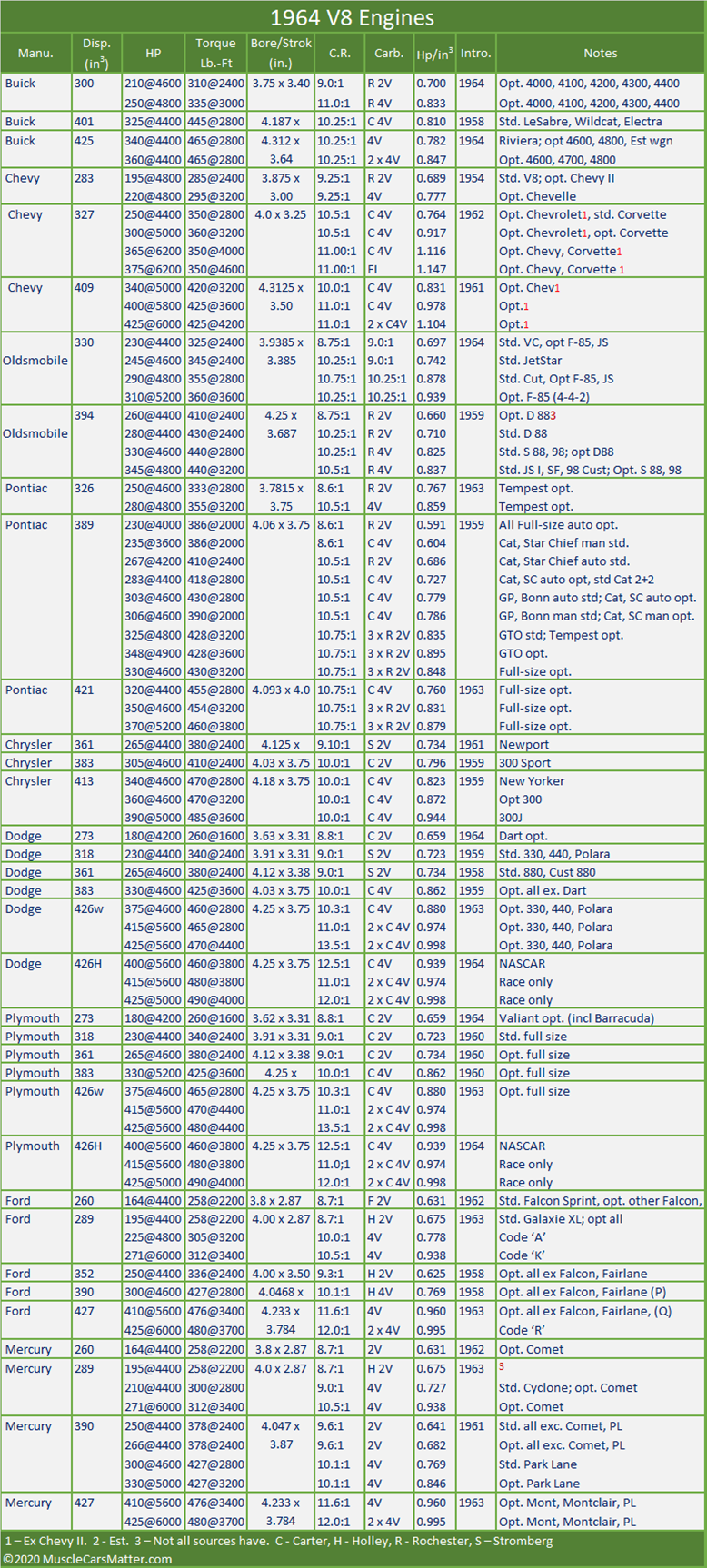
1964 V8 Engine Specs

1964 Newspaper Ads


Some things never change! “We don’t care about profit! We just want to sell cars!”

The add above for Mustang refers to it as a ‘1965’. The date of the ad is one month after the introduction of Mustang. This illustrates the point that when Mustang was introduced, it was the early release of a 1965 model! In a mere five months, all of the other 1965 models would appear. I think it’s fair to say that Ford regarded the new Mustang as a 1965 model, although they did make very minor changes to the car that would appear, again, as a 1965 model in September.

Pontiac was still using the ‘tiger’ theme at this time, but that wouldn’t last forever.


The article above appeared on the front page of the business section. Note the last paragraph with the sales expectation: “…25,000 to 30,000 4-4-2s…”. The actual number for 1965 was indeed right at 25,000 units. Conquest sales are those taken away from other automakers.

Here’s Rambler, with the right idea at maybe the wrong time. These were great little economy cars, but the company didn’t have enough offerings to appeal to a broad base. Too bad.

