
NEW STUFF:
This year would go down in the books as another great year for the U.S. auto industry. Ford, Plymouth and Chrysler were each up over 30%. The only major player who didn’t see substantial increases was Dodge, with their slight decline. Industry leader Chevrolet only saw a slight increase over 1964.
Industry sales: 8,960,000; change: +15%.
The introduction of the Chevrolet 396, the first in their Mark IV big-block engine family, was the automotive event of the year.
1965 Noteworthy Events
- Chevrolet – 396cid Mark IV big block.
- Buick – Skylark Gran Sport.
- Dodge – Coronet.
- Ford – 427 SOHC.
- Oldsmobile – 4-4-2 gets new 400cid V8; new 425cid V8.
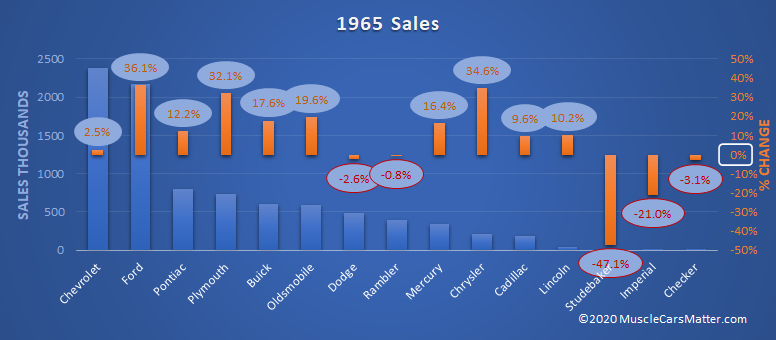
Ford, Chrysler and Plymouth each saw huge gains for 1965. All of the major players were either up from ’64 or saw just mild declines. The 9 million unit mark was approached; it was a great year for the industry.
Chevrolet
This was another great year for Chevrolet, again leading Ford in the sales race. More significantly was the introduction of the Mark IV big-block, in the form of the 396cid V8. For the Impala, the Caprice Custom Sedan Option Package (RPO Z18) added a stiffer frame, upgraded suspension, and visual cues.
Chevrolet became more of a contender in the performance car segment in ’65, with the pairing of the new 396 with the Chevelle SS 396. This package, labeled RPO Z16, featured the 375hp version of the 396cid V8, a manual 4-speed trans, heavy-duty suspension, and a host of other functional and decorative items. The package had a cost of some $1,500, which was enormous compared to the $2,500 for a Chevelle Super Sport two-door hardtop. No wonder only about 200 were so equipped! Despite having a new big block family, Chevy kept the 409 around for one more year.
Corvair got a beautiful new body, with curved, sweeping lines. Sales seemed to reflect the new look, with numbers increasing nicely over the slump of last year.
Some models were a bit larger this year, but there were no significant changes to the lineup.
Approximate sales: 2,375,000; change: +2.5%; industry rank: 1st.
Gorgeous Restyling

Would you just look at the front-end styling of this beauty? Nothing less than gorgeous!

Corvair styling had always been nice, and a bit unique, but in 1965 it became drop-dead gorgeous! Lines became more rounded, smooth and flowing. The front end was positively futuristic. Sales would surge this year, and this would be the high-water mark for Corvair.

The front of Corvair was substantially redesigned. The new look was much sleeker than the ’64 pictured here.

The Corvair rear added a full-width trim panel, while retaining the same sort of tail lights. The ’64 rear shown here sports the same type of bumper as the ’65.
Chevelle SS New Series

Chevelle was mildly restyled for ’65, with the front receiving a new grille and a pleasant, slight pointing of the front.

The Chevelle Super Sport became its own series this year, being available with both six and eight cylinder power. The new Mark IV engine family, in the guise of the 396, would define the Chevelle.

The ’64 front end was nicely restyled for ’65. The horizontal bar on the ’65 grille was a nice addition.

The ’65 rear end showed a similar look to the ’64, shown here.
Big and Beautiful

Where Chevelle was rather slab-sided, Impala had a distinctive ‘hip’ in the rear fenders. Also note that the accent crease ran across the front, down the side, across the back, and back up the other side to the front. Way-cool, in my book.

Where Chevelle had taillights integrated into the rear fenders, Impala placed its six taillights both in the rear fenders and in the trunk deck. Both styles were attractive, but the Impala style was certainly more distinctive.

The grille on the ’64 Impala was set higher on the car and the bumper ran across the bottom of the grille. The front was also flatter on the ’64.

The new rear end lost the trim panel the ’64 had but retained the three tail lights per side, with two of each side mounted to the trunk deck. The ’65 retained the six tail light design.
Not ‘Mark Who‘, Mark What
1965 would become noteworthy for the appearance of this engine family regardless of whatever else might have happened.
Mark IV
The 396 was the initial member of Chevy’s Mark IV (‘4’) big-block family. What, you ask, happened to the Marks I, II, and III? Good question! The term ‘Mark’ wasn’t used by Chevy prior to the Mark IV. They apparently wanted a name for the engine family, and decided to do so by placing it relative to the Chevy big-blocks that preceded it. The Mark I was the 348/409 ‘W-series’ family, with its combustion chamber within the block. The Mark II family was the series of race-only engines, briefly fielded in 1963, that were a combination of the W-series and (eventual) Mark IV engines. The Mark III family was stillborn, being the designation for the proposed purchase of Packard V8 tooling and production rights. It seems so insignificant, hardly deserving of a ‘place holder’ designation. The Mark IV would go on to become one of the most significant engine families of all time.

Three hundred ninety-six cubic inches of gorgeousness! Lawdy! The beginning of an engine family that was to become legendary.

This is not a performance car ad. The message here is all that’s ‘new’, but no mention of the new Mark IV engine!
The fact that is has curved side windows is mentioned in the text.
Wait! Curved side windows? Didn’t all cars have these? Well, no. This was a recent styling change, as side windows were previously flat. Look at a ‘50’s car sometime and you’ll see this.

This advert is similar in theme to the previous one, highlighting ‘newness’.
One thing in the text that caught my eye was the mention of ‘sumptuous, imported upholstery’ in the Impala. Detroit importing upholstery in ’65? Hmmm…..
Advertising Potpourri
This advertisement does illustrate a key point that’s sometimes missed. Chevrolet, like most automakers, had different series that constituted, as in this case, their large-car lineup. Chevy’s big-car series were Biscayne, Bel Air, and Impala, in that order. They all shared the same chassis and sheet metal, with the three series being almost entirely different sets of trim and options. There was some overlapping of the options offered, of course, with other options being limited to just one or two of the three series (here).
If you wanted your large Chevrolet in a hardtop, two or four doors, it had to be from the Impala series, as Biscayne and Bel Air didn’t offer them. Makes sense, as hardtops were more exclusive than other models.

“The car that makes economy exciting!” Well said.

The ad states “On display Thursday, Sept. 24” (1964). This would be the day that the ’65’s showed up in the showrooms. Things like this used to be quite the big deal, with entire families going down to the showrooms to see the new models. Gotta say, though, a mime with balloons? The excitement must have been off the chart!
Fall New Model Announcements
The fall new-car introductions have gone the way of each company having their own V8 engines. In a way, that’s too bad. Government regulations control when an automaker can introduce a model for a given year. For example, the new 2030 models can be available as soon as January 1, 2029!
Automakers now try to introduce their new models at the times of the year they consider optimal for the particular model. Say it’s an SUV. They may want to have it arrive during the snowy season, when people are thinking more about traction conditions.
In addition, it prevents automakers from walking all over each other in the fall, which tended to happen when everyone made their introductions at the same time. Still miss it…


Corvette
Not too many changes for Corvette this year, but the landmark event was the Mark IV 396cid V8, making 425hp. This was the L78 version of the engine. Nothing could keep up with a well-running L78 Corvette; nothing. The one notable styling change was to the vents behind the front wheels, which were now vertically aligned, like gills.
Approximate sales: 23,000; change: +4.5%.

The Corvette front grille was now blacked out. This car looks like it’s equipped with the optional 15″ knock-off style wheels ($322, $2,650-2019$).

This body style had a rear end that was attractive as its front end, which is rather unusual.

I really like the orientation of the Corvette in this ad! Of course, 4-wheel disc brakes were really rare on American made cars at this time.
The text mentions a ‘new V8’, as well as ‘350 hp’, but no further details. This was the L79 327, with single Holley 4bbl, hydraulic cam and 11.0:1 compression.
The new for ’65 396cid V8 made up to 425 hp. However, this engine wouldn’t appear until January ’65. So, the early advertising didn’t mention the engine.

This ad confirms the rumors that were swirling through the performance car market for months. Corvette was getting big-block power!
The 396 not only added a solid 50hp over the previous highest output engine, but it also added a boatload of torque to boot.

Choices…
A ’65 Ferrari 275 GTS had 260hp in a 3.3L V12. It also featured a manual 5-speed trans. The cost was around $14,500. It was an attractive car, but I’d take the Corvette in terms of attractiveness. Unlike the maybe $100k a really nice 427 ’65 would cost you today, the Ferrari, if you can find one, will set you back maybe eleven times that amount!
Put a gun to my head and say:” Pick one to have and drive, but you can’t ever sell it!”, and, you know, I might just go with the ‘Vette.

Behold the 1965 Ferrari 275 GTB. You could have 2 1/2 Corvettes for the price of this back in the day. Price in 2021? Try way, way north of $1M!


Car and Driver Jan. 1965 Article


This article reports the magazine’s test of a ’65 Vette with the 350hp 327, four-speed, and a lazy 3.31 rear end. Their attitude is faked indignation that anyone would think that the new Corvette compares favorably with Europe’s finest, specifically Ferrari and Aston Martin. (Remember this was ’65!) They laugh at the thought of the Chevy being as reliable as the Ferrari or Aston Martin, which alone may date the article. Today, neither European car would be mentioned in the same sentence with the word ‘reliable’.
Buick
Buick stayed the course for 1965 and enjoyed considerable success. They held the number four spot in the U.S. auto industry this year. New this year was the Skylark Gran Sport option, which was a midyear introduction. This put the 401cid Nailhead in the intermediate body, ala GTO. Of course, there was some additional heavy-duty hardware and badging that accompanied this option. There was also a Gran Sport option for the Riviera. Other series were Special, Sport Wagon, LeSabre, Wildcat, and Electra (with Custom and Deluxe levels intermixed). The 300cid V8 was an upgrade engine for the lower series and a base engine for the mid-tier series. The 425cid V8 was reserved as an upgrade engine for the larger, upper-tier series like Wildcat, Electra and Riviera.
Approximate sales:600,000; change: +17.6%; industry rank: 5th.

LeSabre’s lines were changed just a bit and it received an attractive new grille that featured single horizontal and vertical bars centrally placed. With the bumper-mounted round parking lights, it was one terrific look.

Looks kinda like a Chevelle from the back, no? Nice lines and a clean, uncluttered look.
Buick Skylark Gran Sport
The Skylark Gran Sport arrived in 1965 and was a great little package, leveraging the attractiveness of the Skylark body. The 325hp 401 was the engine of choice, with suspension modifications added to handle the higher power. This included stiffer springs, coil and leaf, bigger sway bars, and stiffer shocks. For added stiffness, the convertible frame was used.
The price for the GS package was $253 ($2,445-2023$). With the four-speed manual, the price was $420 ($4,060-2023$); the two speed automatic made this $457 ($4,420-2023$). Bucket seats were mandatory, but not included in the price of the package. They would set you back $72 ($676-2023$). The result was one attractive, upscale performance car, worth of the Buick name. The Gran Sport was a midyear introduction.

The Gran Sport series was based on the Skylark, and consisted of two models, sport coupe and convertible.


By looking at Skylark’s ’64 front you can see the changes for ’65 included slight modifications to the bumper and grille and the deletion of the round Buick emblem in the grille center.

The overall styling of the ’64, here, would be carried over to 1965 with a few tweaks.
Riviera
A fantastic front styling was done for the third year of Riviera.

This would be the last year for this body on Riviera, as well as the most memorable one. The stacked headlights, which were hidden behind a sort of clamshell grille setup, were particularly striking.

The Riviera GS option is mentioned here. Elsewhere it was referred to as ‘an iron fist in a velvet glove’. I like that!

I very much remember this advertisement from back in the day—‘A howitzer with windshield wipers’! I think this advert is brilliant, as well as memorable!


This is Wildcat, the medium-priced-line performance series. It was available in four models, including 2-door hardtop and 4-door hardtop. Though it shared the LeSabre body, it very much had its own character. Damn nice-looking car.

Oh, yeah! Riviera had its own Gran Sports option! It would set you back $306 and included the 360hp 2x4bbl setup, as well as various dress-up items.
1965 Buick Brochure


Oldsmobile
Olds saw record sales for 1965. The F-85 Cutlass 4-4-2 was now powered by the new 400cid V8. This mill made 345hp and had a thoroughly modern design, with large valves and a slightly over-square bore/stroke. The 4-4-2 option was priced at $156. In addition, there was a new 425cid V8 for the larger cars. Both engines shared a 3.975” stroke.
The F-85 continued to gain popularity. The rest of the lineup remained Jetstar 88, Jetstar I, Dynamic 88, Delta 88, Starfire, and Ninety-Eight. The wonderful Vista Cruiser would appear this year.
Approximate sales:592,000; change: +19.6%; industry rank: 6th.

F-85 received a mild restyling this year and was increasingly growing in popularity.

The ’64 Cutlass front was mildly updated for ’65. The center ‘jet’ logo was dropped, as were the O L D S M O B I L E letters on the front of the hood.

Starfire continued to be the Oldsmobile ‘personal luxury’ series, still consisting of two models. You got the big 425cid V8 that the largest Olds models got, but in a slightly smaller body and a 3″ shorter wheelbase. Jetstar I remained as a lower-cost version of Starfire.

The new Olds 400 was available on some models with cold air induction, as shown here. The two flexible tubes went to openings in the grille.

Olds is selling value here. Not much about performance. Note the reference to ‘Rocket’ in the last text.

When you think ‘golfing’, you should think Olds 4-4-2!

Miss America
Not sure what Olds was thinking here. ‘Let’s use a beauty queen in winter and cover her with a heavy coat’. Yeah.
The former Miss Vonda Kaye Van Dyke is now a 77-year-old widow, with one child, a daughter. Her name is (naturally) Vandy. I think I would have accepted that good ole mom and dad gave me a crap name and left it at that. But noooo, she had to pass the ‘V’ insanity on with little Vandy! I wonder what she named her kids.
Oh, the 4-4-2 is the ‘hit’ and she is the ‘Miss’; get it? Those Olds advertising guys were working overtime, for sure.


Starfire, along with Jetstar I, were the large Olds performance cars. I guess a 10.5:1 compression ratio is ‘ultra high’! Didn’t know that.
July ’65 Car Craft Article on Olds 4-4-2


Pontiac
Models at Pontiac received some freshening this year, to nice effect. GTO was still a Tempest Lemans option. The lines of the GTO became straighter and crisper, resulting in a very attractive package. Catalina, Star Chief, Bonneville and Grand Prix remained the rest of the lineup. Catalina, sharing the 121” wheelbase of Grand Prix, accounted for just over one third of all Pontiac sales! Catalina also offered their 2+2 Sports Package. The GTO option was priced at $354, the 326 4bbl $173, and the 389 Tri-Power $116.
Motor Trend Award
Pontiac was presented with the Motor Trend Car of the Year award. You might already know how I feel about a company being given a car of the year award.
Pontiac: “We are the 1965 Motor Trend Car of the Year!” Public: “Huh?” I can see a particular series receiving a boost from this award, like Buick’s Special back in 1962, but I’m not sure how this translates to a company.
Approximate sales: 802,000; change: +12.2%; industry rank: 3rd.

GTO’s lines were straight and sharp. Most people liked the ’65 look relative to the ’64. I certainly did!

GTO Restyled
If you look at the ’64 rear below, you’ll notice that the ’65 trim piece and taillights now wrap onto the fenders, and the presence of P-O-N-T-I-A-C lettering in the center. More ‘updated’ than ‘redesigned’.

Comparing the ’64 GTO front with the new ’65 is interesting. Most significantly, the ’65 featured stacked quad headlights, while also having a more substantial separator in the middle, now sporting the Pontiac logo. The horizontal grille bars were dropped, too.

Despite the substantial restyling in 1965, the ’64 rear styling was carried forward with only minor changes. In ’65 the taillights would be wrapped around the rear fender extensions, thus making them visible from the side.
Grand Prix Styling
Grand Prix, already a damn attractive car, received some front and rear restyling this year. The rear styling remained more or less the same, but the front became extraordinarily unique and attractive for ’65.

Grand Prix certainly had some unique lines. Just look at that grille!

The full-width taillight look was cool.

I’ve always liked the ’64 GP grille. The new ’65 front was interesting, but I can’t really say that I like it as much as the ’64.

Compare the ’64 GP rear to the ’65 above. I’m hard pressed to pick a favorite.

I always liked the tiger-themed advertising. It’s too bad that one of the GM big-wigs, who likely couldn’t find his ass with both hands, insisted they drop it.
But, hey! What do I know?

Marketing to the ladies here. Not too exciting. This is a nice updating of the ’64, though.

The Bonneville was a beautiful bruiser, no question. Sure, it had two tons to haul around, but with the 376hp 421 V8, it was a fun, responsive ride. And gorgeous to boot!


Pontiac 2-Speed Automatic Transmission
Pontiac had not one but two transmissions that were two-speed automatics. One was a Pontiac version of Chevy’s Powerglide and the second was a version of the Buick Super Turbine 300.

Parisienne? Yup. This is from north of the border, in one of the Canadian provinces. Down here in the US we called it Bonneville.

Here’s an advert for the 2 + 2, now in its second year. Yeah, I’ll take mine with a 376hp 421, please.

Chrysler
Chrysler models underwent some restyling this year, which surely contributed to their large sales increase. The sculpted sides of the Newport series were attractive and embraced by the buying public.
This would be the last year for the 300 letter cars, with this year’s model being the 300 L. This would also be the last year for the 413cid V8. Other series remained 300 and New Yorker. Chrysler sold more than 200,000 units this year, a first for them. The 383cid V8 remained the standard engine for the lower two series.
Approximate sales: 206,000; change: +34.6%; industry rank: 10th.

For some reason I really dig the grille styling on the 300, especially the red accent.

The concave panel above the rear bumper gave the 300 a stately, refined look.

This is funny. More than once I’ve seen pictures on the Internet of someone who ripped out their factory seat and replaced it with something totally inappropriate. Maybe the same guy who also had a window air conditioner for a house hanging there, as well as a generator to power it mounted on the trunk deck. Some people’s children…

Yeah, this isn’t a Chrysler as much as it’s an Imperial. This is, of course, a member of the Chrysler luxury line, much like Cadillac with GM and Lincoln with Ford Motor Company.


Chrysler Gas Turbine Cars
This is an incredibly interesting story. All of the domestic automakers did research into the use of gas turbine engines in the post-WWII period, particularly the 1960’s. Chrysler actually produced about fifty turbine cars, which were loaned to selected individuals in many cities around the country. When the experiment was over, all but nine cars went to the crusher.

Chrysler’s Elwood Engle was responsible for most of the design. He was previously employed by Ford and worked on the design of their Thunderbird (can you tell?). The ‘Turbine Bronze’ cars were darned attractive, and the styling was different enough to convey the uniqueness of the vehicle.

This is an exploded view of the Chrysler A-831 gas turbine engine. The low number of moving parts add to its reliability and low maintenance requirements. The A-831 made 130hp at 36,000 rpm, 425 lb.-ft of torque, and had an idle speed of around 20,000 rpm. Its maximum speed was 60,000 rpm!
So, what was the verdict? You’ve already figured out that the experiment didn’t lead to a wealth of gas turbine cars on the street. The powerplant proved to not be very fuel efficient, to lack the ability to provide good acceleration, and its ability to meet the upcoming emission regulations was in serious question.
The A-831 was expensive to manufacture, though Chrysler has never disclosed the cost of the engines. Gas turbine engines, like their jet engine cousins, have components that must withstand very high temperatures and therefore are made from expensive and exotic materials. In addition, some components are investment-cast, which further adds to their cost.
Investment Casting
Yeah, investment-casting. Now just what the heck is that? Well, it’s been around for literally millennia, dating back some 5,000 years. That still doesn’t help much, does it? It’s also been known by the term ‘lost-wax’ casting, which is actually quite appropriate.
The ancient use of this method had a pattern made of wax, such as bee’s wax. This would then be coated with plaster or some equivalent material. The wax would then be removed from the mold by heating and melting it, thus yielding a plaster mold that could be filled with molten metal. The wax could be captured and re-used.
Of course, modern versions of this method might use 3D-printed patterns and mold substances other than plaster.
Dodge
The return of the Coronet name was the big news at Dodge for ’65. The name was now applied to the series above the Dart and below the Polara. Filling out the Coronet line were the Coronet 440 and Coronet 500 series. Also appearing was the new Monaco series, consisting of a two-door hardtop, and aimed at the Pontiac Grand Prix. About 13,000 would find buyers this year, compared to approximately 58,000 Grand Prix. But, hey, it was brand new!
An interesting tidbit is that there were a small number of 426cid V8 Hemi cars sold this year for street use, but without the all-important factory warranty. I’m not sure what kind of buyers jumped at this, but I suspect most were way into drag racing. Buying one of these strictly for street battles would have been a ballsy move; I wonder how many of these there were; there must have been a few!
Dodge offered a wide variety of eight-cylinder engines (in addition to the 426 Hemi), consisting of the 273cid V8, 318cid V8, 361cid V8, 383cid V8, 413cid V8, and 426cid wedge V8. Whew!
Approximate sales: 489,000; change: -2.6%; industry rank: 7th.

The Coronet name was back after a six-year hiatus. It had fairly straightforward styling and was smaller than Polara.


Dart had a new grille and taillights. This was a nice update to the body that was now in its third year.

The ’64 Dart had a very similar front to the ’65. The grille changed to a more mainstream horizontal-and-vertical-bar look, with the D-O-D-G-E no longer spelled out. Bumper and parking lights changed, too. The ’65 headlights seemed to protrude just a bit less than they did in ’64.

Can You Say “Hemi”?

Okay, this one gave me pause. A ’65 Coronet with a (street) Hemi? This would have to be an A990 car. With the hood up, you can’t see the huge hood scoop.
There were so few of these sold. Maybe they were getting things started for ’66, when the Hemi was widely available.


This is kind of a weird add. I wonder how the guy is balancing like that. He must be terribly strong. Or maybe Dodge had an anti-gravity option that I missed?

The Dodge Girl got hung up in the barbed wire. Cute ad; not the cutest car!

Plymouth
1965 wouldn’t see any huge changes at Plymouth. Still, there were some developments. The Barracuda continued to gain in popularity, with a new “Formula S” package, which included the 235hp 273cid V8, as well as other handling and appearance goodies. The Fury III was the big seller, accounting for almost one in five Plymouth sales. The Fury series earned 45% of all Plymouth sales. A Sport Fury convertible was the Indy 500 pace car. Like Dodge, Plymouth offered an incredibly wide variety of eight-cylinder engines, including the 273cid V8, 318cid V8, 361cid V8, 383cid V8, 426cid wedge V8 and the limited-use 426cid Hemi V8.
Belvedere became a series above the Valiant, no longer being just a trim level.
Approximate sales: 728,000; change: +32%; industry rank: 4th.

Plymouth redid their series naming this year. In ’64 the lowest to highest trim levels were Savoy, Belvedere and Fury. This year all intermediates were Belvedere, with trim levels being ‘I’, ‘II’, and Fury.

Satellite was the top trim level for Belvedere and had standard front bucket seats and console.

The ’64 grille had quad headlights and a grille with seven vertical bars, where the ’65 now has one horizontal bar and one vertical, centrally placed. Both grilles had a convex shape. The ’64 quad headlights became dual headlights for ’65.

As this pic of the ’64 rear shows, the ’65 rear was only mildly updated.


The Sport Fury cost about $300 more than the Belvedere Satellite, and you can see it in these two sets of photos. I like the rear window on the Satellite, but everything else seems nicer on the Sport Fury.

The Valiant Barracuda was mostly unchanged this year, with the exception of the front, shown here.
Cool Ad!

Being the Indy Pace Car was always good for image (and sales).
I like the lady at the bottom of the page, making the hand motion and saying, “Like zoom”! That’s so nuts.
We don’t want to ignore the fact that the guy driving the Fury is the center of the ladies’ attention.
If I drink this beer, will it make me more popular with the bikini-clad crowd?
The 426-cu.-in. V8 engine referred to was the 426 wedge. The grille/headlight/hood treatment is rather sharp looking.

I always liked the Barracuda. A fun car with utility. When I was nine, I would happily have dated the Dodge Girl, if she would have been willing. I never let the dozen-plus year age difference bother me.

Fury was a great car. I really dig minimal text and the message: “It’s the flame on the torch, the standing ovations…”.


1965 Plymouth Barracuda Brochure


Ford
Ford models underwent a restyling again this year, with five different series and 44 models being available. They had never offered such a broad selection of cars. The large Ford models now had coil springs for the rear suspensions. Mustang sales, in their first full model year, remained incredibly strong. In fact, Mustang accounted for over one quarter of all Ford sales! The 260cid V8 was dropped, as was the 170cid straight six. Replacing the 170 was the 200cid straight six, with its nearly 20 more horsepower.
The Ford eight-cylinder lineup consisted of the 289cid V8, 352cid V8, 390cid V8, and the 427cid V8.
Ford would introduce the Galaxie 500 LTD this year, which would go on to become its own series in a couple of years. The LTD would offer many features commonly found mostly in upscale lines, such as Lincoln. This would spur others to enter this niche, Chevy with their Caprice, Dodge with Monaco and Plymouth with Fury VIP. Fairlane grew a bit larger, picking up 0.5″ wheelbase and 0.8″ length.
Approximate sales: 2,170,000; change: +36%; industry rank: 2nd.
Ford 427 SOHC
It would be remiss not to mention this engine at this point. (See more complete details in the ‘Muscle Car Era Engines’ section). The engine was intended to be an answer to the dominance of the ’64 Chrysler 426 Hemi in NASCAR competition. You will recall that Chrysler was required to homologate the 426 by offering sufficient numbers of Hemi powered cars to the public. Ford had the same idea with the 427 ‘cammer’. Engines were sold over the counter, but Chrysler protested that since the engines weren’t available optionally in a Ford model, they should not be allowed. That’s what finally happened—they were banned. The SOHC did go on to enjoy success in NHRA drag racing, in non-stock classes.
What’s So Great About This Engine?
How was this engine going to aid in the battle against the Hemi cars? Ford knew that the 426 breathed incredibly well and that trying to produce an engine that breathed significantly better was not realistic. What was realistic was to design an engine, based on an existing platform, that would move more air and make more power by going higher in rpm. Greater engine speed, say, 15% higher rpm, keeping the same torque, means 15% more horsepower. That’s the difference between a 600hp engine and one that makes 690hp.
How do you increase engine speed? You address the one factor that more than anything else, limits the speed of an engine — the valve train. Overhead cams (one per bank, 2 valves per cylinder) eliminate much of the valve train mass, and therefore its inertia This allowed the cammer to achieve 7,500+ rpms, and its free-flowing port and valves supported the making of power at these higher engine speeds.
So, what happened? The engine never reached the point of being factory-installed, and a small number of engines were sold over the counter. You could buy a lower to mid-priced car for what a 427 SOHC cost, some $2,500 (about $20k today)! Bill France, the owner of NASCAR, didn’t like the mere idea of overhead cams, as he considered them “too European”. Thus, what might have become a legendary rivalry was dead.

616 hp at 7,500 rpm (Holley 4V), 657 hp at 7,500 rpm (2 x Holley 4V, code “M”)
12.1:1 compression ratio
First Full Year of Mustang

Mustang production starting in August of ’64 saw the 170cid six being replaced by the 200cid six, and the 260cid Fairlane V8 being replaced by the 2bbl 289. Also, the engine’s generator was replaced by an alternator.

The fastback was a new model this year. It was a great addition to Mustang’s lineup.
1965 Mustang Brochure


Generators and Alternators
An automotive generator makes DC power by rotating a magnet in the vicinity of a coil of wire. At least that’s the simple explanation. The commutator and brushes ‘switch connections’ so that direct current is generated. The problem is that they’re not very efficient, especially at low speeds, and didn’t always do the best job of keeping your battery charged.
Then, along came the alternator. Smaller than a generator, the magnets were replaced by electromagnets – current flowing through wires. Current from where? The battery, of course! Their output is alternating current (AC) though, so it has to be rectified with diodes to convert it into direct current (DC). Add all the power accessories you want; your alternator should keep your battery charged like a generator never could.
Car and Driver 1965 Mustang Article


The “gills” behind the windows were to vent air out of the passenger compartment. They were opened and closed via a slide control. I guess if you had the regular coupe you just had to put up with stale air!


I’m not sure what Car and Driver is doing with their ‘Mustang RT’ designation; seems odd. They also interestingly really seem to have hated the front styling of Mustang! I mean, what’s with that? They make the argument that Mustang sales were largely taking sales from their Falcon, but I have to think that, although true, there were a lot of other makes and models that were victimized by the enormous success of Mustang. Finally, they mention that apparently Ford had ‘promised’ an independent rear suspension! I’ve never heard that elsewhere, and it seems out of character for Ford and Mustang. I wonder where this came from? Okay, I promised myself I wasn’t going to say this, but part of me wonders if the Car and Driver staff really were the whiny little bitches they sound like in this article.
Car and Driver May, 1965


Galaxie Tweaked

The ’65 Galaxie now sported vertical stacked headlights, creating a nice new look. The round ‘jet exhaust’ taillights of ’64 were reshaped into a rounded square shape.

From this picture of the ’64 Galaxie front, it’s easy to see the changes for ’65. The new stacked headlights imparted a certain something, and it was a nice change.
What’s in a Name?
There has apparently been debate since the ‘LTD’ name first appeared as to what it stood for. Ford of Australia had made some reference to ‘Lincoln Type Design’ (Lincoln’s weren’t marketed there), but that seems like a forced attempt after the fact. The best information suggests that LTD, like so many car labels, means nothing at all.
A well-known forced acronym is the RPG, aka ‘rocket propelled grenade’. The weapon is very much not a grenade. RPG stands for ruchnoy protivotankovy granatomyot (translation from Russian) or ‘hand-held anti-tank rocket launcher’. Rocket propelled grenade is something of an apt description, but really not entirely. Anything that can blow a hole through several inches of steel armor is most definitely not a ‘grenade’!

Falcon was only slightly updated. With all of the focus on the new Mustang, why would it receive anything more? The new grille was attractive, with its horizontal bars and vertical divider. I like how the fronts of the fenders are shaped.

From the rear, Falcon really has the Ford look, doesn’t it? I like the large taillights.

This is Falcon’s front in ’64. Looks kinda whimpy, doesn’t it? The ’65 was nicely updated, with a horizontal-themed grille that had a center vertical bar. It was also now convex, not concave as shown here. Great updating, I’d say.

The front of Thunderbird was updated by replacing the T-H-U-N-D-E-R-B-I-R-D block letters with the Thunderbird logo. Below is the ’64.

The ’64 Thunderbird front, here, wasn’t changed much for 1965.

The value of Fairlane. Value was indeed on the minds of buyers of cars of this type. This ad seems to work well, especially with the color coordination and the sweet 2-door hardtop.

An upscale ad for Mustang? Yes indeedy. This was still the first full year of Mustang sales, and they were still finding what worked. Later advertisements would be much more focused on performance.
FoMoCo Trickery
I don’t know about their earliest years, but in the 1950’s and ’60’s saw FoMoCo do all sorts of hanky crap that crossed the line. Most of this involved bogus ‘awards’.
Tiffany & Co. ‘Award’
‘Award”? Umm… Not really. This was the latest in Ford’s occasional practice of being ‘awarded’ honors that implied some sort of competition, but in fact were not. If Tiffany & co. were really engaged in awarding auto design medals, a search on the web should come up with other cars so honored. Nope. Just the early Mustang. C’mon, FoMoCo! Where’s the confidence? You don’t have to award yourself medals for us to love you!

This is a step in the right direction—telling all the things you can get with your Mustang. Plus, you can never go wrong with a red convertible, can you? Oh, and an attractive girl in the passenger seat (a redhead, no less!).

I’m telling you; I’ve never wanted a Thunderbird as much as I do this one! I love the color and the interior color coordination.
Never was a huge fan of the Landau thing, but this really seems to work well.


Mercury
Mercury followed their parent in experiencing an ‘up’ year. Comet was restyled, receiving stacked quad headlights to replace the ’64 horizontal quads. The Comet really had a Galaxie look, which wasn’t all bad. Again, a solid year, but not a lot of change. Series names remained as last year. Mercury eight-cylinder engines were the same as those of Ford, minus the 352cid V8: 289cid V8, 390cid V8, and the 427cid V8.
Approximate sales: 347,000; change +16.4%; industry rank: 9th.

Comet was nice looking, with its stacked headlights and broad grille with horizontal lines.

This is the front of the ’64 Comet. The ’65 featured stacked headlights and a more contemporary grille with horizontal bars.

Marauder
Marauder was a member of the Park Lane series and consisted of both 2-door and 4-door fastbacks. In the case of Mercury, it seems that ‘fastback’ is a relative term, given that this doesn’t look like a fastback to me! Marauder started as a 2-door fastback in 1963, adding a 4-door hardtop fastback last year.
It seems to me that Marauder may have lost something when it went from strictly a 2-door to both 2 and 4-doors. In its first year, when it was based on Montclair, it was a 2-door hardtop that was a true fastback and seemed to have a true ‘cruiser’ persona. This year’s model is more like a luxo-barge. Is that too harsh?

It seems that most of the (surviving) Mercury advertisements are for Comet. Maybe that shouldn’t be too surprising, since Comet was undeniably the hottest selling Mercury.

I’m not sure what they’re basing the durability statement on; probably just marketing department feelgood BS.
They are right about it being more beautiful.


Here’s Caliente having fun on the beach. Why is that gal in back of the car hopping on one leg, while the guy is trying some bull-fighting crap with his blue cape. I’m so confused…

Comet wasn’t the only series that Mercury offered. Here’s Park Lane being used at the Del Monte Lodge in Pebble Beach, California, as a courtesy car for ‘special guests’. Ooo-freakin-la-la. ‘Special guests’? That’s how ‘special’ this car is!

1965 V8 Engine Specs


1965 Newspaper Ads


Wow! A July 4th theme with exploding firecrackers! What will they think of next?

