
NEW STUFF:
This year was unquestionably another good year for the domestic automakers. Sales, at 8,930,000 vehicles, were just off the record pace of last year (-0.35%). This was a huge year for the muscle car market, with the arrival of the 426 Hemi for the street, the Ford 428, the Chevy 427, the Chrysler corporation 440 and the Dodge Charger. Whew!
Total Sales: 8,930,000; change: -0.35%
1966 Noteworthy Events
- Chevrolet –Caprice becomes a series. 427cid V8!
- Corvette – L71 and L88 427s.
- Buick – 340cid V8.
- Oldsmobile – FWD Tornado.
- Pontiac – Six-cylinder Overhead Cam engine.
- Chrysler – 440cid V8.
- Dodge – 426 Hemi! Charger!
- Ford – 428cid V8, Mustang sales record.
- Mercury – 410 and 428cid V8s.

The only major player that experienced any significant sales changes over last year was Dodge, with their 29% increase. Most of the declines were moderate. Total sales were almost unchanged from ’65. Keep in mind that sales were almost the same as last year, which was a record year!
Chevrolet
Chevy saw only a single digit decline in sales for ’66. The Caprice was elevated to become its own series, and the Mark IV big block was enlarged to 427 cubic inches. For many, this was to be the quintessential Chevy performance engine of all-time. Of course, the 396 was still very much around.
The Chevelle SS 396, after a very slow start in ’65, exploded on the market this year, with over 72,000 sold. This would become one of the most successful and iconic of muscle cars.
Approximate sales: 2,206,000; change: -7.1%; industry rank: 2nd.

Last year Caprice was part of the Impala series, and was RPO Z18, a 4-door hardtop. For ’66 it became its own series consisting of a 4-door hardtop, 2-door coupe and two wagons.

Yeah, the rear styling of Caprice was ‘nice’, but…

Caprice didn’t change the front look for ’66, as this ’65 pic shows. Changes were mostly to the bumper.

The ’65 Caprice had those six tail lights, which was a cool look. The ’66 is rather plain in comparison. I think I know what the stylists were going for, but I greatly prefer the look of the ’65, don’t you?

Chevelle SS

The cut-back front fender edges looked great, showing the sides of the headlights. Add an uncomplicated front and rear bumper, and you have one nice looking car.

Chevelle had a clean, well-integrated look. There weren’t any ‘ooh-ahh’ features like some cars had, but it was well-styled and there was a certain consistency to it from all four sides. For example, the inset rear window was kind of mimicked by the rear fender/rear fascia styling, with the rear edges of the bumpers protruding. A very nice look!


The most noticeable change to the ’66 front end was the removable of the horizontal bar the ’65 grille had and the cut-back front fenders.
Nova

Nova did have some nice lines. Yeah, nothing too fancy, but still nice. It compared well with its competition.

Nova never seemed to receive much updating, but that didn’t seem to matter much. It was a great, basic style to begin with and seemed to age quite well over its lifetime. I think the way the tail lights are integrated into the rear fenders is really a cool. The trim panel looks nice, too.

Here is the newest member of the Mark IV family, the incredible 427cid V8.

I like this Chevelle SS 396 advertisement. It’s pushing performance, for sure, but not to men!
If ‘She’ likes it, too, her man won’t have as hard a time convincing her that they ought to buy one!
Hey! I remember ‘hip-hugger’ jeans for gals! And she’s a red head!

This Impala advertisement isn’t selling performance as much as it is luxury. Again, no guys are pictured.
The color-coordination does work to make it an attractive advert.

I like this ad; Impala is just too attention getting to be a spy’s car. Remember that the 1960’s brought us I Spy, Get Smart, The Man From U.N.C.L.E., The Avengers, and Mission Impossible, among others.

Here we see two people who are being exhilarated by their new Chevelle SS 396. The fun of driving such a car is being promoted, but to both men and women.
“SS Doesn’t stand for ‘Standing Still’!” Truer words have never been spoken!


‘Beauty & the Beast’! This was absolutely spot-on. This big two-door hardtop fastback is a real beauty, and the Mark IV engine, in 396 or 427 form, was indeed a beast. Marvelous advertisement.
Paul Revere and the Raiders recorded their song ‘SS 396’, which was given away by Chevy dealers. The band would later record ‘Judge GTO Breakaway’, singing the merits of Pontiac’s 1969 GTO Judge.
SS 396
Forget about your Hemis and your GTOs
I’ve got a new machine, and she really goes
When I pass you up on the drag strip you’ll know darn well
Been beaten by a porcupine V8 Chevelle
Tachin’ it up now, you better be quick
Nothin’ can outrun my SS 396
There’s lots of chrome goodies sittin’ under the hood
She looks real pretty like a tough one should
On the redline tires she sits real mean
She’s the coolest hot one… you’ve ever seen
Crusin’ the highway, I get my kicks
Everybody’s diggin’ my SS 396
Look at her go (Look at her go)
She sits real low (Sits real low, wah-ooh)
Feel her tires grip the road
Her deep breathin’ fours (Deep breathin’ fours)
Man, they’ll never sell short (Never settle short, wah-ooh)
Feel the rear end grab the load
I’ll take you for a ride, man, it’s really a treat
Strap yourself into a bucket seat
And the four-speed tranny is startin’ to whine
We’ll know about the Super Sport
Once we get off the line
Crusin’ the highway I get my kicks
Nothin’ can match my SS 396
Look at her go (Look at her go)
She sits real low (Sits real low, wah-ooh)
Feel her tires grip the road
Her deep breathing fours (Deep breathing fours)
Man, they’ll never sell short (Never settle short, wah-ooh)
Feel the rear end grab the load
I’ll take you for a ride, man, it’s really a treat
Strap yourself into a bucket seat
The four-speed tranny is startin’ to whine
We’ll know about the Super Sport
Once we get off the line
Crusin’ the highway, I get my kicks
Nothin’ can match my SS 396
SS 396
SS 396
SS 396
SS 396
SS 396
Songwriters: L. Adessa, V. Benay.
Corvette
Oh, the wonder of it! The glorious 427cid V8 was here, being everything the hottest 396 was, and more! Ports big enough for a baby to crawl through, manhole size valves, high compression, wild cams, huge carbs, the works! The Vette was little changed otherwise, but nobody cared! Life was grand! Approximate sales: 28,000; change: +21%.

The Corvette now had an egg-crate grille, no more roof vents, and spoke-type wheel covers. This car provides a nice view of a convertible with the optional hardtop in place.

What a gorgeous car! Maybe not as striking a view as the fastback, but attractive none the less.


I didn’t remember this ad. As the text says, they bought this 427, 4-speed car a week ago and she hasn’t driven it until today. He was going to ‘teach’ her how to drive it ‘someday’. She hid the keys and he took the bus to work. Now, she’s having fun with the car, driving it every bit as well as he.
Men are such asses, aren’t they?
Note the term used is ‘flew the coupe’, rather than ‘flew the coop’, as the normal saying goes. Of course, the term ‘coupe’ here is appropriate. I have to admit that I missed this the first time I saw this advert. But then, I’m not known for being particularly observant, am I?
Some Sweet Performance Advertising

And then there’s this advertisement. Selling power, pure and simple. I love the text ‘Just starting it makes your stomach muscles tighten’. Anyone who’s ever driven a classic muscle car can identify with that!

The tie-in with flight is interesting. I like how, in the next-to-last sentence, the reader is addressed as ‘Orville’ (as in Wright).
‘Flight 427’; get it? Of course you do!
This shifter and console, with the shifter offset like it is, is remarkably cool!


Maybe not my favorite Corvette advertisement, but it does feature a nice rear view of this gorgeous red model. The only thing with any color is the car itself, which makes for a cool look. Yeah, now that I think about it, I do like it!
Buick
This was a year of freshening up for Buick. The Special got new sheet metal, and the Wildcat now featured an extremely attractive new front. The Skylark now offered a Gran Sport series, to position themselves better in the muscle car segment. Finally, the Riviera got its first total redesign and was nothing short of freakin stunning! This was the sort of car where you could sit in a lawn chair with an adult beverage and just run your eyes across its gorgeous lines. There was also a Gran Sport option offered for the Riviera. LeSabre and LeSabre Custom held 25% of the Buick sales this year.
There was a bit engine news at Buick this year. A 340cid V8 appeared, being a stroked 300. This resulted in the stroke (3.85”) being 0.10″ larger than the bore (3.75”). A new under-square engine was certainly bucking the established trend of moderately over-square designs.
401 or 400?
The 401cid V8 was listed in some literature as a “400”, apparently to not run afoul of the GM ban (stated in various forms) on large engines in mid-size cars. (“Shhh! We’re calling it a ‘400’; they’ll never know!”) This sort of dumbassery makes my head hurt. Buick was passed up by Oldsmobile this year.
Approximate sales: 554,000; change: -7.7%; industry rank: 7th.

Wildcat had a killer new front end this year. The grille was split and inset, with a horizontal accent line. The fender accents behind the front wheels became slightly smaller and stood out less, resulting in a somewhat cleaner look.

Hey, what happened to the Buick shield logo in the middle of the rear trim panel? The removal of this piece was the significant change in Wildcat’s rear styling for 1966.

Wildcat’s front was updated, with a somewhat unique new look. I liked it. The ’65, shown here, was attractive, with the circular Buick shield logo and the round parking lights.

The rear of Wildcat wasn’t too much changed for ’66, but like with the front, the round Buick shield logo was gone.
Skylark Gran Sport

Gran Sport seemed to become more attractive every year’ didn’t it? It had just the right amount of ornamentation to make it look sporty, without becoming gaudy.

Skylark picked up the fake vents behind the front wheel openings. It’s interesting to contrast the rear window treatment of Gran Sport with the design of Wildcat.

Skylark’s grill for ’66 featured fewer horizontal bars than the ’65 shown here, but was actually quite similar in design.

This is the new Buick 340, a sweet little engine.

The target demographic here is quite interesting. Remember, it won’t be long before Buick is using the “Light Your Fire” theme in their advertising.
It seems to me that here in ’66 Buick is aiming squarely at ‘mature drivers’ in this advert.
1966 Buick. ‘The tuned car’.

Here Buick is again using their ‘Tuned Car’ theme, but this time for a ’66 Gran Sport.


Not sure why the lady is in this picture. Wildcat is looking good, especially in red. I love the Buick wheels and the accents behind the front wheel openings. This is a damn nice profile, isn’t it? The Wildcat rear wheel openings looked like they were just a bit flatter on top than the ones Skylark had.
Oldsmobile
The news at Olds was unquestionably the new front-wheel-drive Toronado. This beauty was 4,300 lb. of rolling, sculpted art, powered by the 425cid V8, with 385hp. It wasn’t a hotrod, but it certainly was responsive.
The F-85 became an increasingly bigger player for Olds. In fact, over well over a third of all Olds sales were one of the F-85 models. The 400cid V8 introduced a triple two-barrel setup this year, good for an additional 20hp over the already stout 345hp of the ‘standard’ 400cid V8. The 4-4-2 option was priced at $156.
Other series were Vista Cruiser, Jetstar Eighty-Eight, Dynamic Eighty-Eight, Delta Eighty-Eight, and Starfire. This would be the last year for Starfire.
Approximate sales: 578,000; change: -2.2%; industry rank: 6th.
4-4-2

The 4-4-2 option was available on F-85, of course. The F-85 series now featured an inset rear window with side ‘sails’.

The F-85 series, including 4-4-2, had mildly modified lines this year. It was somewhat understated, certainly, but it was after all an Oldsmobile.


The ’66 grille no longer had the horizontal bar with O-L-D-S-M-O-B-I-L-E in block letters. It was otherwise similar.

The rear design of the F-85 family went from the squarish tail lights in ’65 to vertically oriented ones in ’66.
Toronado

Toronado was a gorgeous brute and an example of forward thinking. It’s interesting to think what might have happened if Olds had taken more of a Pontiac Tempest approach to the idea of front wheel drive and made an affordable FWD instead of a high-priced luxury car. There might well be good reasons that this approach wouldn’t have worked in ’66, but it’s still an interesting thought, isn’t it?
Toronado wasn’t the first American FWD car, but it was perhaps the most important. It was gorgeously styled, inside and out. Front suspension was torsion bar, and rear suspension was the GM patented mono-leaf. There were six shock absorbers, four in the rear and two in the front. An additional shock device was mounted on the front steering assembly. Also of interest was the synthetic belt that was used to link the engine to the transmission.
Toronado was aimed at the performance luxury market niche, with Thunderbird and Riviera as the two standard bearers. It was the Motor Trend Car of the Year for 1966.
Cool Wheels
Cool Wheels
Be sure to notice the unique wheels on Toronado; they’re reminiscent of the wheels on the front-wheel-drive Cord. The wheel below is from a 1937 Cord. The wheels of Toronado were intentionally styled in the same general manner. Nice, huh?
What? The Cord was a front wheel drive, too? Why, yes it was!
You might also check out the offset on the Toro wheels. The front track was just so freakin’ wide!


Here’s the engine and transaxle. The cover, if removed, would show the fibrous belt that transferred the power from the engine to the trans. In looking at this picture, as well as the one below, you might notice the heavily silenced air breather and the log type exhaust manifolds. There wasn’t a big lumpy cam, either. Still, we’re looking at 385hp!
Some sources say that in the early ’60’s Ford patented an FWD system similar to that used by Oldsmobile in Toronado. I don’t know if Olds had to do anything special to not violate the Ford patent. Maybe the handling of patents back then wasn’t the dumpster fire it seems to be today. The early Toro’s required special hand fitting of the belts, but this was sorted out later.

This baby made up to 385hp and a ton of torque to motivate the large Olds models. They weighed a good 600 or 700 lbs. more than an F-85.
4-4-2

Well, I’ve not seen very many advertisements for 1966 4-4-2’s. This Hurst Performance ad features a 4-4-2, and it seems that Oldsmobile was far more interested in advertising their Toronado and other models.

Olds was predictably spending a lot of their advertising budget on the new Toronado. They didn’t put a lot of effort into advertising pure performance at this point in time. The ‘with a belt in the back’ is referring to the rear seat belts. This is a bit of a stretch for a headline.

The small text says ‘Toronado-inspired Cutlass Sports Coupe…’. A bit of an exaggeration, I think. Chevy had successful tie-ins with Corvette and Ford with Thunderbird, but I don’t think this ever worked well for Olds.


Motor Trend July 1966


Note that Motor Trend performed two different sets of performance tests on the 4-4-2. The car ran low 15’s for the quarter at 94 mph bone stock. The addition of slicks and headers yielded 13.8 seconds at 103 mph. The 9 mph increase in terminal velocity would indicate a substantial power increase due to the headers. Oldsmobile isn’t known for free-flowing manifolds, even with their highest performance engines.
Pontiac
This was the year that the GTO graduated to its own series, no longer being a Tempest option. The Catalina 2+2 followed suit in becoming a separate series, consisting of 2-door hardtop and convertible.
The midsized cars continued their ever-increasing share of sales. For ’66, the various Tempest models accounted for over 80% of Pontiac’s sales! This would be the last year for both the Tri-Power and the 389cid V8.
GTO was restyled after only one year of the previous style. The ’66 model had flowing, contoured lines in place of the earlier straighter lines. The rear window was inset, in the same manner as with the Chevelle, Skylark and 4-4-2. The ’65 was undeniably an attractive car, but the ’66 raised it to another level altogether.
OHC?
Pontiac did something this year that was incredibly cool. They used the Chevy 230cid straight six as the basis for their own six, which featured an overhead camshaft! The block and head castings were different than the Chevy’s but retained the same key dimensions. Not only was this an OHC design, the camshaft was driven by a fiberglass reinforced rubber belt. The ‘Sprint’ version of the engine made 207hp, with 10.5:1 compression, free-flowing manifolds, and a Rochester Quadrajet 4bbl carburetor!
Approximate sales: 831,000; change: +3.6%; industry rank: 3rd.

Chrysler had their slant six engines, Buick had its V6, and Pontiac had their OHC six. They also earlier had their 195cid four.
GTO

Lines of GTO were more fluid and rounded this year. The change from the rectangular grille openings to those seen here, which were pinched toward the inside, made a huge difference. So did the relocation of the parking lamps to the grille area. Car sides now took on some of the ‘Coke bottle’ styling. It would be hard to point to a similar ‘style refreshing’ that was done better than Pontiac did with GTO for ’66!

The rear styling of GTO was nothing less than brilliant. I mean, the tail lights, the bow-tie shape, the chrome trim on the fenders and trunk lid edge, even the block P O N T I A C, it was all just perfect!


The ’65 GTO front featured straight lines, something that would change in ’66.

The only thing that was similar between the ’65 and ’66 rear ends was that they both featured tail lights that were well integrated into the design, rather than being round or square.
Bonneville

Bonneville certainly had a unique look, especially in the front end. It was amazing. The ’66 grille was a bit pinched in the center, where the ’65 was straight.

The rear look was clean and uncluttered. I think I like the separator between the taillights just a bit more than the ’65 look.

The Bonneville front styling was updated but retained the overall design of the ’65 model shown here. The ’66 headlights were more cleanly integrated into the front of the fenders than with the ’65 model.

The rear was modified by adding a separation in the middle between the taillights. The B-O-N-N-E-V-I-L-L-E script was moved up to the trunk lid edge.

The GTO was substantially different than last year’s model and was indeed ‘new and improved’. The Big-Wigs were still okay with the tiger theme, here in ’66. That would change.
This was an example of the famous Pontiac ‘Wide-Track’ advertising. This was a huge and very successful advertising campaign.


Here’s Bonneville looking awfully attractive. Reminds me of some of the car advertisements of the 1950’s where the cars were all drawn wider, longer and lower they actually were.
1966 Pontiac Performance Brochure


1966 GTO Monkeemobile

This, of course, is the famous Monkeemobile which was created for the Monkees television show in 1966. The car pictured here is one of two that were built by Dean Jeffries, a car designer and fabricator. Cars were very similar, though not identical. The blower was fake. Jeffries was under contract with MPC, a plastic car model company, and facilitated the eventual construction and sale of some seven million Monkeemobile models!
Jeffries designed Black Beauty for The Green Hornet, as well as other vehicles seen on television and in movies. He also worked as a stuntman, appearing in such movies as Romancing the Stone and The Blues Brothers.
The Monkees
I was 10 when the Monkees debuted. I don’t recall being terribly impressed, but the girls sure were. In the subsequent decades I’ve come to appreciate both their music and acting abilities.
I thought I’d address what I have come to believe is a bad rap regarding the group. No, they were not an ‘organic’ group that formed in the usual way, but they were actually and truly a real group. If you’re too young to know the Monkees, they were a made-for-TV ‘group’ who stared in an NBC show for two seasons, starting in 1966. The show highlighted the lives of the four members of the group, who all lived together. Yes, this concept was very much inspired by that other four member group, the Beatles! The show won two Emmy awards in 1967.The lack of respect seems to stem from the fact that “they didn’t play their own instruments”. What might not be so widely known is that in the 1960’s and 1970’s many (possibly most) groups didn’t play their own instruments on the records we listened to! Studio musicians were much more likely to have produced the music you heard. They were incredibly talented professionals who knew their way around a recording studio and knew exactly what was needed. They could aid in the recording time taking a fraction of the time that it might when using the groups own members. In that business time is money, and this was incredibly important. Of course, the band members themselves did the up-front singing, with backup singers brought in as needed.
Michael Nesmith had previously performed as ‘Michael Blessing’ and Peter Tork was a struggling musician. Davy Jones had been a child theater actor, where he presumably sang, and Mickey Dolenz had been a regular in a tv western as a child actor. I’m not sure where his voice came from, but you certainly can’t fault it! So, three of the four had music experience and two of the four had acting experience.
The Monkees wrote little of their most popular material, but this was not at all unusual at the time. In fact, people like Carole King, who wrote and sang her own material, were quite rare. Carole King co-wrote several Monkees songs, including Pleasant Valley Sunday. The group benefited from having access to some top-notch writers, including Neal Diamond, Barry Mann and Cynthia Weil, and Tommy Boyce and Bobby Hart. Look at a Three Dog Night album sometime and check out the writing credits; you’ll see some big names but not much written by group members.
The Wrecking Crew
You may not be aware of it, but you have absolutely, positively heard the group of studio musicians known as the Wrecking Crew; guaranteed. This assembly of sixty to seventy musicians played on many of the records of the ’60’s and ’70’s. They represented just a small percentage of studio musicians, the majority of such musicians not belonging to an identifiable entity such as this. Leon Russel and Glen Campbell were two of the more recognizable members of the Wrecking Crew, with both artists going on to have successful solo careers.
Below is a table of Wrecking Crew work; you should recognize most of the names.

Chrysler
This was a strong year for Chrysler, with a surge in sales. Not a lot of change for ’66, the notable exception being the arrival of the 440cid V8. It made 350hp at its introduction. Series remained Newport, 300 and New Yorker. The base series Newport took the largest share of Chrysler sales for ’66 by a wide margin.
Approximate sales: 265,000; change: +28%; industry rank: 10th.

The 300 was an attractive car with slab sides and a rather cool front styling.
Chrysler Corp. 440cid V8
This was the final installment (of note…) of the B/RB engine family. The first were the 350 and 361cid engines introduced in 1958. The 350 would be as short-lived as an engine can be, one year, but the 361 would last through the mid 1960’s. The 440 shared the 3.75″ stroke of all of the B/RB family members, the 350, 361, 383, 413, 426W and 426 Hemi. The 400 was part of the family, too, but it was not a significant engine. At introduction, the 440 had valves sized at 2.08″/1.60″.
It would be the next year, 1967, when the 440 began its transition from a big car engine to a muscle car engine. See Pre-Muscle Car Era Engines and Muscle Car Era Engines for information on the 440 and other B/RB engines.

The 440 would go on to become the mainstay of Dodge and Plymouth muscle cars.

Chrysler is obviously selling luxury here. The new 440cid V8 is mentioned, as is safety.
Safety was touched upon in many of the print ads from this era. This ad lists ‘safety rim wheels’ among its features, which is a bit of a surprise. These were more of a ‘50’s thing and were old hat by this time.
Safety Rim Wheels
This was a Chrysler corporation concept that dates back to the ‘50’s. The wheel rim held the tire in place so that a nearly flat tire would be less likely to come off of the wheel. This also might allow you to creep at 5mph to the nearest service station to have the tire fixed.


Dodge
Without a doubt, the Charger was the source of most of the excitement at Dodge for ’66. Well, that and the “street” Hemi! Put the two together, and you have 3,600 lb. of the sexiest, hottest, meanest motor vehicle to ever roll out of Detroit. Coronet was the Dodge mainstay, without a doubt. Coronet models accounted for just under half of Dodge sales. Charger was based on the Coronet chassis but shared no sheet metal with it. Polara 500 is intended to be a competitor for Impala SS and Galaxie 500XL.
Approximate sales: 632,000; change: +29.2%; industry rank: 5th.
Charger

Charger was gorgeous, no way around it. The styling was fresh and new, and the rear window and roof line were stunning. This was a home run hit, for sure!

Just look at that rear window and how it just flows into the trunk lid. Fantastic styling!


Chrysler had their 5-year/50,000-mile powertrain warranty, which it’s said served them well to bring in business. That’s the theme of this ad, with Coronet highlighted and other models mentioned.
Dodge Charger
The Charger was built on the Coronet chassis (but with 121” w.b.) and was unlike anything that had been seen before. There were fastback designs, notably the Mustang, but this was a gorgeous, full-size car with such styling features as a rather flush front grille, with hidden headlights, and a sloping roofline that led back to a full-width taillight assembly. Inside were folding bucket seats, floor shifter, and a unique dashboard.
Glorious Engine Options
Under the hood, the optional 426 Hemi exuded the essence of a gorgeous, race-inspired engine that commanded instant respect, with chromed air breather and huge chromed valve covers, featuring holes for the spark plugs. Nothing subtle about this package. The 325hp 383cid V8 was also available and was much more affordable than the Hemi. The cost of the Hemi was in the neighborhood of $700 ($6,120 – 2021$), a hefty sum to add to a $3,000 car.
Today, when you say, “classic Charger”, most people envision the ’68 and on body style. The ’66 came before the “Coke bottle” styling trend, which sets this body apart from the other Chargers. Many people share my belief that this was a breathtaking, gorgeous car. Then, add the new street Hemi? Holy crap! It doesn’t come better than this!

Something like this was the first exposure for many to the new Dodge Charger. The new street Hemi is prominently featured, both in picture and in print.
Gotta say, ads like this reinforce my belief that Charger was first and foremost a performance car. Statements often found even in authoritative publications say that Charger was targeting the Olds Toronado and Ford Thunderbird, both of which were far more costly. I just don’t see that in their advertising, nor do I in the car itself. I’m leaning toward this being something fabricated or misunderstood that’s been repeated enough to become ‘fact’. Of course, if anyone could provide me with information indicating otherwise, I’d gladly revise my opinion.
Charger II

The 1965 Charger II is the show car from which the production Charger was derived. I have to say that I greatly prefer the looks of the production vehicle, don’t you? Charger ended up with a frontend that was much cooler than the one pictured here.
The ‘Charger II’ name made me think there must have been a Charger ‘I’, but I didn’t remember one. A Google search took me to supercars.net, where I learned about the 1964 Hemi Charger concept car. It was built from a stock Polara and looked nothing like the ’66 Charger. It had at least its share of ‘show car’ styling, which the 2020 me doesn’t care much for, but it also had a 9.6:1 compression 426 Hemi making (ready?) 600 horsepower! That I like!

Dart continued to use the same body for ’66, though the front and rear were updated.

Dart had an attractive rear styling with half of each taillight mounted on the trunk lid and half on the rear fender.

The ’65 Dart front bore a strong resemblance to the ’66.
The new front now had D-O-D-G-E on the front edge of the hood.

Since the block letters on the rear were removed for ’66, maybe it’s more accurate to say that they were just moved from the rear to the front for 1966.

Dart no longer had a very large portion of Dodge’s annual sales. Here they’re advertising the roominess of this smaller car.
The ‘Dodge Rebellion’ marketing theme, which was brilliant, is well represented here.
I’m kinda thinking that the bomb wouldn’t be featured in an ad today.
Chrysler Corp. 426 Hemi
The fact that this incredible engine even existed is rather happenstance. The Chrysler corp. abandoned their first V8 engine family, based on hemispherical combustion chamber heads, in 1958. Six years later they would come back to this design, putting hemispherical heads on the 426b block, to make the ‘Race Hemi’. This engine tore up NASCAR and NHRA, but there were few Hemis that saw street duty. Part of this was due to the fact that cars with this engine had no factory warranty!
The 426 ‘Street Hemi’ was the result of the requirement by NASCAR that engines be available to the public, a process called homologation. This required that at least 500 copies of the engine be sold to the public. 426 Hemis available to the public had some necessary differences from the race version, of course, but they truly were ‘detuned race engines’. They were expensive and a bit temperamental, but there was little else that elicited as much excitement, or respect, as a 426 Hemi car.

Behold the mighty Hemi! 426 cubic inches of race-inspired gorgeousness! The 426 would be a top candidate for the Best Muscle Car Engine award, if there were one.
1966 426 Hemi Brochure


The Dodge flagship Monaco only accounted for less than 6% of Dodge sales. I’ve always liked the Dodge rebellion marketing theme; it was so cool. The ‘Don’t follow the leader . . . drive it.’ was rather ingenious, too.
Plymouth
Plymouth models were mildly refreshed this year, with the Belvedere receiving the most attention. It would receive a powerful squared look, with flatter body panels. It was a clean, strong look. The 426 Hemi was the main story, of course. The favorite choice of platform for this engine was the Belvedere Satellite hardtop, which received the lion’s share of all Plymouth Hemi’s in ’66. The 383 and 440 were available for those who wanted the performance but didn’t have an extra grand or so for the Hemi.
Series names remained Valiant, Belvedere, and Fury, with the customary Plymouth breakdown within each series. The Fury VIP was a new addition to the Fury line, but, with a 2.4% share of sales, few seemingly cared. However, the Fury line was very popular, accounting for almost one of every two Plymouths sold.
Approximate sales: 687,000; change: -5.6%; industry rank: 4th.

Belvedere styling was new in ’66, with front, rear and sides being restyled. The sides were now heavily contoured, and the 2-door ‘C’ pillar treatment continued to be gorgeous. Belvedere Satellite consists of a 2-door hardtop and a 2-door convertible.

The Belvedere rear featured larger taillights and a more substantial look. The taillights extended around to the sides for increased visibility. The rear trim panel was also taller than previously, with the license plate no longer located in the middle of it.

The parking lights in 1965 were located in the bumper, being moved up to the grille in 1966. This seems to buck the current trend, doesn’t it?

The ’65 Belvedere rear styling theme was carried over to 1966 with some nice modifications.
Fury

Fury received some restyling this year, now sporting an attractive new split grille and stacked quad headlights.

The rear of Fury matched the front styling with its divided rear trim panels. The rear bumper was much taller and flatter than it was last year. Notice how square the corner of the trunk lid is, with no sloping as before.

The ’65 Fury didn’t have the split grille that the ’66 would have.

The rear of Sport Fury for ’65 was clean and attractive and rather unremarkable. The ’66 rear styling would be less mainstream.
Barracuda

Barracuda wore the attractive split grille that Valiant now sported. The circular medallion in the center, between the grille halves, was specific to Barracuda.

What other car had such an incredible rear window as Barracuda? Okay, Corvette did, but it certainly was attractive and distinctive.


The ’65 grille and front bumper were modified, with the parking lights being moved to the bumper.

The attractive rear of Barracuda in 1965 was only slightly modified for 1966. The notable change was with the backup lights.
1966 Barracuda Brochure


Fury’s grille was now split, too. I like the ad text “…in case you’ve only been seeing the rear.” The reference is obvious. Was Fury a muscle car? Well, mostly ‘No’. It could be outfitted to be very responsive, for sure, but it was aimed at a different market segment. It was some 400lbs. or so heavier than a Belvedere, which didn’t make it the best Plymouth high-performance platform.

There were a few similar advertisements for Barracuda, with a man and woman placed in the bottom of the ad.
From the Barracuda advert of the era it’s clear they were pushing it as a sporty performance car that also had everyday utility.

I haven’t gone to the trouble to date the this ad, but it’s from this era. It’s so different and cool!


1966 Plymouth Brochure


Car and Driver April 1966


Ford
Ford claimed the number one spot in the market this year on the strength of their great lineup. Mustang, in its second full year, sold over 606,000 copies, a sales record that would remain unmatched. This would also be the last year Mustang had to make do with a small block engine, the top offering being the 271hp 289. The 428cid V8 made its appearance, but it didn’t cause much commotion. After all, it made far less horsepower than the 427, which was still around. Plus, it was a “big car” engine. The 428 would create some excitement in the very near future, though! The Galaxie 500 7-Litre series paired the wonderful 500 with the new 428cid V8.
Custom and Galaxie lines were mainstays, along with Mustang, of course. Falcon sales accounted for only about 8% of the total. Buyers must have been figuring that for just a couple of hundred more bucks, they could have a Mustang. Mustang vs. Falcon? No contest! Falcon picked up 1.4″ in wheelbase this year.
There were no major styling changes in the Ford lineup, but that was okay; whatever kind of car a buyer wanted, Ford had them covered. Plus, they literally owned the newly created “pony car” niche. Yeah, it was a good year at Ford.
Approximate sales: 2,212,000; change: +2%; industry rank: 1st.


The ’65 grille had a centered vertical piece that was deleted for the ’66. Both were attractive, but I sure loved the ’65!


1966 Mustang Brochure


What’s a T-5? It Looks Like a Mustang!
Ford was not able to market Mustang in Europe using the Mustang name, as it was owned by Krupp AG of Germany. Ford simply changed the name to T-5, which apparently had no meaning at all.
Okay, so what did a ‘Krupp Mustang’ look like?

Trucks, Tanks and Big Stuff
Krupp AG
The maker of the Mustang truck, Krupp AG, had its roots in the very late 16th century! They produced arms and munitions for Germany during both WWI and WWII, including battleships, submarines and tanks. The company existed until 1999, when it merged with Thyssen AG. Today, Thyssenkrupp AG has 30B euro revenue and over 100,000 employees worldwide. (No, this is not the company that makes those coffee makers with coffee in the little plastic cups)

In case you wanted to see something else Krupp was responsible for, here’s a German WWII Tiger II with a turret that was designed and/or built by Krupp. This thing looks absolutely solid, but an M1A2 would shoot a sabot round right through the entire tank, continuing on to do who-knows-what damage and mayhem. You might note the huge width of the Tiger II tracks. This reflected the 68.5 ton weight of the vehicle and the nature of the European fields it was intended to traverse.

You might be aware that I really, really like big engines, and they don’t have to be in cars. Tractors, tanks, trains, planes, ships, count me in!
The Maybach H230 was used in the Tiger II and was 23 liters of gas-powered V12 beauty. The crankcase and block were aluminum, and the engine had a 5.1″ bore and 5.7″ stroke. It made 690hp at 3,000 rpm and 1,364 lb.-ft. of torque at 2,100 rpm. A late war update to fuel injection would yield 900hp, and the addition of supercharging was expected to result in 1,200hp. (Source: Wikipedia.org)

I couldn’t find any references to this advertisement causing Ford any trouble, but that doesn’t mean there wasn’t, and it certainly was pushing the envelope in ’66.
The reference is to the book ‘Sex and the Single Girl’, written by Helen Gurley Brown. The very same lady who would go on the head the magazine Cosmopolitan for thirty-two years.
Regardless, Ford was right on target with this type of marketing, as there were many, many women who cared nothing for speed and power, but were attracted to the other attributes of Mustang.
I have to think that Mustang had more appeal to both ladies and guys than any other single car ever built.
Mustang Changes for ‘66
The side scoop in front of the rear wheels was jazzed up a bit for ’66. Though not functional, it added a nice touch. This year it was accented by three narrow horizontal bars. The grille was slightly changed, with the most noticeable difference being the deletion of the vertical member ‘supporting’ the corral and running pony. The broad horizonal bar was retained.
The gas cap was changed, too. The previous part had the cast pony under glass, this part being inset from the circumference. The ’66 had the glass removed, and the formerly inset center was now raised relative to the circumference. Both were attractive, and I have to think the ’66 was less costly to manufacture.

Yep, the 428 arrived this year. However, it was relegated to select large Ford models. We would have to be patient for Mustang to make use of this new mill.
Galaxie 500

We said above that there weren’t any major styling changes in Ford’s lineup. That wasn’t entirely accurate. The full-size Fords, Galaxies, received new sheet metal, but the overall styling was strongly reminiscent of the ’65’s.

Nice lines, huh? I like the two accent lines down the sides.

The front parking lights of Galaxie were located behind the grille. For 1966, they would be in the same location but brought out so that they weren’t behind the grille.

There wasn’t much change in the rear styling of Galaxie from the ’65, here, to the ’66. That’s okay, because it was a great look.

I’m not sure about this Galaxie 500 XL advertisement. They’re talking about quietness, ride quality, sportiness and the ‘optional Stereo Tape System’.
Is it just me, or does anyone else think it’s just a bit odd to refer to the Galaxie 500 XL simply as ‘XL’?
Honestly, the XL’s bucket seats would be a must-have for me, but I never really considered the ‘XL’ as being all that different from the regular Galaxie 500.
Thunderbird

Thunderbird’s grille for 1966 became egg-crate like. The Thunderbird emblem, which had been on the front of the hood, was now in the center of the grille.

This Thunderbird Landau 2-door hardtop would set you back $4,500, before adding any options. That’s hands-down, way more than any other Ford model cost. But, hey; it’s a Thunderbird!


Thunderbird’s front styling in 1965 was wonderful, and it would become even nicer in 1966.The big emblem on the front of the hood would be relocated to the grille.

Thunderbird’s two backup lights would become one centered light in 1966.

This one caused me to stop and think about what Ford’s message was with this advert. They’re highlighting the overhead ‘Safety Convenience Panel’, but apparently, it’s only available on the Town sedan? The new 428cid V8 is mentioned almost as an afterthought.
Yeah, I know that Thunderbird wasn’t a boulevard bruiser, but I’m still kinda scratching my head about this one.
Seems like the driver is an airline pilot. Either that or he’s posing as one. Hey! Aircraft have overhead panels, don’t they?
Aircraft Inspired?
Data Control Center
The back cover of the February 1966 Popular Science features a Ford advertisement for what they call a ‘Data Control Center for drivers’. It mounts low on the dash, to the right of the driver and has five buttons, each of which are lighted. They are lock, low fuel, seat belts, door ajar, and flasher (left-to-right). The text points out that just the first, door lock, and last, flasher, are actually buttons; the center three are merely warning lights, though all are styled the same. The ad text goes on to say, “Test drive a new Ford with our automatic co-pilot on board”. This was clearly the same concept as the Thunderbird overhead console, at least in part. I have yet to find a reference to this option in any of my printed documentation.

Here is the Ford ad for their ‘Data Control Center’. Using terms ‘data center’ and ‘co-pilot’ seems now kind of silly, as it was just buttons and lights. But, hey, that’s marketing! My 1969 GTO Judge had ‘fiber optics’! This was a simple large-diameter fiber that transported light from a bulb to the ashtray! I don’t recall ever seeing any printed documentation regarding this feature, but web references mention ’67 – ’69 Firebird, GTO, and Camaro.


Here we have a Paris art collector raving about the ride quality of Ford’s XL, himself being the owner of an expensive Italian Facel Vega. Gotta say, I do not get the reference to ‘Ford’s Quiet Man’. John Ford directed the movie The Quiet Man, in 1951, so maybe this is a play-on-words type of reference? That’s a Facel Vega in the background.
Facel Vega
The Facel Vega mentioned in the Ford ad was a low-production Italian luxury car. The vehicle was introduced in 1954 and was available until the early 1960’s. Interestingly, they were powered by a variety of Chrysler corporation engines, as well as their Torqueflite automatic transmissions.
The use of the name ‘XL’ by itself bugs me for some reason. To me it’s always been Galaxie XL, and ‘XL’ just sounds odd. The car was, after all, first and foremost a Galaxie, and there were different trim and option levels aside from ‘XL’.
Mercury
1966 was a strong year for Mercury, largely based on the sales performance of Comet.
Mercury chose to move Comet into the midsize market, by basing it on the Fairlane. This added two inches to the 114” wheelbase and 400 – 500 lb. to the gross vehicle weight. The midsize automotive market was becoming huge, with more and more automakers positioning at least one series in this segment. Many of the noteworthy muscle cars would come from the midsize market.
Cyclone GT offered the 335hp 390, and this became ‘GTA’ if paired with an automatic transmission.
Fun Engine Options
Merc decided to offer the venerable 390cid V8 as a Comet option this year, making for one hot ride. The new 428, as well as the 410, were large-car engines. The 410 was a 0.20” stroked 390, while the 428 shared the 3.98” stroke of the 410, but had a larger bore of 4.13”, versus the 410’s (and 390’s) 4.0468”. The 410 was a Mercury-exclusive engine.
Approximate sales: 343,000; change: -1.2%; industry rank: 8th.

The Fairlane-type grille wasn’t radically different from the one Comet had been using previously, and it sure looked good on the now-midsized Comet. The flatness of the front, with headlights being on the same plane as the grille, made a bit of a different look that was rather attractive.


The single grille of the ’65 was now two parallel horizontal grills separated by a horizontal body-colored piece. The ’65 grill was not unattractive, but the new ’66 look was wonderful.

S-55 wasn’t a bad looking car, but oh, the name! I mean, ‘S-55’? What the hell kind of a name is that?

Mercury was clearly selling their performance here and being the Indy Pace Car was always a great marketing aid.
They are also not limiting their target audience to just men.
When is a Cyclone not a Cyclone?
When it’s a Syclone!
Some two and a half decades from now GMC will decide they want to produce a performance truck. Their first choice for the engine is the Buick 3.8-liter V6, but Buick wasn’t interested. Instead, they stuffed into the Sonoma pickup the 4.3-liter V6 that had been introduced as s 3.3-liter in 1978. Using a Mitsubishi turbocharger and a Garrett intercooler, the 280hp and all-wheel drive propelled the truck to 60mph in 4.6 seconds!
They wanted to name this ‘Cyclone’, but Mercury still owned the rights to the name. GMC then decided on ‘Syclone’.

Syclone came only in black and was available just in 1991. Okay… three were built in 1992, though none of the three were sold to the public. I’m glad we cleared that up!

Yup, They’re Bigger
‘…big, new-generation Comets’. Yep, it sure was big, or at least, bigger. Mercury was partaking in the industry trend of enlarging most of their smaller cars. This practice did indeed give us the midsize cars that were the staple of the muscle car segment, but this also meant that buyers looking for small cars increasingly were looking at imports.
So, did this trend of enlarging models come back to bite Detroit? It’s a bit hard to say, but maybe.


Heater, defroster, and emergency flasher. My gosh, is there anything Comet doesn’t have?
Car Life April 1966


Hot Rod April 1966


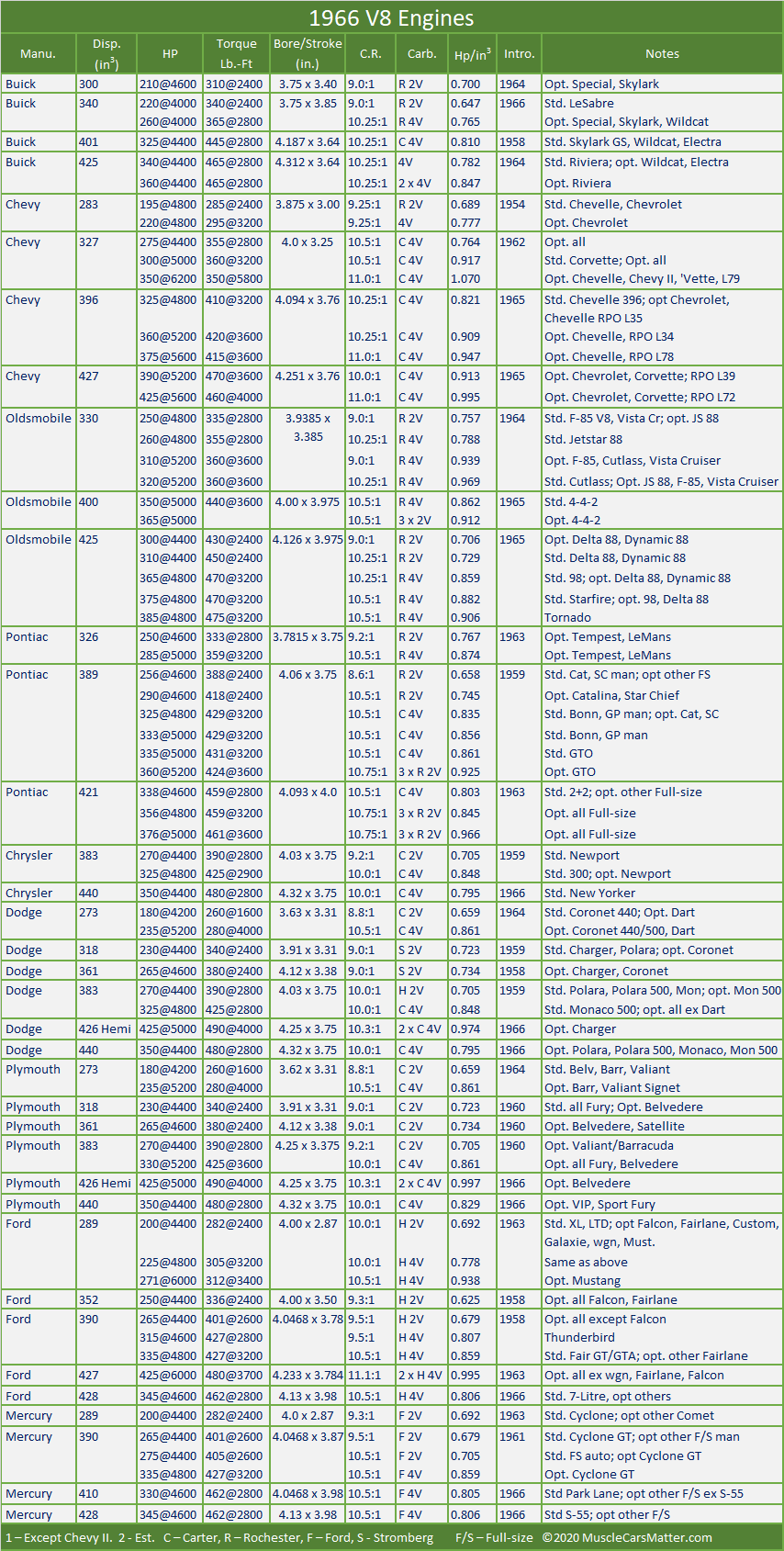
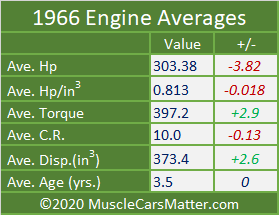
1966 V8 Engine Specs
1966 Newspaper Ads


Boss to company lawyer: “Sid, you got the permission to use the Casper character, right?” Sid: “Uh, sure…, boss.”
The price is actually a bit lower than the factory price listed in documentation.

Yeah. I don’t think we’re going to be seeing Native Americans depicted this way in the future. Don’t miss the “HIM HEAP BIG TRADER”. They have the ‘Seal of Integrity’, too. The cynic in me wants to say that this isn’t worth diddly squat.

