
This was a down year for the industry, with most automakers seeing double-digit declines from last year. Chevrolet came out the clear market leader this year.
Approximate sales: 7,820,000; Change: -12.4%.
1967 Noteworthy Events
- Chevrolet – Camaro! 350cid V8.
- Buick – 400cid V8 (so long, Nailhead).
- Pontiac – 400cid V8, Firebird!
- Dodge – Coronet R/T, 440 Magnum, Scat Pack.
- Plymouth – GTX, 440 Super Commando.
- Ford – Mustang redesigned, gets 428. Four door Thunderbird.
- Mercury – Cougar!

All of the major players were marginally down (Olds, -5.2%) or substantially down (Dodge, -26.4%) for ’67, with the exception of Buick, who eked out a small increase over their 1966 sales numbers. Interestingly, Ford took a much bigger hit than Chevrolet did.
Chevrolet
Chevy had a solid year, helped in part by some 221,000 copies they sold of the new Camaro. It had taken two long years for them to respond to the automotive market phenomenon that was the Ford Mustang. They did so with a similarly sized vehicle that borrowed nothing from Mustang, except for the general concept. Just over 63,000 Chevelle SS-396 cars were sold this year!
They also introduced the wonderful little 350cid V8, the result of adding 0.23″ to the stroke of the 327.
Approximate Chevrolet sales: 1,948,000; change -11.7%; industry rank: 1st.
Chevy Camaro
The Camaro could be ordered as a two-door hardtop coupe or convertible. There was no fastback style available, but that didn’t matter. I think it could be said that offering a fastback would have moved into the territory of perhaps being guilty of copying the Mustang. Well enough. The body lines were crisp and clean, especially when compared to the newly restyled 1967 Mustang (which was undeniably attractive).
Significantly, Camaro would offer the option of a 375hp 396, creating a level of performance that Mustang couldn’t touch with its optional 390, which had some forty or fifty fewer horsepower. Remember, several years ago there were two versions of the 390 that made more than 375hp. Why did Ford limit the 390 output so much? Those wanting the sporty looks but with less power could chose the 230cid six or the 210hp 327cid V8.
That wasn’t all, though. The Z/28 package appeared, which put 302 cubic inches of pure dynamite underneath the hood. This was the product of the marriage of a 327 block, with its 4.00” bore, and a 283 crank, with its 3.00” stroke. The reason for this wonderful little package was to homologate the engine for racing in the Sport Car Club of America (SCCA) racing series, with their five-liter displacement limit. The upgrade cost for this? A mere $328.10.
Sports Car Club of America (SCCA)
The Sports Car Club of America is based in Topeka, Kansas, and has been in existence since 1944. Their Trans-Am racing series was inaugurated in 1966, and limited displacement to five liters, or approximately 306 cubic inches. (People have argued that 302 cubic inches, as referenced to the Ford Mustang 5.0, “is actually 4.9 liters”, but why get anal about it?).
The process of homologation, in this context, is the certification that a car and/or engine is “production”, as opposed to specialty built for racing. It has to have been available to the public. The number of copies required to be sold is more often than not 500, although this might depend on other factors.
This concept of “it has to have been available to the public” isn’t unique to motorsports. Track and Field equipment, such as running shoes and pole vault poles follow the same practice.
Camaro DZ 302
Not surprisingly, this engine was designed for high-rpm power, possessing a redline of some 7,000 rpm. Heads were from the fuel-injected 327, with 2.02” intake valves and 1.60” exhaust. Internals were forged, and the pistons made for an 11.0:1 compression ratio. Induction was provided by a 780/800 cfm Holley carburetor sitting atop a dual-plane, aluminum high-rise intake manifold. The camshaft was an aggressive “Duntov 30/30”, with solid lifters. Specifications for the cam are .452″ intake and .455″ exhaust lift, 229° intake duration and 237° exhaust duration (both measured at .050″ tappet lift) and 78° of overlap (at 0 lift).
The DZ was factory rated at 290hp at 5,800 rpm and 290 lb.-ft of torque at 4,200 rpm. It’s long been rumored that the engine power was substantially under-rated by Chevrolet. Figures have been published, based on “guesstimation” or mysterious, midnight dyno runs, that range from 350hp to “well over 400hp”.
Really 290hp?
Frankly, I resisted accepting the supposed reported horsepower levels of both the Z/28 and the ’69 – ’70 Boss 302, its Ford counterpart. This is all fully discussed in Horsepower and Torque. Upon looking at all of the available information that’s been generated over the years I have come to believe that the DZ 302 was indeed substantially under-rated by Chevrolet by some 40 to 60hp.
With the DZ, we do have a reference point we can use. These are the same heads the carbureted L76 365hp 327 used. This 327 made 1.116hp/in3. Using this same figure for the 302 gives us 337hp!
The Z/28 was capable of very low 14 second quarter mile times. The gearing was appropriate for a smaller, high-revving engine, being in the range of 3.73:1 to 4.11:1. A well running Z/28 could walk all over an unsuspecting big block car, especially one that had more “daily driver friendly” rear-end gearing.
GM Self-Inflicted Dumbassedness
In my view, GM has a long history of doing really dumb, and sometimes unethical things. Those who are jaded might have expected them to screw up their pony car market entry, like they would later botch their initial economy car, Vega.
General Motors … Didn’t Mess It Up!
I know that I dump on GM a lot. They usually deserve it; even here in 2020 they’re still doing dumb things. Regardless, they really did the Camaro right. They took enough time and didn’t rush to market with something half-assed. The Camaro, as introduced, was a killer product. It was undeniably a pony-car, aimed straight at the Mustang bullseye. But it wasn’t a “Mustang wannabe”. It had its own character and did things its own way. The 230cid six and the 327 had the base market covered, with the 396 offering performance Mustang couldn’t (yet…). Then, add the Z/28 to the mix, the great options like hidden headlights, and I just can’t see how they could have done this better. Way to not screw it up, GM!

I really like this little engine! I think Chevy created the definitive ‘small car with a hot, smaller engine’ with the Z/28. A lot like a small block Corvette but having 4-passenger utility.

The lines of Camaro were really clean and attractive. There was little in the form of bolt-on enhancements, like fake scoops. It didn’t need it.
I find it a bit odd that some sources say that Chevy viewed the first series Camaro as something of a stop-gap. I mean, they had plenty of time to develop the car it would seem. These same sources indicate the second series Camaro (1970) was finally the fully-developed model. This could possibly be true, but I’m not sure what to believe. What do you think?


Camaro didn’t have to go through the learning curve that Mustang did, being released 2 ½ years after Mustang. It had big-block power from the onset, as well as (of course) an available giant-killer small-block, in the DZ302. First year sales were 221,000, about half that of Mustang for ’67.
Car and Driver March, 1967


Chevelle SS

Chevrolet sold roughly 63,000 Chevelle SS 396 cars this year, about 20,000 fewer than Pontiac sold GTOs. There weren’t a lot of changes for ’67.

Chevelle’s new rear look was clean and sporty, with ‘SS’ centrally located. That tells you all you need to know!

The ‘solid’ grille of the ’66 was redesigned for ’67, now sporting a substantial horizontal bar. The front fender cut-back was reduced on the ’67 model.

The rear styling of Chevelle was redone, with the Chevelle script being removed and the ‘SS’ placed in the center. The tail lights on the ’67 were also more integrated into the rear fenders, and were also visible from the sides.


Note the text at the bottom of this ad: “THE QUICK-SIZE CHEVELLE FOR THE DRIVING MAN”. There was no mistaking who their target audience was here.
Nova

Nova’s and Nova Super Sports accounted for the majority of the Chevy II sales this year.

Not much updating was done, but Chevy II would be known for clean styling and minimal updates.

The sweet little 350 V8 small block. This would be the displacement, more than any other, that would cement the Chevy small block’s place in history.

The message here is that a smaller economy car doesn’t have to be plain. This probably resonated with a lot of people.
I like the monster sized lollypops the kids have. They’ve kinda gone out of popularity it seems. As cute as these girls are, would you let three lollypop-licking kids into your new Chevy II? Yeah, I guess I would, too.


Impala

Here’s a front look at the big, beautiful bruiser that is Impala Sport Coupe. Chevy is boasting about how big and heavy it is. When I see something like this from the late ’60’s I always think “You high-priced auto executives really had no clue what was happening and what was going to happen, did you?”
Don’t miss the text at the bottom: “Everything new that could happen… happened!”
Chevrolet Large Cars
How Many Different Models?
First of all, this isn’t a Chevrolet or General Motors issue; it applies to all domestic automakers. It’s also not totally a critique as much as it’s an observation. We’re going to use the 1967 Chevrolet full-size cars as our example.
How many full-size cars did Chevy offer in 1967? If you happen to be well versed in mid-to-late ’60’s Chevys, you might say “Four; Biscayne, Bel Air, Impala and Caprice”. You would not be wrong, but let’s take a closer look at it.
All four of these series used the same chassis, with its 119 in. wheelbase, as well as the same body by Fisher. The differences between the four series consisted of two things: base equipment and options available. To be clear, this was not at all a new concept in 1967. We just chose to highlight it here.

Biscayne was the base level full-size Chevy. It was pretty spartan. Base price for the 2-door was about $2,550 ($19,980-2020$). The car shown here does not have the small hubcaps that were standard. Notice that there are no wheel well moldings, drip rail moldings, or lower bodyside moldings.

Bel Air was the next step up. Base price for the 2-door was about $2,650 ($20,765–2020$), $100 over the base Biscayne. Added to the Biscayne level were a glove box light and an ignition switch light. The same molding comments apply here, except that a drip rail molding was present.

Here’s Impala, priced at $2,845 ($22,295–2020$). Unlike the Biscayne and Bel Air, there was no Impala 2-door ‘post’. What was available in its place was a 2-door hardtop, as shown here. This was about $200 over the base Bel Air price. This car has full moldings. Looks like the buyer spent the $16 for front bumper guards.

Caprice was the top level of full-size Chevys. Base price was about $3,080 ($24,135–2020$), or $235 over the base price of Impala. Caprice was available with a V8 only, while the others could be had with a straight six. The Caprice here has full moldings.
The comments above are by no means complete regarding the differences between the four series. Aside from the additional exterior bright pieces, there were also interior trim pieces, such as accelerator pedal trim.
Smoke and Mirrors?
Was this ‘repacking’ of the same body/chassis an attempt to deceive in any way? No, it wasn’t. Even an automaker like Chevy didn’t need more than one full-size car at a time. This type of presentation (four different series) afforded the buyer their choice of price points and option levels. I view it as smart marketing, more than anything else.
Most other automakers followed the same process of model differentiation. This year Ford had their midsize Fairlane, available in Fairlane, Fairlane 500 and Fairlane 500 XL, all both 6 and 8 cylinders. Their full-size lineup followed suit, with Custom, Custom 500, Galaxie 500, Galaxie 500 XL, and LTD, most both 6 and 8 cylinders. These were mostly just different option and trim levels of the automaker’s small, midsize or full-size platforms. Of course, if you wanted a V8 engine that might preclude you from choosing one of the lower models in some cases.
1967 Chevrolet SS Lineup Brochure


The optional hidden headlights looked cool, didn’t they? Rather than lift or pivot upward, they slid inward toward the center of the grille. They were electric motor activated, unlike Pontiac’s GTO and its vacuum system.

1967 Chevrolet Accessories


Early solid-state consumer electronics makers loved to specify the number of transistors and diodes their products contained. This was actually based on the earlier practice of indicating different levels of electronic sophistication by specifying the number of vacuum tubes.
Note the highlighted statement at the left. Indeed, the electronics industry was moving to printed circuit boards. There were still many units with wired backplanes. I love the reference to “modern space ships”!


Here’s an advertisement for an aftermarket 8-track tape player. You should recognize the name, but not from the tape player market. This is the same Lear Jet as the aircraft manufacturer. Bill Lear was an early pioneer in this area.

Here’s the more familiar Lear Jet product, the Learjet 23. There were 101 built during the period from 1964 to 1966. This is the aircraft that ignited the private jet market.
Corvette
Though 1967 Corvette was a cleanup or refinement of the ’66, it was still gorgeous. Sales were down, relative to the huge ’66 surge, but still healthy. After all, everyone knew a new ‘Vette was on its way for ’68, so maybe selling around 23,000 copies was a major achievement. You could get up to 435hp (officially) in the 427cid V8, or up to 350hp in the 327cid V8. That’s over 1hp/in3!
Approximate sales: 23,000; change: -17.8%.

Yeah, this would be the final year for this body, which very well might have depressed sales somewhat. We’ve certainly seen that in the years since.

Side pipes were optional, of course.


Can you imagine lifting the hood and being greeted by this beauty? You’d just have to pop the hood and check the oil every time you got gas!


“A plodding sort of economy car. (Wheee)” That’s great! The car looks good from the front, doesn’t it? The ‘Wolf in wolf’s clothing’ is an apt description of a 427 Corvette.
427 RPO L88
This was a ‘race-only’ engine that was produced and sold in very limited numbers, and was hideously expensive. It featured heads that were optimized for high-rpm horsepower, and every other component of the engine was similarly race quality. Dyno testing of the engine yielded 500+ horsepower, though Chevy rated all such ‘race’ engines at either 430 or 435hp. The L88 liked 100+ octane gas, which might have been hard to come by where you lived. And, at around $1,500, it added over one third to the cost of your Corvette! You can read all about the L88 and other Chevy 427 engines in the Muscle Car Era Engines section.

I really, really, really like ads like this that have a cool pic of the car and tables of specs! I couldn’t have been the only kid who folded up ads like this and kept them in his wallet, pulling them out to admire that which I could never afford. (No, don’t go there; we’re talking about cars, not girls…)


Chevy had a bunch of great advertisements for Corvette, and this was one of them! Just look at that engine.

Buick
Buick presented two new engines this year a 400cid V8 and a 430cid V8. The 400 replaced the 401 Nailhead, and the 430 replaced the 425. The 400 had a smaller bore and longer stroke than the 401, with the 430 going the same direction. In fact, the 3.90” stroke was shared by both new engines.
The 400 picked up 15hp over the 401, but at 600 rpm higher. The 430 made the same 360hp as the 425, but again at a 600 rpm higher engine speed. Both engines had conventional wedge-shaped combustion chambers, rather than the unconventional, ‘semi-pent roof’ of the 401 and 425. Valves were larger than the tiny ones of the Nailhead V8s but were still rather smallish when compared to those of similar sized engines. The GS340 made its appearance this year.
Approximate sales: 562,000; change: +1.4%; industry rank: 5th.
Skylark and Skylark Gran Sport

Skylark didn’t see a lot of change this year. However, the GS model did pick up a smaller sibling in the form of the GS 340, a midyear introduction. This featured a 260hp version of the little mill.

The inset rear window with roof ‘sails’ was not unique, but was an interesting look. Riviera took a different approach, with the glass sharply sloped with the roof line. As a practical matter, the way the window was designed here didn’t increase the interior volume with mostly unusable space.

The front of Skylark last year was not nearly as pointed as it was in 1967. The previous single horizontal and vertical grille pieces were replaced with a grille that was composed of several substantial horizontal pieces.

The ’67 rear styling was similar to the ’66 look shown here, but the delineation between the rear trim panel and the tail lights was made much more pronounced in ’67.

The 400 was a great little engine. I find it mildly amusing that Buick replaced their 401 with an engine that was slightly smaller. This kind of bucked the trend of the era.

Big-car engine exclusively, not much for the muscle car enthusiast to get excited about.

‘The Tuned Car’. Maybe not the worst slogan I’ve heard, but far from the best.
This advertisement is a bit odd. It does talk about the 430cid V8 and shifter, and I guess the implication is wide open spaces.
The girl in the rising sun (maybe she had to pee?) I dunno. Do like the silhouette of the Riviera, though.

Wildcat had s somewhat different grille this year and continued to be a wonderfully styled car.
Buick Gran Sport California

The GS California used a post coupe body style (as opposed to a hardtop) and used the 260hp 340 V8. Like the GS 340, it too was a midyear introduction. Standard transmission was the Super Turbine two-speed auto.

Riviera

The Riviera received an updated grille and tail lights. $138 got you the GS equipment.

Riviera was gorgeous from virtually any vantage point.

Here’s the front of the ’66 Riviera. The ’66 and ’67 were very similar, with the ’67 having a horizontal accent piece the ’66 did not.

Looking at these pictures of the rear of the ’66 and ’67 makes it kinda hard to actually see any difference. I had to find some high-resolution pics and compare them side-by-side to spot any difference, which was quite subtle.


Here’s Gran Sport as a 2-door hardtop. The picture of the bronze color GS California, above, shows the 2-door coupe version. Buick faced a considerable obstacle during the muscle car era, which was their persona as ‘an old person’s car’. This was not a totally unfair depiction. Their advertising took this head on, with ads like this one. What demographic were they addressing? Young men AND women!


LeSabre and Electra

Remember back in the early post-WWII years when Buick developed their own automatic transmission, Dynaflow? It didn’t shift gears, by design, relying instead on a complex torque converter. This was in the name of ride quality, something that Buick is espousing here.
“When better automobiles are built, Buick will build them” is one terrific marketing slogan, isn’t it?

Okay. First of all, the seats remind me of my grandma’s sofa. With all due respect to Mr. William Neale, Real Estate Investment Counselor, just what the hell does he know about cars? I’m going to listen to a real estate person about cars? No, don’t think so. Maybe I should find Vinnie, the ambulance-chasing lawyer and ask him his opinion. Gimme a freakin break! The guy in the background (Mr. Neale?) bothers me, too.
Okay, gotta say I do like the slogan used here: “Wouldn’t you really rather have a Buick?”
Oldsmobile
This was the year that the Cutlass Supreme became its own series, having been previously (’66) just a single model. It would be offered in five models, one of which was a convertible. Cutlass supreme sales exceeded Cutlass by 50%, and the series combined accounted for about a third of total Olds sales. Cutlass S is now the sole vehicle for the 4-4-2 option.
The marketing wizards at Oldsmobile decided to shake things up a bit, by introducing a new name. This was the ‘Delmont 88′. This occupied the position that had been occupied by the Dynamic 88. Wow, from ‘Dynamic’ to ‘Delmont’! The advertising guys must have been working overtime!
Approximate sales: 548,000; change: -5.2%; industry rank: 6th.
4-4-2

I like Oldsmobiles. I like 4-4-2. But I have to think that up to this point, 4-4-2 just wasn’t doing it for me. I think the styling of GTO, for example, was light-years ahead. I’d also have to say that both Gran Sport and Chevelle were better styled.

Last year the 4-4-2 option was available on both F-85 and Cutlass. For ’67 it was only offered with Cutlass Supreme. Supreme was now its own series, consisting of five models. It was introduced in ’66 as a 4-door hardtop member of the Cutlass series.

The most obvious changes to the front of 4-4-2 were the headlights on the ’67 being spaced apart on each side, no longer being side-by-side. Also, the ’67 grille area is ‘pinched together, no longer being the height of the headlights like the ’66 here is.

The ’66 car had the tail lights located in the rear fenders, while the ’67 split them so that the upper half was in the fender and the lower half in the bumper.
Toronado

Toronado just saw minor updating in its second year, but heck, it was brand new just last year!

This thing was built like Secretariat. 4,300 pounds of sculptured American steel in a drop-dead gorgeous body. Utterly unique, this was rolling proof that Olds was not interested in following the pack.
Olds couldn’t keep this good thing to itself, apparently, as Cadillac introduced their Eldorado based on Toronado. As a Cadillac, Eldorado was the ‘baby’ of the lineup! The Eldorado was some 300 lbs. heavier and $1,800 more expensive. I think the Olds was the more attractive of the two cars.

Olds Advertising

I think it’s fair to say that while cars like the Pontiac GTO were ‘mature’ muscle cars, 4-4-2 was still in the process of coming into its own. Just under 25,000 found buyers this year.
The text of the ad mentions ‘sway bars, front and rear‘. You might be tempt to think ‘big deal’, but remember that Pontiac didn’t have rear sway bars because John DeLorean didn’t believe in them! It also mentions ‘beefed-up’ wheels. Sportier, certainly, but ‘beefed up’?

One thing that was something of a constant with Olds advertising was their use of the term ‘Rocket’, and here, ‘Rocket Action’.
I’d have to say that ‘neutral’ advertising, like the example here, wasn’t what it was going to take to win market share. Olds would, in a few years, have some of the coolest advertisements of the entire era.


Don’t miss the fact that the little 330cid V8 could be had in 310hp and 320hp versions. The latter is close to 1hp/in3, from Oldsmobile!

Cutlass Supreme was quickly becoming the intermediate of choice for Olds’ buyers, while F-85 and Cutlass saw smaller and smaller market share. This would continue in the coming years.

Yep, that’s right. Cutlass Supreme now had five models: 2-door Sport Coupe, 2-door convertible, 2-door hardtop, 4-door sedan and 4-door hardtop. Just short of 22% of all Olds sales were from Cutlass Supreme. The ladies are wearing rather modest bathing suits, aren’t they?
Pontiac
1967 will always be remembered as the year that General Motors responded to the Ford Mustang. The Mustang had successfully defined an entire new market niche, of which it was the undisputed master. To their credit, GM responded with two different makes, Firebird and Camaro. Although Camaro and Firebird were understandably similar, being built on the same platform, the styling was unique to each brand. The difference in available engines served to further differentiate them. GM and Pontiac hit a bullseye with this one, no question. Firebird was released on February 23, 1967.
The Star Chief name is now gone, and the great Grand Prix picked up a convertible model.
Pontiac Engines
This was the year that the venerable 389cid V8 would be retired. U.S car makers were masters of recycling, and the 389 was ‘recycled’ into the 400, by increasing the bore by approximately 0.060”. The block remained the same, and similar heads were used, but with larger valves. The new 400 was also available in an optional “Ram Air” version, the centerpiece of which was the functional hood scoops.
See Muscle Car Era Engines for complete Pontiac 400 information.
The GTO had always featured hood scoops, but they were never functional, until this option came around. Cars with the base engine still had non-functional scoops.
The Ram Air engine made an additional 25hp over the 335hp of the base engine, thanks to a hotter cam and exhaust manifolds that were more free flowing.
The 421 had its bore increased by 0.030”, making the 428cid V8. Horsepower ratings didn’t change, with 376hp being the highest output engine. Seven cubic inches? Hardly seems to have been worth the bother.
The other significant engine news came courtesy of GM itself. This was the ban on multi-carb setups for all but the Corvette. No more Tri-Power setups. If you are thinking “GM dumbassery”, you’re right on the mark.
Approximate sales: 782,000; change: -12.4%; industry rank: 3rd.
GTO

GTO got a new body last year, so this year there was just some mild tweaking. Note the grille change and the front fender badge relocation compared to the ’66, below. Also note how the front trim piece now runs the width of the front, dipping in the middle.

The grille changes from the ’66 pictured here were quite subtle. The front bumper certainly looks the same for the two years. Note where the fender badge is mounted for this ’66, and how it was moved down to the rocker panel on the ’67.

Another GTO change was was to the tail lights, with the ’66 below.

The rear of the ’67 no longer has the chrome follow the trunk and fender edges, as it did here with the ’66. The ’67 also has tail lights that look more separate. Frankly, I’m kinda favoring the ’66 look over the ’67, though I’d gladly take either!

The Pontiac 400, successor to the wonderful 389.

Grand Prix

Grand Prix was updated but continued to show unique styling. An attractive car for sure, but I’m rather partial to the ’66, especially the front end.

Here’s the front of GP last year so you can see how much different the new design is. Frankly, I like the ’66 look more. You?

Grand Prix’s rear end styling changed from last year, too.

Here’s the ’66 rear end, which I think I prefer to the ’67.
Firebird!

Firebird was the sibling to Camaro, yet presented its own unique personality. Both cars were aimed at the same target market, although Firebird was often portrayed as having a European flavor.


Firebird had some gorgeous lines! It was clean from any angle, and had a well-integrated look.
I like this advertisement. It appeals to women, but doesn’t turn guys away, either. It’s certainly true that the five different performance levels had appeal that cut across a broad swath of the buying public, both male and female.

The OHC 6 was a wonderful little engine. An American car with an overhead cam engine in 1967! Plus, there was Sprint, a 4bbl 215hp version you could get!


Here’s ‘The Great One’ theme. Yeah, it was.


Why Doesn’t my Carb Thingy Open all the way?
I remember reading 30+ years ago how some Firebirds of this era “had their peak horsepower rating kept low” by having a carburetor linkage that didn’t allow the secondaries to open fully. It seemed strange to me way back then and I was skepticle.
The Formula 400 was rated at 325 hp, just ten horsepower less than the GTO’s 335 hp. But, Firebird weighed a couple of hundred pounds less than GTO did. GM was adamant about not allowing engine power to exceed 10 pounds per horsepower, and a 335hp Firebird might have run afoul of this. I have one or more period repair manuals, such as Motors and Chiltons, that refer to a Rochester Quadrajet carburetor with a limiter tab on the secondary air valve to prevent it from opening fully. Given that GM did some weird crap, I’m finally willing to accept this as as fact rather than fiction.
1967 Pontiac GTO, Sprint, 2+2 Brochure


Chrysler
Not much exciting at Chrysler this year. Newport, 300, New Yorker. Some big engines, but hauling around between 4,000 and 4,200 pounds! This is going to be our last entry for Chrysler. They were indeed a part of the ’55 –’63 performance movement, but that was then.
Approximate sales: 218,000; change: -17.5%; industry rank: 10th.


Not a bad advertisement, all in all. I don’t know how many people skydive and target their car when picking their landing area.
So, did she jump, too? He has his special skydiving suit, but she’s wearing all black. Seems like I’m missing something here…


Dodge
This year the Dart was redesigned, resulting in a nice look that was more “big car” looking, although it wasn’t actually larger than the ’66. The Coronet now carried a front bumper and grille that were flush mounted, like that of the Charger. The Polara was totally redesigned, now being wider, lower and longer.
Monaco became something of an upscale Polara this year, having adopted the Polara body. Both Polara and Monaco featured a bodyside crease that ran horizontally, just over the rear wheel-well. It started just behind the doors (2-door) or in the middle of the rear doors (4-door) and extended to the rear of the vehicle. In a way, it was reminiscent of some of the late ‘50’s Dodge lines. Charger continued with only minor changes.
The wise sages at Dodge decided to tweak the 440, by creating a performance version of it. They added heads with larger ports and valves, a free-flowing intake manifold, a hotter cam, and a performance Carter carburetor. The result? The 440 Magnum, of course! 375hp, Baby!
Coronet R/T
The Coronet R/T (Road and Track) was offered this year, with the 375 hp 440 as the standard engine and the 426 Hemi available optionally. Two Dodge Hemi cars!
After Dodge’s performance last year, that was better than most, maybe it’s fitting that ’67 was worse than most for Dodge. Their decline from ’66 levels exceeded every other automaker’s.
Approximate sales: 465,000; change: -26.4%; industry rank: 7th.

Dart got new sheet metal on the same chassis as last year. Front styling was updated and was quite attractive. ’66 front is below.

The front of Dart in ’66 was just about as plain as it could possibly be. The ’67 front had a grille with a central vertical piece and the hood sloped down to the front, making an area for the D-O-D-G-E lettering to be more forward-facing than it had been.

Rear styling was also nicely updated and still featured a full-width trim piece. Taillights were now more modern.

While not unattractive, the ’66 rear was not nearly as pleasing as it became in ’67. Tail lights on the ’67 were integrated into the fenders, unlike the ’66 here with them placed in both fender and trunk lid.
Charger

Charger didn’t change much this year. It’s been said that some felt the styling similarity to Coronet hurt Charger. It was indeed built on the Coronet platform, and did share some sheet metal. Sales were disappointing, especially considering what the car had to offer. Dodge would take this to heart, and, as we all know, next years model would be new and breathtaking.

Substantial reinforcement work had to be done to the C-pillars with such an extreme fastback design. Remember, the platform was not designed initially with this style in mind.


I don’t know about that rear fender crease feature. It reminds me too much of the ‘ugly Dodges’ of a few years ago. Monaco was only a bit player for Dodge, representing less than 4% of their sales.

Here ‘pure performance’ is being sold; nothing less.
I’ve always referred to the car as ‘Coronet R/T’; it still seems a bit odd to see it referred to as simply ‘R/T’. Which R/T? Coronet? Charger? Others? (I’m so confused…) On top of this, I just noticed that the ad says “road” and “runner”. Road Runner! But that’s Plymouth! And not until 1968! I need an Excedrin…


‘kiddy car compacts’. I love it! The ‘little’ Dart had all of the go-fast hardware you could want, including a 235 horse 273. Lotta go for not a lotta bucks.

440 Magnum! Oh, yeah, baby! I sure like the term ‘Big Bore Hunter’. The red-on-red, the 440 picture, the Dodge Girl; this ad has it all.

For some reason, I didn’t remember liking gray sweaters so much.
1967 Dodge Brochure


Plymouth
Plymouth gave the Valiant a new body this year, which saw no radical change from the previous styling. The Barracuda became its own series in ’67, no longer being a member of the Valiant family. There was also a fastback called Sports Barracuda.
Belvedere received a mild makeover, with the Satellite remaining a step-up from the base models, and the GTX placed at the top of the lineup. GTX would go on to become a feared and respected street fighter. It was the sole Plymouth model to have optional the 426 Hemi. All intermediates are Belvederes.
As with their Dodge sister, Plymouth wanted a performance 440cid V8. They used the same formula as Dodge, with heads, cam, etc. The Plymouth version was named the Super Commando. Again, we’re talking about 375hp and a veritable crap-ton of torque.
The nineteen Fury variations would round out the Plymouth lineup.
Approximate sales: 638,000; change: -7.1; industry rank: 4th.
Belvedere GTX

Belvedere GTX received a refreshing, with the grille now sporting quad headlights.

The rear styling of the ’67 was updated but still bore the same general styling as the ’66.

The Belvedere front in ’66 had single headlights on each side and large round parking lights mounted in the grill.

The ’66 rear bore a strong resemblance to the ’67 style.

Barracuda continued to be the ‘neglected pony-car’. Too bad. It was an attractive little thing and would really move if equipped properly, and without breaking your bank account, either! The fastback and rear window were now a little less unique, but still gorgeous. The new front end really worked nicely, too.

Barracuda’s 1966 front is pictured above, and you can see how it was changed for ’67. The new look was attractive.

Barracuda was indeed new this year, and it was darned attractive.
Plymouth was selling sports performance with this add, not necessarily brute straight-line speed.
The references to ‘European’ makes a lot of sense, too.

This advertisement for the Belvedere GTX reflects the same ‘win you over’ theme as the Barracuda advert. This was an advertisement for a muscle car.


Hemi GTX! Need I say more? Note the redline tires in the top picture. There’s more info on these tires in the box below. For some reason, I can’t get it out of my head that the guy with his fingers in his ears is John Candy. I know it can’t be. And who puts their fingers in their ears anyway? Don’t most people just put their hands on their ears when something is too loud?
Redline Tires
Redline tires first appeared around 1964 or 1965 and were inspired by a similar style in use on sports cars in Europe. The line width was 3/8 inch, the same as the latest white line tires that were available. These imparted a certain sporty look and were followed by tires with blue and with gold lines. It would seem that their popularity was rather short-lived, though they have reappeared in recent years.
1967 “Motion By Plymouth” Brochure


Ford
The two noteworthy events at Ford this year were the graduation of the Mustang to big-block power (as an option) and the introduction of the first Thunderbird four-door model.
The Thunderbird as a four-door would seem like sacrilege to many people in later eras, but at the time, it made perfect market sense. The car had initially weighed in the low three-thousand-pound range, having only a 102 in. wheelbase. The redesign in 1958 saw a longer wheelbase and substantial weight being added. In 1962 the 4,000 lb. point was passed by all models in the series, and for the next five years the weights hovered in the low four-thousand-pound range. The ’67 was in the same weight range, and had a 1.8 in. longer wheelbase for the two-door, with an additional two inches added for the four-door.
The point is that the ’67 wasn’t that much bigger, really, and the focus on “luxury performance” had been taking place for much of the decade. Ford executives had calculated that the public would embrace a four-door model, and they seemed to have guessed right. The four-door had rear “suicide doors”, with hinges at the rear, which imparted a sense of uniqueness. The four-door model accounted for just under a third of T’Bird sales this year.
Mustang now received the 320hp 390cid V8 as its top engine option. This would prove to come up a bit short relative to the new Camaro’s 396, but it was certainly an indication of things to come. Mustang had graduated to big-block power! Ford experienced a 57-day UAW strike this year.
Approximate sales: 1,730,000; change: -21.8%; industry rank: 2nd.
Thunderbird

Thunderbird was totally redesigned for 1967, with the front featuring one large oval area with hidden headlights. As last year, the Thunderbird emblem was placed in the center of the grille.

The ’66 front, pictured here, was quite changed for ’67.

Thunderbird styling is way different this year, especially from the front. I thought the ’66 look was nice, but the ’67 with its wide expanse of grille and the ‘bird in the middle was just fantastic.

The ’66 rear sported full-width tail lights and a bumper that surrounded them. The ’67 bumper would be more conventional, and the tail light setup similar to the ’66 design.

Here’s the new 4-door Thunderbird. I have to think that this was pretty well done.

The grille of Mustang was larger than last year, but was otherwise similar. The grille did now feature a horizontal bar. Parking lights were smaller than last year.

It’s easy to see that the ’66 grille was smaller than the ’67.

The rear panel of Mustang was similar to the ’66, below, but now had a concave shape and chromed piece that ran around the perimeter.
The 1966 Mustang was a darned attractive car, but I do like the changes that were made in 1967.

Mustang’s rear was flat and its tail lights convex in ’66. This year both will become concave.

Mustang Changes for ‘67
The side scoop in front of the rear wheels was now two adjacent non-functional scoops, painted body color. The front grille lost most of the horizontal bars, having but one, and one vertical bar, centered on the corral surrounding the pony. It was more like the ’65. The rear was similar to before, but with a bit more separation between the three taillights on each side. The shape also went from convex to concave, and a chrome piece was now seen extending from the edge of the bumper, up to the trunk lid, across the edge of the lid, and down to the bumper. The ’67 body was roughly 2 in. longer and wider, and a half inch higher. Weight increased marginally, and, at 108.0”, the wheelbase was unchanged.

A fair amount of Mustang advertising played on the name as being a type of American horse. Here they were highlighting the sportiness of the car, only mentioning the V8 engines.
I have no way of knowing for sure, but I suspect this manner of advertising was fairly effective.

This is a cool ad. Note that it is targeted straight at the ladies. Ford did this well, especially with Mustang.

Carroll Shelby’s association with Ford was unique, and it resulted in some of the most memorable and collectable cars of the era.
1967 Mustang Brochure


1967 Shelby GT500
Car and Driver February 1967


Galaxie 500

Galaxie sported some nice lines for 1967. LTD, which had been the top trim level, became a bona fide series this year.

Galaxie had that ‘I’m a mature adult, but don’t mess with me or I’ll embarrass you’ look to it. Maybe the demographics were a bit older for Galaxie owners, but you didn’t want to make the mistake of disregarding them.

Galaxie had some nice front styling in ’66, which became even better in ’67. I like the way the grille and the front of the hood are peaked in the ’67, shown here.

The ’66 grille was fairly flat, while the ’67 followed the trend of being pointed in the center. The cool parking lights that were located in pairs on each side of the grille were replaced by more conventional bumper-mounted lights in ’67.

The Galaxie rear was just a bit plain in ’66. The ’67 model would add a trim panel to the bottom of the trunk lid. Where the ’66 tail lights were square, the ’67 tail lights were taller than they were wide.

Fairlane wasn’t known as one of the hardcore muscle cars, but it could be optioned with the 427.
The girl’s dress having the same color and stripe as the car and the guitar with its stripe made for a cool look.


Ford 428cid ‘FE’ Engine Mystery
I have to say that Ford’s 428 has always puzzled me. There were a few engines that were intentionally under-rated by their factories, usually picking a horsepower and rpm value that were true, just not where the peak power actually occurred. Chrysler’s 426 Hemi likely did make 425hp at 5,000rpm, but that wasn’t the horsepower peak. It was closer to 6,000rpm, where it made about 475hp. When this was done, it was typically with the hottest engines. Even there it was not at all common.
Ford, on the other hand, seemed to have just picked a horsepower number out of the air for their 428. Earlier versions of the 390, from which the 428 was derived, made more power than the 428 ever did, at least officially. In 1961, Ford had a 375hp and a 401hp version of their 390. In 1961! There was even a 360hp version of the 352 in 1960.
But It’s the Largest One!
In the entire Ford FE engine family, the 428 made more horsepower than only one engine, the 332, and that’s using the 360hp version of the 428! Also, the 428 was the end of the line for the FE engine family, which started in 1958 with the 332 and 352 engines. It was Ford’s top engine in just 1966 and 1967, with the 385-engine family arriving in 1968 in the form of the 429 and 460. Preparations for the 385 family were probably underway since 1966, the year the 428 landed. Come to think about it, the 428 never made the horsepower that most versions of the 427 did, even limiting the 427 to a single 4bbl, like the 428.
Actually, there’s a bit more to the story. As detailed in Horsepower and Torque, the 428 is one of the Ford engines of the ’60’s that was under-rated by FoMoCo. Even if rated for its actual output, it was not one of Ford’s 1hp/in3 engines, but it deserves more respect than the factory rating would indicate!
FoMoCo Automatic Transmissions
Maybe the only thing harder than keeping Ford automatic transmissions straight is keeping the Mopar semi-automatics of the 1950’s straight. The C4, introduced in 1964, was derived from the Borg-Warner two-speed Ford had been using. This was the Cruise-O-Matic. There was a Dual-Range version, a fancy name for the fact that you could start out in 2nd if there was limited traction. This position was indicated by a small green dot on the shift indicator, while a larger green dot indicated the normal ‘Drive’ position. I guess people got these backward and were unwittingly skipping first gear!
In 1966 the C6 came along. This shared the overall design of the C4 but was much stronger and was able to easily survive service behind the Ford big engines of the era. The C5 would actually not arrive until 1982, being mostly a C4 with a locking torque converter. So there you have it!

It seems like it would be a shame to omit any reference to the Ford GT40, winner of four consecutive Le Mans 24 Hours victories.

Yes, Ford is indeed trying to use Mustang to help market their lawn tractor. LGT -> Lawn GT? Ford was involved in farm tractor production from the WWI timeframe until the 1990’s. Lawn tractors, like this one, were manufactured for Ford by Gilson Brothers, a company based in Wisconsin and founded in 1911. Gilson was swallowed up by Lawn-Boy in 1988. Throughout its history, Gilson Brothers made snow blowers, snowmobiles, barbeques, and minibikes, as well as other items.
Mercury
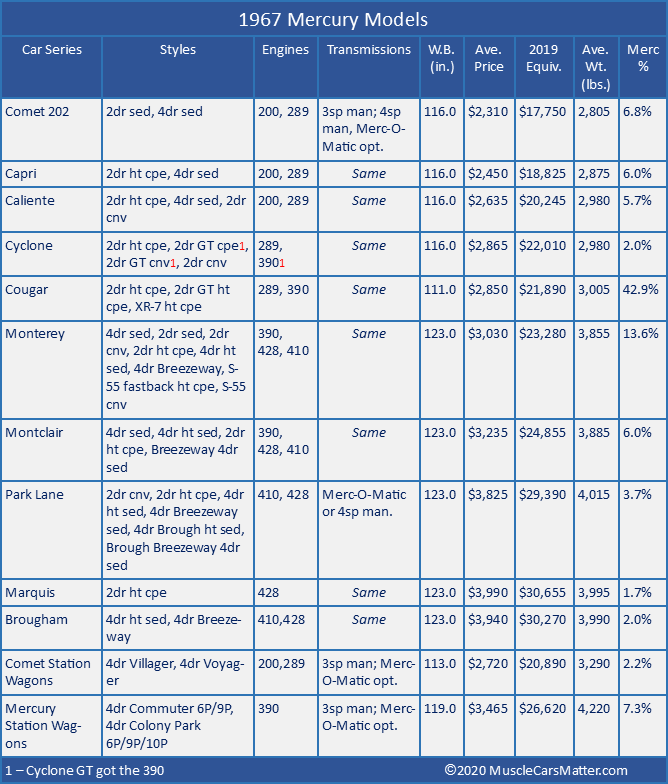
Mercury held steady this year, with a slight increase in sales over ’66. Of major interest was the Merc “sister car” to the Mustang, the Cougar. The Cougar wheelbase was 111 in., or some three inches longer than the Mustang. Still, it was far shorter than any other Mercury model. The Marquis series arrived, consisting of a two-door hardtop coupe.
Cougar had a look that was all its own, with straight, bold lines. All three models within the lineup were two-door hardtops. In addition to the base model, there was the XR-7 hardtop coupe and the GT hardtop coupe. There was about a $200 spread in price from the base to the GT. Roughly one in five buyers bumped up to the XR-7, with the XR-7 outselling the GT by about four to one. Cougar was the Motor Trend Car of the Year for 1967.
Approximate sales: 355,000; change: +3.5%; industry position: 8th.
Cougar
Under the Heading “Get Freakin’ Real. . .”
Jaguar of England was concerned about Mercury’s use of the name ‘Cougar’ and their proposed cougar emblem. They are both cats, after all. People might get confused, right? Merc would have been justified to have told the Brits to go pound sand up their collective arses, but they worked out a deal to placate the makers of those British cars, known for their wonderful engineering and reliability. Mercury agreed that, for the first two or three years they would always place the name ‘Cougar’ by any cougar (the animal) representations. Brother!
Hey, we kicked your butts in 1783 AND 1815, and don’t forget it! Wait… They did give us Monty Python, Benny Hill, Fawlty Towers, The IT Crowd and Elizabeth Hurley. Okay, we’re good.
Mercury would capitalize on the success of the Cougar by associating itself with cougars (the big cats) in much of their advertising of the ‘60’s and ‘70’s. Many of you remember “The Sign of the Cat” theme that Mercury used, as well as the shot of a cougar laying atop a raised Mercury sign.

In this low-res image, the cougar looks a bit like a meerkat! There are a butt-load of vintage Mercury ads on YouTube, if you care to check them out. One I just watched, but didn’t recall, featured the lovely Farrah Fawcett in an even lovelier white dress with a plunging neckline. I think it was from 1975. Oh, my!
Cougar, like all Mercury models, was based on a Ford platform. Initially, Cougar was based on the Mustang (which was originally based on Falcon). With a 3 in. longer wheelbase than Mustang, Mercury advertised Cougar as “The longest wheelbase in its class!”.
European?
Cougar was intended to appeal to U.S. buyers by projecting a European flavor. It was an instant marketing success, and was picked as the Motor Trend Car of the Year for 1967.
It’s interesting to note that the name ‘Cougar’ was originally floated for what would become the Mustang! The Cougar was a bit unusual for a Mercury, given that Mercury models had always been, more or less, ‘badge engineered Fords’. Yeah, it was based on the Mustang platform, but it was so very different from the Mustang that the relationship wasn’t really very obvious.


The XR-7 option would set you back just over $200 ($1,690–2021$). What you got was an upgraded interior, and the base trans was a 4-speed manual, not the 3-speed everyone else got. The 200 horse 289cid V8 came standard, with the 225hp version available, as well as 320hp and 335hp flavors of the venerable 390cid V8. No wimpy sixes here, folks!
Mercury did well in their marketing with their ‘The Sign of the Cat’ theme. It’s ironic that just a few years earlier, Pontiac had been using their ‘Tiger’ theme, which their upper-level executive bigshots didn’t like and killed. (Yeah, executives always know best. And I’m Mary, Queen of Scots.)
Comet was changed a bit this year. At least the names, that is. The bottom series was still known as ‘Comet’, but the other series now went by what were their previous sub-series names. They were, in order, Capri, Caliente, and Cyclone.
Cyclone was Mercury’s premier performance entry, but it was certainly lost in the glare of the Cougar spotlight. The Cougar was new and distinctive, and the Cyclone, nice as it was, just didn’t have the image to compete. In its first year Cougar outsold the entire Comet line by 50%.

1967 Cougar Brochure


Comet Cyclone

Comet no longer had that cool, vertically-divided grille that it did last year.

Where the tail lights in ’66 were horizontally aligned, the ones in ’67 were now vertically positioned.

The ’66 Comet grille was very cool, with its body-color horizontal divider.

The ’66 Cyclone rear featured horizontal tail lights that were in line with the trim panel.

Well, it’s not really a mystery who Mercury was targeting with this advertisement, is it? ‘Mercury, the Man’s Car’.
Gotta say, I think they hit the bullseye with the naming and with the use of a real cougar in their print and television advertising.
In this, its initial year, Cougar accounted for over 42% of total Mercury sales!

“… a man’s car…” I guess Mercury wasn’t interested in selling cars to ladies.
Was Cyclone a Market Failure?
Yes, by many common standards, it was. FoMoCo struggled with their understanding of the muscle car market. The base Cyclone engine was a 320 hp 390. This didn’t compare well with much of its competition. The Mustang could do no wrong and seemed to be smiled upon by Heaven. With other FoMoCo series it seemed to be an approach characterized by ‘just throw a larger engine into it’. The 428, and later the 429, would change Cyclone’s character and performance, but by that time it was much too little, too late. Cyclone would never be an important player in the muscle car market. Too bad.


Cougar grabbed 42% of Mercury sales in its first year. It was truly fresh and cool, and could be made luxurious. This is a cool ad, though I still question the wisdom of the ‘man’s car’ theme.
1967 V8 Engines Specs


1967 Newspaper Ads

I was curious about this company, partly because I’m from Nebraska, and partly because I’m not sure how to pronounce the name. I did a quick search and found a 1980’s lawsuit against a guy who bought a truck, trading in the truck he had bought (somewhere else) just three months earlier. He claimed 45k miles, but when he traded it, the thing had 90k on it. He admitted to taking out the cluster ‘to clean it’. Hmmm….real clean freak here. Anyway, the dealership figured out they had been scammed and sued him and won. The idiot then appealed the ruling on some made-up crap and lost. As Bugs Bunny says, “What a maroon!” I still don’t know the pronunciation.

$4,087 for an Impala with base V8 and automatic (no air)? You must be funnin me!

I checked the pricing information I have, and I have to say that I think they’re fibbing about the list prices.

Ooooo… ‘Executive Cars’! And ‘First time offered’!

