
Sales were up across the board for 1968. Chevrolet sales surpassed Ford’s by a good margin. The biggest automotive news for the year had to be the new Corvette. The styling was a major departure from previous models and was breath-taking. Chrysler corporation saw larger sales gains than either Ford or Chevy did, with Pontiac and Buick being responsible for GMs biggest changes.
This was also the year that the good ole’ boys in D.C. stepped up and made automobiles oh-so-much safer by mandating all ’68 vehicles have front and rear body side markers. An incidental effect of this was to provide an additional way to differentiate between adjacent years for some models.
Total Sales: 8,600,000; change: +10.4%.
1968 Noteworthy Events
- Chevrolet – New Corvette! Chevelle restyled. Nova SS.
- Dodge – New Charger! Super Bee! Coronet restyled.
- Ford – Mustang gets 428. 429 introduced in Thunderbird.
- Mercury – Comet restyled.
- Oldsmobile – 455cid V8 replaced 425. Hurst/Olds.
- Plymouth – Road Runner! Intermediates restyled.
- Pontiac – Tempest/LeMans and GTO totally restyled.

The market was up nicely this year, especially for Dodge, with their 34% increase. Sales rebounded from ’67 but weren’t back to the ’66 levels yet.
Chevrolet
Chevy introduced the updated Chevelle for ’68. The body incorporated a long hood, which contrasted with the short deck. It was a great look. The wheelbase was reduced from 115” to 112”.
The Chevy II Nova was facelifted, receiving a new roofline. It also now rode on a 111 in. wheelbase, just shy of the 112 in. midsize cars. Some regard this as the third generation of the Chevy II. It would also be the last year the term ‘Chevy II’ would be used, deprecating it in favor of ‘Nova’. Chevrolet had actually been on this path for some time, deemphasizing the ‘Chevy II’.
More interestingly, the Nova would become a bone fide muscle car this year, as the ‘SS’ option became less cosmetic and more performance-oriented. Both the 350hp and the 375hp versions of the Mark IV 396cid V8 were offered. Oh, yeah! No, the typical 396-powered Nova was not usually outfitted as nicely as a 400 GTO, 4-4-2 or Gran Sport, but it was still plenty nice and plenty fast.
Corvair was on life support this year, selling something like a tenth of what it did its highest selling year. Camaro was basically unchanged from ’67. Engine news (such as it was) consisted of the new 307, a ‘base V8’ engine that would never go on to become anything even remotely interesting. The Impala Super Sport ceased to be a series and was now merely an option package.
Of course, the big Chevy news was the new Corvette body, but that will be covered in the Corvette section.
Approximate sales: 2,139,000; change: +9.8%; industry rank: 1st.
GM ‘A’-Body Platform
General Motors made it more than a bit confusing to decipher their ‘A’, ‘B’, and ‘C’ platform designations. Most muscle car guys think “1968 – 1972 Chevelle, GTO, 442, Skylark, etc. with 112” wheelbase” when you say ‘GM A body cars’. While this might be true, there were cars bearing the ‘A-body’ designation far earlier than 1968. Apparently, the A-body designation belonged to GM RWD midsize cars from 1964 to 1981. Of course, wheelbases and other dimensions did vary throughout this period. ‘A’-body cars from an earlier era might have had nothing in common with those from a later era.
The Monte Carlo, which would come around in two years, was actually a ‘G-Body’, which was an A-body with a 3 in. longer wheelbase. Strange. I had always thought the Monte was an A-body!
The F-body cars were Camaro and Firebird. A ’68 Firebird had a 2 in. longer wheelbase than a Camaro, 108” versus 106”. Thanks for the confusion, General Motors.
Chevelle Restyled

The lines of Chevelle were fantastic! It has always been an attractive car, but the new body was killer. Straight lines were gone being replaced by graceful, flowing lines and curved body panels. The design, especially the front and back, were readily identifiable as ‘Chevelle’ even without looking at the lettering or badges.

Chevelle was totally restyled for 1968, with a gorgeous new body that followed the short deck – long hood theme, and with a graceful hip effect ahead of the rear fenders. Rear styling was clean and the front, while clean, was unmistakably sporty. The front fender styling adjacent to the headlights had swept back lines that were visually pleasing. All in all, the ’68 Chevelle was a bases-loaded home run!

The ’67 Chevelle front would become far more peaked in ’68 and the front fenders adjacent to the headlights would have a unique swept-back look.

Chevelle’s rear look didn’t change as the much as the front or the rest of the car. That’s okay, as it was already a clean and attractive look.

Those Body Side Markers
This was the year that the federally mandated body-side markers were required. In many cases, it’s the easiest way to tell a ’67 from a ’68, when viewed from the side. I can’t really argue that these weren’t needed; it’s kind of surprising it took this long for them to appear. I can’t say the same for the federally mandated 85 mph speedometers, with ‘55’ highlighted, that would show up in the ‘80’s. Come to think of it, those huge-assed, 200 lb. chromed bumpers that were supposed to protect us from 5 mph collisions certainly made us feel safer, didn’t they?
Camaro

Camaro made no huge changes from ’67. The exceptions, which applied to many GM cars, were the addition of body side markers and the deletion of vent windows. The Z/28 option, not shown here, was a $400.25 upgrade.

Camaro continued strong into its second year. It had all of the bases covered, from lowly six cylinder power to 375hp 396, not to overlook the hot DZ302 in the Z/28.

The ’67 Camaro parking lights were round, but they became rectangular in ’68.

In ’67 the backup lights were attractively integrated into the tail light assemblies. For 1968 they would be relocated to the panel below the bumper.

Nova

Chevy II received a refreshing for ’68, now sporting a semi-fastback roof line. Body panels were now rounded, which imparted a contemporary look relative to the previous flat panels.


Great Ad!
I think Chevy did a great job of leveraging off of Corvette, particularly with Camaro. Ford had done this a bit earlier with their Thunderbird, but somehow I question whether it was as effective as done by Chevy. By the time Camaro came along (’67) Corvette had firmly established itself as the premier American performance car, and the Camaro tie-in with it was smart, smart, smart!

Chevrolet got a lot of mileage out of their ‘Hugger’ designation for Camaro. Kinda reminds me of Pontiac’s use of ‘Humbler’ in 1970, but probably more effective.
The first paragraph says “It’s lower, heavier, too… big-car solid and steady”. Yeah, that’s just what I want in a smaller, sporty car–heavier! However, that’s what a lot of buyers found value in, the belief that a heavier car was a better riding car, and somehow you were getting more for your dollar.

The ‘Chevy II’ designation was almost dead now, having been replaced by ‘Nova’, which earlier had been a sub-series of Chevy II. The “II much” (too much) is a nice play on words. The last sentence is “You’ll second the motion”, another play on the word ‘two’. The Chevy advertising guys were at the top of their game here!
Impala

Notice that Impala has the same type of ‘hips’ that Chevelle has. Chevy sold an awful lot of large cars like Biscayne, Bel Air, Impala and Caprice. Impala could be had in seven different models and outsold by far the other Chevy big cars combined. The top-of-the-line Caprice was competing with some Buick and Olds models. RPO Z24 was the Impala SS. When optioned with the L38 385hp 427, the upgrade cost was $358.10; with the 425hp L72 the cost was $542.45.


You might already realize that Chevy sold a crap-ton of Impalas. One of every three Chevys sold was an Impala. In case you wondered, Chevrolet’s are really quiet.
Chevy ‘SS’ Cars were always V8’s, Right?
Well, usually, but not always. Especially earlier, the Super Sport designation or option was more trim-oriented and didn’t mean the vehicle necessarily had a V8 engine. The ‘SS’ option was limited to the sportier body styles, such as 2-door hardtops, coupes and convertibles. No 4-doors need apply.
As we all know, the ‘SS’ designation, even late in the ‘60’s, didn’t even mean the car had a big-block V8. Looking back, this has to be one of the very coolest and most recognizable and successful options ever.
It would later become a bit of a ‘badge engineered performance’ thing, but who cares?
Chevy Has a Better Idea?
This, I believe, is an example of WTH (What the Heck) thinking. Chrysler corporation companies had jettisoned their semi-automatic transmissions long ago, but here was Chevy offering a two-speed semi-automatic transmission in 1968!

Note the “For people who hate clutches”, above the Torque-Drive. Chevy’s answer was to take a two-speed Powerglide and to remove the throttle body and solenoids from it, making a two-speed trans that you shifted manually.

Camaro wasn’t the only Chevrolet to have optional hidden headlights (no, I’m not including Corvette….). The full-size Chevys offered this option as well. The $79 cost ($690 – 2022$) just happened to be the same amount the gauge package cost. I haven’t seen any figures for this option, but I have to think it wasn’t very popular.

Here’s a reference for the GM platforms that I threw together. It should pretty well cover the 1946 through 1974 period, although it’s not intended to be an ultimate resource.

Corvette
The new Corvette arrived this year. This would be the body that took the Corvette into the 1980’s. Gone was the fastback, having been replaced with a tunnel-roof, with a detachable rear window. Two roof panels removed, too, making a T-top that very much had a convertible feel. What it didn’t have was the limitations and problems of a traditional convertible (noise, heating, cooling, lack of security). Of course, there was also a true convertible model available. The bodies had little chrome and now featured flush-mounted door handles; it was a clean, striking look. The 327cid V8 continued to offer up to 350hp, with the wonderful 427cid V8 being offered in no less than a half dozen different versions.
The public liked the new Corvette, with an all-time sales record being set. There were probably quite a few buyers who might have purchased a corvette in ’67 but were waiting for the new body style to arrive.
Approximate sales: 28,600; change: +25%.

Corvette styling was both modern and stunning. Although the look was significantly different than the previous iteration, it somehow still carried the same Corvette DNA.
The arches above all four wheels were retained from the previous body, although in a beautifully modified form. The crease down the sides that was so attractive on the ’67 wasn’t retained, with the ’68 now featuring smoothly curved sides.

The rear of the new body retained the four tail lights from the ’67 model. Despite being a bit of a carryover, it worked perfectly with the new body. In later years it would come to be regarded as something more than a styling cue.

Mid-Engine?!
There was already talk about the ‘new’ Corvette being a mid-engine design, way back in the ‘60’s! It seems that every time Chevy starts talking about the next generation Corvette, someone starts the mid-engine rumor. I don’t know if Chevrolet itself is responsible for this. Just seems kind of silly that we finally have the vehicle in 2020 that people have been talking about since the 1960’s. I wonder how many ‘Vette enthusiasts got excited about the prospect of a mid-engine car back in the day, only to be disappointed by a front-engine model.

Here is one of the proposed ‘next Corvettes’. The mid-engine concept would reappear occasionally for years, finally becoming reality some fifty-one years after this picture appeared!
Corvette Concept Cars

Behold the Mako Shark and Mako Shark II! The Mako Shark name was retroactively modified by appending a ‘I’ to it when the MS II appeared. The ‘I’ first appeared in 1963 and was designed by one Larry Shinoda. Does the name sound familiar? Think Ford Mustang Boss 302 and Corvair.
The Mako Shark II debuted in 1965. Note the similarity to the 1968 Stingray. The same lines are present in the production car, though moderated from those of the MS II. Front fenders were brought down and the rear modified to provide something of a rear view for the driver. I think the production car has a more attractive front end than the MS II does anyway!
T-Tops

The T-top was an absolutely brilliant concept. The fun of a convertible with the practicality of a traditional top. I’ve never been attracted by the convertible allure. They’re too easy to break into, hot in summer with the top up and they can be cold in winter. And I don’t have the long hair to flow in the breeze when the top’s down. But this…this I could very much see myself in!
Short History of T-Tops
The concept of the T-top was patented in 1951 by a Mr. Gordon Buehrig. His work history included General Motors, Stutz, Auburn, Duesenberg, Studebaker, and Ford. While at Ford he worked on the design of the 1951 Victoria coupe and the 1956 Mark II. Late in his life he worked with Franklin Mint in the design of their model cars.
The 1968 Corvette was the first domestic car model to utilize this design.
Here’s the artwork portion of the 1951 patent granted to Mr. Buehrig.


This is the mighty Chevrolet L88 427 engine, the top of the Chevy engine heap. Forget the factory rating; this engine had a true SAE gross output of over 500hp! This was as close to a full-race engine as you could get, and it did not have the mild manners of a more civilized street engine.


You get noticed if you drive a ’68 Corvette. It was true then and it’s true today! I like the last line of the small text: “It does all the work, you get all the credit.”.

Some of the sweet options you could have gotten with your ’68 Corvette.

My first reaction to seeing someone standing on the hood of a Corvette is, frankly, a bit violent. Upon further inspection, though, I think I would totally support the ladies standing on my Vette hood! Maybe lose the shoes, though?
Buick
Buick got their new 400cid and 430cid V8 engines last year. 1968 saw the Buick 340 being turned into the 350cid V8 by a 0.05 in. bore increase. Of course, the GS 340 then became the GS 350. Like sister A-body models Chevelle, Tempest/GTO, and Cutlass/442, the Skylark received new sheet metal on a 112” wheelbase. The 225cid V6 was replaced by a straight six of 250cid that was a Chevrolet design. It seems like a step backward, and I suspect manufacturing cost had something to do with it. Maybe public acceptance, too?
The tooling for the 225cid V6 was sold to AMC, though I can’t find any reference to an AMC V6 from this era.
Approximate sales: 652,000; change: +16%; industry rank: 5th.

Skylark styling sure was both attractive and unique from virtually any angle. Look at the features behind the front wheel opening, the skirted rear wheel openings and the curving side accents. Great combination of style, luxury and performance.

This is the front of Gran Sport for 1967 for reference. The front is much more pointed on the ’67 and the grille design is different with its large horizontal bar and more pronounced vertical center separator.

Riviera

Riviera’s mix of straight and curved lines created a clean, beautiful body. It looked muscular without being ‘juvenile’ about it. This was a ‘muscle car’ for the somewhat older driver who valued luxury. Riviera was a real home run hit, for sure.

The ’68 rear was just mildly updated. The license plate is no longer positioned between the tail lights.

Where the ’67 Riviera front had ‘Riviera’ in script on the driver-side front hood edge, the ’68 would have R-I-V-I-E-R-A in block letters, centrally placed.

The ’67 trunk lid edge featured ‘Riviera’ in script. This would not be retained for ’68.
Buick Advertising

I like this. No references to luxury or inferences that this is what ‘real men’ drive. Here’s Buick, going straight at the performance crowd. Yeah, the guy shown doesn’t appear to be a stereotypical ‘car guy’, but that’s okay. Buick never targeted the hardcore street performance crowd that Dodge and Plymouth did, and also Ford and Chevy to a bit lesser extent. They were true to themselves.

“They Didn’t Louse It Up!”
Wow, there’s a statement you want to have in your car ad, right?
I could really dig the new Riviera. I’m not really taken with the quotes from Joe Meyer, though. I do agree with the statement about loading up a medium price car with options. But who’s fooling who? There’s no ‘Joe Meyer’! Stockbroker my butt! And it’s not a damn ‘investment’! It’s a car to own, drive and experience. It’s gonna lose value just like every new car does.
Well, at least ‘Joe Meyer’ wasn’t a lawyer! Or a politician.

We’re seeing an awful lot of people standing outside by their Buicks, aren’t we? I wonder what their advertising theme was this year? Any ideas?
I think I’d just as soon take car buying advice from her than from ‘Joe Meyer’, anyway! (I love that big old house in the background!)

The Skylark side accent strip had grown on me over the years. This is one good looking car! The second paragraph mentions shortening the wheelbase down to 112″ for the 2-door. This is kind of interesting. Skylark was a midsize car, and its 112″ wheelbase was shorter than some of the smaller cars of the competition. I kinda don’t think parking maneuverability had much to do with the shortening, but who knows? The girl’s cute, and I suspect the unsmiling guy might be Joe Meyers’ son.


LeSabre was the heavy-hitter in the Buick big-car lineup. It accounted for roughly one-quarter of all Buick sales.
You may already know that LeSabre is French for ‘the sabre’.

Oldsmobile
The Cutlass name this year referred to 4-door models, with the 2-door bodies bearing the name Cutlass S. The 4-door cars retained the 115 in. wheelbase, while the 2-door cars had the new A-body 112 in. wheelbase.
Olds had a lot of activity in the powerplant arena this year. The 330cid V8 was bored to 350cid and the 425cid V8 was stroked to 455cid.
The gorgeous Tornado was freshened just a bit, and a high-performance RPO W34 was offered. Not many buyers stepped up to buy this large, luxurious high-performance beauty.
The 4-4-2 was made its own series this year, which reflects how successful this model had been. It was available in a 2-door Sport Coupe, a 2-door Holiday hardtop, and a convertible. The Hurst/Olds (see sidebar) was based on the 4-4-2.
The 455 powered Hurst/Olds was sold in low numbers but earned itself a spot in muscle car history. In its inaugural year, only slightly more than 500 copies were sold.
Approximate sales: 635,000; change: +13%; industry rank: 7th.

Hurst/Olds was very much a top-shelf performance car. With power brakes and steering, and an automatic trans, it easily exceeded $4,000.

The Hurst/Olds air scoops were placed below the front bumper. Yeah, it was cool, but I always thought it had just a wee bit of the feeling of an afterthought. They did it up right the next year.

I recall reading that Hurst had first approached Pontiac about the sort of cooperative effort that they eventually formed with Oldsmobile. Chevrolet, the favored child, nixed this as a threat to their new Camaro, and Hurst formed their blissful union with Oldsmobile.
All of the various iterations of Hurst/Olds had very similar logos that were slightly different from year to year.
Hurst/Olds
This was an interesting story, and not at all like Oldsmobile. Chevy had been selling Chevelles and Camaros with 427cid V8s, in defiance of the GM corporate 400 cubic inch limit. Chevy did this two different ways; the first was the R.P.O. system, and the second was through dealerships like Yenko, who would remove the factory mills and drop in a hot 427. Cars sold this way accounted for very low numbers.
Olds kind of went the second route, with a Lansing company called Demmer Engineering installing the 455 V8s and handling all of the special appearance items. The problem was, though, that Olds actually installed the 455s at the Oldsmobile factory!
The first Hurst/Olds received the 390 hp 455, a Turbo-Hydramatic 400 trans, silver paint with black stripes, and cold air intakes below the bumper. Of course, it also featured a Hurst dual-gate shifter! The body was the Cutlass/442 body, available as a post coupe and a hardtop coupe (Holiday). Just over 500 copies went out the door.
1968 Hurst/Olds Brochure


4-4-2

The Olds F-85/Cutlass/4-4-2 intermediates all received the same new styling, along with the rest of the GM intermediates. The front-end styling was clearly inspired by the previous body, but with the grille area being peaked and extending ahead of the headlights.

The rear bumper with its exhaust tip cutouts was cool. The tips had a flared look which was a nice touch.

The ’67 front was modified by the grille and bumper becoming pointed, which was common at this time. The ‘pinched’ grille and spacing between the headlights on each side were retained for ’68. The colorful ‘442’ badge was changed to larger, white, centrally placed numbers.

The trunk lid for ’68 became more sloped than shown here on the ’67.
The O-L-D-S-M-O-B-I-L-E lettering on the rear was removed for 1968.

Cool Shifter

This is a picture of a Hurst ‘Dual Gate’ shifter that your Hurst/Olds came with. Regular driving used the left gate, which functioned as a normal three-speed automatic trans. Using the right gate, you started with the lever pulled all the way back; that’s first. Then, push it forward once for second, and then again for third. It wouldn’t allow you to overshoot the gear, and it made the Turbo Hydramatic shift when you wanted it to. Pretty cool. It was also called a ‘His and Hers’ shifter.
This pic is from a shifter that was for sale, and not cheap!
Hurst Performance
This company was formed in 1958 by one Mr. George Hurst. Hurst shifters were known far and wide to be far superior to any factory shifter, and in 1965 Pontiac began supplying them with their GTO four speed cars. Hurst manufactured other speed equipment as well but was famous for their shifters.
Hurst also invented the Jaws of Life, used to disassemble wrecked car bodies in order to extricate an injured person. Countless people owe their lives to this device. Hurst gave up the patent for no cost. Hurst went public in 1968 and was purchased in 1970 by Sunbeam. They had promised Hurst a position on the board of directors but did not follow through. (This might lead the somewhat jaded to think that a big company will screw you any time they can. Frankly, I can’t argue with this.)

George Hurst (left) watching a demonstration in 1971 of a prototype Jaws of Life. Thank you, George Hurst!

For some reason it took automakers a bit of time to figure out how beneficial it could be to include an aftermarket product like a Hurst shifter. The cred from advertising a Hurst Shifter was worth its weight in gold!
Hurst shifters were truly better than the garden variety OE type. The body was closed on all four sides, and the stops, indicated, gave a firm, positive feel. Great product.
Toronado

The ’68 Toronado front was restyled quite significantly. The bumper was changed to now wrap around the grille, and the part of the bumper that wrapped around the front fenders was very different.

The rear of the ’68 Toronado looks a lot like the ’67, but with a bit of updating.

Frankly, I’ve always thought of this as the ‘classic’ Toronado front end, regardless of what followed in the coming years.

This is the ’67 Toronado rear. For ’68 the license plate was lowered to the bumper, and the tail lights lost their funky squarish decorations.

Here’s the new Olds standard-bearer, the 455. This one is setup for air induction. Buick and Pontiac would have to make do with their 430 and 428, respectively, until 1970. The Olds 455 would be limited to their large cars this year and next, with the Hurst/Olds being the odd exception.

For some reason I’ve always liked this type of advert that lists all of the major specifications. I would read the specs over and over. Can’t imagine that I’m the only one who did this. Don’t miss the axle ratios of 2.56:1 up to 4.66:1. 4.66:1!
I like this advertisement!

I’ve always liked advertisements like this, with the car specs. Options like the ‘cruising package’ confuse me, though. 290hp and a 2.56:1 axle? Zero to sixty in how many minutes?
Let me guess; years later, the same guy who bought this ‘All show and no go’ speedster would regale the kids (and maybe grandkids) with stories about how the old man was a hot-shoe with a 400hp fire breathing 4-4-2 that would humiliate Hemi cars!
If you ever question if the 1960’s really were as bizarre as you think (or remember), just look at the gal that’s sitting on the 4-4-2!
Olds 4-4-2 W-30 Option
- This option was first offered in 1966, but it took a couple of years to become (more) popular. In ’66 it got you a 3 x 2bbl induction setup, special cam, air induction through the grille, and more. None were convertibles and all were 4-speed manual cars.
- 1967 saw an automatic being available with the W-30. Oddly, most W-30 distributors didn’t have vacuum advance! Special heads and cam were used with W-30 for all years.
- 1968 W-30 cars got a milder cam if equipped with power brakes. All cars had Posi rear-ends. Air intakes were mounted under the front bumper.
- 1969 was very similar to ’68.
- All years: 4-speeds were close ratio and automatics had a higher than normal stall speed. Cars with power brakes had a milder cam.
- W-30 continuity ended after the 1972 model year.


Here’s a play on ‘Olds’ and ‘young’. Kinda cool.
They call the 250cid six ‘Action-Line’! Oh, yeah; lots of action with the 250! The cynic in me might picture the marketing guys staying in the office all night, with booze, reefer and who-knows-what-else to come up with this lame-ass name for a lame-ass engine. (Did I say that out loud?)

Again, a play on ‘Old’ and ‘young’.
Geeze, am I a leader or a follower? Maybe a bit of both? How do I know if I’m ‘leader’ enough for a Toronado?
Come to think of it, what other GM products used torsion-bar suspension? Hmmm…

Yeah, you could check the right order form box and add forced air induction to your Cutlass S! Cool for sure!
Olds Forward Thinking
Yeah, Olds was way the hell in front of the herd, as it were, with their front wheel drive. We didn’t know at that time how FWD would come to dominate the automotive world. I sure don’t remember predictions regarding this. I do, however, remember the predictions that come 1980, most engines would be rotary!
Back in the ’70’s and early ’80’s my dad would sometimes watch out the window on snowy days. We were at the bottom of a hill of a road that went straight out from our house, so he could see cars trying to make it up the icy hill. I remember him commenting on how most that made it were newer FWD cars.

1968 Oldsmobile Sports Models Brochure


Pontiac
All four mainstream GM companies (Chevy, B-O-P) got new A-body intermediate bodies this year, with 112″ wheelbases (2-door). The 4-door models rode on a 116″ wheelbase. Pontiac was no exception, with their Tempest and GTO. Lines were much rounder and body shapes reflected the ‘Coke bottle’ styling that was in vogue. The ‘post’ cars were gone; these were all hardtops or convertibles.
GTO received a redesign that was nothing short of breathtaking! Rarely has a car redesign worked so well; lines were swoopy and contemporary, but retained nice tie-ins with the previous body.
The 326cid V8 had its bore enlarged and became a 350cid V8. Top output version was 320hp, which was the Firebird HO engine. The 230cid OHC ‘Sprint’ engine was enlarged to 250cid. The 4bbl version of the 250 OHC pumped out 230hp!
Approximate sales: 910,000; change: +16.3%; industry rank: 3rd.
GTO
The new GTO featured a front bumper that surrounded the split front grille. It was a rubber-like coating on top of a metal core, the material being given the name ‘Endura’. It was painted body-color, the paint being modified with a special additive that made it flex with the bumper if impacted. TV commercials from the era show eager automotive engineer types taking turns hitting the bumper with a crow bar, inflicting no damage whatsoever.
A buyer ordering their new GTO did have the option to have a conventional chromed bumper rather than the Endura unit. Apparently, there were some timid types that felt that other drivers might be confused as to which direction their car was pointing, due to the body-colored bumper. I’m thinking these were the same types that in the ‘90’s and ‘00’s might have been inclined to have the idiotic ‘Baby on Board’ crap in their car windows. “Yeah, Karen, I was just thinking about doing my Emerson Fitipaldi impression, and seeing if I could hit 150 here on the Boulevard, but now that I see you have a baby in your Prius, I guess I’ll just forget about it and drive extra, extra carefully!”
Some Sweet Options
The GTO had optional vacuum-controlled hidden headlights. With the Endura bumper, they made for a really cool look. Also optional was a hood-mounted tachometer. The idea was a bit like a head-up display, in that you didn’t have to look down to the dash to see the rpm. It was said to be a bit hard to read, especially at night, but was undeniably super cool. Firebird offered this option as well.


Note the lack of a rear sway bar in this rear GTO photo. It was said that John DeLorean didn’t believe in them. Chevy, Olds and Buick weren’t constrained like this and tended to control their rear ends better than Pontiac. A lot of people went to a wrecking yard and got the boxed lower control arms and sway bar from a donor vehicle to install on their GTO or other Pontiac model.


I’ll have a Coke, Please!
Many of the 1950’s and 1960’s car models bore design elements influenced by the fighter jets of the day. The ‘Coke bottle’ styling, seen in the GTO and other cars, is well illustrated in this photo of an F-106 ‘Delta Dart’.
The fuselage clearly illustrates the ‘Whitcomb Area Rule’, in that it’s ‘pinched’ in the center over the wing. At high speeds, particularly between 0.75 and 1.2 Mach, this feature allows for greatly reduced drag. Of course, the car body implementation of this was merely aesthetic, having no other function. Still, it was a nice look. Aircraft today still adhere to this design principle, but it’s more difficult to spot.

One Helluva Cool Ad!
This is the short-lived advertisement that caused Pontiac (and GM) top brass to pee their pants like little preschool girls who had OD’d on Hello Kitty juice boxes. Underneath, on the left side it said ‘The Great One by Pontiac’, and on the right it said ‘You know the rest of the story’. Woodward Ave, in Detroit, was THE place for street racing, and the implication was obvious. Ford and Chrysler: ‘Win on Sunday, sell on Monday!’; GM: “No, No, No! Racing be very bad! We no like racing!” (in child-like whiney voice). The add ran one time and never again.
Firebird


350 HO
The nice little 326 HO of last year was now the 350 HO. For $181 (2019: $1,360) you got the 350 with large-port, large-valve 400 heads, a hot cam, 750 cfm Rochester, dual exhaust, and for good measure, some exterior dress-up stuff. This thing made 320 hp, only 10 hp less than the 400! Plus, the upgrade cost was less than half of the cost to upgrade to a 400cid V8.
Grand Prix

GP continued to have some nice lines. I have to say, though, that I like the smaller ‘nose’ of the ’67, and the rear treatment of the ’67 was kind of like that of the Firebird. The ’68 rear bumper reminds me of the one on the 1970 GTO. Nice, but darn, that ’67 look was sharp!

Notice how the vinyl top treatment is different from the firebird. On the GP it doesn’t extend all of the way to the drip molding, as it more typically does with a vinyl top. Kind of a different look.

The ’67 Grand Prix front featured a horizontal bar, which was deleted on the ’68. The ‘beak’ of the ’68 became larger in height, and the cool slotted parking lights above the bumper became more normal (boring), now being located in the valence panel below the bumper.

I always thought the ’67 GP rear was attractive, with its slotted tail lights. The ’68 had the tail lights embedded in the bumper, with a central divider.
Firebird Versatility

This is a different advertisement, isn’t it? I’m not sure Firebirds’ competition was to any extent non-domestic, but it serves the purpose of illustrating the exotic nature of the OHC six engine. This was truly a cool engine, and it made for a sweet little package in the Firebird. Good job, Pontiac!
Soooo… What are the cars under the flags behind Firebird? The middle one is obviously a British car, with the one on the left being a Japanese car and on the right being an Italian car. Regarding what is really under the flags, I’d say “I don’t know, but they’re not cars”. I couldn’t find any Japanese, British or Italian cars, circa 1968, that would fit the profiles, so I’m thinking they’re not real cars.

This is a cool ad, featuring the ‘Heavyweight of Pontiac’s Magnificent Five Firebirds’. The bold text is particularly well done!


This is an absolutely brilliant advertisement! Be sure you read the text!
They posed the car well, showing off the new front end with Endura bumper and the optional hidden headlights.
The term ‘The Great One’ (TGO) was derived from ‘GTO’. (Is there a term for this kind of thing?)

“Get one, before you’re too old to understand.”
Remember that this was the era of “Never trust anyone over 30!”
Antenna Weirdness
This ad shows a rear-mounted antenna on this GTO hardtop. I’m not aware of that being offered, other than for convertibles, and it certainly wasn’t the standard front fender location. Antennas were often not even depicted, as they usually didn’t add anything visually. One notable exception to this were the earlier dual rear-mounted swept-back antennas, which made for a killer look.

Yeah, it’s a Desoto. Those dual rear antennas were a fantastic look, especially with the fins. Who said that antennas were ugly? Is the GTO antenna possibly an optional power antenna?

‘New wider wide-track’. Track went from 58″ (front) and 59″ (rear) previously to 60″ (both) this year. In comparison, a ’68 Gran Sport had 59.35″ (front) and 59″ (rear). In reality, this wasn’t much of a difference. Pontiac did indeed happen to have a wider track than perhaps all others, but was this actually a significant benefit?
This was, in a way, the ‘return’ of GTO. It was totally redesigned inside and out, with just the powertrains being carried over.

1968 Pontiac ’68 Greats Brochure


Dodge
Oh, what a year for Dodge! The Coronet got a stylish, aggressive new body. The Super Bee was a new ‘low-buck, high-performance’ version of the Coronet Deluxe pillared coupe, featuring a 335hp version of the 383. It used a ‘racing bee’ logo to project just the right image. The Super Bee and sister Plymouth Road Runner would own this market niche.
The Charger overshadowed this, having now been given its iconic, classic look. The semi-fastback design, coke-bottle sides and hidden headlights came together to result in one of the most attractive American cars, ever.
The 273cid V8 received a larger bore, to become the 340cid V8. This engine was rated at 275hp at 5000 rpm, but it punched way above its weight. The NHRA (hard to fool) factored it at 310hp. The 273 would continue to be around for a few more years, but not in its 235hp version. Maybe it could be said that the 340 filled the gap between the 318 and the 383?
Dart was redesigned, and now could accept the 383! This created the Dart GTS. Not all that many buyers signed on the line, which is kind of surprising, as this lower-weight car was a rocket with the 383, and wouldn’t wreck your budget, either.
Dodge sales were way, way up in ’68. Approximate sales: 627,000; change: +34.8%; industry rank: 6th.
One Cool Logo

What could be cooler than this? The half-vehicle/half-insect represented the Scat Pack, and a version of it would be used with the Plymouth Super Bee.
The Scat Pack models included the new for ’68 Charger R/T and Coronet R/T. Dart was included, too, in its GTS form. Dart had just been redesigned last year, so the look was all fresh.
Of course, the bumble bee stripes were part of the image, too. They ran across the deck lid and down the quarter panels, being wide double stripes outlined with a narrow pinstripe. Colors were usually black or white. The Dodge Dart GTS had its own unique variation of the stripes.
The Scat Pack theme was a brilliant follow-up to the ’67 ‘Dodge Fever’ advertising campaign. It should be noted that Chevrolet had a market branding that had a few parallels, that being their Super Sport (SS) designation. This, too, applied across models. However, it was more of a ‘sporty dress-up’, in that six-cylinder cars could be had as ‘SS’ models. I don’t think Chevy got nearly as much market bang-for-the-buck as Dodge did with this remarkable packaging and promotion.
Charger

Charger was gorgeous when it dropped in ’66, but the ’68 was something else all together. There was really nothing that would identify it as a Charger, other than the badging; it was that different.
The buying public seemed to love it. Sales this year went up six times over those of last year. There aren’t many cars that could say a redesign increased sales by several times.

The rear window treatment of Charger was wonderful. I love the cool look of the ‘sails’ formed by extending the top around and beyond the rear window. It was determined, though, on the super speedways of NASCAR, this induced air turbulence and the resulting drag. The limited-edition Charger 500 would address this.

1968 Charger Brochure


Hughes-Hatcher-Suffrin (AKA Hughes & Hatcher)
This fine clothing store was a fixture in Detroit, as well as other metro areas. They were known for quality products and exceptional service. Kinda out of the budget of the average working guy. They were swallowed up by United Department Stores, and eventually faded into history with the bankruptcy of that company in 1982. The $9.95 price of the jacket is worth just over $74 in 2019.
Coronet Super Bee

Coronet last year had the kind of sculpted sides that Charger did. For ’68 it received the smooth, curved type of lines that were now seen on Charger.

Coronet had different tail lights than Charger, but they both shared the same flat back. It didn’t share Charger’s tunneled rear roof feature, though.


Coronet’s front in ’67 carried a lot of the Charger styling elements.

Last year Coronet had a rear styling that matched its front to an unusually great degree. That would change significantly this year.
340cid V8 and Friends
The 340 was a wonderful little engine, with fantastic breathing ability. The NHRA gave a 310 hp rating to the ‘275 hp’ 340 4bbl, recognizing that the official rating was too low. You have to be cautious, though, as the term ‘under-rated’ is applied to a bunch of engines from this era where it was not applicable.


Miss Joan Anita Parker, the Dodge Girl, had a short acting career in the early ‘70’s, appearing on Police Woman, The Streets of San Francisco and Police Story, all in the 1972 to 1974 timeframe.
She was actually the second ‘Dodge Girl’, the first having been replaced, it’s rumored, when she became of more interest than the cars she was appearing with.
The ‘white hat’ comment is regarding television westerns of this (and previous) eras that often had the ‘good guy’ wear a white hat and the ‘bad guys’ wearing black.

This is an ad by the Budd Company, featuring the Dodge Charger. It seems like it’s more of an ad for Charger than for Budd. I’m not sure what compelled Budd to do this, since I’m not aware of them selling any of their products to the public.
Budd Company
This company was founded in Philadelphia in 1912, by Edward G. Budd. It was a huge player in the rail manufacturing industry and also the aircraft industry. They also manufactured automotive components, including bodies, hoods, doors, frames, brakes, wheels, and more.
Budd was later sucked up by the German conglomerate ThyssenKrupp, and then its different operations were sold off. You gotta love this “suck it up, cut it up, sell it off” world we live in. Yeah, all in the name of ‘shareholder value’. Seems like we’re heading toward companies having a five-year lifespan before they’re bought up, digested and puked out. (End of rant)

Plymouth
Plymouth had a big year in ’68, in part due to the four V8 engines now available in the Barracuda, and the new, restyled intermediates. In addition to the Belvedere GTX, buyers could now choose the Road Runner. This was the sister to the Dodge Super Bee, being based on the same ‘low-buck super car’ formula.
Both Road Runner and Super Bee followed the same concept of supplying the ‘go-fast’ stuff standard, and letting the buyer go with that, or add niceties as they desired. Both cars used the Chrysler B-body platform. Rear side windows were pop-out, not rolldown. The floor wasn’t carpeted unless you optioned it that way. Bucket seats? Sure, but optional, not standard. The high-output 383 mill and manual four-speed tranny were standard items. If you were an automatic guy, the A 727 could be installed in place of the four-speed.
Barracuda now offered 318, 340 and 383 power! The Formula S 300hp 383 was a $251 upgrade.
Approximate sales: 790,000; change: +23.8%; industry rank: 4th.

Fury had a nice, refined look to it. Maybe not a ‘muscle-car’ per-se, but equipped with the 440, and being only a couple of hundred pounds heavier than a GTX or Road Runner, it certainly wasn’t slow. Fury III outsold Fury I, Fury II, Sport Fury and Fury VIP combined!
Road Runner

Road Runner was an enormous success. It was some $500 less than GTX and it very handily outsold GTX.
It was initially available only in a pillared coop, with a hardtop appearing midyear. Some sources mention that even bucket seats weren’t available in this, the first year of Roqd Runner.

The rather plain look of the rear worked well with the rest of the styling. Like the thing was saying “I might not be all fancy, but I’ll kick your ass!”

Road Runner in orange with black hood and accents is stunningly attractive. I think this look is enhanced by the fact that the car doesn’t have a black vinyl roof. This car has what appears to be a 1969 hood, which may not be ‘correct’ but is a killer look. The standard dual bulge hood was for appearance only, having no air intakes. A four-speed manual was standard, with the A833 Torque-Flite costing a mere $39 more.

The model above has the ‘Décor Group’ option, which added the chrome to the back of the trunk deck. Compare to the blue Road Runner above.


The ’68 grille had an egg-crate look and the headlights on each side were moved closer together.

In 1967 Belvedere had its backup lights located in the trunk lid. For ’68 they were moved to the tail lights.
Super Cool Ads!

“Road Runner is what ‘out of sight’ is all about!” Yeah, I’d agree with that!
You might inspect the small print and the comment about frameless front door glass and the tip-out rear windows. You’d have a true hardtop if the rear windows would roll down, but they don’t. But, you did get frameless doors!

GTX was the top-shelf version of the Belvedere platform. This was a premium muscle car that could be optioned however you wanted it. There was nothing ‘low-buck’ here!

Here’s the Road Runner in the new hardtop model, for those who weren’t satisfied with the frameless door glass the sport coupe had and wanted a true hardtop.
The Warner Bros. Road Runner and Coyote theme was nothing short of brilliant.
‘And The Beat Goes On.’
This is a song by Sonny and Cher. On January 14, 1967 it entered the Billboard Hot 100 chart, eventually peaking at number 6. It was written by Sonny Bono.
Television commercials featured a slightly modified portion of the song; “…the Plymouth win you over beat goes on…”.

The cartoon type of Plymouth adverts seemed to work well, too. Note the sign planted in the ground in the background- ‘Salt Flats’. I don’t think Road Runner was ever a staple at the Salt Flats, but you get the idea.

This is a bit of a twist on the advert above. Racing related for sure. The tire smoke as they’ve drawn it is so ‘sixty-ish’. I love it!


Ford
Aside from Mustang, there wasn’t a whole lot that was new with Ford this year. The Fairlane models were restyled, resulting in a very attractive look. The stacked headlights of the ’67 models were replaced by horizontally aligned headlights. The Galaxie also received the same front-end restyling, with horizontally aligned headlights. Torino was the top trim level of the Fairlane series now. The new Torino GT series included an attractive fastback model. This was the Indy 500 pace car for 1968.
This was also the year that Mustang got the 428cid V8 as an optional engine, the 428 having been introduced by Ford in ’66, but not for the Mustang. Other than this notable exception, changes to the Mustang were minor.
Another Ford event of note was the introduction of the 302cid V8. Of course, a version of this engine would come along next year that would get some attention, and much later in the ‘80’s and ‘90’s, the little 302 would make some serious noise as the ‘5.0’, but the ’68 version didn’t get much attention. The 302 shared the 4.00” bore of the 289, with a stroke that was 0.013” longer. The top version made 230hp, with a 10.1:1 compression ratio and a 4bbl carb.
Also making its appearance this year was the new 429cid V8, with its 4.36” bore and 3.59” stroke. In this, its inaugural year, it would be exclusive to the Thunderbird. This was a member of Ford’s new 385 family of engines.
Approximate sales: 1,753,000; change: +1.3%; industry rank: 2nd.
Fairlane Torino

Torino was the top trim level of Fairlane, and GT was the top sport model. Torino GT was available as a convertible, 2-door hardtop coupe or 2-door fastback coupe. The fastback sold 3 to 1 versus the hardtop, which itself sold over 4 to 1 verses the convertible.
What a striking look! The front-end was clean, and maybe not terribly impressive itself, but the smooth sides, the rear fender hips, the faux vents behind the rear side windows and that incredible rear window and deck! The rear design was kinda nice, too. The striping is subtle, but it makes the thing look like it’s going 100 mph just parked there. Good job Ford!

Torino’s fastback looks were fantastic! The trunk deck, rear window, and top are all aligned in an arc. Rear window visibility? Forget about it, but who really cares? It is freakin gorgeous! The hip on the rear fenders, the louvers, and the shape of the rear side windows all add to the incredible looks.


Torino GT could also be had in a 2-door hardtop, as shown here. Not as striking as the fastback, but still attractive.

Gimme a Brake!
Ford updated their disc brakes this year, going from 4-piston calipers to single-piston floating calipers, at least according to this issue of Popular Science. Chilton’s Auto Repair Manual 1964 – 1971 indicates that these were introduced last year, 1966, and were for the Falcon and Fairlane, not the larger cars.

Fairlane was totally restyled for 1968. The Fairlane series was the Ford mid-size platform and the three trim levels were Fairlane, Fairlane 500, and Fairlane Torino.
Mustang

The horizontal bar on the grille is gone for ’68, and the pony and corral are smaller. Also, no longer the F-O-R-D on the leading edge of the hood.

No big changes back here, either. Still a killer good looking car from virtually any angle.

The Shelby Mustangs
Carroll Shelby was a race car driver and designer, who also had a penchant for business and self-promotion. These traits served him well during his long career in the performance automotive field.
Shelby had a long affiliation with Ford, predating the Mustang. He seized the opportunity the new Mustang presented by marketing a significantly-modified Mustang, beginning in 1965. The car had numerous performance modifications, the most significant of which was the K code 289cid V8, modified to produce 306hp. All ‘65’s were Wimbledon white, with blue rocker panel stripes, and went by the model name ‘GT350’. A four-speed was the only trans choice. GT350R versions were produced in very small numbers and were intended for SCCA racing duties.
“Shelby Mustang” or “Shelby”?
The ’66 Shelby was just that, a ‘Shelby’, not a ‘Shelby Mustang’. There were a handful of performance tweaks, and an automatic transmission was available for those who wanted it. Hertz Rental bought some 800 ‘H’ models that were used as rental cars. Renters abused enough of the cars to make Hertz rethink the idea. I have to think it was good exposure for both Shelby and Ford, though.
For 1967. Shelby added the GT500 to the lineup. This model was based on the 427cid V8, rated at 400hp. The 428, at 360hp, was also used.
I think it’s fair to say that the original Shelby concept was a factory race car. This evolved, for better or worse, into an ‘upgraded Mustang’, with the final Shelby Mustangs being made by Ford itself, not Shelby.
One might be tempted to say it’s too bad things went this course, but they were what they were, and looking back over so many years, it’s just too hard to understand and appreciate the pressures and influences of that time. Carroll Shelby was a genius, and I sure as heck am not going to second guess him!

The Shelby Cobra GT 350 clearly shows its Mustang heritage, with just enough modification to make it distinct. It was definitely not a deal like “I’m gonna turn my Fierro into a Testarossa”.
1968 Mustang Changes
Aside from the powerplant changes, there were limited changes for Mustang this year. The side scoops were now larger single, rather than the smaller double. The federally mandated body side markers also appeared this year. The F-O-R-D lettering that was on the leading edge of the hood was removed.
Finally, the horizontal grille bar was removed, and the pony and corral were made smaller. These weren’t all the changes, just the most significant ones.
1968 Mustang Brochure


Thunderbird

Starting last year, both the front and rear of Thunderbird were now about the same size and shape. This carried into 1968, with the front Thunderbird logo being removed.

Thunderbird didn’t receive any major changes this year. The front grille was changed, as was the real tail light area.

The 428 had been around for two years now, but not in Mustang. Now it was!

The 429cid V8 was new this year, but it couldn’t be had in Mustang (yet). Don’t confuse this 385 family 429 with the Boss 429 that would appear in 1969.

I thought this was a different kind of advertisement. The look from the rear is really striking. The reference to the Thunderbird as ‘the bird’ is a kind of interesting twist on the usual, too. In the small text there are references to ‘flight’, as in ‘bird’.
Mustang and Shelby Advertising

This is obviously tongue-in-cheek, and I like it.
Sidney bought a Mustang and now the girls just won’t leave him alone.
Note the (appropriately) conservative bikinis.
The positioning of the car couldn’t have been better. It has an amazing look from this angle.

In the advert above, note the “Buy it…or watch it go by”. This is an absolutely fantastic ad, isn’t it? Makes me want one!

This Shelby ad showcases the cars nicely. The roll bar is just too cool! I like the statement “If you don’t flip your lid over this, you just don’t flip”.


Wow! Ford chose Autolite spark plugs for their expensive experimental car. Could it possibly be because Ford had owned the Autolite trade name since 1961? Just maybe, hmmm…?
Autolite
Electric Autolite was founded in 1911 as the manufacturer of buggy lamps. They transitioned to automotive components in the 1930’s, with the introduction of their first spark plug in 1936. Over the years, Autolite has been bought and sold many times. Ford acquired them in 1961 but was then the subject of a federal antitrust lawsuit, which was finally settled in 1972. Ford was forced to sell their Autolite assets, which were purchased by Bendix.

This was now the standard shifter for Ford’s automatic transmissions, at least when equipped with console shifters.
427cid V8 Mustang, Really…?
Here in 2022, there are many web and printed resources that refer to the 427 being an optional engine for the ’68 Mustang. Apparently, there were Ford references to this option, but it never came about. Still, it seems that this engine option just won’t go away.
Carroll Shelby used a multitude of higher-performance Ford engines in his Mustangs, including the 427. Remember that the 427 was one expensive engine.

This is an ad in the November 1967 issue of Popular Science for the Ford Cortina. It was built by Ford of Europe. The car was incredibly successful in the U.K. and sold some 23,000 units in the U.S. in 1968. It continued to be offered here through 1970, with the Pinto replacing it in 1970.

Mercury
Mercury followed Ford’s lead, in having essentially unchanged sales numbers over 1967. There wasn’t a lot new for ’68, one exception being that the Comet was restyled. It now had horizontally aligned headlights and looked a lot like a slightly smaller Montego.
The extra-special Cougar GT-E was the last FoMoCo model offered with the famed 427, good for 390hp. This was one rare and expensive model, costing well above $1,000 over the base Cougar. For perspective, a base XR-7 was about $3,200. The GT-E price exceeded this by well over one third!
The Cyclone continued to exhibit gorgeous, sweeping lines, almost identical to those of its sister car, the Fairlane Torino. Just over 3,400 Cyclone GT hardtops were sold.
Approximate sales: 360,000; change: +1.4%; industry rank: 8th.
Cougar

The GT-E had a bunch of extra fancy-shmancy stuff added to it. This did not come cheap! The GT-E package carried a cost of about $1,300. Significantly, it included the 390hp 427, which was the swan song for this venerable power house.

Cougar didn’t change much at all for 1968. Sales dropped somewhat from the phenomenal first year sales last year, but were still well over 100,000.

Why does my Cougar smell like Feed Silage?
Well, maybe not. Some of the fancy Cougar versions, like the GT-E, pictured above, had their final decoration details added at a company called A.O. Smith, of Milwaukee, Wisconsin. You may know them from their hot water heaters, or from the tall, blue grain silos (Harvestores) they used to manufacture. Up until the early ‘80’s, they used to manufacture automobile frames. The company was far more involved in the automotive field in the earlier decades of the 20th century than in the later decades. They actually developed and patented a method for making auto frames. Their plant in Milwaukee put out as many as 10,000 frames a day, from 1921 until 1958!
Their initial foray into frame manufacturing dates from 1899, and they sold frames to Cadillac, Studebaker, Ford, and others. My dad briefly sold Harvestores in the late ‘60’s/early ‘70’s, but I never imagined that this company possessed such an automotive heritage.

Behold, the majestic blue Harvestore (‘Harvest-store’) silos!
This method of feed and grain storage was designed to minimize loss due to spoilage. It accomplished this by using a first-in-first-out system and by limiting the exposure of the stored product to oxygen.
It does seem that the history of Harvestore might be a bit spotted. The web has many references to lawsuits filed against A.O. Smith for this product. May be just the nature of the business, I don’t know.
Picture: Wikimedia Commons
Cyclone GT

Cyclone GT was a looker for sure. It’s kinda interesting to compare it to Ford’s Torino GT. The heritage should be obvious, with a few styling cues to differentiate them. Which 390 car would you choose?

Just look at those gorgeous, sweeping lines!

Comet and its Ford sister Fairlane were totally redesigned this year, and Comet Cyclone along with them. The squarish angles, straight lines and stacked headlights were now gone.

Needless to say, Cyclone’s rear end was also completely new.
Why Were Torino GT and Comet Cyclone GT So Similar?
The simple answer to this is because Fairlane and Comet themselves were so similar. If you parked a generic ’68 Ford Fairlane and ’68 Mercury Comet side-by-side, you would see the extremely strong resemblance. The wheelbases were within about 2 ins. between the two platforms, and vehicle dimensions and weight were quite similar.
Since the early years of this decade, Mercury cars had been based on Ford models, with wheelbases and other vehicle dimensions being close to the same. There were some models in some years where almost twins of one another, and years where the relationship was far less visible.
Mercury itself was the creation of Edsel Ford, with the intention of bridging the gap between Ford models and those of Lincoln. After 73 years, Mercury would become defunct in 2011. As with other brands that didn’t make it far into this new century (Plymouth, Pontiac, Oldsmobile), it left a rich heritage.

Note the crazy model names in this ad: LeMoyne, Montcalm, Rideau. What the heck? These sound like names of towns in Iowa! Actually, this is another north-of-the-border ad and these are Canadian model names.
Those Canadian Names!
Louis-Joseph de Montcalm-Grozon was a French soldier from a noble family, and was important in the history of Quebec.
Rideau Canal was completed in 1832 and joined Ottawa with Lake Ontario.
Charles Le Moyne was a French officer and merchant who was a prominent figure in the early days of Montreal.
I knew these names had to be significant!

Dan Gurney campaigned a Cougar, but he had nothing to do with the ‘XR7-G’. In fact, it was Carroll Shelby who was involved, though it’s not entirely clear what his role was. A.O. Smith performed a similar role that they played with the XR7-GTE.
This year’s ‘G’ was said to be a more complete package than the initial ’67 was. The majority of the option package was interior and exterior aesthetics, rather than performance. Still, it was a cool option.

I’m pretty sure that ‘4-stacked’ refers to a 4bbl carb, though I can’t really say I’ve heard this term before. But, I’ve lived a sheltered life…
Kind of a cool advertisement. The text makes it clear that it’s her car.
The reference to the Lincoln Continental is a bit odd. Remember that the company was ‘Lincoln Mercury’, but I’m questioning if the average potential Cyclone GT buyer cared much about the gun-boat Continental. Seems a bit like Chevy referring to Cadillac when marketing their Chevelle SS 396. Consider me unconvinced.


Federal Safety Regulations
This is an article from the June 1967 issue of Popular Science detailing the new federal auto safety standards for 1968. It was part of the National Traffic and Motor Vehicle Traffic Act of 1966, which created the National Highway Traffic Safety Administration.


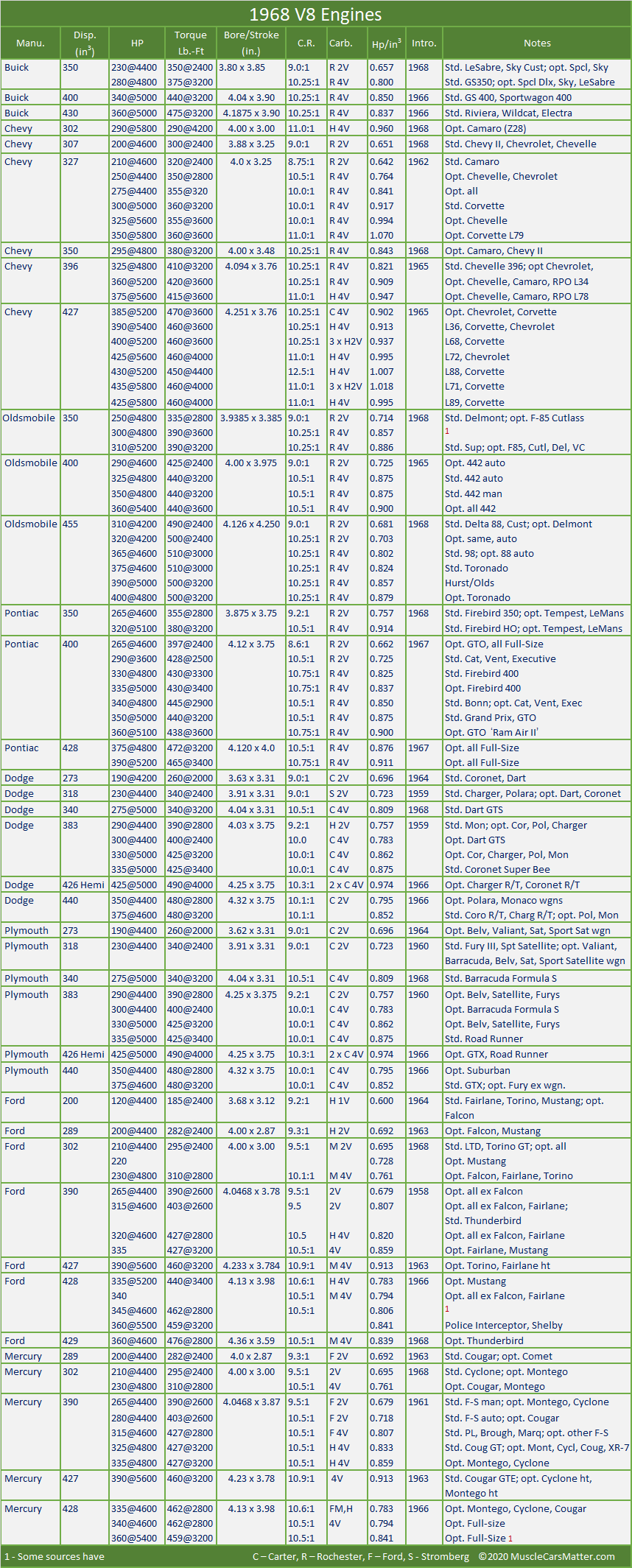
1968 V8 Engine Specs

1968 Newspaper Ads

Late March and they’re already talking about hot weather!

Car salesmen in suits? Aren’t they supposed to wear short sleeve shirts and ugly ties? Or athletic wear? Ray Davis, on the right, looks like he’s in junior high and wearing his dad’s suit.

That looks like a troll doll at the top! Those were so cool! A couple of Firebirds, a ’66 GTO and Mustang fastback. Not a bad lineup.

Okay. The owner’s name is Moore, right? The character at the top is “Lil Moore”. Cute. You certainly don’t see many ads hand marked like this.

I get the ‘rejected’, sure, but ‘injected’? Hmm…
Injected and Rejected?
The text in the ad above piqued my interest. The one thing that popped into my head was the song Alice’s Restaurant Massacree, by Arlo Guthrie. This was on his 1967 debut album, Alice’s Restaurant.
The song was recorded in New York City, in front of a studio audience. (When you listen to it, this feature will become significant)
Part of the lyrics:
Came to talk about the draft.
They got a building down New York City, it’s called Whitehall Street,
Where you walk in, you get injected, inspected, detected, infected,
Neglected and selected.
From Wikipedia.org:
The song consists of a protracted spoken monologue, with a constantly repeated fingerstyle Piedmont blues ragtime guitar backing and light brush-on-snare drum percussion (the drummer on the record is uncredited). This is bookended by a short chorus about the titular diner. Guthrie has used the brief “Alice’s Restaurant” bookends and guitar backing for other monologues bearing the Alice’s Restaurant name.
The track lasts 18 minutes and 34 seconds, occupying the entire A-side of the Alice’s Restaurant album. Due to Guthrie’s rambling and circuitous telling with unimportant details, it has been described as a shaggy dog story.
Guthrie refers to the incident as a “massacree”, a colloquialism originating in the Ozark Mountains that describes “an event so wildly and improbably and baroquely messed up that the results are almost impossible to believe”. It is a corruption of the word massacre, but carries a much lighter and more sarcastic connotation, rather than describing anything involving actual death.
This is an absolute original, unique, and hilarious song. I greatly encourage you to give it a listen!

Here’s a car ad with no cars!

