
New Stuff:
- Oldsmobile Brochure
- Pontiac Performance Brochure
- Firebird & GTO Brochure
- Plymouth GTX & Road Runner Brochure
- Ford Boss 302 Brochure
- Thunderbird Brochure
- Mustang Brochure
1969 was kind of a plateau year for the muscle-car segment of the auto industry. 1970 would be the absolute peak, before the whole thing fell off the cliff. There would be some interesting developments, like the Boss 302, Boss 429, Dodge Daytona, Mercury Cougar Eliminator, GTO Judge and Trans Am. It was also a good year for the auto industry in general.
Total Sales: 8,732,000; change: +1.2%.
1969 Noteworthy Events
- Chevrolet – Chevy II Nova becomes simply ‘Nova’. Camaro restyled.
- Dodge – Dart Swinger; 440cid 390hp 3x2bbl! Daytona.
- Ford – Mustang Boss 429 and Boss 302.
- Mercury – Cougar Eliminator.
- Oldsmobile – Another Hurst/Olds!
- Plymouth – 440cid 390hp 3x2bbl.
- Pontiac – GTO Judge; Trans Am.

None of the industry’s major players experienced significant ups or downs in ’69, with the possible exception of Oldsmobile and their 13% gains. Imperial and Lincoln were both way up but had no market share.
Chevrolet
Chevy didn’t change all that much this year. One thing that did change, though, was that the Chevy II name was retired. In ’62, when the Chevy II made its debut, it consisted of three series, 100, 300, and 400 Nova. Chevrolet had seemingly been trying to focus more on the ‘Nova’ than on the ‘Chevy II’, but this year they finally made the break.
This would be the last year for the Corvair. This was a unique vehicle, which was more than anything an ‘American VW Beetle’; at least it followed the basic concept of a smaller car with a rear-mounted, air-cooled engine of adequate power, having good mileage.
Camaro got a nice styling update, with a new front end that featured an egg-crate grille. The previously smooth body sides now had some rather striking accent lines. Both were at the same height, and both started at their respective front and rear wheel openings, extending back. The front line extended to the center of the doors, and the rear line ran to the back of the body. There were sixty-nine ZL1 Camaros constructed, with an aluminum 427 and 850cfm of Holley induction. Hot? Hell, yeah!
Approximate sales:2,093,000; change: -2.2%; industry rank: 1st.
Cowl Induction
We’ll take this time to talk a bit about the cowl induction hood that was available on Chevy Camaro’s and Chevelle’s. Chevrolet didn’t have ‘traditional’ hood scoops, such as those found on Pontiacs, Oldsmobile’s and Buicks. The Chevy cowl induction hood had a raised center section, and at the back by the windshield, there was a flap that opened. The idea was that the high-pressure area at the base of the windshield would force air into the intake tract. This was a trick borrowed from Smokey Yunick, the race car designer and mechanic.

(See I Love Hood Scoops! for an idea of the effectiveness of this method and others.)
What’s a ‘Smokey Yunick’?
Henry ‘Smokey’ Yunick (1923 – 2001) was involved in racing all of his adult life, mostly with stock cars. He worked with Ford and Pontiac but is more known for his association with Chevrolet. His name is inexorably linked with the Chevy small block engine.
Yunick was a character, and he was a supremely confident individual. Stories abound of him ‘cheating’, which might more accurately be described as ‘exploiting loopholes’ or working in ‘the gray area’. One of his more famous exploits was coiling many feet of huge diameter hose and using it as the fuel line. There were limits on the size of the fuel tank, but not on the fuel line! Yeah, I think simply labeling it as cheating really doesn’t do it justice. ‘Cheat’ or not, the man was undeniably one hell of an innovator.
How Many RPO Codes Can There Be?
In a word, many. I pulled up a list of GM RPO codes that was 104 pages long! Some, maybe most, were destined for obscurity, but a handful would live on as forever, having taken on almost mythical status.

Corvair
What Killed Corvair?
There’s certainly no one reason that the Corvair failed. The competition from the Ford Mustang likely played a part in it, as did the Ralph Nader book “Unsafe at Any Speed”, which was published in late 1965. Nader, who’s run for president a few times, is either a saint or a kook, depending on who you talk to. I’ve always leaned more toward ‘kook’, myself. But I’m reserving a bit of judgement, given that many, many large U.S. companies have done things that were arguably immoral, and at times, illegal. (Google ‘Goodyear tire controversy’, Firestone tire controversy’, or see the section on Fuels and read about tetraethyl lead)
You have to remember that Chevrolet introduced the Chevy II on the heels of the Corvair, having suffered from a crisis of faith. Corvair sales were initially great, but I think, more than anything, Chevy lost faith in the concept and was willing to let it die on the vine.

Camaro


The ‘Hugger Orange’ with the white stripes was a brilliant color combination, a real visual treat. The new grille and the side creases worked well to differentiate the ’69 from earlier years, as well as to freshen up the design. All updates should work this well.
This color combination has to be one of the all-time best, especially when the car has the cowl-induction hood. Stunning! Of course, ’69 was the last year for the 1st generation of Camaro.

Camaro sure did hidden headlights right, didn’t they? Instead of using doors that blended into the grille, like GTO (to name one), these were partly body color and partly translucent plastic. Sure, it might not have been for everyone, but it was unique and I sure found it cool looking! These were part of the RS option package.

Indy 500 Pace Car
Camaro became one of the most significant of the Indy 500 pace cars this year, when a Camaro RS/SS 396 convertible performed the honors. There were a number of replicas sold to the public, the majority being white convertibles and powered by the 350cid V8, rather than the 396. This option was known as RPO Z11. A few hundred RPO Z10 cars were made, these being hardtops rather than convertibles.

The parking lamps Camaro had in ’68 were located in the grille, but for ’69 they were relocated to the valence panel.

The two tail lights per side became three in 1969. Bumper uprights were changed to not extend above the bumper.

This advertisement is absolutely brilliant! It would be a candidate for ‘The Best Muscle Car Ad Ever’ award, if there was one.
The two cars are posed like horses and the ‘We’ll take on any other two cars in the magazine’ is just so cool!
This advertisement was a work of art, in showcasing the kinship of Camaro with Corvette. I’m sure that simply having the Corvette helped Chevy sell other cars to people who might have preferred the Vette, but couldn’t afford one (me).

For just $68 you could have a two-speed auto tranny. Just had to shift it when needed, since it wouldn’t do it for itself.
Chevy Torque-Drive Transmission
I’m really not sure exactly what this is an example of. Chevy took the two-speed Powerglide and removed the components, such as solenoids and the valve body, to produce a transmission that you had to shift manually. This saved the buyer some $56, equivalent to just over $400 today. Cost-conscious buyers who didn’t want to mess with a clutch but didn’t want to foot the entire cost for a Powerglide, could specify this option. Some 14,000 of these units were sold over the three model years of ’69 –’71.
I’d kinda like to see one of these things.
Chevelle

The ‘SS’ badges were now placed in the middle of a new, horizontal bar that ran across the grille. The front had a mildly-peaked front. The accent stripe matches the vinyl top, which is a nice look.

The Chevelle had such a cool look, front, back and side. I just love the looks. The way the taillights are integrated into the rear fenders is particularly appealing.

The ’68 Chevelle grille became blacked out in ’69 and picked up a horizontal bar. The front was also mildly peaked or pointed this year.

The integrated style of the taillights in ’68 were changed to upright type, integrated into the back of the rear fenders.

Nova

Note that the Nova didn’t offer a hardtop body style or a convertible, for that matter. It was 4-door sedan or 2-door coupe. A hardtop model might have sold well; who knows? The original concept of an economy-sized platform wasn’t compatible with a hardtop, at least not like the mid-sized models were.
Impala

The Impala SS was a full-size bruiser. Not a muscle car, per se, given its weight, but a nice package none the less.

The grille of Impala in ’68 was split by the bumper. In 1969 a new bumper would enclose the grille and headlights. The updating was very much in line with styling changes in the industry, but the ’68 look will always be the iconic Impala to me.
Three 4-Speeds?
GM’s Muncie (after Indiana) four-speed transmission was regarded as the strongest and best of its type. It, and seemingly all four-speed transmissions, was styled after the Borg Warner T-10. GM offered three distinctly different versions of their four-speed: M20 wide ratio, M21 close ratio, and M22 heavy duty (which was a close ratio). The M22 ‘Rock Crusher’ had a number of changes, the most significant being beefier gear teeth that were not angled as much as those in the other versions. This added the strength to withstand big block abuse but made the trans somewhat noisier (hence the name).
The M21 close ratio unit could be ordered if the owner was interested in straight line performance, and wanted a trans that was better suited to the quarter mile contests. The gear ratios, being closer to one another (see table), helped to keep the engine in its power band. For purely street driving, the wider ratios of the M20 were better suited for most drivers.

It should be noted that there was an early M20 with ratios that were slightly lower (higher numerically) than those shown. This trans was available in ’63 to ’65.


The 396 Nova was a page right from the book of Dodge and Plymouth, with their Super Bee and Road Runner, respectively. Take a lower-buck body and stuff a high-output big block between the fenders. Come to think of it, this was the original muscle car recipe, wasn’t it?

The Hugger. Chevy did well with this theme for Camaro. I always viewed it as part of the tie-in with their Corvette stablemate. The stance of this green SS couldn’t look much meaner, could it?
Camaro Super Scoop

Super Scoop was better known by the alternate name ‘cowl induction’, which certainly sounds cooler and less ‘advertisey’. As with most scoops of this era, the benefit to performance was minimal. The Super Scoop did peg the cool meter, though. I mean, c’mon; you’re driving with a bud or a girl and put your foot into it, the air flap (visibly) opens, and you’re rewarded with a moan from the intake tract, as you’re both pushed back into your bucket seats. That, my friend, is cool!

Here’s an advertisement for Chevelle SS 396 as well as Frigidaire. Frigidaire, of course, didn’t sell air conditioner compressors directly to the public. They did sell refrigerators, freezers and air conditioners, and the name became almost synonymous with ‘refrigerator’.
Frigidaire Appliance Company
So, ‘Only GM Air Conditioners use Genuine Frigidaire Compressors’, hmmm. Well, yes, since GM owned Frigidaire!
William C. Durant, founder of General Motors, was an early investor in Frigidaire and GM owned them from 1919 until 1979.

I believe this is from a Chevrolet brochure, highlighting the different styles Chevelle was available in, including the wonderful SS 396.

I like this advertisement. One guy is (presumably) under 30 and the other is obviously over 30.
Corvette
This year Corvette adopted the name ‘Stingray’, which was missing in ’68. Prior to that, it was ‘Sting Ray’, two words. The venerable 327 was now gone, being replaced by the 350cid V8, with its slightly longer stroke. Both the ’68 and the ’69 base engines were rated at 300hp. The ignition switch was moved to the more familiar position of the steering column.
The five-crossmember ladder-type steel frame was reinforced to dampen shake and vibration. This frame was welded. The conventional door handles were dropped this year, in favor of the lift-up type that were mounted flush. The wheel rim size was increased to 8 in., previously having been 7 in. One notable option offered in ’69 was the side mounted exhaust pipes. Cool. A nice selection of 350cid V8s and 427cid V8s were available. Selection depended only upon your bank account and your nerve!
Sales surged this year, being up by more than a third over last year.
Approximate Sales: 38,700; change: +35.3%.

The Stingray script was back on the front fenders, now being spelled as one word.

This was the second year for (now known as ‘C3’) this gorgeous body style. The backup lights were now integrated into the taillights.


Can you say ‘Can-Am Racing Engine’?
The three characters ‘Z’, ‘L’, and ‘1’, when put together into ‘ZL1’ are enough to make a hard-core Corvette enthusiast hyperventilate. This all-aluminum 427 was the direct result of the successful Can-Am campaign of Bruce Hall and his Chaparral race cars, which used the aluminum 427.
The sleeved 427 engines got the stronger everything, block, rods and bolts. Heads were open-chamber and had larger, round, exhaust ports. The intake (aluminum, naturally…) was an open-plenum, high rise type that was topped with Holley’s 850cfm double-pumper.
A small number of Camaros were outfitted with this engine via the Chevy COPO process and a grand total of two Corvettes received the ZL1. The enormous cost of this option resulted in a $9,400 price for Corvettes so equipped, which was awfully hard to justify when looking at the benefits.

Have you ever gazed upon such aluminum gorgeousness in all your life?
Racing With the ZL1

Here is one of Bruce Hall’s Chaparral race cars, powered by the aluminum 427. There was a later version of the car that used Lexan side skirts and a blower motor to create substantially lower pressure beneath the car. Atmospheric air pressure would then force the car down by as much as the equivalent of 1G, thus affording incredible grip on the track.


Corvette had just a few visible changes for ’69, the door mechanism being one. The ’68 design is at the left and the new at the right. Other changes were the relocation of the ignition assembly to the steering column and the integration of the backup lights to the taillights.

Yeah, pretty much true. Made by a company who a decade-and-a-half earlier didn’t even have an eight-cylinder engine! Why, our little caterpillar turned into a butterfly!

This ad details all the sweet junk you can get with your new Corvette. They are right about not mistaking a Corvette for anything but a Corvette.

This is a fabulously well-done advertisement that uses a play on words to highlight the ease of using the removable roof panels and rear window. This was an incredibly brilliant feature, that gave you a hardtop with a convertible feel, without all the hassle of a typical soft-top convertible.

Geeze. Just two words, yet the message comes through loud and clear.

Again, all the cool stuff you can get with your new ’69 corvette. I remember looking at ads like this, trying to decide what options I couldn’t live without in my new Corvette. At 13 years of age! Yeah, that was gonna happen!
1969 Corvette Brochure


Buick
Buick didn’t offer much new this year, which was okay. The Skylark GS 350 and GS 400 continued to be the standard bearers, not to ignore the 430-powered Riviera. The Riviera had its own GS option, which consisted of some dress-up items, as well as heavy-duty suspension and a performance rear axle with limited slip.
The GS 400 had available a ‘Stage 1’ option (I love the name!), with a higher compression ratio, hotter cam, carburetor changes and exhaust manifold changes. These items were installed by the dealer.
There were some minor changes made to some of the models, such as the front-end of the Riviera, but overall changes were minimal.
Approximate sales: 665,000; change: +2%; industry rank: 5th.
Riviera

Riviera was such a great looking car from any angle. It, of course, was aimed at the same sport/luxury market segment that the Olds Toronado and Ford Thunderbird were. It was a worthy competitor.
Riviera received only minor updates this year.
GS 400

I do like the design of the ’69 GS in general. Frankly, I was never really fond of the ‘drooping’ body-side accent. The Skylark series didn’t change much this year.

The Skylark/GS rear treatment, with its curved bumper, was distinctive.

The ’68 Skylark GS grille didn’t have the horizontal bar the ’69 grille did.

The ’69 rear didn’t differ from the ’68 in any significant way.


The 430 was a great engine for Buick. It was limited to their large cars, though.
Buick GS Stage 1
This was a fabulous option. It was dealer installed and consisted of a number of performance and aesthetic upgrades. Most notable specific components:
- 11.0:1 compression ratio
- Camshaft1, Valvetrain
- Radiator, fan
- Distributor
- Exhaust
- Carburetor upgrades
- Fuel pump
- Rear-end; 3.42:1 with AC, 3.64:1 without; both are limited slip
- Chromed valve covers, decals and badging
1 – Some sources omit camshaft
Stage 2?
This is where things get a bit murky. Yeah, the ’70 GS 455 had a Stage 2 package, but the ’69 option isn’t terribly well documented. It’s been said that some Buick guys worked on the package in their free time, and that Buick listed it as being available, but didn’t promote it at all. It’s safe to say that it consisted of cam and valvetrain and oil system mods. It also may have contained modified Q-Jet OR Holley carb, aftermarket intake manifold and headers. I guess the lack of hard specifics lends an aura of mystery, doesn’t it?

Hmm… Is Buick going after the huge market that is skeet shooters? Seriously, the notable thing here is that Buick is not targeting the age demographic of typical muscle car buyers, are they?

The little open-wheel racecars are a little weird, but because I like Buick and the Gran Sport so darn much, I’ll overlook it!

Alright, kids riding bikes. Okay. I do like the appearance of the Skylark though. Notice how the side accent crease isn’t highlighted with a chrome strip on this car. I rather like the muted effect.

The LeSabre was darned attractive, wasn’t it? Especially the hardtop. Look at those wheels, too! And dig the lines coming off of the tops of the wheel openings! The 4-door hardtop LeSabre might have been one of the most attractive 4-door models anywhere.

So, Buick owners keep selling Buicks. O-k-a-y… Better than Buick owners selling Dodges, huh? Anyway, is this a good-looking car or what?
1969 Buick Brochure


Oldsmobile
The nice folks at Olds were busy cooking up some fun this year. This took the form of the hot ‘W-31’ option for the Cutlass, featuring a 325hp 350cid V8. Not to be ignored, the 4-4-2 had its own ‘W-30’ option. This gave the lucky buyer functional hood scoops for their 360hp 400cid V8. For those who had the bank account that would support spending more than a third more than the cost of a 4-4-2 hardtop, there was the Hurst/Olds option, with its 380hp 455. Unlike ‘68’s silver/black color scheme, the H/O for ’69 was white and gold.
Approximate sales: 635,000; change: +13%; industry rank: 6th.
4-4-2

The Oldsmobile midsize platform, of which the 4-4-2 belongs, received an attractive new grille in ’69. The central grille with separate areas on each side for the headlight pairs was replaced with a large grille area that incorporated the headlights and was split by a small section of the hood, as well as a projection of the bumper. This was actually the final break with the ’67 styling and was very attractive.

Horizontal taillights were replaced with vertical ones, nicely integrated into both the body and the rear bumper. Exhaust tips continued to pass through the bumper. This was a damned attractive look, one which many guys got when challenging an Olds 4-4-2 W-30.

The ’68 4-4-2 front was the last styling cue left over from the ’67 body style. For 1969 the grille became full width with a central divider that was formed by the body and bumper, with the quad headlights located within. The members of each pair of headlights would now be positioned side-by-side, no longer with parking lights between them.

The ’68 had horizontal taillights, which became vertical in 1969. These look really small, don’t they?

Olds 4-4-2 W-30 Option
This option was first offered in 1966, but it took a couple of years to become (more) popular. In ’66 it got you a 3 x 2bbl induction setup, special cam, air induction through the grille, and more. None were convertibles and all were 4-speed cars.
1967 saw an automatic being offered with the W-30. Oddly, most W-30 distributors didn’t have vacuum advance! Special heads and cams were used with W-30 for all years. The price for the W-30 option was $264.
1968 W-30 cars received a milder cam if equipped with power brakes. All cars had Positrac rear ends. Air intakes were mounted below the front bumper. 1969 was very similar to ’68.
All years: 4-speeds were close-ratio and automatics had higher than normal stall speed. Cars with power brakes had a milder cam. W-30 continuity ended with the 1972 model year.
1969 Hurst/Olds

Hurst/Olds was the special Olds vehicle for both 1968 and 1969. Aside from the special paint scheme, the hood scoops and the rear wing certainly added to the attention-getting looks!

The ’69 Hurst/Olds option was possibly even more striking than it was when it was introduced last year.
For most buyers who wanted a hotter-than-normal 4-4-2, the W-30 option was the way to go. It wasn’t stratospherically priced like the H/O was. This year there was a W-30 option for Cutlass that gave you the 310hp 350cid V8. This was priced at $310 and referred to as ‘Forced Air 350’.
Gee, next year when the 455 becomes available and the W-30 option takes on a different persona, I wonder what kind wing they’re going to use?
The ’68 version had been painted Peruvian Silver with black trim, but the latest incarnation was Firefrost Gold on white. Where the ’68 had rectangular air intakes below the front bumper, the ’69 had a more conventional setup with hood scoops, although there was nothing conventional about these hood scoops. They were of the bolt-on variety, being somewhat reminiscent of mailboxes!
The two engines in the ’68 H/O were designated W-45 and W-46, with the ’69 engine having the designation W-46. It was a bit of a combination of the two previous engines. It received a 380hp rating, while for the larger Olds models there were engines with 390hp and 400hp ratings. Just over 900 Hurst/Olds cars found homes in 1969, up from 500 in 1968.
If you are confused as to how a hot 455 like the W-46 could be rated 10 and 20hp lower than a ‘large car’ 455, you are not alone. Check out Understanding Horsepower and Torque for a full explanation of this and other rating hijinks.
Hurst/Olds Brochure


Dr. Oldsmobile

“Don’t throw away the lumber. You’ll need it to crate up the competition.” This is part of the most interesting, outrageous and cool car advertising campaigns of the era. Hell, maybe of all time!
This play on Dr. Frankenstein and his laboratory was nothing less than freaking brilliant!
Note the chains, visible in front of the rear tires, needed to restrain the unruly beast!
Dig the air scoops located below the front bumper on the W-30 cars. They used flexible ducts to connect to the air breather. Cool.

“…a 1969 W-Machine. Or two.”
“When heads turn and hearts thump, you’ll know the Ws are nearby. Make friends with them. They’re your way to escape from the ordinary.” I love it!

I like this. A lot!
Toronado

There weren’t many changes to Toronado this year.

Toronado continued on largely unchanged. The high-performance W-34 option was introduced in 1968 but became much more popular this year. It gave you a hotter cam and air intake through the driver fender wheel opening.
An apparently obscure feature of this option incorporated an under-hood temperature sensor to open the headlight doors if the temp got too high! No, the lights didn’t come on when this happened, it just allowed more air to enter the engine compartment. Pretty damn cool! The price for this coolness? $47 and change.

Note the funky ‘drum’ speedometer centered in the dash. Soon, every car will follow this trend (no, wait…). The row of six buttons on the left balance the radio on the right. And, by golly, it has a clock!

“Separates the Men from the Boys”. Could this be a reflection of the fact that Olds was aiming at a somewhat older demographic for the Toronado? They certainly were–there weren’t many 25-year-olds buying Toronados. ‘Youngmobile’ was a term that Olds used in some of their marketing. The Old/young thing was a no-brainer, but part of me questions how effective it really was.


1969 Oldsmobile Brochure


Pontiac
This was an exciting year for Pontiac! In the second year of the new bodies for the mid-sized Pontiacs (read ‘GTO’), the styling adjustments made for an even more attractive package. Exterior changes were minimal, most notably the deletion of the vent windows and the change to the cool bomb-sight front parking lights. The change to the ‘GTO’ fender emblem, below, made for a nice look, too.
‘The Judge’ GTO option has become legendary as the years have passed. Some 6,833 Judge models were sold in ’69. The approximately $300 price ($2,140–2019) of the option gave you the Ram Air III engine (366hp) with driver-controlled functional hood scoops, a 60” rear wing, and ‘Judge’ front fender decals and body stripes, in slightly gaudy dark blue/yellow/red colors. The majority of Judges were colored in carousel red, which is often mistakenly called ‘orbit orange’. Indeed, it is more orange than it is red.
Ya Want Options?
Hidden headlights were optional, as was the cool, hood-mounted tachometer. A base, un-optioned GTO Judge had a manual three-speed gearbox, manual steering, and manual drum brakes on all four corners. This wasn’t an option package that provided a lot of extras, other than the engine, wing, and decals. Still, it was more than enough!
Also making its inaugural appearance was the Firebird Trans Am. It was a costly option and Pontiac didn’t seem to give potential buyers a good reason to choose it over a lesser Firebird or a Ram Air GTO. Just under 700 were sold. We know now, of course, how the model would change and how incredibly popular it would become in a couple of years.
Approximate sales: 870,000; change: -4.5%; industry rank: 3rd.
What Changed?
The GTO in general had a few changes from ’68. The vent windows were gone, for a cleaner look, and the front parking lights were changed to the cool ‘bomb sight’ type. Side emblems were now the large, white ‘GTO’, rather than the older faceted type. The few changes were positive, I think. I mean, how do you improve on an already gorgeous body?


It seems that often when GTOs are restored the wonderful exhaust tips are installed pointing down, unlike shown here. It is my belief that the tips as shown here are indeed correct.
Emblems

The GTO fender badges were fantastic! I remember 35+ years ago painting these with body paint and with white, doing both with a small brush. I baked the parts at a low 175 degrees or so for a half hour and let them cool in the oven.

The front grille had an emblem similar to those on the front fenders. The bombsight parking lights/turn signals were sweet and were happily carried over to next year. Note the small round front bodyside marker. In the ’68 body the front parking light/turn signal had done double duty as the front body side marker. The attractive new design faced forward only, thus requiring the additional light.
History of The Judge
Chrysler corporation, with the Dodge Super Bee and the Plymouth Road Runner, created a market sensation in their newly developed low-buck, low-frills, big-block muscle car segment. This success didn’t go unnoticed among the top brass at other automakers, including Pontiac and John Z. DeLorean.
The original Pontiac concept was called ‘E.T.’, at least informally, for Elapsed Time. The body selected was the Tempest post coupe, powered by a performance 350, sprinkled with a few high-performance options and with some exterior graphics elements. DeLorean knew the 350 didn’t have the cubes and that the engine needed to be a 400.
Next year the GT-37 would appear as Pontiac’s ultimate embodiment of this low-buck concept, but for ’69 parts of the concept were adapted to create The Judge. Through its four model years (1969 – 1972) The Judge was never sold in significant numbers and it’s a bit of a question about what Pontiac was going for.
The Judge featured the Ram Air III engine and its cold air induction, exterior ‘The Judge’ decals and stripes, interior glovebox decal (some) and a 60” rear spoiler. Everything except the wing and decals could be had on any GTO. Pontiac’s Judge did earn a prominent place in muscle car history and lore, mostly due to its unique visual impact, certainly helped by the extraordinary lines of the GTO. ‘The Judge’ was released on December 19, 1968.

Nice looking car, huh?

GTO, and not just The Judge, was attractive from any angle. Few cars were styled as cohesively as GTO–all elements of it just seemed to work together.
Judge Advertising

“The Judge can be bought”. Why, yes, indeed, it certainly could be. Only some 6,600 buyers ponied up with the additional $330 ($2,390 2020; about 11.5%) for The Judge. The vast majority of these were Ram Air III cars, this being the default engine for The Judge.

The ad above features a pre-production model of The Judge. The significant obvious differences with the production model are highlighted.
Uhh… I Guess We Changed our Minds!
The original concept of the GTO Judge (‘The Judge’) was that of a low-buck muscle car, much like the Super Bee and Road Runner. Plymouth would sell 84,000 Road Runners in ’69 (compared to under 7,000 GTO Judges), and Pontiac was angling for a piece of that pie. Somehow, though, when it was all said and done, the Judge had turned into something of an upscale GTO.
The Judge was not well optioned all by itself. The only two things that it had that you couldn’t get in a regular GTO were the wing and the decals. Even the Road Runner, some $300 (10%) less than a Judge, gave you a four-speed manual gearbox standard. When ‘The Judge’ was introduced, the only vestige of the original low-buck concept was the missing chrome wheel trim-rings.
Early print ads for The Judge had different stripes/decals than those of the production vehicles. Gotta say, I like the way it turned out better than the pre-production version (above), as seen in the reprint (below).
Pontiac hired Paul Revere and the Raiders to do a commercial theme song for the advertising campaign.
Judge GTO Breakaway by Paul Revere and the Raiders
(3 pounds of a gavel)
(spoken) :
This court has been called into session to pass judgment on a special new car from Pontiac. All rise for the judge!.(instruments enter)
Judge! The special great one from Pontiac, GTO!
Hurst gear shifter, three speed or four
Pontiac Ram Air, 366 horse
Mag-type wheels, 60-inch spoiler, airfoil
The Judge will rule!
Judge! The special great one from Pontiac, GTO!
Pontiac Ram Air 400 cubes for action!
Wide track, mag-type, Polyglas shoes for traction
The Judge will rule!
Judge! The special great one from Pontiac, GTO, woo!(instrumental)
(repeat verse 2)
Breakaway in a wide track from Pontiac, GTO
Breakaway in a wide track from Pontiac, GTO
Breakaway

Two great advertisements for The Judge. The production styling was wilder than the that of the pre-production, and I have to think greatly preferred by most people.
Well Optioned?
There are many reports of Judges coming standard with this and that, including hidden headlights, hood mounted tach, manual four speed trans, power disc brakes, hood tach, and other stuff. This has been misleading. The Judge was standard equipped as any GTO, with the exception of the exclusive wing, decals and (sometimes) glove box badge. Of course, the Rallye II wheels were not equipped with chrome trim rings.
Disc brakes, power brakes, power steering, 4 speed manual or automatic transmission, posi rear-end? These were all optional! Standard were manual drums on all four corners, no P/S, three-speed heavy duty manual trans, no console (at least with man.), open rear-end (no posi), standard GTO gearing, and standard GTO buckets. These could be deleted for a bench seat (but why?). Standard tachometer was dash mounted.
The Judge was as optionable as any GTO, but it didn’t come well equipped in standard trim.
You Bet Your Sweet Bippy!
The inspiration for ‘The Judge’ came from the NBC show ‘Laugh-In’, which aired from 1968 to 1973. It starred the comedy duo of Dan Rowan and Dick Martin as hosts. If you haven’t seen this rapid-fire show, I strongly suggest you look it up on YouTube. Any description that we give here will not begin to do it justice.
One reoccurring segment had someone, often comedian Flip Wilson, saying “here come ‘da Judge!”, followed by a judge in an oversize powder wig. The show was non-stop silliness. The name ‘Laugh-In’ was a spoof of ‘love-in’, a popular hippie culture saying of the time.
It was overwhelmingly successful, having originally aired as a special. The success of the special led NBC to make it a series. “You bet your sweet bippy” was frequently heard on the show.
Ram Air IV

The marvelous Ram Air IV engine, showing the foam gasket that seals the air filter tray to the bottom of the hood, to facilitate the functional hood scoops. A driver control just under the dash opened and closed flaps to close the scoops if weather necessitated it. The RA III had this same setup. One thing you can’t see here are the huge round exhaust ports the Ram Air IV was known for.
See Muscle Car Era Engines for more info on the RA III and RA IV.

Here’s the knob under the dash and in front of the driver that opens and closes flaps to the air scoops. It seemed to be a well-thought-out design.

The round RA IV exhaust ports flowed incredibly well. Factory rated a mere 4hp more than a RA III, this was one of a relative handful of intentionally under-rated performance engines. True output approached 400hp. I’d have to think that many buyers thought of RA IV: “That’s a lot of extra cash for just 4hp; I’m gonna go with the RA III”. True horsepower difference was more like 30hp to 40hp.
The hood tachometer and hidden headlights were both optional and added a nice touch. The hood mounted tach was a cool look, but in actual use it tended to be a bit hard to see, especially at night (yes, it was lighted).

Sweet Wheels!

Here are the wonderful Pontiac Rallye II wheels. The background color of the hubcap was either red or black and the remainder was chrome. The wheels were often fitted with chrome trim rings. Lug nuts were chrome, or with the Judge, chromed with black centers. Interestingly, Judge didn’t feature the chrome trim rings as they were deleted in the original ‘low buck’ concept of the car.

The hood tach was available on just about any Pontiac in 1969. It was lighted, of course, and although the idea was to place it so that you didn’t have to look down, it was a bit hard to read, especially at night. The hood of the car isn’t the best environment for an instrument, and this one suffered accordingly. This didn’t matter, though, as it absolutely pegged the cool meter! It was a $63 option ($455 – 2019$).

The ’68 GTO front parking lights wrapped around the valence to the sides, to serve as body-side markers. The ’69’s bomb-sight lights added to the side of the valence panel a small round light to serve as the front body-side marker. The GTO badge is mounted a bit higher on the ’68.

The ’68 rear was a lot like the ’69, but the taillights were fully surrounded by bumper. The ’69 taillights were raised to the top of the bumper, no longer being bordered on their top by bumper. Gas filler is behind the license plate mount.
Firebird

The ’69 Firebird now had wheel openings with flattened tops, which is one of the ways to distinguish a ’69 from a ’68 when viewed from the side. The main exterior difference was at the front, with the ’69 radically changing the front chrome, now having the area around the headlights body colored. Both looks were nice, and which is ‘best’ is a matter of personal preference. The great Firebird 350 HO was again offered this year, with an additional 5hp, to bring the output to 325hp.


The ’68 Firebird had the headlights positioned within the bumper-encircled grille area. Parking lights on the ’68 Firebird were similar to those on the ’68 GTO. In ’69, they would again be like the ’69 GTO.

On the ’68 Firebird rear, the four taillights were all shaped the same. On the ’69, the taillights were slightly taller and had rounded top corners. The fuel filler was above the bumper in ’68, shown here, and was moved down to behind the license plate in ’69.


The First Trans Am
All of the first series Trans Ams were Cameo White with Tyrol Blue stripes. Body styles were hardtop coupe and 2-door convertible.

The Trans Am package debuted this year as Code 322, UPC WS-4, a $725 option ($5,250 2020$). This got you suspension upgrades, power front discs, variable ratio power steering, the 366hp Ram Air III engine, and appearance items such as stripes and the same style wing as the GTO Judge. The base transmission was the heavy-duty manual 3-speed. A mere 697 buyers opted for the package. You might note that the TA was some $400 more than a GTO Judge. In fact, for the cost of the TA you could get the Judge with a RA IV engine. TA appeared on March 8, 1969.
Numbers have Grown!
There might be more ’69 Trans Ams around today than the 697 that were made, due to the proliferation of ‘tribute’ models. The first year TA didn’t make much of a ripple in the muscle car market. You could get more for your money in a variety of other makes and models. Few of these would go on to establish the legacy the Trans Am would, though.

Grand Prix got a new look from all angles, most noticeably the front. The front-end change was along the lines of the Firebird, with less chrome and body-color surrounding the headlights. No more hidden headlights, and the rear wheel opening skirts were gone. Personally, I’m not sure I’ve seen a car with skirts and thought it looked better because of them. GP went from a 121″ wheelbase to 118″ this year. It featured the longest hood in the industry.


Grand Prix still had hidden headlights in ’68, but they were gone in 1969.

The rear styling of the ’69 was greatly different from the ’68, but in some ways the two looks had strong similarities.
But…What about the SJ?
We didn’t forget about the Grand Prix SJ. This, however, was an option package, not a model. For your extra $225 or so you got larger tires, badges, and an up-rated engine. I have to believe that a lot of people did think the SJ was a model.


Can you believe that Pontiac had eight different versions of the 400? They did the same thing with the 389 back in ’59 through ’66.

Pontiac X4?
The image below is the front cover of Popular Science for April of 1969. There’s not much on the web about this project, but Pontiac was indeed working on this 1,500lb. car that had a rear-mounted 4-cylinder 2-cycle air-cooled radial engine! The cylinders were in an X-configuration, with the entire engine and transmission mounted just ahead of the rear axle. Don’t confuse this with a rotary engine; this was a radial configuration, which most of the US Navy aircraft used in WWII.
The article did mention that GM approval had yet to be granted for this car to go into production, and that it was likely going to be another 2 1/2 years before it came to market. This would have made it a 1972 model.
The article goes on to say that around 1939 Volvo had a similar engine setup with an 8-cylinder engine. Given the emissions laws that were on the horizon, it’s tempting to say that Pontiac should have known that a 2-cycle engine wasn’t going to fly. There was still some forward thinking going on in 1969, but in this case, it led to nothing.

Sunken Sub Scorpion
Finally – did you notice “How we Found the Sunken Sub Scorpion“? It took several decades for the truth to be known, but we always knew where it was! It was torpedoed by a Soviet sub and was never really ‘lost’. John Walker had just started spying for the USSR in 1967, and he’s the one responsible for the Soviets knowing the location of Scorpion. What did he get for enabling the Soviets to kill 99 USN sailors? About $55,000 a year for eighteen years. He died in prison, along with his brother Arthur whom he recruited. His brother got $12,000, a barbeque and a toupee for his life term. This waste of a human being also convinced his son to go into the navy, where he was a spy aboard the Nimitz.

Lest you have any images of a James Bond type figure, here’s the butt-wipe while under arrest. The book Scorpion Down, by Ed Offley, is a meticulously researched account of the Scorpion incident and a great read.
1969 Pontiac Performance Car Brochure


Note the rectangular front body marker positioned above the small marker. The small marker made it to production but the larger one didn’t. The picture of the pre-production ‘The Judge, below, also has the two markers.


1969 Firebird and GTO Brochure


Dodge
For ’69, Dodge continued the excitement of ’68. Their sales held constant, after the huge increase of ’68.
New was the ‘Six-Pak’ induction for the 440cid V8, boosting the output to 390hp. This engine was way cool. Dodge wanted an engine to bridge the performance between the 440 Magnum and the 426 Hemi, which was one expensive option. The answer was to fit the 440 with an aluminum intake manifold that accommodated three Holley 2bbl carburetors. As was usually the case with 3 x 2bbl carburetion, the engine in normal driving ran off of the central carburetor only. When you pushed the accelerator far enough, the end cards came into action.
Charger got a divided grille, which was quite attractive. I really liked the ’68 front-end, but if you put a potato gun to my head and said “Choose!”, I might have to go with the new ’69.
There were two Charger versions specifically tailored for NASCAR racing, the Charger 500 and Charger 500 Daytona. The 500 version featured a flush front end and a ‘filled-in’ rear window, which eliminated the normal inset window. It was reasonably successful on the large tracks. The ‘500 Daytona’ carried this concept to the ultimate.
Polara and Monaco could be optionally equipped with the Super-Lite, a novel (though short lived) exercise in better nighttime visibility.
Approximate sales: 611,000; change: -2.6%; industry rank: 7th.
Charger

Charger remained a fantastically attractive car. The tweaked front end was still quite striking, now having a vertical grille separator in the middle.

A lot of guys were familiar with this view of Charger. Know what I mean?

The gorgeous Charger second series that arrived in 1968 had an open, clean grille. For ’69 it got a center divider. Both were attractive, but man, that big open ’68 grille was just stunning.

The round taillights in ’68 were now rectangular-ish in ’69.

Dart Swinger

The round grille-mounted parking lights of last year became rectangular this year. The center, vertical grille bar was removed for ’69.

The smaller, less expensive Dart Swinger gave you an awful lot of bang for the buck. But this is where both Dodge and Plymouth excelled in bang for the buck!

The ’68 grille was clean and attractive. The outer portions of by the headlights were extended beyond the central grille, a feature that was carried over to the ’69 model.

The rear trim panel Dart had in 1968 was deleted for the ’69 model. That’s too bad, in a way, as it was quite attractive.
Coronet

This is, of course, the Super Bee version of Coronet. The 4-door Coronet was a popular taxicab platform in the late 1960’s. This Super Bee, with the A12 option package, was very, very much un-cab-like! Lift-off fiberglass hood with huge air intakes, 440cid V8 3 x 2bbl induction, this thing was a bruiser that could kick your butt if you looked sideways at it.

The attractive rear end styling of Super Bee mimicked the general styling of the front.

The ’68 grille was flatter than the ’69. The extension of the grille was quite attractive.

The rear of the ’68 Coronet was different, for sure. While not unattractive, I find myself preferring the ’69 look.

A12 Option
In mid-1969, the A12 package was introduced on the Super Bee and Road Runner. It included a 390 hp 440 with three 2bbl Holley carburetors on an Edelbrock aluminum intake manifold, a black fiberglass lift-off hood secured with metal pins, heavy-duty suspension and steel wheels with no hubcaps or wheel covers. The hood had an integrated forward-facing scoop which sealed to the air cleaner assembly. They got Bumble Bee tail stripe and diecast chrome plated Bumble Bee medallions in the grille and on the trunk lid.
The scoop on the hood was as big and bad as anything ever seen. Mothers pulled their small children away from it for fear their tyke might be sucked in, never to be seen again. (I might exaggerate a bit…) I’m not sure the ladies were all that impressed with this thing, but the men sure were. Having an A12 was, in and of itself, your man card. Nothing else needed!
Car Life Article July 1969


According to Car Life their 440 Six-Pack Super Bee isn’t running quite as quick as the Plymouth Super Bird in the advertisement below is. The trans here is the wonderful TorqueFlite, with the ‘Bird having a 4-speed. Both presumably had the standard 4.10 rear ends.
Cutting the Air

Does this Wing make my Butt look big?
When people look at the Daytona, they tend to focus on the nose first, and then the wing. What seems to be ignored is the smooth, sculpted fastback feature. I think this is actually more significant to the car’s high-speed performance than the wing was. The rear window was flush with the body, which itself lacked the ‘inset’ element of the regular Charger. (Compare images of the rears of the two cars). The regular Charger, moving at the near-200 mph speeds of the Daytona, would experience substantial air turbulence in the area of the rear window, where air flowing off of the top separated from the car body. The significance of this effect is hard to appreciate. You’ve noticed NASCAR cars drafting. The car in the front receives a huge benefit, in addition to the more obvious benefit to the car in the rear. That’s because the tumbling, ‘unclean’ air that’s normally at the back of all cars is now affecting the following car more than the lead car, which would normally have to deal with it.

West Texas A&M University image of turbulent air at the back of a fast-moving car. The flush rear window in the Daytona was intended to minimize this effect, since it can produce an incredible amount of drag on the car.
My, That’s a Lovely Nose!
Chrysler, via their Dodge division, raised the NASCAR ante this year by introducing a super-streamlined, low-drag version of the Charger, specifically aimed at NASCAR competition.
The Ford guys had their Talladega, which was proving to be a problem for the Charger 500’s.
Daytona featured a fiberglass front ‘wedge’, an insanely tall rear wing, and flush-mounted rear glass (vs. Charger’s normal tunnel fastback).
The result was a vehicle that, when race Hemi powered, could hit 200 mph on the super speedways. Super speedways like Daytona. Hence the name. Get it? Well, they had to homologate the body to be approved for racing, which meant making street versions available. Since the 426 Hemi was already homologated, the street versions didn’t necessarily have to be 426 powered, though some were. Others used the 440cid engine.
Dodge did quite a bit of wind tunnel testing when developing the Daytona, and there is still in existence a 3/8ths scale model that was used in the Wichita State wind tunnel.
The height of the towering rear wing was not strictly a product of the wind tunnel, though. It had to be tall enough for the trunk deck to clear it when open!

You could get this beauty for $100 to $250, with the Hemi setting you back some $700 to $800. That was a helluva difference in 1969!


Yet another example of Dodge advertising lower prices for ’69.
The ‘White Hat Special’ was kind of a thing, but not really. I’m not sure what to compare it with.
The Dodge Girl
The Dodge Girl (actually the second one) was one Miss Joan Anita Parker. She was also an actress, with small non-reoccurring roles on Police Woman, Streets of San Francisco and Police Story.
Questions

This advertisement brings all sorts of questions to mind. It says the ’68 Coronet with the 440 was only 0.02 seconds faster than the ’69 Super Bee with the 383cid V8, with Dick Landy driving. So, the 440 car I bought last year (and am still paying for…) is only that much faster than this years’ 383 cars? I’m not sure that makes me a happy Dodge owner!
Both Dodge and Plymouth were really focusing on value in this period of the very late ‘60’s. The market had become saturated, and competition was fierce. Both companies did particularly well in the ‘low buck’ muscle car segment, with the Super Bee and the Roadrunner. It seems that they were focusing on what had already proven successful.

Would you just look at that fiberglass hood! I don’t care what you drive; this pulls up next to you at a light and you’re gonna have at least a momentary ‘oh, crap’ moment, no question. Maybe pee yourself just a little bit. Nobody would blame you. This was in-your-face-badass. I really like the dual meaning of “SIX PACK TO GO”! Yeah, guys who drove these drank beer; I think it was required in order to own one! Buick GSX or Olds 4-4-2 drivers might have been cocktail drinkers; slightly more refined.
Got the Fever?

This is a cool ad, brought to you by the Dodge Girl and featuring the now-familiar Dodge Fever theme. Dart Swinger was a cool new entry in the ‘budget sporty car’ segment. (I shouldn’t have to mention this, but the word ‘swinger’ here is in the context of someone who’s cool and popular, not the other ’60’s – ’70’s meaning of ‘swinger’.)

Yeah, the text is pretty sexist, isn’t it? ‘The Eternal Triangle’, though, is perhaps not a bad depiction of the relationship between a young man, his car, and his girl. The two people pictured in the ad seem just a bit old for this kind of drama. I think maybe a younger guy and gal would have worked better, no? The guy’s name is Ralph, and he wears a striped turtleneck. Is that cool or what?

Here’s an advertisement for the Super-Light. It seemed like legitimate out-of-the-box thinking, and might very well have been, but market acceptance was missing.

Here’s a young Lee Trevino making a play on the words ‘swing’, ‘drive’, ‘stance’, ‘backspin’, and ‘follow-through’. Wait. ‘Follow-through’ is two words, isn’t it?

A cool Scat Pack advertisement for the Dart Swinger 340. Dodge gave you a ton of bang for the buck with this package.

Plymouth
What was a good year for Plymouth in ’68 continued in ’69. There were a handful of new developments, starting with a new Barracuda option, the ‘Cuda 340’, which was a $309 upgrade and featured the great little 340cid engine. The ‘Cuda’ options not only gave you a higher output engine, but also such niceties as heavy-duty suspension and brakes, and a 4-speed manual gearbox. You could also outfit your Barracuda with a 383, and later in the year, with a 375hp 440 Super Commando. Of course, Plymouth also had the A12 option for their Road Runner. As with the Super Bee, this provided the 390hp, 3 x 2bbl 440, the lift-off fiberglass hood with the gargantuan hood scoop, a Dana 60 rear-end with 4:10 gears, and 15” x 6” black-painted wheels with chrome lug nuts. Yeah, Plymouth was spreading happiness everywhere in ’69.
That wasn’t all, though. There was now another performance Belvedere derivative, the Sport Satellite. The Road Runner was now also available in a convertible, too.
751,000; change: -4.9%; industry rank: 4th.

Road Runner couldn’t be had as a hardtop, like the GTX. Still, it had a brutish look that seemed to say ‘I’m gonna blow your fenders off as I go by’.
GTX was part of the Belvedere line and was at the top of the Plymouth performance lineup. GTX was priced a few hundred bucks higher than a similar Road Runner.
Plymouth GTX

Here’s the ‘top dog’ GTX, with its straight lines and slab sides. It’s not svelte like the Cuda, but more aggressive looking, in “As long as we don’t go around too many curvies, I’m gonna suck your headlights out” kinda look. All business. Functional hood scoops were a $55 option.

Note the chrome trim that’s on GTX that’s not on Road Runner.


The ’68 GTX had an egg-crate sort of grille styling. For ’69 it became much finer detailed, with a black grille.

The slight redesign in 1969 saw the trim panel become thinner, and the taillights, though changed slightly, retained the overall ’68 look.
‘Cuda

I have to say that I really like the lines on this car! The black stripes really help to accent the ‘hip’ of the rear fenders.

Oh, so clean and swoopy! This is really a terrifically well styled car!

Barracuda’s front in ’69 bore a very strong resemblance to that of 1968, seen here.

As with the front, the ’68 Barracuda rear was only massaged slightly for ’69.

I’d say that this making good use of the Motor Trend Car of the Year award, wouldn’t you? Here, like the next ad, we have strip performance numbers presented. The Cuda 340 might not post numbers like the 440 Six Pack car, but still impressive as heck.

The poor ol’ GM companies could only look at this with envy. Their midsized cars weren’t allowed more than 400cid engines, and multiple carburetion? Forget about it! Plymouth wanted a package with near-Hemi-like performance but lower cost. Looks like they got it!
Advertisements like this with ETs and trap speeds were rare, for some reason. I gotta say, this one looks pretty damned impressive. I might have preferred a less cartoonish car depiction, but it still makes the desired impact.

If you have difficulty in reading the times and speeds from the advertisement above, here they are with higher resolution.

Racer supreme Ronnie Sox passed away in 2006 of prostate cancer at the age of 67. You might notice that Sox’s fastest time here are slightly faster than the ‘official’ fastest magazine test from the era, which was a 1970 454 LS6 Chevelle.
Car Craft Magazine: 13.12 seconds @ 107.81 MPH

This is the Sox & Martin ’71 Pro Stock ‘Cuda. When Sox & Martin were at the top of their game, they were almost unbeatable.

Track Pak Options
Both Dodge and Plymouth offered the Track Pak and Super Track Pak options in ’68 and ’69. The following is a summary of what the options contained. The most obvious difference is the 3.54 gearing versus the 4.10.
Track Pak – Code A33
(Available with 4-speed Manual Transmission w/ 440 or Hemi. N.A. w/ AC; $143)
- 4-speed Heavy-Duty manual transmission with Hurst shifter with wood-grained shift knob and reverse warning light (available in Package only)
- Power steering cooler (if equipped)
- HEMI suspension with front sway bar
- 3.54 H.D. 9-3/4″ Dana rear axle
- 7-Blade Torque Drive fan (Std. Hemi)
- Dual Breaker Distributor (Std. Hemi)
- 26″ High Performance Radiator w/ Fan Shroud (Std. Hemi)
- Sure-Grip differential
- Firm Ride shock absorbers
Super Track Pak – Code A34
(Available with 4-speed Manual Transmission w/ 440 or Hemi. N.A. w/ AC; $256)
- 4-speed Heavy-Duty manual transmission with Hurst shifter with wood-grained shift knob and reverse warning light (available in Package only)
- Power steering cooler (if equipped)
- HEMI suspension with front sway bar
- 4.10 H.D. 9-3/4″ Dana rear axle
- 7-Blade Torque Drive fan (Std. Hemi)
- Dual Breaker Distributor (Std. Hemi)
- 26″ High Performance Radiator w/ Fan Shroud (Std. Hemi)
- Power Disc Brakes
- Sure-Grip differential
- Firm Ride shock absorbers
What’s a ‘Dana’?
Dana makes axles, as well as other auto components. The previously had the name Spicer, and they hold the patent for the universal joint. Dana rear axles are super sturdy and have been used by all of the key U.S. automakers, even to this day. The Dana 60, referenced above, has a G.V.W. spec of 6,500 lb.! You can do whatever you want to your car that’s Dana equipped and you’re not going to break the rear end!

Gotta say, I’m a little bit confused by this one! Belvedere wasn’t new and had always been midsized. Maybe it’s just a churched-up way to say, ‘we have more models now’.

‘Plymouth tells it like it is’. Okay. The text talks about the ‘160-position driver’s adjustable bucket seat’. 160 positions? Really? 160? Just what constitutes a ‘position’, I wonder? Man, can you trust anybody?

The ad above mentions the engine having an unsilenced air cleaner. This is an unsilenced air cleaner. It’s open around the edge of the bottom, which isn’t really visible. The typical ‘silenced’ type has one or two appendages it breathes through, which can have quite small openings. The unsilenced type allows the nasty noise from the intake tract to escape, which some types find objectionable. These are the same types who don’t wash their Prius, since this requires water.

Look what Plymouth’s up to now!


1969 Plymouth Belvedere Brochure


Ford
There was no shortage of excitement at Ford in 1969. Much of it revolved around Mustang.
Mustang was restyled for ’69, still riding on a 108 in. wheelbase, but now with a body that was about 4 in. longer. It picked up a couple of hundred pounds, too. The front now featured quad headlights, with the second set being integrated into the grille area. It made for a unique and attractive look. The fastback bodies now had a new, higher-mounted side scoop that was a bit less subtle than the previous iteration, but the standard coupes (non-fastbacks) and convertibles had a scoop rather like before, but now kind of facing rearward. Was it a scoop or a vent? Heck if I know.
Fun New Engines!
All Mustang fans know that this was the year of the Boss 302, as well as the Boss 429. ‘Cobra Jet’, you say? How about ‘Super Cobra Jet’, and 360hp? Also, the 351 ‘W’ arrived to fill the gap in the engine displacement lineup. GM had their 350cid V8’s and Chrysler their 340, but Ford had a big hole between the 302 and the 390. The 429 (not Boss) that arrived in ’68 on the Thunderbird was now more widely available.
This was also the year the Maverick appeared, not that you performance types will care much about that. It was built on a shortened Falcon chassis. Wait, wasn’t there a new introduction built on this same chassis, about five years ago? Yep – Mustang! Maybe Ford was hoping that lightning would strike again. The 2,400 lb. $1,995, 2-door Maverick saw some 127,000 copies go out the door in ’69, and that was with a mid-year introduction. Not Mustang numbers, but not too shabby!
Approximate sales: 1,826,000; change: +4.2%; industry rank: 2nd.
New Maverick

Here’s the new Maverick, in all its glory. Ford would later advertise that one of its advantages is that it was easy to work on. Indeed, there was nothing leading-edge here. Easier to work on than a Mustang? Maybe, maybe not. Interestingly, Maverick was introduced on April 17, 1969. Sound familiar? Mustang was introduced five years earlier, to the day!
Where the first Mustang picked up a silly “1964 1/2” designation, at least much, much later, Maverick never suffered from this confusion. It was simply the late introduction of a 1969 model.
Mustang

The sport mirrors look nice, don’t they?

The integration of a duck tail caused the chrome piece that enclosed the rear to be deleted. Not a bad look, but I really, really liked the ’68 design!

1969 Mustang Changes
The ’69 Mustangs were wider, longer, and lower than the ‘68’s, although the wheelbase remained unchanged, and any curb weight changes were insignificant. Side panels were now convex, compared to the concave panels of previous models. This created a new look.
The center-mounted pony/corral emblem was changed, becoming less conspicuous, as well as being moved off-center to the driver side. Quad headlights now appeared, too, with the second set positioned inside the grille, at opposite ends. All-in-all, this was a nice updating of the classic body style.

For 1969 Ford removed the pony and corral from the front grille, as seen here in this ’68 photo. I’m sure this was in the interest of modernizing the styling, and maybe it was the right thing to do at the time. Years later it would seem to some to have been ill-conceived.
The front of the hood of the ’69 Mustang also became more point this year.

The rear deck lid now had a straight line across its top in back, unlike the ’68 shown here. The rear edge with the M-U-S-T-A-N-G lettering became taller, and the entire rear area with the taillights and gas cap was finished in flat black or was body color.
Mustang Mach 1

Mach 1 was an example of wonderful marketing. The package was more appearance than not but did have some go-fast parts to it to lend credibility.
There are few names that evoke the raw performance image that ‘Mach 1’ does. Faster than sound aircraft had only been widely available for a decade and a half, and the term ‘Mach’ (after Ernest Mach) had a particular high-tech performance sound to it.
The Mach 1 option was available as a SportsRoof (fastback) only and met with immediate success. Engine options ranged from the 351, the venerable 390 and the newer 428. Aside from the chin spoiler, wing, and stripes, non-functional (but still cool) shaker scoops and functional versions of the same, suspension upgrades were part of the deal, too, and depended somewhat on the engine installed.
New GT?
It’s fair to say that the Mach 1 became what the ‘GT’ had been intended to be, meeting with so much success that the GT nomenclature was retired soon after.
The base Mach 1 was a bit of a poser, with a 250hp 351 2bbl. When outfitted with the 390 or (especially) the 428, it tended to live up to its name.
The Mach 1 was based on the SportsRoof body style, and all were V8 powered. Added aesthetic items were the blackout hood, a non-functional hood scoop, and deluxe interior. A chin spoiler, rear spoiler and rear window louvers could be added. A competition suspension was included as part of the package. The standard trans was a 3-speed manual, with a 4-speed manual or 3-speed automatic optional. Small-blocks got the FMX unit, with big-blocks receiving the C6.
The 428cid engine could be had either with or without ram air. The Cobra Jet option gave you the 3:91 gears, and the Super Cobra Jet the 4:30 set. The suspension was upgraded according to the power plant, at least to a degree. The big-block cars got heavy duty shocks and springs, heavier sway bars, and shock tower reinforcements. CJ and SCJ cars received staggered rear shocks, for better control of the rear axle under hard acceleration.
‘Detroit Locker’ and ‘Traction Lok’?
Both these differentials were available on the Mustang, usually with the Traction-Lok paired with 3.91:1 gearing, and a Detroit Locker with 4:30:1. The Traction-Lok was Ford’s version of a limited slip differential, with other automakers using names like Positraction, Sure Grip, Anti-Spin, and Safe-T-Track.
The Traction-Lok was a common limited-slip differential in both design and operation. The action of one axle turning faster than the other forced clutch plates to attempt to direct torque to the wheel with the best traction. In ordinary driving the clutches were not engaged.
A Detroit Locker was a different beast altogether, known as an automatic locking differential. It was essentially locked all of the time, unless a wheel was required to turn faster, as in the outside wheel in a turn. This device had no clutches, and when it was locked, it was locked. For regular, day-to-day driving, most people would find this type of differential a bit rough and obtrusive. This unit was manufactured by Eaton Corp.
Grande and GT
The Grande option didn’t include any performance upgrades. In fact, it was quite the opposite, with its Soft-Ride suspension and Wire-Wheel styled covers. It was all stuff to make your Mustang more ‘upscale’, maybe more like your Mom’s Thunderbird.
The GT option, first offered in ’68, added such niceties as dual exhaust, fog lamps, wide oval tires and styled wheels. Oh, let’s not forget the flip-open gas cap! Most of these things (and more…) could be added individually. The GT option could be had with any of the V8 engines (mostly).
The Boss 302
This little gem was available for only two years, ’69 and ’70. It’s hard to say to what extent (or not…) it was influenced by Chevrolet’s Z/28, as they were both implementations of the same concept. Chevy won the SCCA Trans Am titles in ’68 and ’69, as well as experiencing NHRA success. Ford didn’t achieve as much with their car. Nevertheless, the Boss 302 was a well-executed concept. The whole purpose of making the engine available to the public was to homologate it for SCCA Trans Am competition, and most versions of the 290 hp 302 found homes in Mustang bodies. A relative few were supplied in Mercury Cougar Eliminators.
While neither the Chevy nor the Ford product would run toe-to-toe with the muscle car heavy-hitters, at least in a straight line, the lightweight, high revving, nimble footedness was a joy to experience for those who were fortunate enough to have been owners of either of these cars.


See Muscle Car Era Engines for complete 302 information.
Maybe there’s such a thing as ‘Too Big’?
Ford had a penchant for the use of heads and ports that were simply big-assed. Too big, some would say. We’re referring to the Boss 302, 351C 4V, and the Boss 429. Ports were often so large as to ultimately be a disadvantage below 5,500 or 6,000 rpm. These made killer heads for the racetrack, when the rest of the car and engine were properly set up, but for even the ardent hot rodder, the penalty for all but high-rpm operation was great. For what period of time did a street contest see 6,000+ rpms? A few seconds?
There’s a YouTube channel that did a dyno comparison between 2bbl and 4bbl Cleveland heads. The smaller ports and valves of the 2bbl heads made more power and torque than the 4bbl did, at all but the very top of the rpm range. The 4bbl heads’ oversize ports provide too low a mixture velocity to keep the fuel and air well mixed, only coming into their own at stratospheric rpms.
See Muscle Car Era Engines for complete information on these engines.
All That’s Old is New Again

Above is the dash design for Mustang, introduced in the April 1964 model. Gotta say, I love the ‘twin eyebrow’ look.

Fast forward thirty-eight years and this is the Mustang dash design, appearing in 2005. One of the best looking dashes in the two-thousands, no doubt.

Lest you wonder, this is the Falcon dash when Mustang was frist introduced. Nice, but not nearly as sportin’ as Mustang!
1969 Boss 302 Brochure


The Boss 429
The Boss 429 existed for one reason only—to homologate this special version of the 429 engine for NASCAR competition. It didn’t matter what body they stuffed it into, but Mustang was the logical choice. After all, everything Mustang touched was golden. Only one slight problem—the engine was too big for the engine compartment! That’s where the company Kar Kraft came into the picture; they modified the engine compartments for the extra-wide engines to fit.
But wait! Ford didn’t race Mustangs in NASCAR! It didn’t matter, it was the engine, not the car, that was being qualified. Ford raced Torino’s and Mercury raced Cyclone’s, both with the Boss 429.
Both Bosses followed the same formula of limited color selection, chin spoiler and rear wing, with a large hood scoop on the 429, and with tasteful body-side stripes for the 302.
These engines are covered in the Muscle Car Era Engines section.

Boss 429 Engine

This is the rare and mysterious Boss 429. The engine was produced in small numbers and was never able to achieve its racing aspirations. For street use, it had ports and valves that were simply way too big, as well as not enough carburation. As glorious as this engine was, it just wasn’t at home on the street. The price of a Boss 429 Mustang was some $4,700, putting it in the price range of Thunderbird, which was by far Ford’s highest priced series. You can read more about this engine in Muscle Car Era Engines.

Thunderbird


The front styling of Thunderbird was similar to the previous two years and remained quite unique. It’s hard to believe that just over a decade back, this 4,400 lb. vehicle was right at 3,000 lb.

The front of Thunderbird was only mildly tweaked.

The rear of the ’68 had full-width taillights, which were changed to somewhat more conventional units in ’69.
Galaxie 500

Galaxie had a bit of restyling this year, just not much.

Torino Talladega was Ford’s super-speedway warrior. It had a six-inch flush nose extension, and a rear bumper that was reworked into a sort of spoiler. Ford built more cars than were required for homologation, which is odd considering that they lost a considerable amount of money on each one sold.


1969 Ford Thunderbird Brochure


1969 Ford Mustang Brochure


Mercury
Mercury had a slew of new performance variants and options for the Cougar this year. Yeah, you could get a big 428 or 429 in the Marauder, but at 4,000 + pounds, you weren’t going to be very competitive.
The Cyclone CJ 428 was a NASCAR-flavored bruiser but was sold in tiny numbers. In fact, the entire Cyclone series sales only accounted for just over 2% of Mercury’s sales for ’69. Cyclone Spoiler had a 290hp 351cid V8.
Cougar accounted for about a full quarter of sales. Of course, not all of these were high-output V8 powered, but a reasonable number were. You could get the 290hp 302, the 290hp 351, the 320hp 390, or the 335hp 428, all wrapped in a lovely Cougar body. Yeah, there were other Mercury models this year, but it really was all about Cougar. Cougar Eliminator was the real hot ticket. Its 290hp 302 ‘Boss’ engine was a sweet little high-revving mill, but the few hundred pounds more weight than a Boss 302 Mustang worked against it.
Approximate sales: 398,000; change: +10.6%; industry rank: 8th.
Cougar Eliminator

The unique grille composed of vertical ‘blades’ was replaced this year by a grille with horizontal elements, the Eliminator having a black-look grille. Turn signals that were round last year became rectangular in ’69.

The front and rear script that said ‘Mercury’ in ’68 was changed to ‘Cougar’ this year.

Cougar Eliminator had a great look to it. I don’t think many would ever think ‘Mustang’ when looking at it. There just wasn’t any angle from which you could look at this car without thinking ‘sweet’!

Last year the license plate was the separator between the two halves of the taillights. Not so this year, as the license plate was dropped down to the bumper.


This little gem of a product was slated to be available in the Eliminator, but never quite made it. Some contemporary sources seem to indicate that it was offered, but other sources refute that.
A two speed rear-end, made by Dana-Spicer! How freakin’ cool is that! You would have your regular gears for normal driving and then the performance gearing for go-fast time. There are so many guys that would give their left nut for something this cool. I sure would have.
Note the pre-production wing style (circled). This is the general type of wing that did appear on the Pontiac ’69 GTO Judge and on the 1970 Buick Gran Sport GSX.
1969 Cougar Booklet


Cyclone CJ

Cyclone’s grille changed a bit this year, but the look was largely the same as last year.

The rear styling was kinda ‘meh’ below the deck lid, but the lines above were terrific. The rear styling did not change this year.

The ’68 front end, here, was just a bit modified for 1969.

Like the ’68 rear end look? Well, the ’69 was esentially identical.

Mercury worked hard to promote the Cougar as ‘European inspired’. Given its degree of uniqueness, this was a smart move.

This is a cool and creative advert.
I like the ‘wears two bonnets’ rather than the more mundane ‘has two hoods’.
Mercury Cyclone 428 CJ
Cars Magazine June 1969


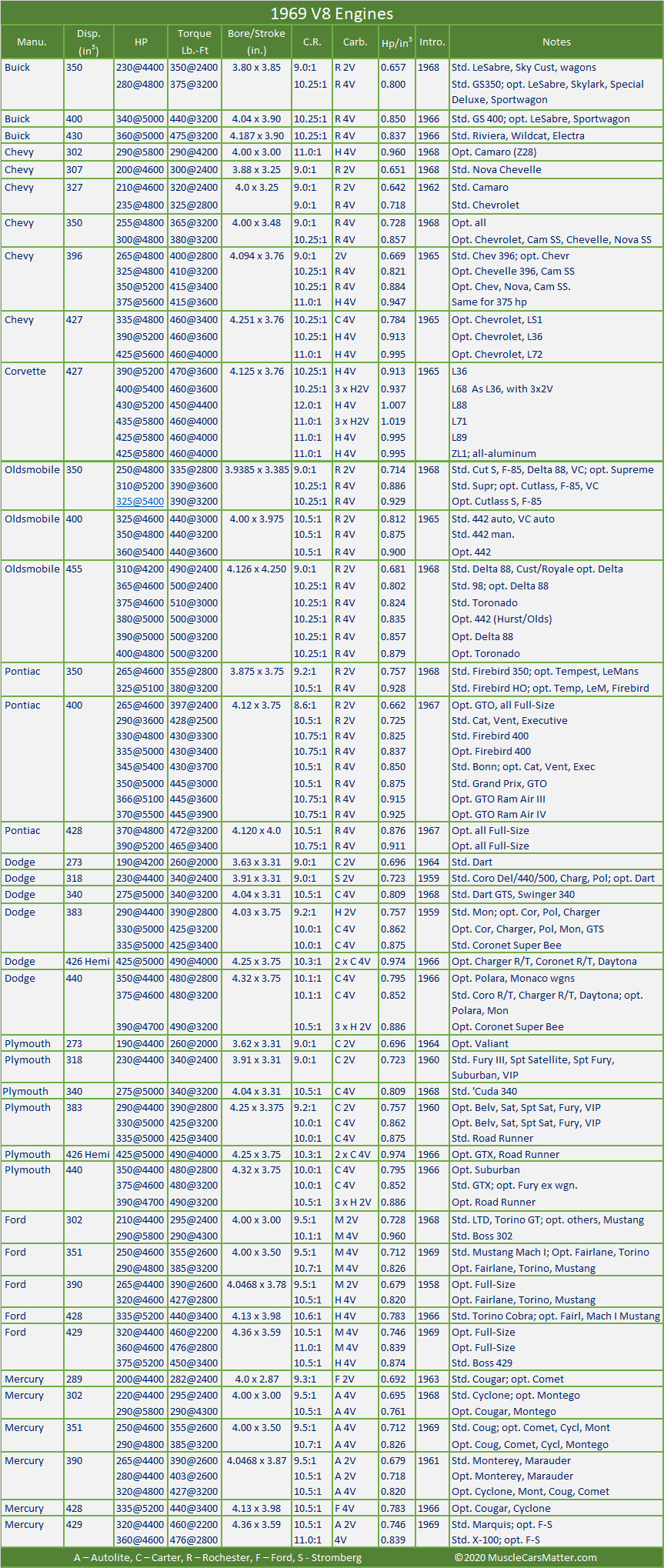
1969 V8 Engines Specs

1969 Newspaper Ads

I like how this dealer lists ‘heater’ with some of their cars. Just in case you wondered- yes, it does have a heater.

Super Bees and Charter R/T. Yeah, I could dig that!

1965,1966 and 1967 GTOs, as well as Camaro, Firebird and Dart GT.

