
This was certainly a great year for the General Motors companies, while much softer for Ford and the Chrysler companies. Sales for ’62 were increased substantially over 1961. Rambler was the only independent of any note that achieved noteworthy sales figures. Approximate total sales: 6,678,000; change: +27.2%.
1962 Noteworthy Events
- Buick – V6 engine!
- Chevrolet – Chevy II.
- Chrysler – 300 Sport.
- Dodge – Redesigned Dart.
- Ford – Galaxie XL, new 406.
- Mercury – 406 V8.
- Oldsmobile – 215 Jetfire turbocharged engine, Cutlass!
- Plymouth – Sport Fury, Valiant look for larger models.
- Pontiac – Grand Prix!

GM’s ‘Big 4’ were up a minimum of 35% this year, while FoMoCo saw much more moderate gains. Chrysler itself was up, but they had a tiny market share. What about Dodge and Plymouth? They were both well off the mark, being victimized by their styling departments. You might say “But I like the ’62 Dodge/Plymouth look!”. Well, you’re in select company then, because the buying public sure didn’t go for it.
Chevrolet
Chevrolet responded to the success of the Ford Falcon with nothing short of gusto. There were four different series of the new Chevy II, containing a total of eleven different models. The base model could be had for just a couple of Jacksons over two grand. This was almost exactly the entry price for a Falcon. Other models were Biscayne, Bel Air and Impala.
The engine offerings for the Corvair were expanded to two additional 145cid flat sixes, one of which was turbocharged and made 150hp, and a ton more torque than any of the normally aspirated versions. This was available in the Spyder version, of which over 9,000 were sold. To get a Monza Spyder, you had to pony up with an additional 13% or so ($300) over the cost of a comparable series 900.
327cid V8
That wasn’t the only news this year. The 327cid V8 appeared to supplement the 283, and there was a new four cylinder of 153cid and a new six cylinder with 194cid. The little Chevy II had a couple of dealer-installed options that provided the 283 or the 327, with up to 360hp! Yikes! Impala offered an SS package that cost $53.80, but also required the purchase of bucket seats for $102.25.
Approximate sales: 2,061,000; change: +56%; industry rank: 1st.

Look where the turn signal/parking lamps are on the ’62 Impala. In ’61 they were at the top of the headlights. The grille last year had consisted of a lot of horizontal pieces and fewer vertical pieces, and for ’62 this was swapped.
The front fenders by the headlights became more conventional. Last year the fenders displayed a cylindrical shape adjacent to the outside headlights, which was cool. The Chevrolet insignia was changed, and moved from the grille to above the grille.

Here’s the ’62 Chevy insignia. The ’61 version is shown below.

The big Chevys were mildly updated, with all four sides becoming slightly less busy than last year. It was a pleasing look, all in all.

Chevy did a good job updating their large cars this year, no question. I still like the way the headlights were done in ’61, though.


While the overall theme of the rear styling was retained for 1962, you can see from this ’61 picture that there were some significant changes.

Chevy II lines were clean and attractive. Even without any badging, you could tell this was a Chevrolet.

The styling of Chevy’s Falcon fighter was fairly simple, yet attractive. This was a unit-body construction, using a front stub frame.
‘Nova’ = “No Go”?
For years now there’s been a story illustrating ‘stupid American companies’ in the form of an account of GM and Chevy marketing the Nova in some unnamed Latin American country. The only problem is that it never happened!
The story goes that Nova was a failure in this unnamed country because Chevy/GM management was too stupid to know that ‘Nova’ in Spanish means ‘no go’. Some of us have long suspected that this was a little bit of fiction, and Snopes.com has verified this to my satisfaction.
If you speak Spanish (I don’t) you might realize that the way you would say ‘it doesn’t go’ or ‘the car doesn’t go’ does not sound like the car name. More importantly, was there no Spanish speaker in Chevy or GM who would flag this? U.S. companies marketing abroad work with people in those countries, of course, and I’d ask the same question as above.
The story doesn’t stand up under any sort of scrutiny, and thanks to sites like Snopes.com, we can put this to rest. It sounds like this bit of fiction has actually been taught in marketing classes! Don’t we have enough problems without making crap like this up?
The Chevy II Story
This is a car that was born of necessity. Chevrolet introduced their brilliant new Corvair in 1960, and Ford responded with their Falcon. Sure, Falcon was much more conventional, but it out-sold Corvair by almost two to one. Chevy immediately started planning a more conventional response to Falcon.
That response, of course, was Chevy II. In this it’s first year it consisted of three series, or trim/option levels: 100, 200, and 400 Nova. The lower two series were 4-cylinder or 6-cylinder, while the 400 Nova was 6-cylinder only. The two available engines, 153cid 4-cyl. and 194cid 6-cyl, were both new this year. The 4-cylinder was 2/3 of a Chevy 230cid 6-cylinder.
It would be another two years before you could get your Chevy II with a factory-installed V8.
We Need Two Small Cars?
It’s been said that the Chevy II was Chevrolet’s ‘Oh, crap! What have we done?’ response to the public’s reaction to the Corvair. Corvair actually sold quite well, after people got used to it. Maybe Chevy reached an early conclusion that Corvair would never be the all-around small car they had hoped it would be, and that a more conventional small car was the way to go. They didn’t give up on Corvair, not totally, in that it lasted until 1969. I think that it’s likely that Chevrolet stopped putting resources ($$$) into Corvair, and maybe let it wither on the vine. I’m sure there’s a lot to the story.
Uh, What Exactly is a ‘Nova’? (not the car . . .)
Good question. This has an interesting answer. A nova is a star that suddenly brightens multiples of times, often brightening from naked eye invisibility to become, for a time, a bright object in our night sky. It then, over a period of weeks and months, fades back into its former state. How it brightens and how it fades can tell astronomers a lot about the nature of the star.

Here’s the 1962 Corvair, tweaked a bit from last year. The big news wasn’t the mild restyling, though; it was the turbocharged engine option.

Again, nothing terribly new here, either. But under the hood… (Wait, the engine is in back; is it still a hood? I guess so; what else would you call it?)
Turbocharged Corvair
The Corvair and the Oldsmobile F-85 Jetfire each staked a claim to being the first turbocharged production cars. I think one was announced before the other, but didn’t actually appear first. For all practical purposes, they appeared at the same time.
The regular 144.7 cubic inch all-aluminum flat six engine was beefed up to withstand the added stress of boost. The engine was fitted with heavy-duty rod and main bearings, chromed upper piston rings, and nickel/chromium alloy exhaust valves. The crankshaft in the turbocharged engine was made of forged 5140 chrome-steel
Managing the heat produced by the turbocharged engine was a challenge. The original steel fan was replaced with a magnesium unit. An air-cooled engine places a greater reliance on the oiling system to provide cooling, so an oil cooler was utilized for both the normally aspirated and boosted versions of the engine.
Interestingly, the turbocharged engine, running a maximum 10 lb. of boost with its 8.0:1 compression ratio, generated more heat than could be removed via the air cooling and oiling system. Chevrolet engineers were counting on the driver not keeping the engine in constant boost, which was probably a reasonable assumption. I could find no references to any substantial heating problems with this engine.

German Comparison
You might recall that the other air-cooled rear-engine performance car was, of course, the Porsche 356. Its 4-cylinder, 1.6L engine made 59hp. It weighed about 2,000lb. Corvair weighed 2,500lb, and had power ratings from 80hp to 150hp. Which means… this thing had a better power-to-weight ratio than a Porsche of the era! The only price I could dig up for this era Porsche was $3,750, which puts its price well above the $2,600 or so for Corvair. Yeah, you could argue the figures and vehicle capabilities of both cars, but one thing is unarguable– for this kind of car, Chevy was offering a lot of bang for the buck!
Gosh, I hope you appreciate the trouble I’ve gone through to provide vintage articles. The hours I’ve spent rooting around library basements and attics, sneezing like a fool, all in the pursuit of vintage articles like this one. It’s from the April 1962 Popular Science and it introduces the new turbocharged Corvair. Enjoy! (Do mice carry rabies?)


Kind of interesting styling with this concept car, huh?

Nothing much here to get the heart racing. Chevy selling styling, ride quality and resale value.

“You know, I wasn’t sold on the ’62 Bel Air until I read that it came with a glove box light, automatic dome light and a special horn bar.” …said no one, ever!
It is a nice-looking car, though.

There’s no doubt that this is a well-designed advertisement. It piques the reader’s interest, in a fun kind of way.
I think the Corvette mention at the bottom helps to create a tie-in between the two cars in the mind of the reader, too.


Corvette
For 1962, the Corvette continued along the path previously defined. This year the chrome trim was removed from the side coves, and only solid body colors were offered. Also, colored wheels were offered, something which hadn’t been available for a while. The front grill was blacked out, which imparted a sporty, aggressive look. The 283cid V8 was replaced by the new 327cid V8. The extra displacement helped up the top model to 360hp, an addition of 45hp over the previous top 283. Sales surged by a third.
Approximate sales: 14,500; change: +32%.

I really like the look of the blacked-out grille. Honestly, I do wish they had still allowed the coves to be a different color, don’t you? As part of this change, the cove molding was removed, too.

The ‘duck tail’ rear-end with four round tail lights was introduced last year, and it was gorgeous.
Front, side and back, this was a great looking car. There’s no doubt in my mind that this was the best-looking Corvette to date, and one of the most attractive of all time.

Well, guess what? You don’t need to be a mechanic to own and drive Corvette. Perhaps there was concern at this time that a car like Corvette required some special ‘car knowledge’ to own.

Not the best ad, but still interesting. Corvette was anything but lackluster, for sure.

This talks about the fun of driving a Corvette. Yeah, in ’62 there was nothing like it and driving one would have been a blast. It might have reminded people of the import sports cars, like MG and Fiat, but we’re talking about up to 360hp here!


Buick
The Buick models this year saw some subtle updates, but nothing remarkable. After a five-year run, the 364 was retired. The little aluminum 215cid V8 and the 401cid V8 were the V8 engines available, with the lineup seeing the addition of a 198cid V6. This was the first regularly available V6 to be offered in a domestic automobile. Who knew that it would one day be enlarged to the legendary 3.8 liter and continue to be offered in a variety of GM cars well into the 2000’s?
Models were Special, Skylark, LeSabre, Invicta, and Electra 225. In ’61 the Skylark belonged to the Special series, being the two-door sport coupe of the series. This year, Skylark became its own series, with two different body styles available. The Wildcat Sport Coupe was a member of the Invicta series.
Approximate sales: 399,000; change: +45%; industry rank: 6th.

I’m not sure I ever realized this, but Buick carried over the look of the round fender by the headlights for a year longer than Chevy did! In fact, Pontiac did this as well. Not Oldsmobile, though. They never utilized this styling cue.

The Buick models received a similar updating to that of Chevrolet. With this era of Buicks, it’s easy to tell the upscale models from the others. How? Only Electra had four ventiports, the others having but three! Over the years, the ventiports would wander around on the front fenders, change shapes from round to slits, and, in some cases, come and go.
First-in-industry V6
We’re so used to V6 engines today that it’s difficult to appreciate how forward-thinking a V6 engine was at this time. Sadly, the public didn’t seem to appreciate it, either.
Buick 198cid V6
This engine was adapted from the 215, but it’s hard to tell that looking at the specs. It naturally had the 90° bank angle of a V8, unlike most of today’s V6 engines and their 60° bank angles. This resulted in an uneven firing pattern of 90° – 150° – 90°… The competition cited the resulting roughness, but many people seemed to like it and considered it ‘V8-like’.
In a strange move, Motor Trend named the Buick V6 engine their “Car of the Year”! I dunno. I remember back in the 1970’s that people would notice the Times “Man of the Year” (is it Person of the Year now?) and talk about it at school or work. Today it would make a good trivia question because nobody knows or cares about it whatsoever, in part because of some of their stupid, inane picks. I wonder if MT has ever worried about going this same death spiral path?

This was the second year for the little Special. Where last year Skylark was a sport coupe with a mid-year introduction, it achieved series status for ’62. The Skylark series consisted of two models: 2-door hardtop and 2-door convertible.

Special was little changed from ’61. Note the unique, clean rear styling that used a rather simple bumper.

Heck, if I was looking for a car that was smaller, I’d sure look at the Special. Wouldn’t you?
I’m not sure I get the marching band. Maybe it goes with the ‘happy-medium size car’ thing. I don’t get ‘happy’ when I think if marching bands, though. I get bored and think of listening to bad music played by kids, half of which are wishing to hell that they were someplace else! And cold–feeling cold. Come to think, I guess I might actually hate marching bands.

Buick went to the V6 mostly because of the cost of the aluminum V8 and the lack of enough market interest to offset these costs. It was a brilliant move!
This allowed the public to become accustomed to the V6 prior to the aluminum V8 going away.

All of the references to ‘Advanced Thrust’ I could find were related to the 1962 model year for Buick. I have to think this dubious feature (we put the engine over the steering wheels…) was more advertising magic than anything else and Buick seems to have discarded it after one year.


Buick Lineup Brochure


Oldsmobile
Oldsmobile restated their intention of becoming a small(er) car maker by introducing more models based on the F-85 112” wheelbase. These included a convertible and a handful of deluxe models. Cutlass arrived but was just a model in the F-85 series and was not yet a series itself. That would come in a few years. The Starfire series added a 2-door hardtop to their lineup, which also includes the original convertible.
With the exception of the F-85, the models featured a 1962-only front-end treatment that looked a bit like “a front-end within a front-end”. Not altogether bad looking and certainly unique. I think of the creature from the “Alien” movies, with its mouth-within-a-mouth.
Engine Fun
Additional series names included Dynamic Eighty-Eight, Super Eighty-Eight, Starfire and Ninety-Eight. The aluminum 215cid V8 output jumped up to 215hp with the optional turbocharger, which was known as Jetfire. The top 394cid V8 picked up twenty horse, to 345hp. Kinda sparse, but not a bad engine lineup. Olds tried to claim the Jetfire F-85 was the first production car to make 1hp per cubic inch, and may have had some legitimacy, with qualifications. That ship had long ago sailed, though, and this claim didn’t go anywhere.
Approximate sales: 429,000; change: +35%; industry rank: 5th.

For some reason, this front-end design really fascinates me. If you were to try to describe it to somebody, they’d think you had lost your mind. But it works! Might not be for everyone, though.

The front of some of the Olds models was interesting, to say the least. The front is otherwise fairly conventional. The rear is clean and conventional, with none of the uniqueness the front has.

The front styling in ’61 was indeed attractive, with some interesting front fender treatment. The ’62 front would incorporate few of these styling cues, except for the quad headlights.

The rear styling of the full-size Old offerings in ’61 was really interesting. This year things became a bit more mainstream, particularly the taillights. There would still be a bit of a remnant of the fender extension in the ’62 rear styling.
Jetfire!

Jetfire was, of course, part of the F-85 series. It was possibly more attractive than last year, with a side accent strip that now ran straight down the side, rather than dropping down on the rear fender like before.

The rear of Jetfire was uncluttered and attractive. I like how the rear (and front) fenders are formed to be evocative of fins without actually being fins. Thia was a darn attractive little car!


The “…delight you!” thing reminds me of a company I worked for. They bought into the contemporary group-think that you should strive to ‘delight’ customers. Oh, my aching ass! When was the last time that you based a buying decision on someone having ‘delighted’ you in the past? I thought not…

High-Tech? Hell Yeah!
Note the highlighted text. One horsepower per cubic inch! There were non-turbocharged cars, even in ’62, that exceeded this specific output. Regardless, a super-cool engine and car! Also, don’t miss the vacuum/boost gauge. If you’ve driven a late model turbo car, you know what this is all about. The ‘fluid-injected’ is in reference to the water/alcohol injection that was used to control detonation under some conditions.
The literature from the era points to “15% boost”, which is only about two psi. However, an advertisement from ’63 specifically states “…5 psi boost…”. I’m not aware of any differences between the engines of the two years that would account for a difference in boost. This engine did have a compression ratio of 10.25:1, quite high for a boosted engine!

Starfire was a cool car, for sure! It would cost you a whole Grand above the cost of an 88, and was well over two tons in weight. This wasn’t a boulevard bruiser as much as it was a great luxury performance car. This thing was just loaded with power accessories.
Pontiac
This is the year that Pontiac crossed the 400hp level, with their new 421cid V8. A Super Duty version of the 421cid V8 made 405hp with 2 x 4bbl induction and was priced at a staggering $2,250. The 389cid V8 remained the mainstay engine.
There weren’t any huge styling changes, though the divided front grilles did receive a new look. It featured a slightly protruding central divider and was simple but elegant. Some models had multi-section roofs that were evocative of a convertible top.
Series names were Catalina, Star Chief, Bonneville, Grand Prix and Tempest. The Ventura name was dropped, having been replaced by Grand Prix, which was a two-door hardtop.
Approximate sales:522,000; change: +53%; industry rank: 3rd.

Grand Prix was a new series this year, replacing Ventura. The larger Pontiacs featured an attractive V-shaped twin grille.

Grand Prix would become a key vehicle for Pontiac and would be a part of Pontiac until their demise. This rear-end treatment is stunning!
Sweet Styling

This is a nice-looking little car, isn’t it? The front grille was no longer split, now looking a bit more conventional. The Pontiac guys hadn’t yet experienced the eureka moment of “Hey, guys! What do you think it would be like if all of our models had a common design element like maybe a split grille?”.

Tempest rear styling was largely unchanged from last year. Lower bumper pieces and trim along fins was new.

‘How to stop staring at other people’s Pontiacs’. I like it! The statement “Turning radius shortened by as much as 3 1/2 feet…” is a bit of a puzzler. I wasn’t aware that Pontiac was doing anything different from other GM divisions that might make this true.

This is an example of Pontiac leading, just like Buick was with their V6. I’m not sure how many buyers would find the ‘Torque Multiplication’ tables relevant. Not entirely sure what Pontiac was trying to convey here.

Pontiac made a big deal of the ‘balanced’ theme, and rightly so. This was the only domestic car that had a rear transaxle. It’s just too bad that it didn’t catch on. I’m not sure that the extra manufacturing cost was offset by the benefits, but regardless it was a cool concept.
LeMans (the place . . .)
We’ve all heard of LeMans, but how many of us really know what the term refers to? LeMans is a city in France of some 143,000 residents. Since 1923 the city has hosted the premier automotive endurance event in the world, the 24 Hours of Le Mans. In French, the name is pronounced like “le-mow”, but with less emphasis on the ‘w’.


Vinyl Tops
You could probably write a book about vinyl tops. The first ones, back in the ‘20’s, were intended to be evocative of the top of a carriage. They really took off in the ‘60’s, with 1962 often mentioned as the start of this fad. Carmakers loved them, as they were huge profit makers. Honestly, I think the vast majority of cars with vinyl tops would look better without them. They can impart a “two-tone” quality, though, that looks good with some body colors.
I always felt that they were intended to produce a convertible like look, which many people regarded as extra sporty. In the 80’s and ‘90s, there were even some cars that featured vinyl/canvas tops that were intended to mimic convertible tops, ribs and all. In my mind, this was akin to something like wearing your pants with the top around your thighs, as is seen with young men.
Automakers loved vinyl tops. Not only could they obviously charge for them, but they also didn’t have to spend the time to smooth and prepare the roof joints like they would without the top.

Chrysler
At Chrysler, the era of fins was over. The Virgil Exner designer cues of prominent, sweeping fins and the resulting concave body sides, were relegated to the dustbin of history. Oh, what an era it had been! Many of these cars still look remarkable today, some sixty years later.
Chrysler confused the living crap out of potential customers by dropping the Windsor name and replacing it with 300 Sport. But, wait! There was already a 300, the top-of-the-line 300H. Yeah, let’s take a model near the bottom of our lineup and give it a name almost identical with our most expensive series, one that costs some 60% more!
Series were then Newport, 300 sport, New Yorker and 300H. Engines remained the 361cid V8, 383cid V8 and 413cid V8.
Approximate sales: 129,000; change: +34%; industry rank: 11th.

This has to be one of the most attractive cars that used canted quad headlights. Beautiful!

The minimal ‘A’ and ‘C’ pillars looked good, didn’t they?

The 413 was a great engine. It ‘only’ made 380hp in its dual-quad form with Chrysler, while the hottest Dodge version made an additional 40hp. Chrysler wasn’t as interested in hot cams, with torque being of more interest in the large Chryslers. Note that the 300H engine, here, featured a more common inline dual-quad setup.


I used to think that it was idiocy that Chrysler named this ‘300’, after the 300 letter series cars, but now I think it might instead have been brilliant. They didn’t sell many of the high-priced 300 letter cars, but I don’t think they really intended to. The 300 Sport accounted for almost 20% of Chrysler’s 1962 sales.


Dodge
This was the year that Dodge redesigned the Dart into what might have been one of the ugliest cars of the ‘60’s. I’m not sure exactly what they were thinking. The one-year-only front end and rear fender treatments are best seen, rather than described. The Dart line contained four different series: Dart, Dart 330, Dart 440 and Polara 500. The Custom 880 was the larger car series, which was a Chrysler with a ’61 Dodge front that was intended to fill the hole left by the demise of DeSoto. Lancer continued as the compact series.
Lots of Engines
Dodge got the full slate of eight-cylinder engines, including the 318cid V8, 361cid V8, 383cid V8, and 413cid V8.
Approximate sales: 240,000; change: -27%; industry rank: 9th.

Behold! You are gazing on the reason Dodge sales fell 27% over 1961, while the rest of the market saw substantial gains.

Looking at the front of Dart, above, you might tempted to think “It has to look better from the back”, but you would be wrong.

The front styling of Dart was a bit unusual in ’61, but you ain’t seen nothing yet! The ’62 styling would be crazy-weird-ass-shit-from-outer-space!

You might want to look back at the ’61 Dodge cars to get a better idea of how unique they were. The rear view of the ’61 Dart here gives a hint, with the loop in the chrome strip visible, as it transitions from the side of the car to turn sharply and run up the top of the fins. The fins themselves were quite remarkable, reminiscent of some prehistoric fish.

Lancer was unchanged from last year. The reason for this was likely that 1962 would be the last year for Lancer.

The lines of Lancer were a bit more subdued than those of Dart. Neither had styles that would be around long, which was a good thing. It didn’t take Chrysler corp. long to figure out that this look wasn’t a winner with the buying public.

I’m a little confused about the jungle background here and what it has to do with anything. Oh, wait. I didn’t mean ‘jungle’. Rain forest; that’s what I meant to say!
I think they could have skipped the part about the grease job interval.
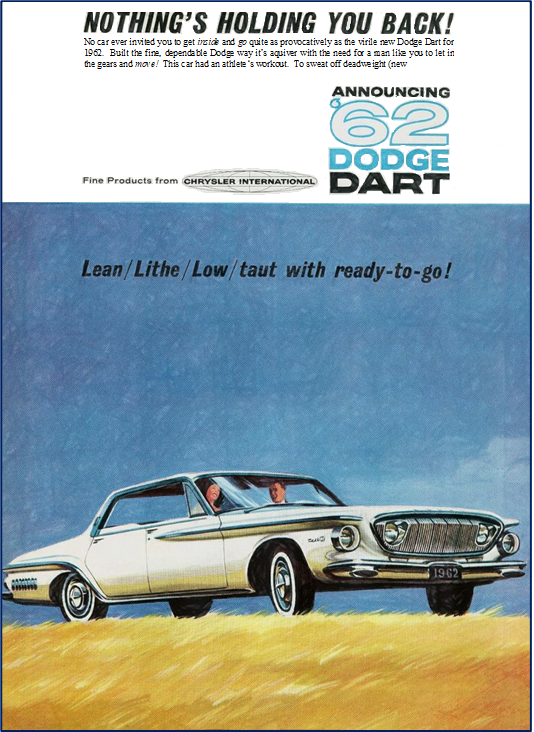
Advertising Magic
The artist for this drawing has taken a lot of liberty to make the car look long and low, I’d say.
With the text “…it’s aquiver with the need for a man like you…”, you know the target demographic for this advert.
Note that the two-speed automatic PowerFlite, introduced in 1954, is no longer available this year.


This was indeed the ‘Big Dodge’, with a 122″ wheelbase and tipping the scales at 3,800 pounds. It only accounted for about 7% of the Dodge sales in 1962.

Plymouth
There wasn’t a lot of change at Plymouth for ’62. One very positive thing was that the hideous front-end treatment of 1961 had been quickly discarded. Valiant’s odd lines were much more subtle, and overall, the more subdued look worked in their favor. Sales would again decline slightly this year, but the bleeding had been stopped. The 420hp 413cid V8 featured 2 x 4bbl induction and was priced at $612. There were two different 413 engines with short ram intakes, intended for drag racing.
Placed at the top of the series lineup was the new Sport Fury. Other models were Savoy and Belvedere.
Approximate sales: 339,000; change: -5%; industry rank: 8th.

Plymouth’s styling did reflect that of Dodge, but with more subdued lines. The two sets of headlights were different from each other, but weren’t as ‘unique’ as the angled headlights of Dodge.

Valiant didn’t see many changes this year.

This title makes little sense to me, especially in how it relates to the first sentence of the text. ‘Independent Americans’? Am I an ‘independent American’? I don’t really know for sure! I should ask my wife!

If you weren’t already aware of it, you’re looking at the Plymouth ‘Forward Flair Design’ here. Not a bad looking car, but damn, they had some serious competition from the newer GM compacts, as well as Ford’s Falcon.


The ‘alive’ theme here must have caused the ad guys to work overtime. It’s kind of an interesting read. It almost sounds like they’re not talking about a car!

Ford
For 1962 Ford made some changes that would grow into great significance in coming years. The Fairlane was no longer merely the intermediate trim level, it was a true midsized series, with models that were smaller than before. Also, the Galaxie received a major redesign that would come to be regarded as classic, with the Galaxie 500XL being added to the lineup. Falcon and Thunderbird remained the other two series. Thunderbird now offered an attractive Sports Roadster, that featured a fiberglass tonneau cover for the back seat. This was priced at a handsome $5,439 ($54,240 2023$).
New Engine Family
This was notably the year that the Ford 90 Degree V8 engine family appeared. The initial member was the little 221cid V8 which was earmarked for the Fairmont. This engine was built using thin wall block castings. It was quickly realized that the engine just didn’t have the size to provide the power needed. It only made a handful of horsepower more than the 223cid straight six. The 221 was therefore shortly bored to provide 260cid. This added about 20hp over that of the 221. The Y-block 292cid V8 was still around, only making a few horsepower more than the 260. Both the 221 and the 260 utilized thin-wall castings that did not extend below the centerline of the crankshaft. See 1946 through 1963 Engine Development by Automaker in Early US Automotive History for information on the 221 and 260cid V8 engines.
406 cid V8
Other Ford Engine news was the 406cid V8. This was based on the 390 engine, and was a 0.078 in. overbore of the 390. Power was up 10hp (4bbl) over the 390, with the hottest version making just 1hp less than the magic 1hp/cu. in. mark. This engine wouldn’t be around long, making way for the fabulous 427 in ’64.
Approximate sales: 1,476,000; change: + 10%; industry rank: 2nd.

The Ford full-size line was restyled in 1962, but they bore a strong resemblance to the 1961 models. The front of Galaxie, here, shows the new front-end. If you compare it to the ’61, below, you’ll see it was more of an updating than a full-on restyle.

The ’62 retained the iconic round tail-lights of the ’61, but they were lowered so that the bumper had to be modified to allow this. Am I the only one who thinks this looks a little odd? Nice, but odd. It’s like my brain is telling me the tail lights should be higher. No?

The ’61 Galaxie front was updated for ’62, but the same overall styling cues were retained. The ‘wire’ grille with the blobs at each intersection, and the central horizontal piece were replaced with a new grille that had strong horizontal elements with secondary vertical elements.

The large round tail lights in the ’61 were retained this year, but would be located lower.
Killer Roadster

This T’Bird is the Sports Roadster, which featured a fiberglass tonneau cover that fitted over the back seats. This imparted some of the feel of the original ’55 to ’57 series. This option added over $600 to the cost of the convertible, which was already about $4,800!

From this angle the Thunderbird looks like it has two J58 jet engines built into it. Galaxie has the same tail lights, but they look more ‘integrated’. These here look like they could go into afterburner and shoot out flames. From the rear, it looks like the rear fenders form the ‘jet engine’, doesn’t it? Not so with the Galaxie.
There were few changes to Thunderbird for 1962, but this was only the second year for the new body.

A family portrait of the 1962 ford automobiles.

I have to say that Ford had a killer entry in the sport luxury segment in the Thunderbird, with or without the landau top.
The Buick Riviera, and later, the Oldsmobile Toronado would become the other key players in this market niche.

Ford expressing the value of their Fairlane series. This is the ‘It looks more expensive than it is’ approach. This is the same approach used by all of the other makers of ‘entry-level’ cars. Hey, wait? Didn’t Ford/Mercury do the same thing about 20 years later, with the “it looks like an expensive European car (Mercedes)”?
Fairlane was Ford’s entry into the new mid-size market segment, of course.


Ford continued to present their ‘longer maintenance interval’ theme. I don’t really know how successful this advertising campaign was or was not.

405hp? Oh, yeah baby! I kinda like the powerful yet quiet sort of theme.
While we’re at it, let’s throw some disease-infested pigeons into the picture.
Lessened Maintenance?


Here’s Ford in the March 1962 Popular Mechanics trying to show how your Galaxie or Fairlane will require less regular maintenance than a competitor’s model. I guess that doesn’t bode well for Gomer down at Wally’s! (If you don’t get this reference and you’re over 50, shame on you!)
Transistorized Ignition
Ford offered a transistorized ignition this year, their first. We’ll cover electronic ignitions in a different section, but let’s take a cursory look here.
I’m not sure what the cost of the option was, but for Chevy’s Corvette it was about $75 ($645- 2019$). I’d guess that Ford’s was perhaps slightly less than this. There were aftermarket units sold in Popular Mechanics, for example, that were priced at $40 – $50 or so.
As you may already know, your ignition system uses 12V to generate several thousand volts that are necessary to jump the sparkplug gap. To accomplish this, the points, which we’ll consider to be closed at the moment, allow current to flow through the primary winding of the coil. This allows a magnetic field to form. When the points are opened by the rotation of the distributor, current ceases to flow through the coil and the magnetic field will collapse rapidly. The collapsing magnetic field cuts the conductors of the secondary winding, of which there are many more than the primary.
The high number of conductor turns in the secondary winding and the rapid collapse of the field generates the very high voltage we need for the spark plugs. By this time the rotor has rotated to the correct position to contact the distributor cap contact for the correct cylinder and our plug fires. The problem is with our points.
To the Point(s)
The points are the weak link in this system. They carry all of the current that flows through the coil primary winding, doing the work of establishing the magnetic field. When they open, the collapsing magnetic field will try to keep current flowing. Toward this end, current will continue to flow even after the points have started to open, resulting in an arcing across the gap between the opening points. The condenser (capacitor) will help diminish this effect, but there will still be an arc when the points open.
This arcing has the effect of degrading the surfaces of the points, slowly and cumulatively. There will come a time when they have degraded enough to merit replacing. What if we could make it so that the points didn’t have to handle so much power, resulting in much, much less arcing? Wouldn’t that be good?
Enter Transistors
Someone had the bright idea that we could use these new-ish transistors to do just what we mentioned above. The Ford transistorized ignition system retains the points, but they no longer carry all of the primary coil current as before. Instead, they merely carry a signal that triggers the transistor amplifier, and it’s the amplifier that ‘switches’ the power that previously would have flowed through the points. The points now act as a low power ‘switch’ and the amplifier a high-power switch. No more point arcing, and the points now last far longer.
Don’t let the term’ amplifier’ bother you. The transistors are just acting like switches, solid-state switches. And solid-state switches don’t arc! Ain’t technology wonderful?

Just to give a bit of perspective, here’s a smallish vacuum tube and a transistor equivalent from a slightly later era. They’re in approximate scale, but note that the transistor itself is tiny, as the picture shows its leads, which will be trimmed once it’s installed. The ratio of the volumes of the two objects is at least 20:1, I’d guess, with the power consumption ratio being even higher. My 1957 Zenith television is all vacuum tubes, no transistors. Buying a similar set less than a decade later would mean purchasing an all-transistor set.
As of early 2023, Cerebras has an integrated circuit (‘chip’) with 2.6 trillion transistors!

Mercury
While 1962 was a good year for the auto industry, that didn’t extend to Mercury quite as much. For its part, Ford had lower sales gains than most of their competition, but only Mercury and Dodge saw losses.
There just wasn’t a lot of excitement at Mercury this year. A bit of name shuffling and a bit of sheet metal tweaking. There was a new six-cylinder, with 170cid and 101hp, but that’s not going to move the excitement meter much. As with Ford, the 221cid V8 and the 260cid V8 engines appeared, being the first members of the Ford 90 Degree V8 engine family.
Mercury also got the new 406cid V8, but not the multi-carb version. Still, 385hp with a 3,800 lb. Merc will get you where you’re going fast enough.
Series were Comet, with Custom and Special, Meteor, Meteor Custom and S-33, and Monterey, with Custom and Custom S-55. Sounds like some marketing guy enlisted the help of his fourth grader in naming these things. Meteor rode on a 116.5″ wheelbase, reduced from the 120″ of last year, now becoming a midsize car.
Approximate sales: 341,000; change: +7.6%; industry rank: 7th.

Put Galaxie and Monterey side by side–what do you notice?

To be honest, these taillights look kinda odd to me. I prefer the ’61 look. I guess in its defense, though, it’s now true that the front and rear designs mimic each other more.

This is the ’61 Monterey grille, and as you can see, it’s concave. What to do for 1962? Make it convex of course! That’s pretty much what Mercury did.

The ’61 Monterey had a fairly conventional rear design, if you consider smallish fins ‘conventional’. The taillights were moved up to the fenders this year, which to my eye resulted in an odd look.

Great Naming!
The ‘S-33’ name was a non-starter. I mean, who thought this was a good idea? Didn’t anyone have the cojones to tell the boss that this name was a crappy name for a car? Not sure I’d use the word ‘hot’ when referencing the 260, but I can’t blame them for this; it was hot relative to the six-cylinder options. Oh, the model is a redhead!


The styling of Comet was really quite nice. I particularly like the side styling and the small fins on the rear fenders.

Comet from the front. Simple, but not plain. Is she from the S-33 advert, above?

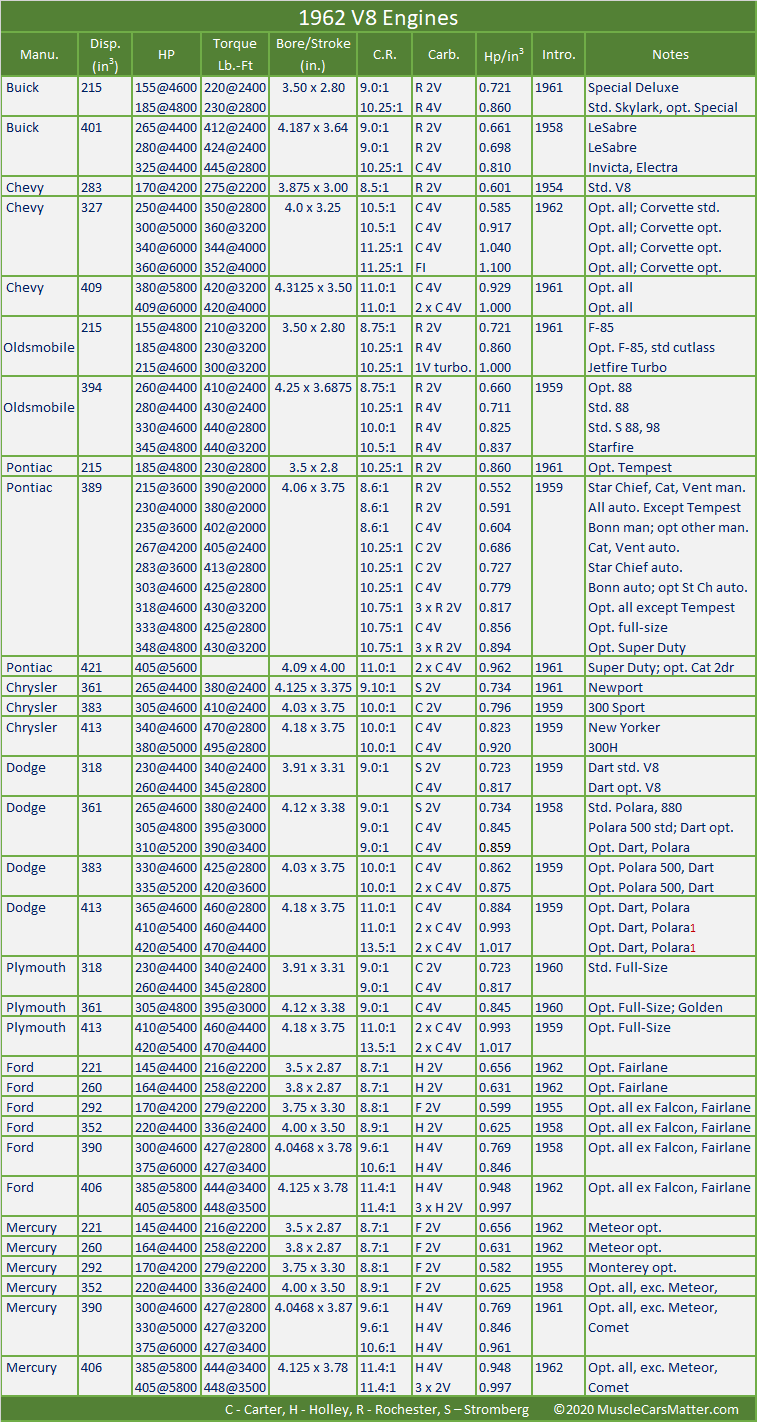
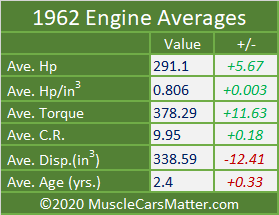
1962 V8 Engine Specs
1962 Newspaper Ads

These prices caught my eye. The 1963 models had been out for a few months at this time, and the $1595 was likely for an early ’62 car that was used and essentially a year old.

This is one busy advertisement, for sure. The two ’63 models at the top are each a couple of hundred bucks below list.

Can you imagine yourself living in rural America in the early 1960’s and driving a Renault, Triumph or Peugeot? Most service shops probably couldn’t even pronounce the name of the car you were driving, much less fix it.

