
This was another good year for the U.S. auto industry, with an additional 700,000 more units sold than last year. Plymouth and Dodge experienced nice gains, after a soft ’62. Of particular interest were the new nameplates seen, Nova, Wildcat, and Riviera. Engine news featured the 426 wedge of Dodge and Plymouth, the 427 of Ford, and Pontiac’s sweet little 326.
Approximate total sales: 7,395,000; change: +10.7%.
1963 Noteworthy Events
- Buick – Wildcat series, Riviera series.
- Chevrolet – Nova, Corvette Sting Ray!
- Dodge – 426 wedge V8.
- Ford – 427 V8.
- Mercury – 427 V8.
- Plymouth – 426 wedge V8.
- Pontiac – 326 V8.

The overall market was up by close to 11% over last year’s levels. Plymouth and Dodge had some crazy sales increases, mostly due to jettisoning the butt-ugly designs they had last year. Mercury was the only significant player to see declines over ’62.
Chevrolet
This was a year of minimal change at Chevrolet. One notable thing was the new Super Sport option for the Nova 400. An indication of things to come, for sure. Other models were Chevy II, Biscayne, Bel Air and Impala. The 230cid inline six was new this year, but hardly exciting. What was exciting, though, is that the wonderful 409cid V8 now made 425hp in its most potent form. The Impala SS package, RPO Z03, was expanded this year to include more nice stuff.
Approximate sales: 2,237,000; change: +8.5%; industry rank: 1st.

What a beauty! Can you imagine being behind the wheel of this thing with a 425hp 409 under the hood? Oh, Mamma! We gonna have some fun now!

Impala’s front look didn’t change much for 1963. That was okay, though, since it was an attractive car.

I did like the earlier curved rear windows, but the rounded C-pillar look here is sure attractive.

Like the look of the ’62 Impala front? Good, because the ’63 is almost identical!

The ’62 rear look was carried over to the 1963 model with little change. The ’63 would see the rear trim plate pinched down in the center.

Not much changed with Chevy II for ’63. One thing that did, though, was the appearance of a Super Sport option for the Nova 400. Remember that Chevy II was not yet available with a V8 engine.

The Chevy II design would always be evolutionary, never revolutionary.
Slow change from year to year. Seems to have worked, though.
1963 V8 Chevy II?
If you look at the tables below, you won’t see any V8 option for Chevy II. That’s because one wasn’t available. Normally, that is.
The Internet has numerous references to questions regarding the availability of a V8 Nova in 1963. The general comments are similar to ‘can’t verify’ and ‘legend’.
I came across an August 1963 issue of Motor Trend a while back. It has an article with the title Bigger Engines for Compacts in ’64. It was written by the legendary automotive writer Roger Huntington. From the article:
“Last year, Chevrolet developed a rather elaborate kit to permit their dealers to install the 327-cubic-inch engine in the Chevy II chassis. The necessary space and even the motor-mount holes were provided when the car was originally designed; the kit supplied all the other necessary external parts for the switch.”
I have to take this as proof-positive of the existence of the 327 option in 1963, albeit dealer installed. It would be absurd to think that this 1963 Motor Trend article is wrong about a 1963 Chevy option. But…if you’re a believer of nano somethings in jet contrails (chemtrails), you might be hard to convince.

This is the Chevy 409, the engine of history, myth and song. This was truly a landmark engine. It would be an enormously important engine in itself, and it would lead to the wonderful Mark IV big-block engine family that is one of the most significant engine families of all time.
Beach Boys 409
The Beach Boys had a song about this engine, named ‘409’ (what else would you expect it to be called?).
[Intro]She's real fine, my 409
She's real fine, my 409
My 409
[Verse 1]Well I saved my pennies and I saved my dimes (giddy up, giddy up 409)
For I knew there would be a time (giddy up, giddy up 409)
When I would buy a brand new 409 (409, 409)
[Chorus]Giddy up, giddy up, giddy up 409 (giddy up, giddy up 409)
Giddy up 409 (409, 409)
Giddy up 409 (giddy up, giddy up 409)
Giddy up 40…
Nothing can catch her
Nothing can touch my 409 (409 ooooo)
(giddy up, giddy up oooo)
(giddy up, giddy up oooo)
(giddy up, giddy up oooo)
(giddy up, giddy up)
[Verse 2]When I take her to the track she really shines (giddy up, giddy up 409)
She always turns in the fastest times (giddy up, giddy up 409)
My four speed, dual quad, Posi-Traction 409 (409, 409, 409, 409)
[Chorus]Giddy up giddy up giddy up 409 (giddy up giddy up 409)
Giddy up 409 (409, 409)
Giddy up 409 (giddy up giddy up 409)
Giddy up 40...
Nothing can catch her
Nothing can touch my 409 (409, 409, 409, 409)
Giddy up 409 (409, 409, 409, 409)
Giddy up 409 (409, 409, 409, 409)
Written by Gary Usher, Mike Love, and Brian Wilson
Released June 4, 1962
Impala Z-11
The Z-11 Impala option was applied to fifty cars in 1963. Some twenty pieces of metal, including bumpers, hood, and fenders were made from aluminum, resulting in a car that weighed a hair over 3,400lbs. What was equally remarkable was the engine, which was a 427 cubic inch version of the 409. It featured special heads, two-piece aluminum intake with 2 x 4bbl induction, a 13.5:1 compression ratio and forged everything. It dominated its stock bracket, running high 11 second quarters at over 120mph.


Have to say, “…the marvelous system that takes rain water and air from the cowl to rinse away corrosion-causing elements” is new to me.
They refer to the Delcotron generator, also known as an alternator. Gotta say, the most unexpected thing is the reference to ‘grandmother’s lap’. My grandma would bite your face off!
It seems that Chevrolet used the ‘Jet-Smooth’ theme quite effectively.

It seemed to me that the ‘Chevy II Nova’ versus just ‘Chevy II’ was always kind of confusing.
Over the years, the ‘Chevy II’ aspect was less emphasized and the ‘Nova’ was more, until it was simply ‘Nova’.
This was a great series in the low-cost compact segment.

Here’s the pairing in one advert of Chevy II and Corvair. Makes sense, I guess, given that they were both aimed at the same market segment.
Of course, with these two specific models we have the ‘utility’ and the ‘fun’ aspects both covered. Corvair was mostly unchanged for 1963.

Corvette
This was a huge year for the Chevrolet Corvette! A new body was introduced, the Sting Ray. It incorporated the rear-end treatment introduced in ‘61 and was sculpted gorgeousness from bumper to bumper. It rode on a four-inch shorter wheelbase and had hidden headlights. For the first time, there were two body styles; in addition to the convertible was the two-door fastback coupe. In this first year, the two styles would sell in similar numbers. Sales exploded, picking up almost half over last year. As is always the case, there were likely buyers in ’62 who decided to wait for the new model, thus somewhat deflating ’62 sales numbers and inflating ’63. Regardless–Corvette was on fire!!
Approximate sales: 21,000; change: +48%.
OMG! Have You Ever Seen Such Beauty?

Nothing but acres of gorgeous, curved fiberglass beauty! This was arguably the most attractive domestic car of all time. This was a tied series, final game, 9th inning, last at bat, bases-loaded-homerun for Chevrolet and Corvette.

Corvette was as attractive from the back as from the front! There aren’t many cars you can truly say this about. The new top (no fastback last year) blended perfectly with the existing rear design.
Makes you wonder–when they were designing the new rear for ’61, what elements of the ’63 did they already have determined?
I always kind of assumed that the ’63’s two-piece rear window evolved into the more ‘modern’ one-piece unit; that seemed reasonable. Apparently, there’s more to this story. The split window allowed the ‘stinger’ design element to flow down the back of the top, between the window sections and down the back. Some at Chevrolet found this highly desirable and didn’t want this styling cue compromised by a one-piece window. Far more interesting story than I imagined! The small block 327cid V8 continued as the corvette engine of choice, making between 250hp and 360hp.


Some Nice and ‘Meh’ Styling

Another pairing, this time of Corvette and Corvair.
I like coming and going aspect, and the fact that both cars are of similar color. Chevrolet did this paring of models better than anyone else. Ford also did it a bit, but I don’t think it was as effective.

Yeah. I’m not so crazy about this advert. I wouldn’t have this horse of a dog in my sport car or my luxury car, truth be told. Can you imagine the slobber this thing is dripping on everything? “…ultimate luxury of an automobile specifically designed for privacy…” strikes me as an odd statement. Privacy? Why, because I can only carry one passenger? Yeah, this advertisement is a swing and a miss.

Definitely the hardtop. With those incredible lines, how could you go with the convertible?

This ad is in the same style as the ‘Corvette – Corvair’ ad just above. It struck me that all four models could not possibly have been available in this color, but that really doesn’t matter.
Buick
The big news at Buick was the introduction of their new Riviera two-door hardtop sport coupe. This was a sport-luxury car that exhibited remarkable styling and striking lines that look as good today as they did in ’63. It came with a 325hp version of the 401cid V8, with the 425cid V8 (340hp) available optionally. The Riviera came standard very well optioned. The name was taken from that of the ’62 Electra 225 4-door sedan.
Riviera was a luxury-performance car par excellence. It would have no serious rivals in the GM stable until the arrival of Olds Toronado in 1966. The other significant player in this niche was Ford’s Thunderbird, which was top dog. So successful was Thunderbird that Riviera would have a hard time gaining traction.
Other models were Special, Special Deluxe, Skylark, LeSabre, Wildcat and Electra 225. The Electra was redesigned this year, with rear fenders that were strikingly different from last year. The Invicta name was replaced by Wildcat, which was the name of the ’62 sport coupe model of Invicta.
Approximate sales: 457,800; change: +14.8; industry rank: 7th.

Buick Riviera. Hardtops only need apply! The look was astounding. The front styling was not complex, but it was undoubtedly elegant and stylish. The hood and sides had clean, uncluttered lines. The faux air scoops in front of the rear wheels were just enough.

The rear look of Riviera was attractive, but you really had to look at the rest of the car to really appreciate its beauty. The front especially was remarkable.
Actually, I think you could make the same comments as the front about the rear. It wasn’t complex, but it was beautiful and stylish. Don’t miss the fact that the rear fender/bumper projections match those of the front. What a car!
Buick Enters Luxury-Performance Market
Riviera started out as a GM design project code named XP-715. Buick accepted the project after Chevy and Cadillac passed on it, and so was born Riviera.
Riviera’s main competition was from Ford, in the Thunderbird. Thunderbird had been the model to really define the luxury-performance niche in the late 1950’s. This really took shape in 1958 when Thunderbird became a 4-passenger car. By 1963, Thunderbird had owned this special part of the auto market. Buick did a good job fielding a unique, attractive, luxurious and powerful car that was a worthy competitor to Thunderbird. Thunderbird’s market lead wasn’t in jeopardy, though, handily outselling Riviera at this time.

The ’63 Special was larger and sported a new bodyshell. The front fenders, that extended forward in ’62, became more conventional and conformed to the outer headlights. The front of the hood became thicker, and still bore B-U-I-C-K in block letters. The horizontal lines of the ’62 grille were now fine vertical lines.

The front of Special in 1962 featured these cool fender extensions. They wouldn’t be carried forward to the ’63.


This is a fun advert. Hey, wait! Is that John Wayne Gacy under the clown makeup? (Was that over the line? Hey, he didn’t kill kids!)

This was a gorgeous car with a ton of power. Just look at that profile! This design was just so well balanced.

Skylark and luxury. What in the name of all that’s holy is the guy in this picture wearing? I mean, really? Is that grandma’s quilt? I am so confused…
1963 Buick Lineup Brochure


Oldsmobile
Oldsmobile merely made incremental changes this year. There were now two Cutlass models, an indication of things to come. Many models received minor redesigns, though focused on “below the beltline”. Series remained F-85, Dynamic Eighty-Eight, Super Eighty-Eight, Starfire and Ninety-eight. Engines were carryover, being the 215cid V8 and the 394cid V8.
Approximate sales: 476,700; change: +11.2%; industry rank: 5th.

Starfire was the Olds performance series, available as 2-door hardtop or convertible. When it was introduced last year it was as a convertible only.

Those are Square Fins!
The ’63 Olds styling was clean and uncluttered, and perhaps a little less unique than last year. Notice how straight and ‘sharp’ the fins are, matching the features of the front fenders. Man, those are square! (No, I don’t mean in the ’60’s sense of ‘square’).

This is the front of Starfire last year. The essential styling of the grille was carried over, but the unique and funky ‘fender within a fender’ look was retired. I think it’s a cool look.

The restyled F-85 was attractive. The grille was redesigned and now featured a horizontal piece with the block O-L-D-S-M-O-B-I-L-E in the middle of it. The ridges on the tops of the fenders were modified from last year, becoming somewhat more subdued. This front styling seems really Chevy-like to me.

The rear design of F-85 now had a deck lid with a much greater height. The rear horizontal part of it had O L D S M O B I L E centered on it. Rear tail lights were squarish and located in the rear of the fenders.

The ’62 front was nice enough, but I really like the redesign in ’63.

The ’62 rear styling was unimpressive. It had four small tail lights and a flat style trunk lid. The ’63 rear styling is way, way nicer.


The body-side accent is hard to miss. I like it. The rear window was indeed a bit unique. Starfire was a winner, for sure!

I Want a Jetfire!
I read recently that there were an estimated twenty Jetfires left with the engines still intact.
Even if a million of these little gems didn’t end up going out the door, it still served to showcase what Olds could do.
The things that prevented this engine from being a success were, in no particular order: buying public didn’t appreciate the value of an aluminum engine, owners didn’t observe the unique coolant requirements of an aluminum engine, and owners let the ‘Jet Fluid’ run out. Add to this the fact that large aluminum castings were problematic and waste was substantial, and this spelled the end of this project. We’d have to wait some four or more decades for things to come full circle.
Water-Methanol Injection
Jetfire used water/methanol injection to control engine detonation (knocking) under certain operating conditions. Of course, being Oldsmobile, they named this ‘Jet Fluid’ (who could have seen that coming?).
You might know that this method of temporarily increasing engine power was used heavily by the German Luftwaffe in WWII, and to a lesser degree by the allies. But who pioneered this?
It was a British engineer named Harry Ricardo who came up with this process. So, a brit pioneered fluid injection and the Germans embraced it more than the allies did. Does this sound familiar? It might, because Frank Whittle, an RAF cadette, submitted a patent for a jet engine in 1930. The German Hans von Ohain has been mentioned as the jet engine inventor, but he later admitted to having seen the Whittle patent. Who made the earliest use of jets in combat? The Germans, of course!

Can’t mention aircraft without a picture! Here’s the Messerschmitt Me 262A at the National Museum of the United States Air Force. It’s Junkers Jumo 210 engine made use of technology first conceived by Frank Whittle.
F-85 Booklet
This sales brochure is dated 1961, but I’ve decided to reign in my OCD (temporarily…) and put it here, in 1963. So, there!
The booklet is presented in order, front cover to rear cover.

Here are Mom, Dad and the kids all stuffed in the F-85 and cruising by the fire department. It looks like one or more of the kids are in the front seat, so let’s hope Dad doesn’t hit something relatively immobile or he’ll have little Susie as a hood ornament!

I’m sure the F-85 really did feel nimble if you’d been driving the larger cars that were common at the time.

These two-tone interiors are rather cool, aren’t they?

Aluminum Gorgeousness
Oh, just look at this little all-aluminum beauty! And it was standard! Air breather looks kinda funky. This engine is ‘Rockette’, not ‘Rocket’. I assume that’s because it’s small. Didn’t know that’s what you call a small rocket. I guess the chorus line Rockettes are a whole different matter.
That reminds me of an aftermarket turbocharger setup that was available in the 1980’s. Can’t think of who marketed it. It had a bonnet that went around the carb, because the whole thing was pressurized. I’ll have to look into it further, but I wonder if that’s the case here.
I’ve never been a fan of Oldsmobile’s manifolds, but these exhaust manifolds are gorgeous!

I like cutaway images like this. It’s interesting that ‘A’ mentions that it’s liquid cooled. But when you think about it, the few other all-aluminum engines at that time were air-cooled! ‘E’, “two-piece prop shaft” is significant because the extra joint allows the shaft to be positioned lower, thus making the floor hump shallower.
The text: “Large centrifuse brake drums…” at ‘G’ was odd. I felt challenged to find an answer.
Motor Wheel Company
The company that would become Motor Wheel had its roots in 1898, with the company being formed in 1920. By 1934 they controlled one third of the nation’s wheel business in the U.S. CentriFuse is their trade name for their centrifugally cast brake drums.
Centrifugally cast drums are lighter and stronger than regular drums. I don’t know why the add text says ‘centrifuse’, with a small ‘f’. Either the company changed the name of their product (doubtful), or it was a mistake that didn’t get caught. Theis wasn’t a word familiar to most people. I had to Google it!

More interesting stuff, plus the all-important specs. 112 in. wheelbase–same as a 1970 4-4-2. But look at the weight–2566 lbs. shipping weight. Maybe some 1,200 lbs. lighter than our ’70 4-4-2.

C’mon! Who really cares about the wagon? Interesting accent crease on the wagon’s side, huh?
Oldsmobile Hydra-Matic 3-speed Automatic Transmission
The booklet page above that features the Rockette engine mentions the Hydra-Matic with Accel-A-Rotor Action.
You might recall that the first product to bear the Hydra-Matic name was a four-speed automatic transmission that used a fluid coupling that was not a torque converter.
Before I go on, I should mention that it’s sometimes difficult to determine exactly which vehicle got which transmission for a given year. Online documentation might indicate three different things, making it difficult to determine what’s correct. I’m going to lean heavily my 1969 copy of Motor’s Auto Repair Manual and Chilton’s Auto Repair Manual 1954 – 1963 (1971 reissue), as well as other printed materials and online resources.
From the Motor’s Manual:
“The transmission provides three selective drive ranges: “D”, “S” and “L”. For 1961 models, in “D” range the transmission starts in first gear and shifts automatically to second and third. For 1962 – 63 models, the transmission starts in first and shifts automatically to second, third and fourth.” This is for the transmission the manual refers to as Olds F-85 Hydra-Matic.
The manual further states that the larger Olds models had versions of the Roto Hydra-Matic 375 transmission.
From Chilton’s:
“The transmission used in the Oldsmobile F-85 is, for all practical purposes, a scaled down version of the one used in the larger Oldsmobile models.”
Putting it all Together
Okay–here’s the bottom line. This transmission was like the previous 4-speed, no-torque-converter trans of previous years. It was different in that it had three gears, not four, and it had a simple torque converter in place of the previous fluid coupler. This was by the addition of a fairly simple stator to the fluid coupler, making it a torque converter. This converter functioned in first gear only.
The car goes from an effective first gear ratio of 3.64:1 to 3.03:1 when the Accel-A-Rotor drops out of of operation. Olds, in some instances, refers to this as ‘3-speed’ and at other times as ‘4-speed’, the fluid torque multiplication being counted (sometimes) as a gear. Whew!

Pontiac
Pontiac models received some attention this year, with the Grand Prix sporting all new sheet metal. Grand Prix also had a roofline that was not shared by any other model. On all but the Tempest, the quad headlights were rearranged from the horizontal layout to stacked. They would continue to be horizontally aligned on the smaller series. The Lemans was promoted to a separate series (kind of), becoming Tempest Lemans. Tempest became some 2″ wider and 5″ longer this year, picking up a bit of weight in the process.
A small number of Catalinas were lightened for racing, with one modification consisting of holes drilled in the chassis! These became known, not surprisingly, as the ‘Swiss Cheese’ cars. A tri-power 421cid V8 was available that added $401 to $445 to the cost, over the base V8.
Engines
Catalina received some refined styling this year, with straight lines and flatter panels. The engine news for 1963 was the new 326cid V8. It shared the stroke of the 389 at 3.75”, so its bore was a smallish 3.72”. An under-square V8 was unusual by this time, with most designs being significantly over-square. This engine would replace the aluminum 215. There were also two more versions of the Super Duty 421, with output up to 410hp. These were only available on the big Catalina two door. Pontiac only had four engines, but there were seventeen different versions in all!
Series this year were Catalina, Star Chief, Bonneville, Grand Prix and Tempest.
Approximate sales: 590,000; change: +13.2%; industry rank: 3rd.

Aside from the change in the orientation of the headlights, the grille area was modified somewhat. It’s still made of horizontal pieces, but they’re finer than they were in ’62. The grille is V-shaped, with the edges set further back than the center.

The new tail lights are positioned so they can be seen from the side of the car. There is a single horizontal trim piece, with P O N T I A C lettering placed within it.

In 1962 Catalina sported horizontal quad headlights. Notice how the grille extends onto the center divider piece. The two pieces of the grille are almost aligned on the same plane.

The 1962 rear styling had the tail lights recessed into the ends of the fenders.
All-New Tempest

Tempest had a crap-ton* of changes this year. The new 326cid V8 was available, as well as the previous ‘Indy 4’, four-cylinder (194.5cid) engine. The new body was five inches longer and two inches wider than last year, keeping the wheelbase unchanged. There was also a slight Coke-bottle styling effect. This year the LeMans was no longer under Tempest, becoming its own series.
You can read about the little 326 V8 in the 1946 through 1963 Engine Development by Automaker section of Early US Automotive History, but we need to say a short word about it here. It had a 3.78″ bore and 3.75″ stroke. That means the displacement was 336cid, not 326 cubic inches! Yet it was absolutely referred to as ‘326’! Even stranger, next year it would have a 3.72″ bore, for a true 326cid! Pontiac! What the hell?
*Crap-ton: An indeterminate amount, subject to the nature of the topic of discussion. The words ‘whole lot’ can be substituted without changing the meaning to any great extent. In case you’re wondering, ‘crap-ton’ has a certain something-something that ‘whole lot’ just doesn’t. Also, a crap-load is substantially smaller than a crap-ton. You’re welcome.


Mixed Ads

Yeah, this is an odd one. Maybe you have to be ‘in on the joke’ to really find this funny. Imaginative, but not the best example of car marketing.
‘Destry’ is the character in, and the name of, a 1954 movie that was a western. Is that what they’re going for with the rope tied to the car?

Again, imaginative. Better than the previous one by far, I would say.
The juxtaposition between the headlight orientation of the two cars is cool!

Parisienne? Isn’t that a later Pontiac name? Well, yes it is, but this advert is from north of the border, with Parisienne (and Laurentian) being Canadian series names for Pontiac. And, in case you were wondering, yes you can wear your mink stole in your Pontiac and not be out of place. Pontiac is just that special!
Canadian Car Names
Those silly Canadians! They wanted to change some names, but not all. Sure, let’s keep ‘Chief’, often a reference to American Indians (and Canadian Indians…?), who were treated shamefully by their government, but we can’t have ‘Bonneville’, nope, nope, nope! Maybe it’s an anti-Mormon thing; I hope not. I know, you’re thinking ‘WTF’, right? Bonneville is in Utah, where there are a large number of residents who are… Mormon! Regardless of this dumb argument, ‘Bonneville’ refers to a location in the USA. Laurentian refers to the Saint Lawrence river, and there are countless geographical and other references in Canada that use this term.
Lest we be too hard on our Canadian brothers and sisters, remember that they gave us Red Green, Corner Gas, and Letterkenny, just to name three. Gosh, I love Canada!

Chrysler
The Chrysler models received a restyling for ’63. Lines were cleaner and body panels flatter, with less chrome ornamentation to be seen. Headlights were now horizontally aligned, not angled like last years’ models. The series for ’63 were Newport, 300 Sport, New Yorker and 300J.
Approximate sales: 129,000; change: None; industry rank: 11th.

The Newport front-end lost some of its distinctiveness with the new, traditional quad headlights. I’m partial to the earlier canted headlights, truth be told.

An attractive car overall, but the rear-end seems to be lacking something. Just seems kinda plain, doesn’t it? Tail lights are mounted lower than the ’62 model, and I suspect that they’re more visible due to being larger.

Yeah, I know that canted headlights were on their way out, but would you just look at this front styling! The shape of the grille, the grille material itself, the headlights fit into the fenders, it’s all wonderful!

I do like the way the fenders end in projections like this. The tail lights look like they were projecting a lot of light up, rather than back, didn’t they?

This was likely one of the first advertisements to use the pentastar logo, which was created in ’62 by an advertising agency.
Chrysler Corporation Pentastar Logo
It’s said that Chrysler wanted a new logo to represent all of their companies. The pentastar logo was designed in 1962 and went away in the late ‘90’s, with the Daimler purchase of Chrysler. The five points of the star apparently represented Chrysler, Imperial, Plymouth, Dodge, and Dodge trucks. It’s very memorable and seems to have been very successful in its role of representing the company with a mere image.


The blue New Yorker looks a lot like the green Newport, doesn’t it, at least in this drawing? There were a ton of trim pieces NY had that Newport didn’t, comfort and convenience options, and NY got about 75hp more ‘Go’.
Chrysler 300-J Road Test
Car and Driver April 1963


Dodge
The biggest news at Dodge this year was the end of the hideous styling of the ’62 models. The Dart series itself was fundamentally changed in that the Lancer was gone and the Dart was reduced in size to replace it. Dart had previously had a 116” wheelbase, which was now reduced to 111”, and models were each a few hundred pounds lighter. Coupled with the 413, this made for a hell of a power to weight ratio! But wait! You didn’t have to settle for a 413. A .060” over-bore had turned the 413 into the 426cid V8, available in 370hp or 425hp versions! Holy Crap, Batman! Dodge decided to pull the plug on the Slant Six aluminum blocks.
The full-size 330 was restyled this year. Series were Dart, 330, Polara and 880.
Approximate sales: 446,000; change: +85.8%; industry rank: 8th.

Why Are Sales Up?
The ’63 Dart wasn’t a bad looking little car. The styling was just a bit different, but not in a bad way. The silliness that was the 1962 design was gone. Do you think Dart sales increased this year? Dodge sales were up over 85% over last year, with Dart having a 40%-plus portion of the Dodge pie, so yes, Dart sales did pick up in 1963! (I wonder if the stylist guys last year got their Christmas ‘Jelly-of-the-Month’ subscriptions?)

Much cleaner styling than last year! These cars look nice from any angle.

Maybe I should apologize for this small bit of trauma that I’m inflicting on you right now. You just have to see the ’62 front end again to appreciate how nice the ’63 is.

Yeah, ditto the above. Although not as hideous as the front, the ’62 rear had its share of “just what in the heck were you thinking?“. I think those top lights are the backups; I don’t know what else they would be. Yup. “Let’s make the backup lights freakin huge and put them way up high.” ‘Sigh’…

Custom 880 styling is rather straightforward, with nothing too fancy. I’d say it works well, wouldn’t you?

Big Dodge styling was clean. The rear fender and tail light design is rather different, as is the concave look of the rear deck.

Yeah, the front styling of Custom 880 was much improved for 1963, from the ’62 here. Never been much of a fan or the concave grille look.

There weren’t really huge changes made to the rear styling, other than the change of shape and relocation of the tail lights.
Styling – Bold or Bungled?
Yeah, I’ve struggled with this era of Dodge and Plymouth styling, that’s for sure. But, I know that I’m in good company in this regard.
Why the Disrespect?
I know I’ve been hard on Dodge and Plymouth regarding their early ’60’s designs. I willingly and fully acknowledge that these little 2,700 lb. bombs, when equipped with one of the various 413 engines, could be absolute monsters. We’re talking about suck-your-headlights-out, “What the hell just happened?”, “I peed myself a little bit”, blew your arse away acceleration!


This is ingenious! Small on the outside and big on the inside. For the gals or the guys. Get the play on words? (Of course you did, you’re not an imbicil.)

An interest play on the term “Public enemy number 1”. Hey- Aren’t these both the same model, and who are the people by the top car?
The second paragraph says something about Dodge’s 63% sales increase over last year. True enough. But why was Dodge down last year, enabling this large increase in sales in ’63? Why, because their small cars were so hideously styled that they made ladies and small children cry and run away, that’s why!

The text is correct in that Dart was selling big! Over a third of Dodge sales were thanks to Dart. Now why didn’t they just do this last year…?

Plymouth
Plymouth series for 1963 received some restyling, starting with the Valiant. Lines were much cleaner and much more conventional, and now featured flatter body panels. Valiant did get just a bit longer. It was of comparable size and price with the Dodge Dart. Other series were Savoy, Belvedere, Fury and Sport Fury. Sales took a huge jump this year, after mediocre performance over the past several years.
426 Wedge!
The 413 was enlarged this year to 426ci V8 and could be had in versions from 370hp to 425hp. Engines went by the names of ‘Super Stock’ and ‘Max Wedge Stage II’. Also, 4-speed manual transmissions appeared this year. Along with Dodge, 2,130 426 wedge cars were sold this year.
Approximate Sales: 488,000; change: +43.9%; industry rank: 4th.

You’re looking at the reason Plymouth sales surged this year. Styling was much, much more conventional (and attractive…) than last year.

Fairly conventional styling, all in all, and reasonably attractive. This car does not have factory wheels.

Though Plymouth wasn’t as guilty of offending the senses as Dodge last year, they inflicted upon an unsuspecting public their share of pain. Is that a piece of window screen for the grille? And the headlights…

As with Dodge, the offence was lesser back here in the rear, but the ’63 rear end look is undeniably better than the ’62.


I like the highlighted statement- ‘Built to rule the Plymouth-Ford-Chevrolet League’.
This was an obvious effort to portray Plymouth with the Big Two of Ford and Chevy. I think this was smart.

I sure don’t remember Plymouth using a ‘Tiger’ theme in any of their adverts, do you?

Another reference to ‘tiger’ in the text. The 5-year/50,000 mile powertrain warranty is new this year. This would go on to generate a lot of interest for the Chrysler corporation companies.
1963 Plymouth Brochure


Ford
This year saw another redesign for the full-size Ford models. Other series received much more minor updating, but the little Falcon did get V8 power this year.
Great Engines
The engine news at Ford was exciting this year, with two new small V8 engines, the 260 and the 289. The 292 Y-block engine was retired. The 406, while still around, was replaced as the top engine by the 427cid V8, which shared the same stroke. The 390cid V8 was still available, too, and continued its trend of detuning and lower power ratings. There were two versions of each the 406cid V8 and the 427 with compression ratios exceeding 11:1!
Approximate sales: 1,525,000; change: +3.3%; industry rank: 2nd.

Galaxie was restyled, but with lines that were very much like the ’62. The horizontal paired quad headlights were retained, as were the slab sides.

Thankfully, the wonderful round tail-light design was retained. This year the rear fenders were rounded, which was a great look with the round tail lights.

While the ’63 rear fenders contoured to the shape of the big taillights, the front fenders were no longer contoured to the headlights as in 1962.

It’s a bit hard to say, but the ’62 taillights do seem to be smaller in diameter than the ’63, don’t they?

Thunderbird continued with the same body style used in the previous two years but added an attractive accent crease on the front fenders that extended back onto the doors. Just below where it terminated on the doors were a series of cast hash marks. The look was terrific.

The rear styling of Thunderbird continued to be striking, especially with the small fins on the rear fenders.

This is really a pretty unique advertisement, touting the value of a first gear that wasn’t limited to merely being used to climb insanely steep hills. But how accurate was this?

Nice Advertising
An interesting ad touting Ford’s V8 engines, but not necessarily installed in a car! It’s interesting that they never actually mention the great 427cid V8 itself.
The text at the end of the first paragraph refers to a ‘tone poem’. Despite my years of education (3 years in 7th grade alone), I hadn’t heard this term. According to Wikipedia.org:
A symphonic poem or tone poem is a piece of orchestral music, usually in a single continuous movement, which illustrates or evokes the content of a poem, short story, novel, painting, landscape, or other (non-musical) source.
I can’t help but feel my education let me down just a bit.


Fairlane wasn’t usually regarded as a sporty car, but you could sport it up with some well selected options.
The reference to the fully-synchronized 3-speed is interesting, in that a synchronized 1st gear was new for the plain-old-base 3-speeds. It’s hard to judge just how worthwhile this was to drivers. But, heck, it was undeniably an advancement.
Fully Synchronized Three-Speed
This is kind of interesting. While the later 4-speed manuals were typically fully synchronized (synchros on all four gears), this feature was slow in coming to the base manual 3-speed units. It seems that Ford beat GM in releasing these fully synchronized tyrannies, with the changeover generally in the mid ‘60’s. It seems that Chrysler made the change in 1970, with the New Process A230.

Mercury
This year saw few changes for Mercury. Buyers who wanted power in the 400hp range could choose between the 406 or two versions of the mighty 427. Series remained Comet, Meteor and Monterey.
What’s a Marauder?
One kind of unusual thing Mercury did in mid ’63 was to introduce an option, named ‘Marauder’, for its four full-size lines. These were coupes, and featured swept-back rooflines. A parallel to this would be the Ford Galaxie and Galaxie 500.
The name Marauder had been used a few years earlier for some 383 and 430cid versions of the Ford MEL engine family. The 383 330hp 4bbl was the Marauder, with the 430 360hp 3 x 2bbl bringing (you guessed it) the ‘Super Marauder’. See the 1946 through 1963 Engine Development by Automaker section of Early US Automotive History for more info on the MEL series engines.
Mercury sales were down, which was an exception to the norm for the ’64 auto industry.
Approximate sales: 301,000; change: -11.7%; industry rank: 9th.
What’s in a Name?
According to Merriam-Webster, marauder means “one who roams from place to place making attacks and raids in search of plunder”. Kind of similar to ‘Viking’ or ‘vandal’. (Shout out to you Idaho Vandal fans; both of you!) This was a cool name for a performance-oriented car, for sure!

This little gem accounted for 45% of Merc sales for 1963.

Notice the tail lights and small, canted wings. Looks a bit like Marauder from the rear.

The Comet grille design was changed a bit from the ’62 look, seen here.

Uhh… it’s hard to tell the ’62 rear from the ’63, isn’t it?

The lines of Monterey were equal to those of Galaxie, I’d say. The concave grille effect is attractive, even though I’m not a big fan of concave style grilles.

Clean Rear Design
The power rear window imparts sort of a ‘three-piece’ look that was popular a few years ago. The car is attractive from the back, but it doesn’t equal the Ford look, with those two big round tail-lights. At least, that’s my view.

Geeze! The ’63 grille looks like they took the ’62, here and just flipped it inside out! Naw, they couldn’t have!

Yeah… The ’62 rear end makes you question if the designers had a discussion best described as “Just where the hell do we put the tail lights?” Much better for ’63!

Ads like this would certainly get the heartbeat of an auto enthusiast going! Just look at the Super Marauder 427 V-8 box: 425hp @ 6000 rpm, 480 lb-ft of torque at 3700 rpm, dual 4bbl carbs, 11.5:1 compression ratio, solid lifter cam, and 4-speed manual transmission. Whew!
Don’t miss the wordplay, here– ‘scat’ (Mercury is associated with ‘The Cat’…)

Cool Rear Window!
This was a cool feature! When I was a school-age kid, my parents had good friends who had a Mercury four-door with this feature. Always thought it was quite the car. Notice that the bird apparently isn’t getting wet.
The term ‘aerodynamic styling’ is used in the text. That would take on a different meaning in a few years, when the NASCAR-inspired models appeared, including the Mercury Cyclone.


Monterey, in it’s various forms, accounted for over one-third of Mercury output in ’63.

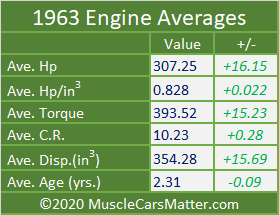
1963 V8 Engine Specs

1963 Newspaper Ads


“SNIAGRAB” is ‘bargains’ backward, of course.

