
New Stuff:
This was a recovery year for the auto industry. Almost everyone saw double-digit gains, with Ford and Chevrolet gaining roughly 35% over the disastrous 1958.
The smaller makes and independents had a mixed year, but time was not on their side. Packard had thrown in the towel and DeSoto was on life support. Edsel had been mortally wounded and dropped by almost a third. Studebaker, on the other hand, was up some 180% and exceeded the sales numbers Chrysler put up.
Approximate total sales: 5,599,000; change: +34.4%.
1959 Noteworthy Events
- Buick – New bodies, canted headlights, 401cid V8.
- Chevrolet – New bodies, Impala series.
- Chrysler – All wedge engines, new 383, 413 V8 engines.
- Dodge – 326, 383 V8s.
- Ford – Galaxie series,430 Mercury V8 available.
- Oldsmobile – 394 V8.
- Pontiac – 389 V8.

This was a solid year for pretty much everyone. Studebaker introduced their smallish Lark and discontinued their other models, which accounted for their huge gains over last year. Ford and Pontiac’s gains were huge.
Chevrolet
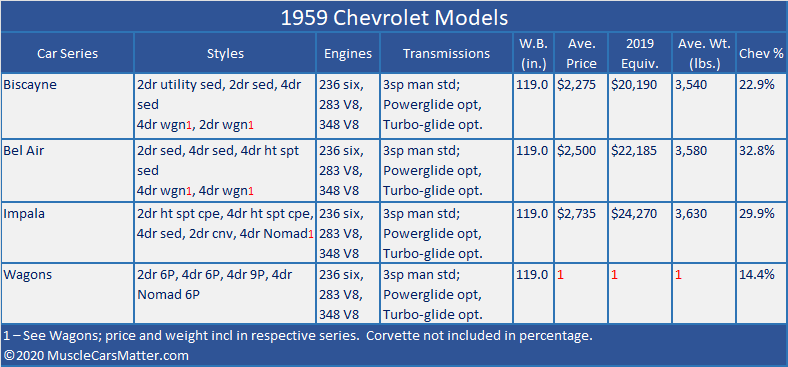
The Chevrolet offerings for ’59 shared the same overall styling as their BOP stablemates. The look was radically different from anything Chevy had ever produced. The models were Biscayne, Bel Air and Impala. Cars were wider and roomier and had a more streamlined look. The rear fin treatment was somewhat like that of Buick, with fins starting just behind the front doors and extending to the back. While the Buick fins were canted outward, the Chevy design had them folded over almost to the horizontal. A rear trim piece was in the shape of a stretched “V”, meeting both rear fins. The rear tail lights were “cats’ eye” shaped and quite attractive. The wheel well openings continued to be swept back and non-circular, with the rear openings lower in height than the front. Wheelbases of all cars was 119”, up 1.5” from ’58.
Engines
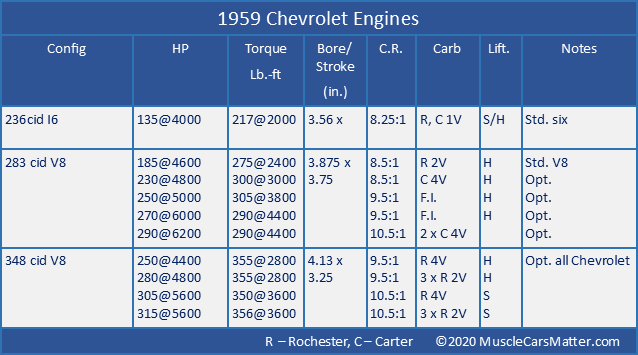
Engine offerings were still based on the 236cid inline six, and the 283cid and 348cid V8s. The six was a carryover and both V8s were available in more different flavors than in ’58. The 283cid could be had fuel injected with the carryover 250hp at 5000 rpm, 9.5:1 C/R engine, as well as a 10.5:1 version that made 290hp at 6200 rpm. The 3 x 2bbl, 11.0:1, 348cid engine continued to be the top offering, with 315hp at 5600 rpm.
Transmission offerings were unchanged, being a 3-speed manual, close ratio 3-speed, a 4-speed manual, two-speed Powerglide, Corvette style Powerglide and the Turboglide. The availability of a particular transmission was based on the choice of engine. For example, overdrive was only available with the 230hp 283, not with the higher power variants or the 348. The 3 x 2bbl 348, with its 315hp, could only be had with a three speed or four speed manual trans. The same 3.36:1 and 3.55:1 rear gearing was available, but this year saw a 4.11:1 ratio added for go-fast fun.
Approximate sales: 1,462,000; change: +28%; industry rank: 1st.

Some of the design cues from last year were carried over, though modified. We still have the full-length side trim, and the wings were clearly inspired by those on the ’58.

This rear-end treatment, with the simple bumper, cats-eye lenses and folded over wing treatment is one of the classic looks of all time. Both front and rear bumpers are really understated relative to the past years. Notice how the side trim runs to the tail light surround.

I like the way they posed the car in this advert. The rear-end treatment is fabulous, and even the little side rear window is kinda cool.

Another sort of ‘meh’ advertisement here. Where’s the motivation?

A Chevrolet family portrait, including Corvette. There’s no question as to why so many of the ’59 advertisements showed a rear view of the car. It was an automotive styling masterpiece!

Corvette
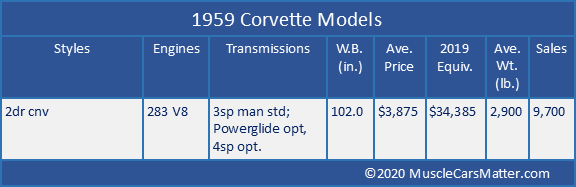
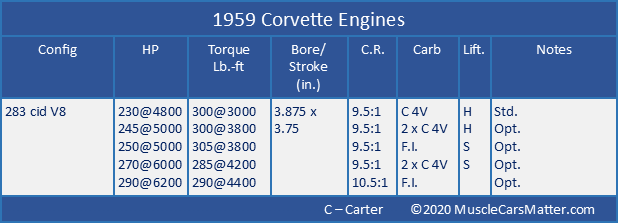
There weren’t many changes with Corvette this year, but some of the minor changes included removing the chrome strips from the trunk lid and the louvers from the hood. Corvette sales were only slightly above those of ’58. The 283cid V8 made from 230hp to 290hp.
Approximate sales: 9,700; change: +5.7%.

The ’59 Corvette styling was a cleanup of the ’58 version. The faux hood louvers were now gone, as were the twin chrome strips on the trunk deck. Honestly, I regard both of these changes as positive.

Yeah, no more old man suspender strips!

Nice advertisement with a good angle on the car. Great choice of exterior colors, too.
You can see the new front fender accent strips that run from between each pair of headlights and back to the windshield.

Yeah, the little guy with the megaphone not only doesn’t have to help carry the scull, but he gets to talk to the chick with the new Corvette. I’m thinking he’s going to pay for that later; know what I mean?
The ad boys were eager to portray him as a geek, as he’s the the only one wearing glasses. All geeks back then wore glasses, don’t you know. They were like your ‘geek badge’.
Buick
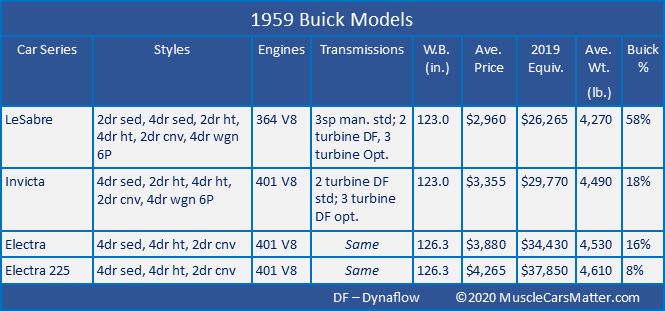
Buick, like her GM sisters, came into 1959 with all new bodies. Gone was the “1958 only” styling. Series names were new as well. LeSabre was the base model, followed by Invicta, Electra and Electra 225.
The ’59 grilles continued with the previous year’s rectangular elements, but everything, including the overall grille design, was new. Styling was particularly striking. From the front there was a chromed line that angled down from the top of the fender, across the top of the pair of canted headlights, horizontally across the top of the grille, and up to the other fender. If you can imagine a horizontal chrome piece with maybe one fifth of the total length angled up 40 degrees or so at each side, you have the picture. The cool thing is that the rear received the same treatment.
The cars had long, canted-outward fins running from the front to the back. The rear accent line ran down one fin, across the lower trunk line, and up the opposite fin. I can’t say enough about how striking this was. The two lower models had a 123” wheelbase, while the two upper models had a 126.3” wheelbase. All models continued the ’58 rear wheel opening design with the top of the opening flattened, hiding the top third or so of the wheel and tire.
401cid V8
The 364cid V8 was a carryover at 250hp. New for ’59 was the 401cid V8. Its bore and stroke were 4.1875” x 3.64”, and with a 10.5:1 C/R it made 325hp @ 4400rpm, breathing through a Rochester 4bbl. This would go on to become a noteworthy engine.
Transmissions available were a 3-speed manual, standard on LeSabre, Twin Turbine Dynaflow was standard on the other three series, with the Triple Turbine Dynaflow being available on all four series.
Interesting Options
Some interesting options were a transistor portable radio, a speed control safety buzzer and the Autronic Eye. Regarding the transistor radio, it needs to be remembered that transistors were new and hadn’t really even begun to replace vacuum tubes. Portable vacuum tube radios were available, but they were large and had quickly depleted batteries that were costly. A transistor radio that could be removed and taken with you was quite novel. The “speed control safety buzzer” was set to the speed that the driver wanted to stay below. If the driver happened to wander up to that speed, the buzzer reminded them to slow down. If you wanted to pass someone, the buzzer quieted once the car was going 15 mph or more over the preset speed.
The Autronic eye was a system that used a photosensor to detect the headlights of oncoming vehicles. The system turned off the high beams until the vehicle had passed. It could be overridden with the standard floor-mounted low/high beam control.
Approximate sales: 285,000; Change: +18%; industry rank: 7th.
Interesting Headlights
Even though the ‘egg crate’ grille was more-or-less retained, the look is good. The canted headlights really seem to work well, following the angle of the front fender ‘fin’ and trim.

Here’s Electra, all dressed up for 1959. It’s kind interesting to compare it to Chevy Impala and note the two different styling thoughts. Notice the canted quad headlights and the accent line that runs across the grille, up the headlights, and back down the front fender, door, and rear fender.

What incredible freakin’ lines this thing had! The rear styling mimics the front, with the accent strip running across the top of the rear, up to the fins and down the fin tops to finally fade out while running along the doors.
This was a nice look, for sure.


This advert talks about Equipoise ride, fin-cooled brakes, aluminum front brake drums, Wildcat engines, electric windshield wipers, and twin-turbine and triple-turbine transmissions.

Four happy folks streaking into the future in their partial Buick. It looks like the little girl has discovered the ‘demon girl’ who lives in the paint of this shiny new car. I know it’s a few years before the movie Poltergeist comes out, but this doesn’t bode well for this kid. She’s probably a little brat anyway.

Hey! The text says 2 out of 3 car buyers can afford a new Buick! Then, I could have “An emotion. A sense of wellbeing that’s pretty wonderful to have.” Gosh, why the hell wouldn’t I buy a new ’59 Buick? Because I was three freakin years old at the time, that’s why! (Wait…does that mean I’m not in the 2 out of 3? Guess not.)
Buick Product Line Brochure


Oldsmobile
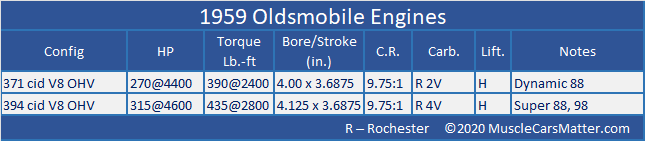
Oldsmobile for ’59 continued with the same three series, the Dynamic 88, Super 88 and 98. The overall styling was somewhere between that of Chevrolet and Buick, but with a unique front treatment that had each pair of headlights separated, and with a round parking light between them.
394cid V8
The 371cid V8 was a carryover, picking up 5hp over ’58. While it came with a 2bbl carb, a 4bbl was available optionally. New was the 394cid V8, which was a 0.125” bore of the 371. The 394 had a bore/stroke of 4.125” x 3.6875”, a compression ratio of 9.75:1 and made 315hp at 4600 rpm. Torque was 435 lb.-ft. Carburetion was courtesy of a Rochester 4bbl. The base Dynamic 88 got the 371cid engine, while the Super 88 and 98 got the new 394. The Dynamic 88 and Super 88 came with a 3-speed manual, while the 98 got the Jetaway Hydra-Matic. This auto trans was optional on the lower two models.
Approximate sales: 383,000; change: +30%; industry rank: 5th.

I’m sorry, but I don’t think Olds styling for ’59 has anything at all on Chevy or Buick. Nice, maybe, but not as nice!

Maybe a slightly more impressive look from the rear, but it can’t begin to compare to the rear styling of the ’59 Chevy. But what could?

This advertisement shows the new Olds straight lines to good effect. The 4-door hardtops were fitted with this flat top and super-wraparound rear window.


This advertisement does well to show you the unobstructed views from inside the new Oldsmobile. ‘A’ pillars and ‘C’ pillars, who needs ’em?

Taking your new ’59 Olds and some random hot blonde to the horse races. Yeah, then you lose your ass because you don’t know jack about horse racing. That’ll sure impress her! Probably his cousin anyway.

Pontiac
For 1959, Pontiac dropped the Chieftain name for the base model, replacing it with the Catalina. You will remember this as the name of the hardtop models for the past few years. The middle offering was now the Custom Star Chief, and the Bonneville Custom was the premium offering. The lowest tier Catalina, with its seven different models, accounted for the majority of Pontiac sales.
The fronts now featured a twin grille theme, which would become a Pontiac staple. Other styling cues were a bit more sedate compared to Pontiac’s stablemates. Pontiac was chosen as the Motor Trend as the Car of the Year.
Probably the most significant change this year was the appearance of the legendary 389 V8. This was the engine that would become, a few years later, one of the primary catalysts in the start of the ’60’s muscle car movement. This engine shared the same bore dimension of 4.06” with the 370, with a 0.19” longer stroke.
Approximate sales: 383,000; change +76%; industry place: 4th.

Catalina, as well as the rest of the Pontiacs, was now sporting an attractive split grille. A foreshadowing of things to come.

The Catalina fins were dual or split. The rear bumper formed the back of the rear fenders in a different way, and the rear styling was interesting in a slightly love-it-or-hate-it way. The side trim piece ran down the side, straight and unassuming, not bothering anyone, before diving down on the rear fender and doing a loop-back, sort of a “crap, I changed my mind and want to go back” kind of way.


Wide-Track
Yeah, we moved the wheels out a couple of inches and it made all the difference in the world. In fact, if you just look at the freakin picture (drawing) you can see how unworldly wide our wheels are! Catalina is looking oh-so-wide in this artist’s rendering here. Thank goodness for artists, I guess.

Do companies like General Mills still do sweepstakes like this? I can’t remember the last time I saw one. This must have been a magazine advert, and nobody reads magazines anymore.

That is one wide-ass car! This guy’s ego has been boosted by his sweet Pontiac convertible, and he’s feeling good enough to put the moves on the hottie with the bike.

Chrysler
Chrysler came into 1959 with the same four series as the previous year: Windsor, Saratoga, New Yorker and, at the top, the 300E. Styling was updated, but not radically changed. The ‘raised headlight’ look of some of the ’57 and ’58 models was now much more subtle.
The really big news is what was missing, namely the absence of any engines with hemispherical combustion chambers.
In place of the 354 and 392 were two new wedge head engines, the 383cid V8 and the 413cid V8. These were known internally as the “Raised Block”, or RB, engines. The RB blocks were indeed raised, almost ¾ inches, over the B blocks. The top shelf 413 had dual quads and made 380hp.
The three upper series were built on a 126” wheelbase, while the base Windsor, being built on a Dodge chassis, had a 122” wheelbase. TorqueFlite and power brakes were optional on the Windsor but were standard equipment on the Saratoga, New Yorker and 300E. There were no performance rear end gears available.
Approximate sales: 70,000; change: +9.4%; industry rank: 12th.

Chrysler didn’t do any terribly significant updating this year, mostly stuff like grilles, bumpers, and other easy to change items. Under the hood, though, was an entirely different matter.

Four thousand pounds of American steel, and up to 390hp. (Well, okay, not on Windsor; just 325hp.)

‘Lion-Hearted’
This is an example of the Chrysler “Lion Hearted” advertising campaign that commenced in 1959. Note the mention to Torsion-Aire ride and Total-Contact brakes. The specific nature of ‘Lion-Hearted’ seems to be a bit hard to pin down. You might be tempted to think it refers to engines, but that’s not really clear. Might this have been part of an effort to mitigate any fallout from the loss of the hemi-head engines? I dunno.
Total-Contact Brakes
These were drum brakes with a design that differed from more conventional drum brakes in a couple of ways. First is that the shoes had their linings shaped in such a way as to make nearly total contact with the surface of the brake drum. This is in contrast to other automaker’s brakes, where the shoe lining had a contact patch that was significantly smaller than the size of the shoe but would increase in size as the shoe linings wore. Also, the Total-Contact brakes used two brake cylinders, one for each shoe, rather than the usual one cylinder for both shoes.


You are gazing at the Imperial LeBaron Southampton with Silvercrest Landau roof. If someone were to ask this guy what he drove, I wonder how he would answer? Of course, the name ‘LeBaron’ would play a big part in Chrysler in the future.
Imperial, of course, was the Chrysler corporation answer to Cadillac and Lincoln. The Imperial name itself had been used since 1926, with the formation of the make and division of the same name in 1955. It would end in 1975, making a short reappearance for a couple of years in the early 1980’s.
1959 Imperial Brochure


Dodge
The Dodge series names were unchanged, with Coronet as the base, and then Royal and Custom Royal. Much of the ’58 styling was carried over. The fins were still well represented, and they continued to have a substantial, less integrated into the body look. The front “brow line” over the quad headlights became more pronounced. The year’s sales were remarkably well distributed among the four series, counting wagons.
The new 361cid V8 was available, as was the 383cid V8.
Approximate sales: 551,000; change: +13%; industry rank: 8th.
What the Heck Does This Thing Do?
Another item on the option list, for $13, was undercoating and hood pad. The hood pad was a fibrous pad affixed to the underside hood by metal or (usually) plastic clips. This, of course, was to dampen noise. It really did work well. Back in the day, when my friends and I were young and dumb, we heard that this pad was there to smother any engine fires. You see, the plastic clips would melt, and the thing would drop onto the burning engine, thus smothering the fire. Except… it was flammable! Oh, yeah! We had it all figured out!

The Dodge models used the same styling as in ’57 and ’58, but some of the styling elements became more extreme. These include the raised headlight brow feature and the rear fins. Look at the ’58 front, below, and you might appreciate the statement that the ’59 is a more extreme ’58.

Well, maybe the rear styling of the ’59 Coronet isn’t that much more unique than it was last year.

The ’58 front had the headlights as part of the grille area, where that was changed for 1959. It’s interesting to compare the ’58 and ’59 front views, and how there was a good bit of modification, while keeping the same basic feel.

This is the ’58. Like this look? Good–you’ll see more of it in ’59!


Economy in a 3,600lb. Car
I suspect that this advert does what was intended fairly well. It’s tailored to the cost-conscious buyer, of course. Dodge always did well in the Mobilgas Economy Runs, and it was wise of them to do so and advertise it. That said, the 21+ mpg stated is way higher than anything you could remotely expect from these 3,600 lb. cars.

The ‘push-button’ theme is something unique to Chrysler divisions, and it probably struck a chord with the buying public at the time. Push buttons were the future, or so many thought. Oh, wait… didn’t Edsel have pushbuttons for their transmissions?
Wither, Hemi?
It’s logical to ask why the hemi (and poly head) engines were discarded. Chrysler had done substantial research on head design and was convinced that the hemispherical head design was optimal. All of its divisions had their own hemi head engines. Chrysler found itself at a price disadvantage for each V8 engine it sold. Its head design required more machining, and the valve train was much more complex and expensive to manufacture than that of the wedge head engines its competitors built. In addition, the overwhelming public acceptance of V8s over six-cylinder engines caught all automakers by surprise. Of course, the company would return to this head design in 1964 with the marvelous 426 Hemi that would tear up drag strips and racetracks across the country. Two years later it would appear as a street version and become what many consider as the iconic, ultimate muscle car engine.

This was the Canadian Dodge offering, the Viscount. As you look at the Plymouth section, below, it might dawn on you that this car from the rear looks like a Plymouth Fury. Indeed it is, uh, sort of. Viscount is a Fury from the firewall back, and then Dodge forward of this. I like the Fury look better than the Dodge look anyway, but this car must have caused confusion back in the day when seen here south of the border. (Those silly Canadians; always having to be different!)

Plymouth
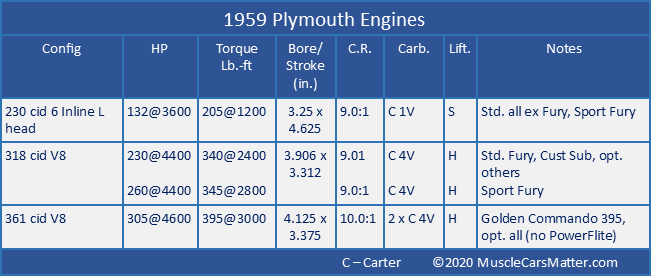
Plymouth did a bit of reshuffling this year, with the Savoy at the entry level and the Sport Fury at the top. Sheet metal was tweaked a bit and a new, egg crate grille appeared. The 350cid V8 was bored and became the 361cid V8. The top shelf 361 made 305 hp. This engine was dubbed to as the “Golden Commando 395”, which referred to its torque rating. The polyspheric-head 318cid V8 was still a Plymouth exclusive this year.
Among the interesting options available was the Instant Air gas heater. Why wait for the car to warm up on those cold mornings, when you can have a gas-burning heater in the engine compartment that supplies you with warm air instantly? You could also get the swivel seat (driver’s) or the Constant-Level air suspension.
Approximate sales: 702,000; change: +3%; industry rank: 3rd.

I dig those wheel covers!

I love the looks of this roofline. Plymouth styling this year was much more appealing than Dodge’s. The fins and taillights were more attractive, and the look of the Dodge grille, with the two horizontal elements, just doesn’t work as well as on Plymouth.

The Plymouth front styling was just tweaked a bit for ’59. Both years were attractive.

The rear styling changed more than the front did. I think maybe the ’58 look was a bit more conventional.

Another advertisement from north of the border.



The guy with the big boat has a little captain’s hat and everything. The other guy’s boat is almost too small to matter. There’s sooo much car and sooo little boat. I guess if he had a little captain’s hat like the other guy, it would look pretty silly.

Ford
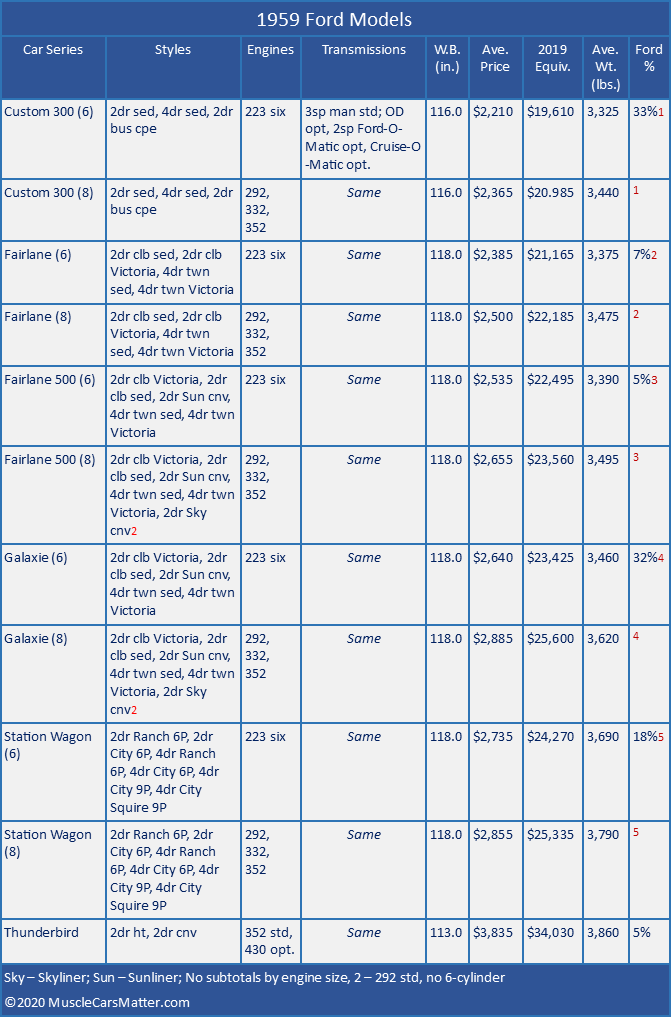
Ford experienced a strong recovery this year, with sales up almost one half. In addition, a restyling imparted the models with beautiful lines that even today are regarded as some of Dearborn’s finest ever. The look was long and low, with flatter and squarer panels.
New this year was the 430cid V8 engine. The engine made 350hp and was optional in the Thunderbird. This was the largest member of the MEL family of engines, and would continue to be until the 462 was rolled out in ’66. Note that this engine was a member of the “Mercury – Edsel – Lincoln” engine family, and didn’t see much use in Ford models.
Galaxie to the Top
The Galaxie series supplanted the Fairlane 500 as the top-of-the-line series. The two were quite similar, with the roofs being the major difference. Galaxie had been a midyear introduction last year, and it looked a lot like a Fairlane with a Thunderbird top. The look was wonderful. Both Sunliner and Skyliner moved from the Fairlane series to the new Galaxie series.
Ford sold 269,000 station wagons this year, accounting for about almost one in five of every Ford sold.
Approximate sales: 2,054,000; change: +46%; industry Rank: 2nd.

Bumper and grille were significantly changed for ’59. The hood now came down to the grille, where last year there was a body panel between the two.

This is the cool, forward-thinking Skyliner convertible hardtop. It cost about $400 ($3,560-2020$) more than a Sunliner soft-top convertible. Too bad it was around just a couple of years. Was it the price, or the lack of storage space?

Round tail lights! The thing has huge round tail lights! Yup. Behold the iconic Ford round ‘jet exhaust’ tail lights. One of the best looks ever!

The previous style of grille and bumper. The hood and grille have a body piece separating them, unlike the new design.

It’s like the Ford stylists said “We’ll take this little mess back here and just roll it into two large circles!” (Yes, I know. These two pics are of Fairlane, not Galaxie. Given that the front and rear views were almost identical last year, I thought they would work fine, despite my OCD saying “Crap! They’re different; you can’t do that!”)
Galaxie Skyliner
Given that the Galaxie example above is a Galaxie Skyliner, I thought it might be a good place to provide a short refresher on this very unique model.
There were convertibles that had available hardtops, namely Thunderbird and Corvette. Hardtops were good in the colder months, and they could also provide more security, in that some ne’er-do-well could slit the convertible top with a knife and thus gain access to the interior. Hardtops were also quieter.
One challenge with a convertible hardtop was storing it when it wasn’t on the car, and the fact that removing or installing it was really a two-person operation. Sunliner solved this, albeit at a price.
Put it where?
The unique feature of this car was that it stored the top automatically in the trunk. Skyliner top used four reversible electric motors, seven lift jacks, a series of relays, ten limit switches, ten solenoids, four locking mechanisms for the roof and two locking mechanisms for the trunk lid and accomplished the transition in several seconds. Aside from the cost of the model, one thing you gave up was storage space. With the top stored (down), there was only a small space in the trunk for stuff. Obviously, if the top was up, you had plenty of space.
I do not know what happened if you had the trunk full of groceries or whatever and forgot about that and tried to lower the top. I imagine nothing good would happen, and that this might be one of life’s little ‘learning lessons’ for you. Like the time you got interrupted while changing oil and forgot to put the new filter on. Then you filled the crankcase and walked behind the car and saw the river of clean oil running down to the curb. You felt like you were Jed Clampett, who was “…shooting at some food, and up from the ground come a bubbling crude. Oil that is. Black Gold. Texas Tea.” This wasn’t me. Just sayin’.
Carryover ‘Bird

Thunderbird saw few changes for 1959. The honeycomb grille became one with horizontal bars, and this styling cue was carried to the back area by the taillights. The five chrome hashmarks that adorned the doors in ’58 were replaced by a spear or bullet shape this year.

The rear styling of Thunderbird continued to impress, but designers decided not to use the huge round taillights. Maybe that would be too much like the ‘lesser’ series. Given ’em a couple of years; they’ll come round! (Come round –come around. Get it? Oh, never mind.)

Ford-O-Matic and Cruise-O-Matic
The Ford-O-Matic was a Warner Gear (Borg-Warner) transmission that, although a 3-speed, would start out in second. The F-O-M was introduced in 1951.
The Cruise-O-Matic was an improved version of the Ford-O-Matic and was internally designated as FX for the smaller version and MX for the larger. With a relocated pump and different valve body, this trans started in first gear like a proper three-speed should. The Cruise-O-Matic appeared in 1958.
The F-O-M would continue to be produced until 1964, seeing duty in smaller FoMoCo cars and trucks. In 1959 a two-speed Ford-O-Matic was developed, being a low-cost transmission that was used in Galaxie; Falcon and Fairlane, and in Mercury Comet and Meteor cars. Edsel also used it.

So, you remember the ‘award’ Ford ‘won’ in 1949, from the Fashion Academy of New York? Then later the FTC prohibited the academy from presenting this as a competition. Ford had in fact paid for the ‘award’!
Well, now a decade later and they’re doing it again! There was no such award given at the World’s Fair! It was all the marketing boy’s magic fairy dust. C’mon, Ford! You’re better than that!

This one is different. Ford was pretty savvy when it came to knowing who to target in their advertisements. They didn’t always aim at the men like some seemed to do.

The use of the Thunderbird roofline allowed Ford to create a connection between Galaxie and Thunderbird. The small text says “…the Galaxie means Thunderbird in every elegant, glamourous sense of the word except price.” This was brilliant marketing!
Looking at the two white cars on the bridge, it’s not obvious at first glance which is Thunderbird and which is Galaxie. I’m sure that’s exactly what Ford wanted. But, in the process, did they unintentionally make Thunderbird less exclusive?

Mercury
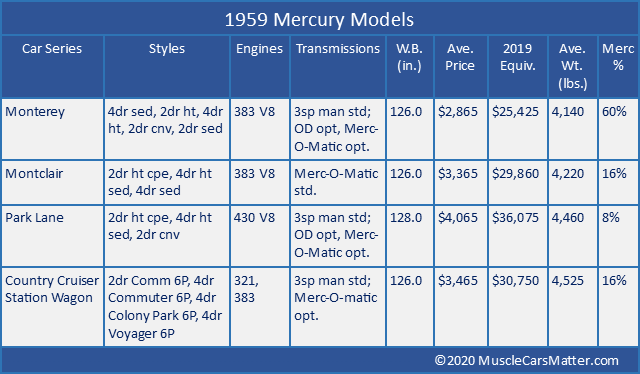
The entry level Medalist was gone this year. Series were Monterey, Montclair and Park Lane. The models were attractive, but if you parked your Merc by a ’59 Ford, you would see fairly insignificant differences, especially from the front. Featured this year were larger front and rear windows. Of course, Mercury followed Ford in reducing compression ratios.
Engines were the 312cid V8, the 383cid V8 and the 430cid V8.
The station wagon series was dubbed “Country Cruiser”, with four different models, down from six last year. Names remained the same.
Approximate sales: 150,000; change: +12.8%; industry rank: 9th.

Mercury had a bit of a ‘meh’ year in 1959. The fact that their models strongly resembled Fords from the front probably didn’t help sales. The 430cid M-E-L V8 made 345hp and was available in the Park Lane.
‘Meh’ Styling?
Rear styling remained ‘Mercury’, though I don’t find it as attractive as the rear styling of Galaxie. Mercury would drift through the years, being very Ford-like at times and less so at other times. It certainly didn’t enjoy the separate image that Buick or Oldsmobile did as very distinct upper-tier series. I think that there were many years where Mercs were regarded as just fancy Fords, and this view was more well-founded than not.


Mercury’s front styling in 1958 was fairly nice looking. I don’t think the new ’59 design was as nice as the ’58.

The styling of Park Lane’s rear didn’t change much in nature, but the bumper size was reduced substantially. That’s okay, because the ’58 rear bumper was freakin’ huge! With the design features mounted within the rear bumper, the front and rear designs were very, very similar. I think that Merc went too far in this regard, because the rear styling was weird.


Check the guys in suits looking at the engine. “I say, Eugene, that’s one fine engine you have there. Is that one of those vee-eights I’ve been hearing about?”
That picture also shows the rear-opening hoods that FoMoCo was using at the time.

Cool Tail Lights
Just look at those taillights! Hey, do you know what’s different about this advert? It’s a photograph! We haven’t seen many of those to date. In fact, some of the advertisements that did use photographs had small text that said, “Actual photograph”, or something similar. The time would soon come where almost all car advertisements used photos, not drawings, and any drawings were cartoonish.

Hey, kids! Let’s jump off the top of the Mercury into the pool! Talk about wanting everybody to see your sweet new station wagon!
1959 Mercury Brochure


1959 V8 Engine Specs


The Germans are Coming!
The domestic automakers were well aware of the trickle of foreign (read “European”) cars coming into the states and the fact that the numbers were increasing each year. I don’t think it would be accurate to say that they were unduly concerned, though. Volkswagen, the primary foreign importer, had just small, quirky cars available. The general consensus seemed to be that this would forever be a small niche market segment.
Here’s what it looked like from the first imported VWs through 1974. The graphs generated from these values show the trends better.


Sales climbed dramatically starting about 1958 and they never did drop off as severely as some of the domestic models. The section The Numbers Tell the Story shows how several popular U.S. models had huge sales when introduced but then declined substantially each and every year thereafter. Actually, the VW sales graph is a lot like that of the Chevrolet Corvette!

The VW price graph is much like those of many domestic models with its almost flat orange “2025 Dollars” line. The increases in sales price (blue) were due largely to inflation
1959 Volkswagen Brochure
Gotta say, I have in the past had the belief that Volkswagens were simply 1930’s technology. I’ve been forced to revise my opinion. Things like all-aluminum boxer engine, torsion bar suspension, fully-synchronized four-speed transmission with overdrive fourth gear, full steel body pan and formed steel backbone are pretty forward-thinking. We Americans sure couldn’t seem to get the hang of air-cooled engines or aluminum block and heads, that’s for sure.


Earlier years saw the rear window being of two-piece design.

Text Summary: Two Million happy owners form a unique “sales force”. Combination of performance, engineering and economy. “A sound and secure investment.”

Text Summary: Focuses on convertible and lady drivers, mentioning interior and exterior styling. Enamel paint is used for durability. (GM used lacquer through at least ’87!) Easy to park and maneuver (No power steering, which was the norm at this time. Larger cars without p/s were a pain to park at times.)

Text Summary: “…the smart-looking and amusing companion in hours of recreation.”. Standard heater and unobstructed front and rear views.

Text Summary: Well designed dash and controls. Space for a radio and for a speaker!

Text Summary: The weight of the engine is placed over the rear driving wheels for optimal traction. Electrically spot-welded chassis. Volkswagen has a large international network of trained service technicians.

Text Summary: The chassis has a center tunnel for cables and linkages. Importantly, it also functions as a structural member.

Text Summary: The steering design affords precise control, even over bumps. Car straightens itself out when exiting a turn.

Text Summary: Typical interior controls and features, albeit with front-mounted trunk.

Text Summary: Luggage compartment behind rear seat in addition to the front trunk!

Text Summary: Sophisticated front and rear suspensions with torsion bars. More about center structural tunnel and how it splits at the rear to accommodate the transaxle. Lower body pan reduces air resistance.

Text Summary: Advantages of lightweight air-cooled engine. Crankshaft is drop-forged manganese steel with hardened bearing surfaces and is dynamically balanced. Engine configuration is, of course, four-cylinder horizontally opposed boxer.

Text Summary: All the interesting technical bits. This engine is 1.2L (72in3); engine was enlarged a few times over the run of the car. Final drive ratio is 4.4:1 and the 4th gear is an overdrive (0.82:1)!
1959 Newspaper Ads


Hey! They’re advertising monthly prices, just like they do today! (But without all of that interest disclosure stuff). It doesn’t matter what the price is, just look at that low payment!!


