
This was a good year for the auto industry. Total sales had continued to climb, after the huge drop during the 1958 recession. It wasn’t a good year for the remaining independents, or for Edsel. Both Dodge and Mercury saw huge gains this year, due in no small part to the huge demand for their new Comet. Approximate sales: 6,096,800; change: +8.9%.
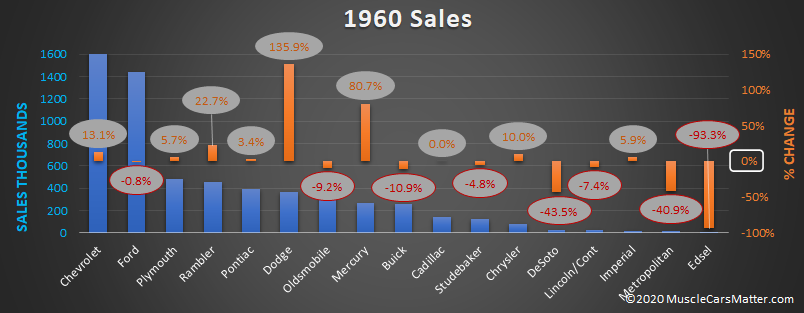
I don’t know what got into Dodge and Mercury this year with their huge gains over 1959. Poor Edsel was down over 90%!
1960 Noteworthy Events
- Chevrolet – Corvair.
- Buick – Ventiports are back!
- Chrysler Corp. – Unibody construction.
- Dodge – Dart series, slant 6 engine, 318cid V8.
- Edsel – The ill-fated experiment comes to an end.
- Ford – Falcon series.
- Mercury – Comet series.
- Oldsmobile – Indianapolis 500 pace car.
- Plymouth – Valiant, slant 6.
Chevrolet
This turned out to be a good year for Chevrolet. There was an attractive new grille that worked quite well with the quad headlights. The glass was never more expansive and the missile/jet inspired side trim imparted an element of high-tech coolness.
The cranked fin lines were altered, and, with the departure of the remarkable “squint eye” tail lights, the rear was no longer evocative of an owl. Tail lights were now round. It was a nice look, but the ’59 rear treatment was one of the very best ever. As with previous year models, the trunk could hold about two dozen neighborhood kids of assorted sizes. There were a bunch of different options for the 283cid V8 and 348cid V8 again, and the 283 variants were up to 315hp, with the top-shelf 348 up to 335hp.
New Make
The big news was the arrival of the compact Corvair, a truly unique and forward-thinking vehicle. The two- and four-door models weighed less than 2,500 pounds, were of unibody construction, had a rear-mounted, aluminum block, air-cooled flat six engine of 140 cubic inches displacement and outputting 80 or 95hp. The transaxle was rear-mounted, and the suspension design featured swing arms in the rear, dual swing arms in the front, and coil springs at all four corners. First year sales were approximately a quarter million vehicles.
Approximate sales: 1,653,000; change: +13%; industry rank: 1st.

Note the new ‘jet streak’ decoration on the rear quarter. You can’t tell by looking at this car, but the rear wheel openings are flattened at the tops now.

Nice looking car from the rear, but damn I miss the cats-eye tail-lights and the swoopy ‘V’ of the ‘59’s!

The ’59 front had the funky design elements on the front of the hood, which were not carried over to the 1960 design.

Oh, this was quite a look, wasn’t it? This design was so extraordinarily bold and unique.

Corvair at a car show. You just have to have the front ‘trunk’ open, since there will be the occasional uninitiated passer-by that approaches the car from the front, expecting to see an engine.
Corvair
This was the most ‘un-Detroit like’ car ever roll out of the Motor City. The name was very Chevrolet-like, and few knew that the name had been used for a Corvette show car in the mid ‘50’s.
The car was well received, being named the Motor Trend Car of the Year. The Ford Falcon was also introduced in 1960, and greatly outsold the unconventional Corvair. The two-door Club Coupe caught the interest of the public as a sporty, responsive, European-flavored car.
Rear-mounted, air-cooled, aluminum engine, four-wheel independent suspension, unique styling, and, later, turbocharging all made the Corvair one-of-a kind. Corvair would eventually sell fairly well, but the initial low sales caused a panicked Chevrolet to quickly field a more conventional small car – the Chevy II/Nova.

Here’s what the 164cid engine (’64 – ’69) looked like. Yeah, the 140cid and 145cid versions are really, really, really similar. Notice the air breather and the ‘runner’ over to the top of the carburetor.
Chevrolet’s First Air-Cooled Car
No, we’re not talking about Corvair; we are referring to the 1923 Series M Copper-Cooled Chevrolets! Oh, yeah; this is one interesting story!
This 135cid, four-cylinder, air-cooled engine was the brainchild of Charles Kettering, who was head engineer at GM’s research division in Dayton, Ohio. The concept gained the support of Pierre S. du Pont, manager of General Motors.
The concept of an air-cooled engine wasn’t new. Franklin had been making air-cooled cars since 1902 (and would continue until 1934). Their marketing made use of the fact that air-cooled engines were popular engines in aircraft. Franklin cars were favored by pilots and others associated with the aircraft industry.
Why Air Cooling?
Air cooling had some advantages. The cooling system was simple and robust, and not prone to failure, unlike liquid cooling. It allowed cars to be made lighter, due to the absence of a radiator, coolant and pumps. The engine material itself was typically aluminum, further adding to the weight advantage.
It took Kettering four years of constant lobbying for the engine before production was started. Originally, Chevrolet and Oakland were involved in the project, with Oakland becoming increasingly nervous to the point of leaving the project. Oakland, of course, was the parent company of Pontiac.
Copper-Cooled?
Kettering had experimented with a number of different fin configurations and materials. He ultimately chose copper as the fin material, with the fins being attached via electric welding. The air was forced through the fins using a shroud and a fan that bore some resemblance to a squirrel-cage fan.
The 1923 Series M Copper Cooled cars arrived on showrooms in 1923, but in far smaller numbers than anticipated. The cooling problems were catastrophic, especially in warmer weather. You needed to keep in mind that Chevrolet had plans in place to discontinue the water-cooled engines in favor of the air-cooled. The result was utterly devastating. Chevrolet recalled the few vehicles that had made it into the hands of buyers and destroyed all existing engines. It’s said that only two copper-cooled engines exist today.
What if Chevy had made use of some of the technology that had made the air-cooled Franklins viable? What would have been different in the domestic automotive market in the subsequent years? Where would that put us today? Who knows?

My Car Is Air-Cooled?
Well, kinda yes and kinda no, but consider this. All engines, with the possible exception of marine engines, are cooled by air. That is, air is the medium that is the destination of the heat from the engine. This true whether the engine is ‘air cooled’ or ‘liquid cooled’.
I realize that there isn’t anything new here, other than maybe a different way of looking at things. In a liquid cooled engine, the coolant merely transfers heat from the combustion chamber area to the radiator, where it’s transferred to the air. So, what’s the real difference?
The coolant can absorb heat better than it can be transferred to the fins of an air-cooled engine. This is partially true because coolant can ‘reach’ closer to the source of heat, the combustion chamber. The advantages of air cooling are lower weight, less complexity and lower cost of manufacture. Due to their nature, air cooled engines are expected to operate at higher temperatures than liquid cooled engines, which means that some tolerances have to be larger to allow for increased expansion of components when hot.
Due to the nature of surface area relative to volume, an automotive air-cooled engine can’t be made as large as a liquid cooled can. To illustrate, a 1″ cube has a volume of 1 cubic inch (duh) and an area of 6 square inches, for a ratio of 6:1 (surface to volume). Doubling the dimensions (2″x2″x2″) results in 8 cubic inches of volume and 24 square inches of surface, for a ratio of 3:1. Were these both air-cooled objects, the smaller one with a surface area to volume ratio of 6:1 would be inherently much, much easier to cool effectively. (Doubling of height, width and depth will reduce the surface/volume ratio by one-half.)
Some WWII air-cooled radial aircraft engines had huge displacements; the Pratt & Whitney R-4360 Wasp Major displaced 4,362.5 in3, in making 4,300hp. Of course, an air-cooled aircraft engine like this one spends most of its time in a 200+ mph airflow, not to mention the temperature at altitude can be below freezing even on a hot day. Yes, the thinner air is a disadvantage in cooling both air-cooled and liquid-cooled engines, but you get the picture. It should be noted that liquid cooling serves to transfer heat from where it was created to a different location, one that is ideally well suited for the transfer to air.
Lastly, we need to recognize that with both types of cooling the oil system is removing a very substantial part of the engine heat generated. The transfer of this heat to the air can be via an oil cooler, which most air-cooled engines use, or by the surface of the oil pan, which applies to most cars from the eras we’re covering.

Your laptop is very likely liquid cooled, via a device similar to the one shown here. The flattened copper tube is filled with water, which turns to water vapor at the heat source and condenses at the ‘radiator’. The fan/radiator assembly then transfers heat to the air. With the exception of a water pump, this is a lot like an automotive cooling system.

Here Chevy is selling ‘elegance with economy’, the same type of theme as all the other automakers.
The images they used show the lines of the car well. The rear view is still attractive, but I really, really liked the ‘cats eyes’ tail lights.
I love the looks of the Sport Coupe!
Corvair

I think this is a great advertisement. It points out just how different Corvair is from more traditional compacts. I love the line ‘America’s only compact car that isn’t just a small echo of a big one’. Truer words have never been spoken!
Some drivers would learn about ‘snap oversteer’ the hard way. I’m not sure how much of a problem it really was, but someone pushing the limit on the twisties could find themselves in trouble. This is when the rear breaks traction and the momentum of the mass (engine in rear) rotates the car in the direction of the turn. This was addressed, in part, by the use of two slightly different air pressure values in front and rear tires. A 1965 suspension redesign also helped.
The Ralph Nader book Unsafe at Any Speed hurt Corvair sales significantly. The NTSB, in 1972, released results of their study that could be summed up by saying that this small car wasn’t any more dangerous than any other small car. I guess maybe it comes down to how much you trust the NTSB, a federal government agency, to tell you the truth!
1960 Corvair Monza Brochure


This is a bit of nostalgia, isn’t it? I like the portable record player and the 45 rpm records. She’s looking at him, and I’m not sure what he’s doing. It just doesn’t look like they are really playing chess. Oh… she’s a redhead, too!

Power steering! Only Chevrolet has it! Wait… No, everyone has it! Why are they advertising something everyone has? By this time, power steering was not really new; why was this the focus of their ad?

Corvette
The Corvette was mostly unchanged for 1960. The top engine option got bumped up 25hp, to 315hp. Not bad for 283cid!
A rear sway bar was added this year. Roughly half the Corvettes sold had the 4-speed manual trans, and half were sold with removable hard tops.
Approximate sales: 10,300; change: +6%.

The white cove with the red body looks oh-so-cool!

Some sources say that aluminum heads were introduced this year, then later deleted. As many manufacturers learned, early aluminum castings had porosity issues that mostly doomed their use until technology caught up in the 1980’s.

I like this advertisement. It does a great job of conveying the thrill of driving a sport car. Judging from the angle of the buildings, this isn’t a ’tilted camera’ shot, either. That’s one steep street!
The caption ‘what happened to gravity?’ is fantastic!


This ad is interesting in its limited use of color. I’ve always liked interior photos of Corvette, too.
Buick
For 1960, the Buick models had their fins deemphasized a bit and receive new front bumpers and grilles. The quad headlights returned to a more conventional arrangement with all four on the same horizontal line. The ventiports, last seen in ’57, were back this year. Models remained LeSabre, Invicta, Electra and Electra 225. The 364 powered LeSabre captured almost two-thirds of the Buick market this year.
Both the 364cid V8 and the 401cid V8 were carryovers from last year.
Approximate sales: 254,000; change: -9%; industry rank: 9th. It should be noted that the last time Buick ranked so low in the domestic auto market was 1905!

It’s easy to see that major Buick lines didn’t change all that much from last year.

Cool Headlights
Notice how the front fin over the headlights runs the entire length of the car, blending into the semi-cylinder that contains the tail lights. The rear fins also run all the way forward to the base of the windshield. Contrast this with the Chevy Impala or one of the Olds or Pontiac models. All are nice looking, but the Buick has a unique style that’s all its own.

The ’59 Buicks had these funky and cool canted headlights. They were unfortunately not carried over to the 1960 models.

The rear styling of the ’59 models was tamed a bit for 1960. Both looks were great.

Buick was using the name ‘Turbine Drive’ for the name of the modified Dynaflow.
I have to think that showing the Buick towing a boat was intended to demonstrate the ability of the transmission. Buick worked constantly to improve the transmission, which was important because Buick used it to differentiate themselves from their competition.


The car and school bus in the background are clearly moving, but I’m not sure about the Buick… I’m confused. The kids are bouncing around in the rear seat, just like they used to back in the day.

Turbine Drive. Cool name, but we’re just talking about a transmission! Specifically, the Dynaflow, which has been around since 1948.
As previously stated, Buick’s market share was in the toilet this year. Could their advertising have had something to do with this?

Oldsmobile
The Oldsmobile models for ’60 saw minor changes. The front ends had new grilles, and each of the quad headlights was placed closer to its mate, with no parking lights between them. Also, the fins were just a bit less obvious, being folded over more than last year. Engines were mostly the same, with the 371cid V8 receiving a lower compression ratio and losing about 30hp. The 394cid V8 made 315hp.
A 98 convertible was the Indy 500 pace car this year.
Approximate sales: 347,000; change: -9.4%; industry rank: 7th.

Here’s Oldsmobile, looking all Oldsmobiley. Yeah, that’s a word. It’s in my dictionary. Of course, I had to add it…
Uh, not really much excitement in the Olds camp this year.

I little trim here, a tuck here. The rear styling of Olds wasn’t much different this year.

The lowered front section seen here on the ’59 model was gone in 1960. Headlights would be closer together, too.

The rear would be changed up just a bit, but the cool and funky taillights remained for ’60.

The ‘Quadri-Balanced Ride’ was more marketing department word magic than anything else.
Note the ‘all-new Regular Rocket Engine’. This was the 371cid V8 with an 8.75:1 C/R and a 2bbl Econ-O-Way Rochester carb.
Compare the lines of the Olds to those of the Buick. The lines of the Oldsmobile are definitely understated, at least relative to the Buick.


‘Custom-Lounge Interiors’. Wow. You mean, like the ‘lounge’ down the street on the corner? Vinyl seats that are thirty years old and smell like beer?

Kind of a ‘meh’ ad, all in all. I do like the drawings of the engines though.

The new-for-1960 Olds Rocket emblem was said to have been inspired by the Lincoln logo, below. Yeah, I can see it.


Pontiac
For Pontiac, the twin grille theme of last year was no more. That seem strange, knowing what was coming next year, and for the many years following! The grille treatment consisted of horizontal bars, though there was a center point from which each side angled back. Fins were much deemphasized, giving the trunk a flat look. The Ventura was now the model placed right above the Catalina. Star Chief and Bonneville both used the longer (124 in.) wheelbase. A 4-speed manual transmission appeared midyear, intended for racing purposes. Pontiac introduced the term Sport Sedan for their 2-door pillared hardtops.
The 389cid V8 made from 215hp to 348hp.
Approximate sales: 397,000; change: +3.6%; industry rank; 5th.

Nice Styling
I have to say that the Pontiacs had better styling than their Oldsmobile cousins this year. I like the front styling of Pontiac and the way the contour of the front fenders around the headlights ran down the entire length of the side. Even the rear looked a bit better, with its conventional style wraparound bumper. Among the GM Chevy + BOP models, I think Chevy by far had the best styling.

Like Oldsmobile, Pontiac had their own economy V8. In this case it was their 389 with a 2bbl carb and an 8.6:1 C/R. There was also a 389 with a 4bbl and the same C/R.
The image at the bottom shows the wide-track difference. I’d say the 2” – 3” increase in Pontiac’s track versus the competition is a bit exaggerated, wouldn’t you?


For engines, Pontiac had you covered…as long as you wanted a 389! The two lower-compression engines allowed you to use cheaper, low octane gasoline.

Wide-Track Advertising
It’s ads with images like these that allowed Pontiac to successfully market their Wide-Track feature as a benefit. The front and rear tracks were indeed a bit longer than the norm, but I think you would be hard pressed to make a scientific argument that this was any significant benefit. When it come to advertising, that’s never stopped anybody!
looks like the lady in pink was clothes shopping, and not at J.C. Penney! This looks upscale. Are we appealing to this group or people who would like to be in this group?

Captain’s Hats?
Another version of the ad preceding. Side note–were captains hats’ really that popular in the ’50’s and ’60’s? There sure seem to be a disproportionate number in car ads.
Makes me think of ‘The Skipper’ in Gilligan’s Island. The actor, Alan Hale, Jr., liked to wear the hat in public so he would be more readily recognized. I guess that’s okay, if you like people that much. His earlier appearance(s) in The Andy Griffith Show were funny. He played a big, fun-loving country boy. (I wonder how many drinks were bought for him because of the hat?)
I can still enjoy Gilligan’s Islands reruns. Caught the 1978 Rescue from Gilligan’s Island TV movie just the other day. Yikes! What a stinker! And it wasn’t because of Tina Louise not being there, either. The script can be summarized as: “Just have Gilligan do some stupid crap, have the Professor do something that defies the laws of physics, Mr. Howell should be an ass, and have at least one of the girls show some skin. And, no, I don’t mean Mrs. Howell!”. I don’t think you can begin to imagine my disappointment.

The front-quarter and rear-quarter views of the cars are well shown here. Is that a freakin’ steam train? Where is this supposed to be, Russia?

Yep. Station wagon. And an attractive one at that. Station wagons had been increasingly important to the domestic automotive market and would continue to become more so in the decade of the 1960’s.

Chrysler
There were some interesting things at Chrysler this year. The ’60 styling was new, and bodies were now of the unibody construction. Models remained Windsor, Saratoga, New Yorker and 300(F). Swivel seats, dual air conditioning and automatic beam changer headlights were options. The front treatment featured a bumper/grille like that of the 300, and the rear fender fins were now canted outward. The rear of each fin housed the brake lights, which made for a cool, futuristic look.
The 413 engine had an optional version that featured two 4bbl carbs mounted on a wild cross ram induction manifold, unlike anything previously seen. The carb on the passenger side of the engine actually fed the cylinders on the driver side, and vice versa. It was one crazy-ass setup, designed to improve mid-range torque. There were two basic 2 x 4bbl setups, one with 15″ runners and one with 30″. The 383cid V8 continued to power the Windsor and Saratoga series.
Approximate sales: 77,000; change: +10%; industry rank: 12th.

There’s something about the Chrysler grill this year that’s really special. One great expanse with no bars, just the emblem in the middle. So clean and cool! Windsor was based on the short (122 in.) wheelbase.

The tail lights integrated into the back of the fins is fantastic. They’re actually a part of the fins, not just added to the back. What a cool look!


More Lion-Heartedness
Another Lion-Hearted advertisement from Chrysler.
I’m not sure just what those kids are doing… Maybe this was the moment right before little Buffy unloaded a haymaker on little Jodie, after days of torment at his hands. I’ll bet he won’t touch her again, after he’s released from the hospital!
Dad’s checking the blueprints (as if he knows how to read them…).

Quite the fold-out ad! I like the look of the instrument panel. Some cars from this era had such totally cool dashes and instrument panels, yet they weren’t featured in advertisements very often. Too bad.

Dodge
This was a big year for Dodge. The smaller Dart series was introduced, as was the marvelous little OHV 225cid Slant Six. No more L-head engines for Dodge. Like it’s stablemates Chrysler and Plymouth, Dodge models now featured unit-body construction. Styling was similar to ’59, but with the headlight treatment cleaned up a bit to become more conventional. The fins on the ‘59’s was just a bit unusual, but this year they morphed into something that was really unique, and probably a love-it-or-hate-it thing. Matador and Polara were the low and high models built on the 122 in. wheelbase, with the Dart models using the 118 in. platform. V8 Engine offerings continued to be the 318cid poly-head V8, the 361cid V8 and the 383cid V8.
Approximate sales: 368,000; change: +35%; industry rank: 6th.

Styling
I’d like to have seen the discussions among the stylists for this car. “Hey Virgil; how do you want us to fit the fins on this thing?”. “Is there any limit how far we can have the taillights stick out?”.
The front ends looked nice, but the rest… I dunno. Not nearly as attractive as the Chrysler’s this year. Dodge did have some years with models that would compare well to anything else out there, but this wasn’t one of those years!

I’d have to think that this is an example of ‘love-it-or-hate-it’ design here. The rear bumper backup lights (?) look odd, as do the super-extended tail lights. I kind of like the fins, except I’m not sure I like how they terminated them at the rear. What do you think?


Gotta say that I really like this advertisement. The message is good and the setting really shows the car well.
Naturally, it touts the new unibody construction.
Dart and Polara sure had a similar look. The Dart had a 118” wheelbase, 4” less than the ‘Dodge’ and only weighed a few hundred pounds less. Hardly an ‘economy’ car, at least by later standards.

Unibody and Ram Induction
Note the references to Unibody construction and D-500 Ram Induction, as well as Torsion-Aire ride. These were truly ChryslerCo-exclusive features, not like power steering or such generally available things. The Ram Induction was anticipating the 1980’s, in a way, with long tuned intake runners. Totally, totally cool!

Same type ad as the above, but here we’re given a smaller view of the back of the car. I’ve never been sure about those fins, but undeniably a striking view. I dig the round extended tail lights! Jet engines, anyone?
I think I rather like how the grille area is tapered at the sides, as well as the headlights combined together like they are.

Plymouth
This was the year that Plymouth introduced their great little compact Valiant. It was available as a four-door sedan or 6/9 passenger 4-door wagon. In its first year, Valiant sales represented over 40% of Plymouth total sales. It was strangely introduced as a separate make, that is, not a Plymouth, Dodge or Chrysler, but a “Valiant”. Even though actually built by Dodge, it was offered through Plymouth dealers. Next year it would officially become a Plymouth series. The “Sonoramic” engines were the 361cid V8 and 383cid V8 with dual 4bbl carbs and wild, long-runner cross-ram intake manifolds unlike anything previously seen.
Other models were Savoy, Belvedere and Fury. Plymouth upgraded their electrical systems to 12V this year.
Approximate sales: 484,000; change: +5.7%; industry rank: 3rd.

Valiant arrived with some unique styling, particularly on its sides. Along with Valiant there was the 170cid Slant Six engine.
170 and 225cid Slant-Sixes
There were two or three things that made these engines unique. The most obvious thing was that they were tilted 30° toward the passenger side of the car. This allowed the hood to be lower and also provided ample room for the six individual intake runners. It was a great look and an effective setup.
If that were not enough, there were also aluminum blocks available for both engines, though somewhat intermittently. It seems that Chrysler corporation was going to experience the same issues that GM would later with their little 215cid all-aluminum V8. Finally, a Hyper-Pack option could be had that upped the compression ratio and fitted a 4bbl carburetor! This raised the 170cid horsepower from 101 to 148!

No, it’s not a V8, but this is one good looking little engine that was plenty peppy in motivating the 2,700lb. Valiant.
Funky Fury

The front end looks plainer than the Dodge, doesn’t it? I guess I’m undecided about the accent piece that comes from the headlights down to the rear of the front wheel opening.

I know that I like the rear design way better than that of Dodge! Pretty much everything–bumper, tail lights, trunk deck and fins!

All the Chrysler companies seemed to do a good job in selling their new Unibody construction.
I think the drawing at the top did well to illustrate to the 1960 public what unibody construction was.
All of the Chrysler companies shifted from body/frame to unibody construction in 1960.
This is a weird setting. I guess I’m not worldly enough to know exactly what it is. Looks kind of like a dam, but it’s pretty small. Don’t know what else it might be, though.
Unibody Construction
Unibody construction was uncommon in 1960, but not entirely new. The Chrysler Airflow used this manner of construction in 1934 and there were some European cars in the 1930’s that used unibody construction. The transition to all unibody construction for autos was to take decades. Chrysler and its companies were certainly on the forefront of this transition in 1960. The primary advantage of unibody construction was it allowed more efficient manufacturing of autos.


Here’s Plymouth touting their uni-body construction. Interestingly, some automakers would portray their ‘old’ body-frame construction as ‘tried and proven’ when competing against the Chrysler Corp. products of this era!

Ford
The 1960 Ford models were totally redesigned. Lines were cleaner than much of their competition, though at the time some regarded the styling as plain. New this year was the smaller Falcon, available in two and four door sedans as well as two and four door wagons. Over 400,000 buyers stepped up to buy a Falcon in its first year. Ford V8 engines for 1960 included the 292cid V8, the 352cid V8 and the 430cid V8.
Approximate sales: 1,439,000; change: -0.7%; industry rank: 2nd.
Edsel ended production November 19, 1959. These cars were 1960 models. It’s interesting to note that in one year, 1960, over three times more Falcons were sold than were Edsels over their three year run!
The new Falcon had a 109.5″ wheelbase, while Fords and Thunderbirds shared a 119″ wheelbase.


The back of Fairlane had a cool look, with the fins ‘folded over’ to the fenders. Interesting.

There were relatively few changes for Thunderbird in 1960. The front styling was essentially unchanged.

Thunderbird picked up an additional set of tail-lights this year. Note the change in the trunk badge; it’s larger than last year. 1960 would be the last of the ‘Square Birds’.

Here’s the rear styling of the ’59 Thunderbird, with its four tail lights.
Falcon

The new little Falcon was a marketplace giant. Over 400,000 sales in its first year! Do you get the feeling that there were buyers just waiting for a domestic small car?

The Ford Falcon was produced by Ford of Australia from 1960 until 2016! This is what the final iteration looked like. That’s 56 years! No, wait… that’s 57 years, because you include both 1960 and 2016. Having taken 6th grade math twice, you might think this would be easier for me. But you’d be wrong…
End of the Edsel Saga
It’s been said that Ford invested $300M ($2.7B 2019) in Edsel, the majority of which was before a single Edsel had been sold. It had come in with a bang, but went out with a whimper, with ’60 sales totaling less than 3,000. Roughly 118,000 total Edsel’s were sold. This means, in 2019 dollars, Edsel lost $15,000 per vehicle! Even GM can’t achieve that!

This is another example of what I believe is a well-done advertisement. The focus is the family, with an appeal to practicality. The cutaway drawing is genius. No wonder some 400,000 Falcons walked out the door the first year! This accounted for 40% of Ford’s auto sales for 1960!
The last paragraph says “Made in U.S.A. . . . serviced everywhere.” I have to think this is intended for the buyers who might have been considering one of the smaller import cars. In the early ’60’s this would more than likely have been Volkswagen. If you lived in rural America and weren’t close to a large city, I don’t know where you would have gone to get your VW serviced. Yeah, they were reliable, but all cars need service sometime. This must have been a concern to many buyers.

Ford definitely wanted prospective buyers to think of Thunderbird when they saw Galaxie, and this was more than just fancy big-city marketing. Very savvy.


Yeah, I’m confused by this one. Three new lines, but they have pictures of Starliner, Falcon and Thunderbird. The text talks about Galaxies, Fairlanes and station wagons!

Hey! You could get your new ‘Bird with an optional manual sunroof! I really, really like ads like this that have a picture of an engine.

Mercury
1960 saw Mercury introduce their new Comet compact, as well as implement some major sheet metal changes. Like Ford, styling was understated this year, with the front-end treatment being rather plain. The rear end treatment was bold, with the bumper encircling the large, vertical taillights. This was to be a one year only feature, likely for good reason. Series were Comet, Monterey, Montclair, Park Lane and Station Wagons. This would be the first year that Mercury used a six-cylinder engine, at 144cid. The eight-cylinder offerings were the 312cid V8, the 383cid V8, and the 430cid V8.
Approximate sales: 271,000; change: +81%; industry rank: 8th.
Comet

Comet rode on a 4 ½” longer wheelbase than Ford Falcon (109.5” vs. 114”). With so many of the ‘classic’ muscle cars (GTO, 4-4-2, Gran Sport, Charger, Challenger, etc.) having wheelbases that were anywhere from a few inches shorter than this to a few inches longer, it seems strange for a ‘compact’ car to have a 114” wheelbase!
Comet was initially slated to be an Edsel model, as a sister car to Ford’s Falcon! With Edsel’s demise, Comet was moved over to Ford’s Lincoln-Mercury division and was actually not regarded as a ‘Mercury Comet’ until 1962, instead being just ‘Comet’. I don’t know, but I kind of suspect that many people regarded them as ‘Mercury Comets’.

While using the same body shell as last year, Monterey had a very different look in 1960. The earlier look, with its conventional grille that featured quad headlights above the grille, now became a conventional grille with headlights within the grille. Nice enough, but not very distinctive.

Note the really funky rear window, with the overhanging roof! These design features were for the four-door only.
It’s fair to say that the Monterey rear styling was unique in ’60. I suspect that the public’s response was like mine, in that this design was one year only.

The ’59 front styling was clean and undistinctive.

Yeah, the ’59 styling of the rear was rather attractive, wasn’t it?

Price Reductions?
Hmmm… “It’s wheelbase is 7 inches longer for greater stability”. 7 in. longer than what? “…Mercury’s dramatic price reductions for 1960…” The price for a 4-door sedan went from $2832 in 1959 (Monterey) to $2730 in 1960. That’s about 3.5%. Hardly what I’d call ‘dramatic’.
Self-Adjusting Brakes
‘Self-adjusting’ brakes. Didn’t all cars have self-adjusting brakes? They were invented around 1925, after all. The majority of cars sold in the U.S. at this time did indeed have self-adjusting brakes. These typically performed the adjustment when you applied the brakes while reversing. One of the independents did employ brakes that adjusted when braking in forward motion. When reversing and braking, the shoe assembly would be rotated backward slightly, allowing the star adjuster to rotate if there had been sufficient wear to allow it the room to do so. A catch piece prevented the star wheel from rotating the opposite direction.
The star adjuster was threaded into the piece that held the two brake shoes separated. If properly adjusted for wear, the brake drum would have almost no drag imposed upon it by the shoes, which might brush the drum ever so slightly as you manually rotate them. You should hear this more than you felt it. The idea, of course, was to have the shoes as close as possible to the drum without touching it, giving the driver immediate braking action when the brakes were applied.
What if your car didn’t have self-adjusters? Then part of regular maintenance was manual adjusting, where you lay on the driveway and access the star wheel through a slot in the backing plate, adjusting it properly. This was not part of the fun of owning a car!


“…Mercury’s new beauty is clearly the first reason why sales are up nearly 50%.”
Well, not so much. Comet is the reason Mercury sales were up so much. Comet accounted for 43% or the Mercury sales, with its sister Falcon having a 30% share of Ford’s sales.
The second-to-last paragraph says “…every single Mercury is road tested by a certified test driver before it is shipped.” First, I don’t know what a ‘certified test driver’ is. What constitutes a ‘road test’? Uh, gotta say, I strongly suspect this is more marketing fluff than reality. Remember the FoMoCo ‘design award’ and ‘Worlds’ Fair’ medals? Yeah–same company.
One might think to ask, “If Mercury is so popular, why are they in 8th place in sales?”.

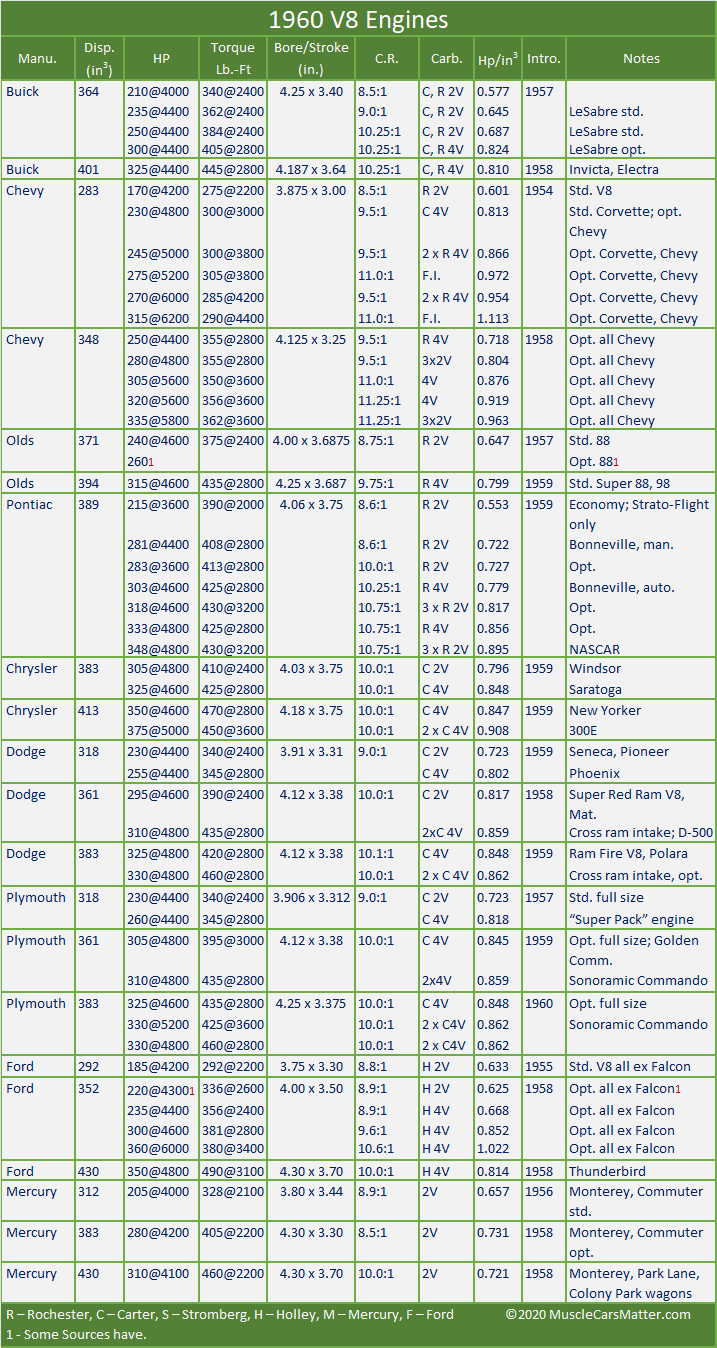
1960 V8 Engines Specs

1960 Newspaper Ads

Yeah. I’m not sure how effective an advertisement like this was. Not very, I suspect.


