
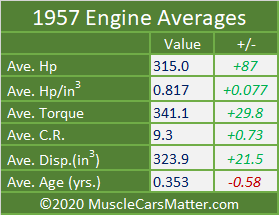
The significant changes for 1957 revolved around engines. The displacement wars had begun, which would in some cases see a brand add a new engine one year, and either bore or stroke it the very next year. Displacement was king. Sure, some were a little slower than others to join the fray, but the pattern for the next decade was in place.
Some examples of the cubic inch gamesmanship:
Chevrolet went from 225hp for their hottest 265 to 283hp with the F.I. 283cid engine.
Buick went from 255hp with their 322 to 300hp with the new 364.
Chrysler’s 354 made a maximum of 355hp last year. Their new 392 made 390hp in optional configuration.
The 312cid Ford engine was introduced on ‘56, but this year it jumped from 225hp to 285hp, or an even 300hp with the available supercharger.
In the marketplace wars, Ford emerged the winner for the year, outselling second place Chevrolet by some one hundred seventy thousand units. While the Ford company numbers held constant, the Chrysler companies had a wonderful year, with most of their divisions seeing increased numbers. At General Motors, Chevy flew high again but its stablemates each saw lower numbers this year. Corvette numbers almost doubled, but still totaled less than seven thousand units.
In a lot of ways, the year belonged to the Chrysler companies. The new Virgil Exner designed bodies were breathtaking. They were longer, lower and wider, and had huge expanses of glass. The fins, which were present last year, came into their own in 1957. I can absolutely believe the stories I’ve heard about people just standing and staring, their mouths slightly open, when they got their first chance to see these models in person.
I don’t know about Ford, but GM was shaken to their core by the new Chrysler “Forward Look” and the way the buying public embraced it. GM already knew what their ‘58’s were going to look like and they were not going to be competitive. Approximate total sales: 6,234,000; change: +0.4%.
1957 Noteworthy Events
- Buick First 300hp; new 364cid V8.
- Oldsmobile First 300hp, multi-carburetion, 371cid V8.
- Pontiac First 300hp, multi-carburetion.
- Chrysler 392cid hemi, torsion bar front suspension.
- Dodge First Multi-carburetion, torsion bar front suspension.
- Plymouth First Multi-carb, 301, 318cid V8, torsion bar suspension.
- Ford First 300hp, Fairlane 500 Skyliner, multi-carburetion.
- Mercury First 300hp, new 368 V8.

The General Motors companies were down from last year, with Ford and the Chrysler companies seeing sales increases. Overall, sales were really close to even.
Chevrolet
Chevrolet for ’57 saw a new, oval bumper and grille for all three series. This has come to be regarded by many as the pinnacle of 1950’s Chevrolet design. The 210s and Bel Airs both received new side spears which delineated the optional second color, for the two-tone cars.
The 235cid six was still available, as well as the 265cid V8, with power ratings of up to 170hp (same as ’56). The available 283cid V8 was a bored 265, and was available as a 4bbl, 2 x 4bbl or fuel injected. This engine had power ratings of from 220hp at 4800 rpm to 283hp at 6200 rpm. Chevy loudly proclaimed the “One horsepower per cubic inch”, but Plymouth fans would point out that they were there first, and with an engine that was not optional, as the fuelie was. So, in addition to the six cylinder, there were seven different V8s offered, one 265 and six 283’s. The four hottest 283’s were Corvette engines.
Approximate sales: 1,506,000; change: -3.9%; industry rank: 2nd.


Chevy had a lot to shout about this year. The new ’57 styles were fantastic and the engine options got better each year.

Wow. ‘Smooth as quicksilver’! That would imply that quicksilver is smooth, right? Is it? By now you’re probably thinking “I remember Quicksilver Messenger Service from the 1960’s, but just what the hell is ‘quicksilver’?” Well, just plain old mercury! The metal that’s also an element. Kinda makes sense… I guess.
Notice how everyone on the bus is looking at the pale yellow and white four-door Chevy. Guess they had never seen one.

This ad is interesting in that it showcases some of the ’57 new features. Note the ‘Sweet, Smooth and Sassy’ which has become the marketing catchphrase of the moment. As the ad says, fuel injection was available for Bel Air*. This would add just short of $500 to the cost of your $2,300 2-door sport coupe. That’s a bump of over 20%!
*There’s information that would indicate that the lesser models, 150 and 210, could also be had with the 283 F.I. engine. I’ve seen one 150 that had the ‘fuel injected’ script on the rear fenders. If this is indeed correct, I can’t imagine many dealers specified such a configuration or that many buyers paid the extra for the engine, without specifying the Bel Air. Doesn’t make sense. But then, how about the people a dozen years later who ordered a GTO with the 265hp low-compression 400? Yeah…
Evolution

The front of the 1955 Chevy was clean and uncluttered. It was attractive in its simplicity. Unlike its BOP sisters, the bumper wasn’t intended to add to the design; it couldn’t have been more unobtrusive.

The 1956 front now sports a flatter hood and a full-width grille that still bore the same rectangular elements. I have to think that this styling change was universally welcomed.

For 1957 the hood remained pretty much unchanged, other than the center ornamentation, The grille retained the rectangular elements but was totally restyled otherwise. The bumper is now major styling element. Oh, and don’t forget that the vents around the headlights provide fresh air to the passenger compartment!
Some Changes
The cabin air intakes in the headlight bezel are cool, although this would prove to be a less than optimal way to accomplish interior ventilation. The reason for moving the intakes here, away from the base of the windshield, was the lowering and flattening of the hood. I have to think that the engineers knew that this was a compromised design. Chevy’s competition knew this, too, and it was one of the points they coached their salesforce on in competing with Chevrolet.
Wheels were now 1″ smaller in diameter, at 14 inches. This contributed to the lower look that everyone wanted. Seems that the instrument panel was now a ‘command post control panel’. Huh.
The front bumper and grille treatment is certainly more fancy than last year. It lost some of the ’56’s stylish simplicity.
The side trim was vastly changed, too. The 150 remained really simplistic, but the 210 and Bel Air picked up the now-iconic side treatment. With the 210 models, if two-tone paint was used, the area enclosed by the side trim pieces would often be painted an accent color. Bel Air models had this area filled with an anodized aluminum beauty panel.
The fact that Chevy had limited themselves to 283 cubic inches hurt them relative to Ford and the Chrysler companies, as well as to their BOP stablemates.
Chevy (and BOP) Styling
The 1957 Chevy, particularly Bel Air, has long been considered as iconic. However, the series was now in its third year and did not compare well with the updated Chrysler corporation models. No, the 1957 Chrysler/Dodge/Plymouth models aren’t themselves considered with the same regard as is Chevy, but they were kicking Chevy’s butt with their ‘modern’ styling. The damage wasn’t limited to Chevy, either, as BOP suffered as well. Ford’s styling seems to have saved them from this carnage. Of course, 1958 is not going to be the big recovery year that GM might have hoped for. It would be a recession year to boot!

Your new ’57 Chevrolet is ‘filled with grace (?) and great new things’! O-k-a-y. If you read further into the text, you’ll see that ‘turning a corner is almost as easy as making a wish’! I do hope they remove the little girl from the hood before they move on.


Here’s a page from Popular Mechanics giving some cool info about the new for 1957 fuel injection.
1957 Chevrolet Lineup Brochure


Corvette
The Corvette didn’t change its styling much at all this year, but they didn’t need to. The 283 fuel-injected horsepower in a 2,700-pound body was plenty of news by itself. Some serious axle ratios were available for the ‘0 – 60’ crowd: 4.11:1 and 4.56:1.
Approximate sales: 6,340; change: +800%.


The rear of Corvette was updated in ’56, so there were no significant changes this year. Note the almost total lack of functional bumpers. It was a nice, clean look.

1Hp/in2
Behold the 1hp/in3 Corvette! Though not specifically making the claim here of being the first engine to achieve this, Chevy certainly had a solid claim to that title. Chrysler might have disputed the fact, though. Regardless, this was a milestone for the engine that would be perhaps the most significant American engine of all time.
Here in its fifth model year, Corvette had come of age.


Ohh, this is too cool! Fuel Injection! F-U-E-L I-N-J-E-C-T-I-O-N ! ! ! 283 freakin’ horsepower from the little 283 small block!
Yeah, you could get a fuel injected Bel Air, but with about 500 extra pounds to haul around, it just wasn’t the same experience as an injected Corvette.

Probably not… But Chevrolet sure as hell did!

Kind of interesting–delivering a new Corvette to (I guess…) Italy! The ’57 Corvette was a fantastic car and a fantastic value compared to some of its European high-performance brethren. However, I really doubt it would ever be mistaken for a luxury car! I mean, it just got external door handles last year!
The reference to the rarity of fuel injection is indeed accurate. Mercedes had just started using it, in limited instances, in 1955. The average person, be it in Italy or the USA, had never been exposed to a fuel injected car.

I have to think that the word ‘new’ here is in reference to the Corvette in general, not just the ’57 Corvette. At the start of the ’57 model year, well under 10,000 Corvettes had ever been sold in total! To many people, this still was a ‘new’ car.

This is a cool advertisement. I like the reference to crank-type side windows. Remember that they were new on the Corvette just last year! Maybe they wanted to remind people, in case they missed it last year, that ‘Vette owners didn’t have to mess with the plastic side curtains anymore. Roll-up windows–just like a real car!
Buick
Buick series remained the same as last year. There were new bodies, which were a bit wider and lower. Bumpers and grille were mildly reworked, but retained the overall look of the ‘56’s. The hoods were flatter than the previous year. The Special had three ventiports, while the Century, Super and Roadmaster had four.
Buick again had only one engine, a new 364cid V8 with a 9.5:1 C/R and making 250hp at 4400 rpm in the Special. Century, Super and Roadmaster got an increased compression ratio (10.0:1) that made 300hp at 4600 rpm with a 4bbl carb. The available ‘high performance kit’ bumped this up to 330hp, which could be had in all but the Special. A three-speed manual trans was standard on the Special, with the Dynaflow standard on the other series. Buick led the GM sales decline this year, giving up their third place to Plymouth.
Approximate sales: 405,000; change: -29%; industry rank: 4th.

Notice the chromed panel between the rear wheelwell and the bumper.


This is a cool drawing of the 364 nailhead. It’s a bit hard to tell, but if you look carefully, you can see the valve cover. Yep, it was oriented this way because the top of the head it mated with was horizontal.
Who Needs Big Valves!
This family of Buick engines had a weird head design and the smallest valves in the business. Buick would never be known for engines with huge valves but thank goodness they moved away from this design. To give them their credit, they were one of very few automakers who came into the post-war era with an OHV engine.
Still, it’s a good advertisement, and it’s hard to argue with 300 horses in 1957.
There’s just one small thing that bothers me; a 1957 Buick, in 1957, is the ‘Newest Buick Yet’? Well, yeah; you could say the same thing every year, right? (Am I overthinking this?)


Roadmaster is looking pretty good, huh? The tagline is kinda cool, too. That round rear wheel opening sure lets you know right away that this is a Buick.


Gotta say, the ‘Zest-seller’ thing seems a bit lame. Maybe back in the day it worked better. Think so? Naw, me neither.

Here is yet another depiction of how the ‘successful man’ (successful ladies need not apply…) should treat himself to a Buick Roadmaster. Not badly written, but did anyone really, truly believe this stuff?
Take a look at the rear roof line and compare it to the picture in the ad below. That’s the difference between the Roadmaster (2-door hardtops) and the other models.

This is one nice looking four-door hardtop! The color combination is unusual, too, isn’t it?
(As I pull into my parking lot each morning I often marvel at how monochromatic (boring) contemporary cars are. What the hell happened to us?)

Another ‘Big Thrill’s Buick’ themed advertisement. Another cool color combination, too.
Oldsmobile
Oldsmobile models got a complete restyling this year. The front bumpers/grilles now had a large oval opening that didn’t have the vertical center piece of the ‘56’s. Also, the ‘57 hoods were flatter than last year’s models.
I think the O-L-D-S-M-O-B-I-L-E in block letters on the grille was a super-cool look. The three-piece rear windows were featured, just as with Buick. The tri-tone paint option was well worth the few bucks it cost.
The station wagon returned after a seven-year absence, and the base Olds was christened ‘Golden Rocket’ in honor of the fiftieth anniversary of Oldsmobile.
Olds Hits 300Hp!
The 324 V8 was replaced by a 371cid engine. It had a larger bore and stroke than the previous engine. Power was up to 277hp @ 4400 rpm, and to 300hp with the optional 3 x 2bbl setup. The trans options remained the same, with the base 3-speed, optional Hydra-Matic and Jetaway Hydra-Matic.
Approximate sales: 384,000, change: -21%; industry rank: 5th.

The two-tone delineation follows a kind of diagonal line from the top of the windshield to the back bumper. This is a real cool and unique look, for sure.

Interesting Back Window
The rear look of Olds was quite nice. The throw-back rear window wasn’t a bad look, but the same window as a 1-piece would have been a better look, I think. This was the ‘StratoRoof’ rear window, by the way. Are you surprised that Olds had a name for their rear window? This color combination, with the red accent, is nothing short of fabulous!

The grille, with the block lettering, was particularly handsome. This was one of the best looking front-ends of any of the ’57 models.

Again, here’s a car drawn with dimensions that make it look longer and lower.
The swept wheel openings we first saw last year impart an attractive look.

Am I the only one wondering why Olds didn’t feature more two-tone color themes in their ads?

Viola! Two-tone-styled car in an Oldsmobile ad! The specific execution of the two-tone styling is a bit different, with the top and the upper half of the rear being the ‘second’ color. Much different from their competition!


A sweet Olds station wagon! Not only that, but a Super 88 Fiesta wagon that you could not get last year.

Olds selling luxury, as well as the power of their Rocket T-400 engine. Hey, wait! ‘400’? They’re naming the engine after the torque rating? Isn’t that unique to Buick? Well, no, not in 1957 it wasn’t.
Maybe the Olds marketing boys couldn’t pierce their drug-fueled fog long enough to think of something original, so one of them just came up with the idea of ripping off Buick.
Pontiac
The Pontiac lineup for ‘57 was redone, with new styling and with the series/model names becoming a bit convoluted. Chieftain, series 27, was still the base series, with Star Chief, series 28, the top tire series. Super Chief was a subseries of Chieftain, and Star Chief Custom was the station wagon lineup for series 27. Under Star Chief was the Star Chief Custom (series 28), which included two and four door models, but no wagons.
Pontiac christened the look “Star Flight”, with missile-inspired trim on the sides of all vehicles. The Silver Streak ‘suspenders’ were no more. Hoods were flatter now and the fronts got new bumper/grilles that were an adaptation of the ‘56 versions. The vehicle back ends were redone, with extending fins that were somewhat flattened or straightened. The Chieftain series greatly outsold the Star Chief line. Part of the Star Chief Custom series was the Custom Bonneville two-door convertible. Each dealer was allotted one of these special vehicles. At $5,782 ($62,675 2023$), this was one incredibly pricey Pontiac!
Another Year, Another Engine
Last year’s 317 got stroked 0.31” to make the 347cid V8. The base 2bbl made 227hp and 252 hp, with different compression ratios. With a 4bbl it made 244hp and 270hp, both at 4800 rpm. The fuel injected engine made 315hp at 4800 rpm. Finally, there were not one, but two tri-power setups that made 290hp and 317hp, at 5000 rpm and 5200 rpm, respectively. What a lineup!
Approximate sales: 334,000; change: -17.7%; industry rank: 6th.

A nice looking car, I’d say. I’m not sure how most people would rate it compared to the Chevy, Buick, and Olds offerings.

The wheels on this car are not factory, of course. The rear design was kind of interesting, with its three protrusions formed by the fin, taillight and bumper.

Check out the flowery praise that Pontiac is heaping on themselves here. Man, the advertising guys must have been in rare form! Is anyone else bothered by the car being parked right by the pool?
Pontiac Strato-Flight Transmission
This was Pontiac’s name for the GM Hydra-Matic (also Hydramatic) automatic transmission. You might recall that this was a 4-speed, fully automatic transmission, with 4th gear being 1:1, as is 3rd gear in a 3-speed automatic. The trans had a fluid coupler, rather than a torque converter. Therefore, all torque multiplication came from the planetary gears themselves.


You just have to read the fine print, or you’ll miss gems like: “…347 of the most commanding cubic inches that ever made a drop of gas say “uncle”.”

‘America’s Number One Road Car!’, whatever the heck that means. I guess it’s in reference to the Grand National Championship!

Pretty nice-looking car here.
Chrysler
Chrysler products got a major face-lift this year and were darned attractive. They had sweeping rear fender lines with fins. On some models the fins were further highlighted by a color panel. Front bumpers and grilles were new, with the bumper lifting at both sides, reminiscent of the wings of a gull. Headlights were now quad, which worked well with the body changes. This was the second year for the Chrysler ‘Forward Look’.
The series were Windsor, Saratoga, New Yorker and 300C. Windsor outsold both Saratoga and New Yorker, while less than 2,500 300C’s were sold. This was the first Saratoga since 1952. Vehicles used separate body and frame construction.
There were many other changes, in addition to sheet metal. Torsion bar front suspension was new this year, which became a Chrysler trademark for decades. The driveshafts were of the Hotchkiss type, which had universal joints on both ends. Also, the rear differential used hypoid gears.
The engine offerings were up to the task of providing the power that Chrysler had become known for. The 331cid was dropped and the 354cid V8 made 285hp at 4800 rpm with a Carter 2bbl.
390Hp, Baby!
Another version of the 354 made 295hp at 4600 rpm with a 4bbl carb. The new 392cid V8 had hemispherical combustion chambers. There were three different 392 setups, one with a single 4bbl and 325hp at 4600 rpm, one making 375hp at 5200 rpm with dual 4bbls, and finally the 390hp job (5400 rpm). All of the 392s had solid lifters. This was the highest horsepower lineup of any automaker. Many view the 392 as the pinnacle pre-426 hemi engine.
Approximate sales: 122,000; change: -4.7%; industry rank: 11th.

This is just a solid and strong-looking car.

The rear styling is clean and goes well with the rest of the car.

This advert text highlights the new Torsion-Aire suspension. It might not have quite achieved the benefits claimed, but it was a bona fide advancement and alternative to coil springs. The rear window on the DeSoto 4-door hardtop is something else!
This ad also shows the similarities and differences in the Chrysler Company cars.
Torsion-Aire Suspension
This was simply Chrysler’s name for their torsion bar front suspension. The use of torsion bars for both front and rear suspensions dates well back to the first half of the 20th Century. There were both European and domestic automakers that used this suspension method. WWII era German Panther tanks as well as the US M26 Pershing tanks had torsion bar suspensions. What was different in ’57 is that no other domestic automaker was making use of torsion bars, thus giving Chrysler the opportunity to offer something different. As always, claims for this hardware usually exceeded the benefits truly experienced by the car owner.
With torsion bar suspensions, a specially formulated and manufactured bar of steel is twisted as the axle moves up and down due to road irregularities. In other suspension types, a coil spring would compress and decompress, or a stacked series of steel leaves would be bent. The main benefit of torsion bar suspensions is that it didn’t intrude upon the interior space like coil springs.


The two bottom drawings look particularly lengthened, don’t they? That’s one of the values of a drawing over a photo.

There is one heck of a lot of red in this ad! You can see the dash-mounted rearview mirror in this ad. What you can’t see is the change to 14 in. wheels the entire industry was going to, the intended result being a lower look.
Dodge
Dodge cars received the same “’Forward Look” makeovers as the rest of the Chrysler family. The fins were large and striking. Front ends received new bumpers and grilles, as well as quad headlights. Bodies were lower, longer and wider, with long 122 in. wheelbases. 14 in. wheels were used to add to the lowered look.
Coronet captured over 60% of sales, with the two Royal series splitting the rest. The now-famous torsion-bar suspension was used this year.
A Bit of Engine Stuff
The engine offerings were a bit less inspired than the Chrysler’s, though. The base engine was the old L-head six of 230cid and 138hp at 4000 rpm. This was breathing through a 1bbl carb! Ho, hum… The Red Ram V8 (325cid) made up to 260hp at 4400 rpm with Carter 4bbl. A higher compression version (10.0:1) made 285hp at 5200 rpm. An identical version of this engine, but with a second Carter, made 310hp at 5200 rpm. The 325 was a 0.06” over-bore of the 315. The top-shelf 354 made 340hp at 5200 rpm, again with two Carters. The 354 was itself a 0.13” over-bore of the “first hemi” (small h), introduced by Chrysler in ’51. Compression ratios were substantially higher this year. The 310hp 354 (D-500) and the 340hp (D-501) were available on any series.
With the exception of the wimpy-assed L6, not a bad lineup.
Approximate sales: 287,000; change: +19.1%; industry rank: 7th.

Notice the cool ‘jet’ hood ornament in this picture. If you look closely, you will also not see an interior rear-view mirror. This year it’s mounted on the dash!


‘All new for 1957?’ Well, maybe not totally new…

‘Autodynamics’! In case you might wonder what all goes into autodynamics, you might consider the following: “It unleashes a hurricane of power, it breaks through the vibration barrier, and it is swept-wing mastery of motion”.

The ‘Low Look’
“4 1/2 feet high…” It seems that this car was a bit lower than many of the other ’57 models. The ‘low’ look was becoming increasingly popular, aided in part by the change to 14 in. wheels. Dodge would use this feature in competing against the GM models.


I like this advertisement. Taking a night drive in the mountains. Note that the series names are different, this being a Chrysler Corp. of Canada advert.
Someday every car will be controlled by push buttons. Or not.

“Swept-Wing is Sweeping The Country!” Well, the fin (wing) design Dodge used was certainly more ‘in your face’ than those of their competition.
Plymouth
Plymouth offerings for ’57 were attractive, like their stablemates, but the engine offerings were less inspired than Chrysler or Dodge. Series remained Plaza, Savoy, Belvedere and Fury, as a subseries of Belvedere. Headlights were quads, like the rest of Chrysler Corp. cars, and followed the corporation “longer, lower and wider” styling. Of course, fins were more prominent, too.
The same 230cid L6 was the base engine. The 270cid engine was gone, being replaced by the 277cid poly engine that made 197hp at 4400 rpm, with a mild 8.0:1 C/R and a Carter 2bbl. The 301cid (actually 299.6) made 235hp at 4400 rpm with a Carter 4bbl. This would end up being a one-year-only engine.
318
This was the first year of the great little 318cid polyspherical V8 engine. It had a 3.906” bore and a 3.312” stroke with a compression ratio of 9.25:1. Power was 290hp at 5400 rpm, with two Carter 4bbl carbs and solid lifters. The three-speed TorqueFlite automatic made its appearance this year.
Approximate sales: 726,000; change: +27.1%; industry rank: 3rd.


Plymouth’s fin design wasn’t subtle, but it seemed more integrated into the overall body design than that of Dodge.

No, this is not an advertisement for a 1960 Plymouth! It’s still 1957 and the point being made is that the car design is three years ahead of the competition. Who do you suppose “the other two” are? Chevy and Ford, of course, the main competitors for Plymouth.


Overcoming my temptation to say “3 full years ahead? What a crock!”, I’m forced to concede that there’s some truth here. This design is a quantum leap ahead of the GM companies or FoMoCo.

This is good marketing: “…sport styling with sedan roominess”. Again, there seems to be some truth here, as well as good marketing. Here Plymouth is showing off the different Belvedere modes. Attractive, for sure!
Ford
Ford had quite a lineup for ’57! Styling was all new and the models were all lower and longer. Of course, rear fins were well represented. Model names were reshuffled this year, becoming Custom, Custom 300, Fairlane and Fairlane 500. Of course, the single model Thunderbird was a series unto itself. As with many of the 1957 domestic models, bodies were longer, wider and lower. The change to 14in. wheels added to the lowering of the vehicles.
Other changes were hoods that were hinged at the front and windshield posts that sloped forward. Bumpers and grilles were modified, with the grilles having rectangular elements consisting of four columns of five rows each. Headlight hoods were separate from the headlights themselves, which made for a bit of a different look.
Skyliner was a two-door hardtop convertible that automatically stowed the top in the ‘trunk’. It was priced at just over $300 more than the Sunliner, a conventional soft top convertible from the same Fairlane 500 series.
Thunderbirds were restyled, too. The longer trunks allowed the spare tire to be brought in off of the rear bumper, where it had created balancing problems. Of course, the Thunderbird got the fin treatment along with the rest of the Fords. The fabulous new Skyliner was the only hardtop convertible in the world.
Engine Offerings
Engine offerings started with the 233cid six cylinder, which make 144hp while breathing through a Holley 1bbl. The 272cid V8 engine made 190hp at 4500 rpm, the Thunderbird 292cid V8 made 212hp at 4500 rpm. There was the Thunderbird Special 312cid V8 that made 245hp at 4500 rpm; the 2 x 4bbl version of this engine had the same 9.7:1 C/R and made 270hp at 4800 rpm (285hp at 5000 rpm with “Racing Kit”). Finally, the Thunderbird Special Supercharged engine made 300hp at 4800 rpm. This engine used a McCulloch/Paxton centrifugal supercharger. All the V8 engines used Holley 4bbl carbs.
Approximate sales: 1,676,000; change: +19%; industry rank: 1st.


Oh, how I love the round ‘jet exhaust’ taillights! Simple, yet oh-so-cool. Was there ever any other styling cue like this that allowed you to identify the make of a car from half a block behind it?
Change to 14-inch Wheels
I used to think that 15 in. wheels were somehow better than 14 inchers, for no particular reason. The 14-inch wheels were introduced to lower the vehicles, as this look had caught on with the buying public. This was certainly the most straightforward way to lose a half inch in height. Wait! A half inch? What happened to the other half inch?


The Thunderbird spare was back in the trunk, where it belonged! It seems a bit strange to think that the weight of the spare on the back bumper significantly affected handling, but that sure seems to have been the case. Many people prefer this cleaner look, too.

Here’s the 312 in all of its 300hp supercharged glory.
McCulloch/Paxton and Other Supercharging Junk
Robert Paxton McCulloch began selling crankshaft-driven superchargers in 1937, many of which were in kit form for Ford flathead V8’s. These units had a fixed 6:1 ratio.
McCullough Motors was then formed, and then McCullough Corporation, who made… chainsaws! Everyone’s heard of McCullough chainsaws, right? They’re now owned by Husqvarna. Paxton Products has its origin with Mr. McCullough, and still exists as a subsidiary of ITW Company, which was formally known as Illinois Tool Works. (ITW seems to be one of those companies like NCR and KFC that used to be known by their full name but then changed to their initials)
Germany’s Daimler was experimenting with superchargers for automotive use by the year 1900.
The Roots Connection
In the first half of the 19th century (1800’s, for those who slept through history class) the Root brothers, Francis and Philander, invented what was basically a more efficient water wheel. A water wheel is driven by a stream or river to power machinery, often a grain wheel. When this device was turned by hand, it proved that it was a surprisingly effective air blower. It was quickly realized that the blower could be used to great effect in iron smeltering. This is where it proved enormously successful. A patent was secured in 1860.
I know a lot of guys who would have had a field day back in high school with classmates named Francis and Philander. Francis is a perfectly fine name, but not in the ’60’s and ’70’s when I was in school. I have a hard time believing that Philander was ever regarded as anything but “What were my parents thinking when they named me?” or “Can I just go with ‘Bud’ or ‘Chip’ or ‘Rocky’?” Just goes to show that there have been crazy parents in different eras, not just today. If I ever meet the parents of Cyven (‘Kevin’), I might just bitch-slap them. Just hope it’s the mom…

This image is of a three-lobe positive displacement blower. Two and four-lobe designs have been used as well. There are various animations on the internet that illustrate the action and make it more obvious the ‘positive displacement’ element of the design.
Term Confusion
‘Supercharging’ is a general term for forced induction of air into an internal combustion engine and can apply to any device that performs this task. Turbocharging is a specific form of supercharging that was developed for engine use. The supercharger ‘air-pump’ design has deeper roots than the turbocharger does, despite the application to automobile engines being in the same general timeframe for both devices.
The turbocharger was initially developed in the very late 19th century by Gottlieb Daimler and Rudolph Diesel. Its first widespread use was in aircraft engines, becoming a significant factor in Axis and Allied fighters and bombers during WW2. The turbocharger design was of a centrifugal design, not the positive displacement that a Roots supercharger utilizes.
Today, with turbocharging very popular, as well as a handful of engines that are factory equipped with screw-type superchargers, the terms ‘turbocharger’ and ‘supercharger’ are generally accepted to referring to the specific method utilized.

For some strange reason, I thought of the Wendy’s ‘Where’s the Beef’ advertisements from the ’80’s with Clara Peller.
Where’s the Beef?

If you were around in the mid ’80’s you absolutely remember the “Where’s the Beef?” advertising campaign of Wendy’s. What you may not know, though, is quite interesting!
The 82-year-old, Russian-born Peller had done a few local commercials in the Chicago area when she was cast by the advertisement agency for Wendy’s for the new advertising campaign. Her small stature and loud voice made her unique. The result was a 31% jump in sales for Wendy’s! A Wendy’s senior executive said that she had done in five weeks what they had achieved in the previous fourteen and a half years! When the short-lived campaign ended, sales declined, and it would be five years before the campaign featuring Dave Thomas brought sales back.
Don’t Diss the F.I.!
In a Ford film made for salesmen in 1957 they compared the ‘unseen features’ of this year’s Ford to a Chevrolet 210. There were things like frame construction, brake drums and shoes and roof sound deadening. What was really interesting was the comparison of the Chevy fuel-injected 283 to Ford’s supercharged 312.
The narrator spoke disparagingly of the Chevy fuel-injection, saying that since it was a continuous flow system, it “was not true fuel injection”. Chevrolet’s system was the most successful and long-lived of those from the 1950’s and early ’60’s. Systems found in aircraft engines frequently are of the same continuous flow method. More F.U.D.* from FoMoCo, I guess.
*Fear, Uncertainty, Doubt

Ford selling value. Note the mention of ‘Ball-Joint front suspension’. This was still fairly new, having replaced the earlier king pin suspensions.
“…Ford set 458 world speed and endurance records at Bonneville, Utah.” 458? Holy crap! I’d like to see that list! How can there be 458? 58 seems a lot, but 458? Ford… are you telling a little fib? F-o-r-d…


It still seems a bit odd to see an auto-maker advertising how large their cars are, with others touting nimbleness and ease of parking. You rarely if ever see an advertisement highlighting the length of a car.

Another appeal to ‘big’, plus a tie-in to Thunderbird. I still think the larger picture fudges on the car’s actual dimensions, making it longer and maybe lower.
Mercury
Mercury completely redesigned their models this year, which were no longer based on Ford or Lincoln models. Like the Ford models, the styling was longer, lower and wider, and fins were prominent. As with the Ford models, the hood hinges were in the front of the vehicles. The front bumpers were redesigned, having two large rectangular pieces joined by a horizontal piece. Series names this year were Monterrey, Montclair and Turnpike Cruiser. The Monterey accounted for over half of the Mercury sales.
The 312cid base V8 picked up a bunch of horsepower, due in part to a healthy bump in the compression ratio, to 9.7:1. New this year was a 368cid V8, with 290hp at 4600 rpm.
The Merc-O-Matic was standard in the middle and upper series, with a 3-speed standard in the Monterrey.
Approximate sales: 286,000; change: -12.8%; industry rank: 8th.

The styling above the headlights looks kind of strange, doesn’t it?


One Strange Option
Okay, this is just crazy. This shows the right front corner of the roof, where the A-pillar comes up. This is an air intake. I believe it just goes to the interior of the car. Shown protruding from the center is a fake antenna. Nuts, huh?

Okay… Mercury was doing a ‘Dream-Car Design’ marketing theme at this time. The Merc styling was nice, but ‘Dream Car’? Did people really buy this? Some of the early 1957 Merc models had dual headlights, not quads.

Mercury was marketed as ‘Monarch’ north of the border.
This view really shows off the lines well. The taillights and wings are cool. So is the rear bumper being designed like the front.


The ‘Dream-Car’ theme continues. This image shows off the wheel openings, which were nicely restyled for ’57. Both were now swept-back, the rear opening also having lost its flattened top of the previous few years. I like this look!
It’s easy to see here how the lower positioning of the pinion gear will allow for a lower driveshaft.

“…to influence the shape of cars for years to come…” Yeah, maybe not so much. Still, a nice-looking car for sure. The color accent on the ‘C’ pillar and rear fender is striking.
Some Other Stuff
Hotchkiss Drive
This rear suspension method is named after a French company who was an early adopter of the system, though not the first. It dispenses with the torque tube that encases the driveshaft and ties the rear axle to the transmission, and hence to the frame. Instead, the driveshaft is open and uses two simple universal joints, one on each end of the driveshaft. The axle is located by two leaf springs, which transfer torque to the body. This includes the torque of braking.
Some manufacturers used coil springs with control arms, two lower and two uppers. The upper arms were angled inward, which served to control the side-to-side motion of the axle.
Hypoid Gears
Hypoid gears were first seen in the 1920’s. They would become common in rear axles, replacing the similar spiral bevel gears. The advantage of hypoid gears in a rear axle is that the pinion gear and the ring gear don’t share the same axis, with the pinion being positioned below the axis of the ring gear. This allowed for a lower driveshaft and a lessened hump in the passenger compartment to provide space for it. Hypoid gears can be stronger than spherical gears and are used in trucks and heavy equipment for that specific reason.
The main disadvantage, though relatively minor, is that there is a sliding between the teeth, and a lubricant for hypoid gears is needed, as it can withstand the higher pressure the lubricant is subjected to.
As you may have picked up, spherical gears are based on spherical sections and hypoids are based on hyperbolic sections. Those of you who like math/trig might enjoy some of the reference material related to this topic. There is a lot that goes into gear design, not even taking into account the considerable topic of gear material selection, machining, heat treating, etc.

1957 V8 Engines Specs

1957 Newspaper Ads

“Curley is Your Boy!” Would you trust him before Moe or Larry? Cointainly!

Note the 36-month loan offers with no interest amount specified! Sure, you could calculate it, but without a calculator?

Ed reminds you of your high school biology teacher, right?

