
The 1947 U.S. Automobiles were much like the ’46. This was a year of very little change, overall. One thing that was of note is the appearance of the automotive lines of Kaiser and Frazier. The company was founded by, and funded by, Henry J. Kaiser. He was a shipbuilder who made a fortune during WW2 and felt called to try the automotive business.
The Frazier’s were the top tier line of the company. Both they and the Kaisers had pleasing, smooth lines, with front and rear fenders that were integrated into the bodies in a manner that would become standard in the 1950’s.
The company got off to a solid start, largely due to the established automakers still offering warmed over ’42 models. Things would change, though, and the Frazer line would be gone after 1951. The Kaiser series would last through 1955, when the great experiment ended.
GM companies and Chrysler corp. surged this year, with Ford and Mercury both losing market share. Studebaker, DeSoto, Packard, and Crosley all saw huge gains, ironic in that the post-war market would prove to be difficult for these four companies. Approximate total sales: 3,360,000; change: +53.6%.

The U.S. auto market continued to be on fire this year, with few real changes in any of the models. We wouldn’t see any significant advances for a couple more years. Only Ford/Mercury didn’t see increases over ’46.
Kaiser
Kaiser is an automaker that started up after WWII. They were able to come to market with new styles, while the established companies had to make do with warmed-over 1942 models. Ship maker Henry Kaiser is the man behind the company.
Kaiser Permanente is a major managed care provider in the US. This was started in the 1940’s by Henry Kaiser, to provide health care to his employees. Permanente is the name of a creek that ran by a cabin he and his wife owned.
Chevrolet
The Chevrolet models remained Stylemaster and Fleetmaster, with Fleetline a subseries of Fleetmaster. The 216cid 90hp inline OHV six-cylinder engine continued as the sole offering, as did the 3-speed manual transmission. 4.11:1 rear axle ratio.
Approximate sales: 671,000; change: +41%; industry rank: 1st.

Not the optional sun visor this Chevy has. It must have made it impossible to see traffic lights if you were at all close to the signals.


Nothing too exciting with this advertisement. It’s red. On black. Really grabs your attention, doesn’t it? And then the message: ‘More value’. Wow.

Buick
The ’47 Buick models included Special, Super and Roadmaster, as before. A 3-speed manual transmission was standard, with the two-speed Dynaflow optional. The Super continued to be the top selling series, but the larger engine was replaced by the 248cid, with a 5hp bump over the same engine in the Special.
Approximate sales: 273,000; change: +43%; industry rank 4th.


The Special is ‘Extra Special in Value’ apparently. Wait… Isn’t that what Chevrolet said?

Yes, this says 1946, but it the same colors were used in ’46 and ’47.
Oldsmobile
The Oldsmobile models for this year were the same Special, Dynamic and Custom Cruiser from last year. A 3-speed manual transmission was standard, with the two-speed fully automatic Hydra-Matic available in any model. The Special could now be had with the 257cid eight-cylinder engine. The series numbers 66, 68, 76 and 98 denoted base, middle and top, as well as 6-cylinder or 8-cylinder.
Approximate sales: 194,000; change: +39%; industry rank: 7th.


Tubeless Tires
Every one of the cars at this time had ‘balloon’ tires with innertubes. The belts were of various materials, including rayon, and nylon. Although radial tires were invented in Europe in 1948, it would be decades before they became available and popular here. Tires with innertubes would remain the norm until after 1954, when the first tubeless tires made their appearance in the U.S.
The tubeless tires offered improved safety and less rolling resistance, just to name two things.

The 98 Custom Cruiser was available with optional Hydra-Matic Drive.
Hydra-Matic Transmission
Remember that Buick, Olds and Cadillac each had their own fully automatic transmissions. These were first-generation units, none of which offered both a torque converter and fully automatic shifting of gears, utilizing planetary gearset(s). The Hydra-Matic was a 4-speed unit, with 4th being 1:1 or direct drive. It had a fluid coupler that was not a torque converter. The four gears, rather than three, helped to fill in for the missing torque converter.
Later Hydra-Matic units had nothing in common with this trans, other than the shared name.

Pontiac
Pontiac continued with two models, Torpedo and Streamliner. Both series were again available as either a six cylinder or an eight cylinder. The only transmission available was a 3-speed manual, with column shift. Available axle ratios remained 3.9:1 and 4.55:1
The grille theme was simplified this year. Where last year had five horizontal bars, this year had three heavier bars and did away with the vertical center bar of ’46. It was more conventional, and frankly, more attractive. Engines remained the same. As with pretty much all automakers, this period continued to be a time of keeping the status quo, while planning for the new platforms and engines that would appear soon and take the industry into the next decade. We all know what a hell of a decade the ’50’s were!
Approximate sales: 230,000; change: +40%; industry rank: 6th.


If you believed this text, you would be an idiot to have anything but a Pontiac. The geese in the background don’t seem to have mastered the art of flying in a ‘V’ formation, have they?

Chrysler
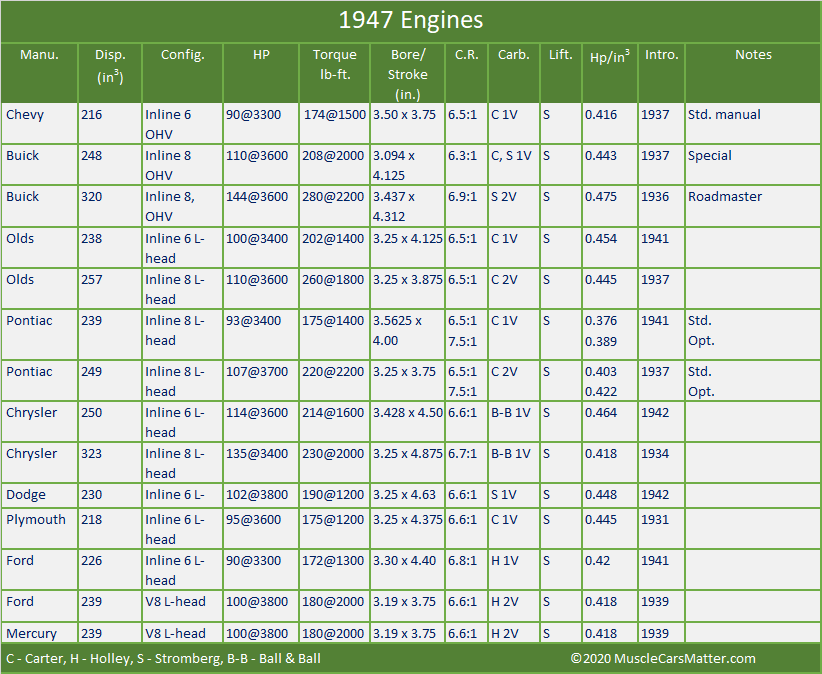
Chrysler took a conservative approach to 1947, with no noticeable changes at all. The series remained Royal, Windsor, Saratoga and New Yorker. The 250 L-head six and the 323 L-head eight cylinder had the same specs as the ’46 versions and the transmission offerings were unchanged, being the 3-speed manual being standard and Fluid Drive and hydraulic M-5 optional (see table).
Approximate sales: 119,000; change: +30%; industry rank: 9th.


Chrysler models had a different look than the GM C-B-O-P cars, didn’t they? Of course, they’re at a price-point that’s a bit higher, too.

Hmm… a ships anchor sticking out of the sand? Why not, I guess.
Maybe the little dog thinks the guy looks as dorky in his ‘captain’s hat’ as I do.
What is that in the distance, a 3-masted sailing ship? I wonder how many of those were around in 1947?


Ball and Ball Carburetors
There’s not a lot of information available on the Ball & Ball Company. They were early manufacturers of carburetors, and sold their designs to Carter Carburetors sometime in the 1940’s. These “designed by Ball, built by Carter” carburetors carried a “BB”, “BC” or “BD” designation.

Dodge
Dodge followed the Chrysler cue in making virtually no significant changes for ’47. Series remained the Deluxe and Custom, with the 230cid L-head six as the only engine. Transmissions remained the same, with the 3-speed manual as standard and Fluid-Drive as optional. The wheel size was downsized from 16 in. to 15 in.
Approximate sales: 243,000; change +33%; industry rank: 5th.


Dodge styling was really pretty solid and ‘mainstream’. That would change in the future.


‘Floating Power’, ‘Full Floating Ride’ and ‘All-Fluid Drive’. A lot of non-specific feel-good speak here, I think!

Wow! ‘Cat-like maneuverability’! Yeah… I wonder if it has Floating Power, too? I guess one thing you could gather from this ad and the previous one is that driving a new Dodge in 1947 was sure to draw a crowd. Even the little girl and her dog have stopped to gawk in the first ad. (I never did try to ride a bike with a dog on a leash. Something tells me it wouldn’t have ended well for the dog and/or me!)

Plymouth
The Plymouth entries were unchanged. A 95hp L-head six remained the sole engine. The two series were again Deluxe Six and Special Deluxe Six. If you liked the ’46 Plymouths, you also liked the ’47!
One interesting option (that did nothing to curb the boredom of this lineup) was a traffic light viewer. This little device was a roundish hooded mirror on a swivel base that was mounted on the dash. The driver would adjust it so that he could see the overhead traffic lights when stopped for one. Remember, these windshields were not curved, and they were still mounted close to vertical.
Approximate sales: 382,000; change: +30%; industry rank: 3rd.


This is kind of interesting. I’m not sure what the ’21 Quality Features’ are. Sounds like you have to visit your Plymouth dealer to find out. Whatever they are, I’m sure it involves a reach on their part.


Ford
The Ford series remained Deluxe and Super Deluxe. They were almost identical to their 1946 counterparts. Engines remained the L-head six and V8.
Approximate sales: 430,000; change: -9%; industry rank: 2nd.


Why, even us rich folk drive Fords! Why would we drive anything else, when Ford has Spring’s smartest styling?

Mercury
Mercury had incremented their sole model name this year; the 69M became the 79M. The 239cid L-head V8 was once again the only engine to be had. A 3-speed manual was the only transmission offering. Want to adjust your radio but afraid to take a hand off of the wheel? Well Mercury has you covered with their foot-controlled radio! Soon every car will have this! Or not …
Approximate sales: 85,000; change: -2.4%; industry rank: 13th.


Mom and Dad prepare to drive off as little Lucy inspects the stream. Yeah, that little grin on her face will change when she sees the big, blue, comfortable Merc fade into the distance. (Why are these ‘40’s adverts so mind-numbingly boring?)

1947 Engine Specs

1947 Newspaper Ads

Here’s a public notice for the new 1948 Tucker, being displayed in the New York Museum of Science and Industry. Just a bit different, but this was a different car. Imagine if this thing had been successful, and what a change it might have caused the auto industry to undergo.

This ad is hard on the eyes, isn’t it?

